Did Pedro Sánchez say no intelligence service warned of the mass entry into Ceuta?
Did no intelligence service warn Spain's government before the mass migrant entry into Ceuta, as Pedro Sánchez says?
Misleading
Sánchez's words are real; his own declassified CNI papers contradict "ningún servicio nos advirtió".
The TVE interview clip and its caption are genuine: Pedro Sánchez did tell La Hora de La 1 on 25 November 2026 that no intelligence service warned of the July 2026 mass entry into Ceuta. His own government's declassified CNI messages of 29 July 2026 show a warning was sent to Ceuta. The overall claim is MISLEADING.
 Genuine
Claims
✓ 1 true · ✕ 1 falseNo intelligence service warned the government of the mass entry into Ceuta ("we were not warned by any intelligence service either").123469
“no fuimos advertidos tampoco por ningún servicio de inteligencia”
This is the claim the headline turns on, and it fails on the government's own paperwork. On 9 September 2026 Moncloa declassified around forty intelligence and police reports from July 2026, and those documents show that on 29 July 2026 the CNI messaged the head of cabinet of the Government Delegation in Ceuta about an online call for an assault by fence and by sea the following evening at 20:00, mentioning two groups with a combined 180,000 followers. A minute later, per the same reporting, the CNI also contacted the Guardia Civil. That is a warning from an intelligence service, delivered to the state's own representatives in the city. Moncloa's counter-argument is narrower than Sánchez's sentence: it says no formal alert reached political level and that the final scale was not predicted. Those may be fair points about escalation and about predicting numbers. They do not make "ningún servicio nos advirtió" accurate. Several of these outlets lean right, but the decisive material is the government's own declassification, reported across outlets including the public broadcaster, so the finding does not rest on any single outlet's framing.
Still open: The full content of the 11-minute call between the CNI and the Ceuta Delegation has not been published, so we cannot say how detailed the warning was — only that it was sent.
There were no failures by his government in handling the Ceuta crisis ("no hubo fallos").91012
“no hubo fallos”
This one is partly a matter of political characterisation, which is why it sits at moderate confidence rather than high. What the record shows is that a specific CNI warning about a fence-and-sea assault planned for 30 July never triggered a response at political level, and that the government itself describes the channel as an ambiguous message to a junior official that was not escalated. That is a described gap between a warning arriving and the executive acting on it, and the government's own account supplies it. The denial is further undercut by Sánchez's earlier concession in Congress that "fallaron cosas" — things failed. Against that, "failure" is a judgement word: one can argue the system worked as designed and the information was simply incomplete. So the statement is not a clean factual error in the way the central claim is, but as a blanket denial of any government mistake it does not hold up against the declassified record.
Still open: Whether an unescalated warning counts as a "failure" is a political judgement; we can document the gap, not assign responsibility for it.
There are no firm elements to say the mass entry into Ceuta came from the Moroccan regime.7811
“no tenemos elementos [...] para decir con rotundidad que eso provenga del régimen marroquí”
This part of Sánchez's answer broadly holds. The CNI's report of 11 November 2026 to Audiencia Nacional judge María Tardón states that, to date, there is no evidence the events resulted from action instigated, planned or coordinated by the Moroccan authorities, while noting that Morocco's passive attitude facilitated the entry. That is the state's own intelligence service answering a judge, which is about as direct as this kind of evidence gets. It is not the whole picture, which is why we say likely true rather than established: police reports point to 97 phone contacts between organisers and numbers possibly belonging to Moroccan security and intelligence personnel. Those contacts are consistent with encouragement or tolerance without amounting to proof of state orchestration, and Sánchez's phrasing was careful — he said there are no firm elements, not that nothing happened. The Guardia Civil has also criticised the 29 July information as partial and insufficient, which cuts against the government's handling rather than against this specific statement.
Still open: The police reports on the 97 contacts and the CNI's "no evidence" finding sit uneasily together; the judicial investigation may reconcile them, but we cannot.
What was posted
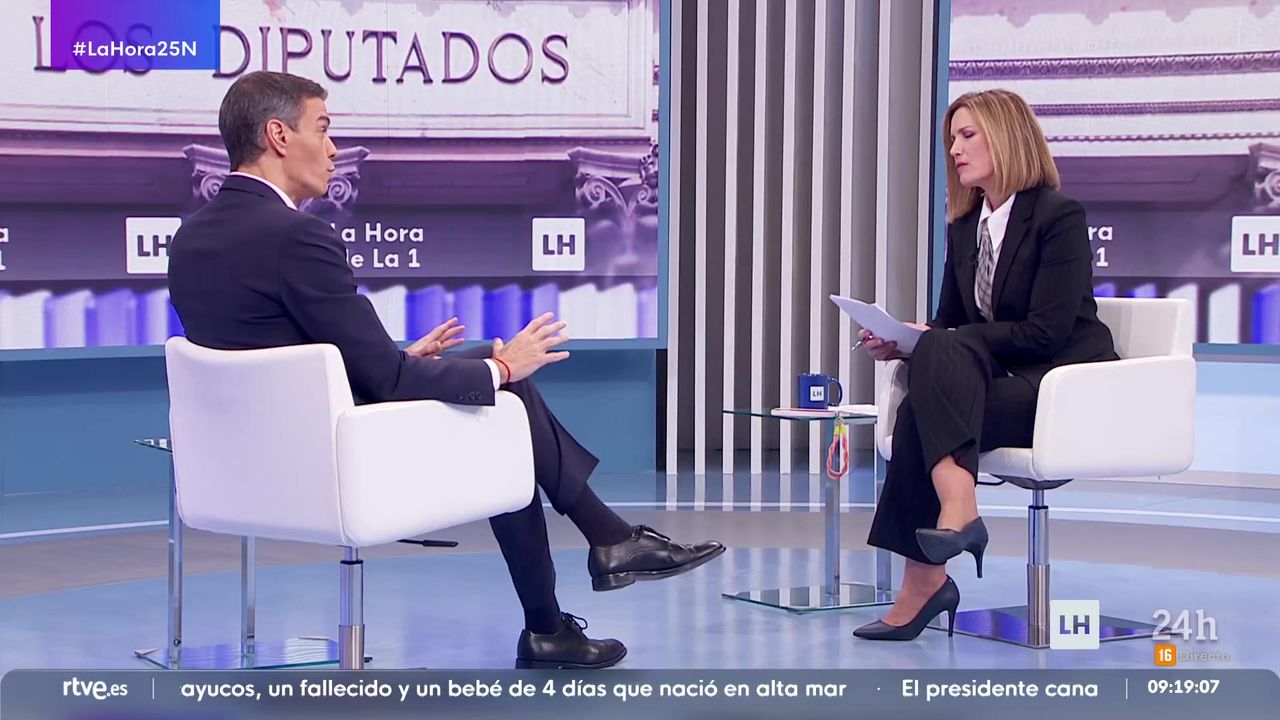
XThe post shares a video clip from TVE's La Hora de La 1, the interview programme presented by Silvia Intxaurrondo, posted by the programme's own account (@LaHoraTVE) on X. In the clip, Spain's prime minister Pedro Sánchez is asked why Spanish intelligence could not anticipate the mass entry into Ceuta, and he answers that no intelligence service warned of it, that he would not call it a government failure, and that there are no firm elements linking the entry to the Moroccan regime. The caption summarises those three statements and asks readers to take them as his position in an election-time interview.
“#29Nrtve | Pedro Sánchez mantiene que ningún servicio de inteligencia "advirtió" de la entrada masiva en Ceuta y que "no hubo fallos" de su Ejecutivo y que "no hay elementos" de la participación de Marruecos #LaHora25N”
“#29Nrtve | Pedro Sánchez maintains that no intelligence service "warned" of the mass entry into Ceuta and that there were "no failures" by his government and that there are "no elements" of Morocco's participation” — translated
Posted by the X account of TVE's La Hora de La 1, under the hashtags #29Nrtve and #LaHora25N, signalling the 29 November election coverage and the interview broadcast on 25 November 2026. The clip carries the channel's on-screen labels, including a chyron reading "Ningún servicio de inteligencia nos advirtió de la entrada masiva en Ceuta".
Who posted it
XAccount check
Estimates from public signals — account age, posting pattern, audience — not a judgement of the person behind the account, and separate from whether this post is true.
What stood out
- @LaHoraTVE is the official X account of 'La Hora de La 1', RTVE/La 1's flagship morning news-magazine, confirmed by its own bio (lahora@rtve.es, rtve.es/play links) and frequent cross-references from @rtve and @RTVE_Com.
- Account was created in October 2013 (~13 years old as of Nov 2026) with ~49,500 posts and ~240k followers — a long, consistent institutional footprint, not a newly spun-up or impersonating handle.
- Historic X verification is documented (archived profile snapshots label it 'Verified account'); the 'not verified' flag in this scrape is likely a data-capture artefact, and the January 2013 style handle matches the real programme account exactly.
- Used as a source by mainstream Spanish press in Nov 2026 (JEC sanction file against presenter Silvia Intxaurrondo), i.e. it is quoted as the programme's official channel.
- Credibility caveats: in 2025 the programme aired the 'bomba lapa' story originating with El Plural and gave only a partial correction, and in July 2026 TVE's own Consejo de Informativos criticised La Hora de La 1 for lack of contrast and no rectification in its Zapatero coverage — so genuine, but not error-free.
- It is also a frequent target of manipulated screenshots (e.g. the fake '#YoConBegoña' caption of June 2026 debunked by Maldita.es and Verifica RTVE), which spreads virally and worsens its perceived partisanship in polarised debates.
- No signals of automation in the sample; posting patterns described by third parties are consistent with a broadcast-team-operated account amplifying its own on-air content.
- Scraped metadata (null bio, followers, creation date, empty recent_posts) is incomplete rather than suspicious — all values were recoverable from public sources.
Signals (11)+
- Account created
- 2013-10
- Approx followers
- 240000
- Approx following
- 291
- Approx post count
- 49500
- Affiliation
- RTVE / La 1 (Spanish public broadcaster), programme 'La Hora de La 1'
- Institutional domain email in bio
- Lahora@rtve.es
- Notable news coverage
- Quoted by Spanish outlets in Nov 2026 JEC/Intxaurrondo coverage
- Fact check history
- Subject of debunked manipulated screenshot (Maldita.es / Verifica RTVE, June 2026); itself criticised by TVE's Consejo de Informativos (July 2026) for unverified 'bomba lapa' and Zapatero-origin reporting without rectification
- Posting cadence
- Consistent with a TV programme's daily promotion of its own broadcasts
- Impersonation risk
- Low; exact handle match with established programme account
- Metadata completeness
- Low — most fields null in the supplied profile object
Account checked November 26, 2026, 14:57 UTC
The media
Video✓ What is genuine
The footage is a genuine TVE broadcast: a studio interview with Pedro Sánchez by Silvia Intxaurrondo, with the channel's election graphics and a live ticker, consistent across frames. The quotes in the caption match the exchange as broadcast.
Synthetic-media detector
Detector not consultedThe media is incidental to the claim; the detector was not needed.
How we checked the media
- Reviewed the keyframes of the clip and compared the studio set, channel branding, election-programme graphics and same-day news ticker across frames.
- Checked the clip against same-day reporting of the 25 November 2026 TVE interview in several outlets.
- Compared the caption against the spoken exchange heard in the clip's transcript.
- We did not run an automated AI-generation detector, because the claim does not depend on the footage being authentic.
Sources
12 sources reviewed- 1El CNI sí avisó al Gobierno de la entrada masiva en Ceuta a las 13:52 del día anterior ↗
El Confidencial · elconfidencial.comUntiereduntiered — treated as signal only, never decisiveEvidence
Establishes the CNI message to the Ceuta Government Delegation on 29 July 2026 and its timing.
- 2El CNI avisó a la Delegación del Gobierno en Ceuta 24 horas antes ↗
La Verdad · laverdad.esUntiereduntiered — treated as signal only, never decisiveEvidence
Adds that the declassified papers set out date, routes and organisation of the planned entry.
- 3El aviso del CNI el día de antes de la entrada masiva a Ceuta ↗
Maldita.es · maldita.esPrimary / fact-checkerIFCN + EFCSN; SpainEvidence
Fact-check confirming the 29 July warnings and noting the limits on verifying the call's content.
- 4El Gobierno niega que el CNI avisara de una "entrada masiva" a Ceuta: "No emitió ninguna alerta formal" ↗
Público · publico.esUntiereduntiered — treated as signal only, never decisiveContext
Records Moncloa's argument that the message was not a formal alert to the executive.
- 5Sánchez vuelve a descartar que Marruecos estuviese detrás de la invasión de Ceuta en una entrevista a la carta con Intxaurrondo ↗
El Debate · eldebate.comUntiereduntiered — treated as signal only, never decisiveEvidence
Confirms the 25 November 2026 interview and what Sánchez said in it.
- 6Los mensajes del CNI al Gobierno que contradicen a Sánchez sobre la invasión de Ceuta ↗
El Debate · eldebate.comUntiereduntiered — treated as signal only, never decisiveEvidence
Publishes the declassified CNI communications that contradict the blanket denial.
- 7El CNI responde a la jueza que "no hay evidencias" que atribuyan la entrada masiva en Ceuta a una acción de las autoridades marroquíes ↗
El Mundo · elmundo.esReputable outletLean RightEvidence
The CNI report to the Audiencia Nacional finding no evidence of Moroccan orchestration.
- 8El CNI no ve evidencias de que la entrada masiva en Ceuta fuera "instigada" por Marruecos ↗
Europa Press · europapress.esUntiereduntiered — treated as signal only, never decisiveEvidence
Wire summary of the CNI filing plus Guardia Civil criticism of the earlier information.
- 9El Gobierno desclasifica los informes del 1 de julio al 1 de agosto sobre la entrada masiva en Ceuta ↗
RTVE · rtve.esReputable outletCenter/Lean Left — public serviceEvidence
Confirms the government's September 2026 declassification of the July intelligence and police reports.
- 10El Gobierno se hace el harakiri con la desclasificación de los papeles de Ceuta ↗
El Español · elespanol.comUntiereduntiered — treated as signal only, never decisiveContext
Describes Moncloa's account of an ambiguous message that was never escalated.
- 11La Policía constata 97 contactos con servicios de inteligencia de Marruecos de los impulsores de la entrada masiva en Ceuta ↗
La Razón · larazon.esUntiereduntiered — treated as signal only, never decisiveEvidence
The police report on 97 contacts with numbers possibly linked to Moroccan security and intelligence.
- 12Silvia Intxaurrondo, Pedro Sánchez y el estrambótico final de una entrevista con la Junta Electoral en el pinganillo ↗
El Mundo · elmundo.esReputable outletLean RightEvidence
Confirms the interview and that Sánchez denied government failures over Ceuta.
Further reading
- 3Maldita.es The fact-check that verified the 29 July CNI warnings, including what could and could not be confirmed about the call.
- 9RTVE The public broadcaster's report on the government's own declassification, the key primary record here.
- 8Europa Press A wire report summarising the CNI's finding to the judge, with the Guardia Civil's criticism of the earlier information.
- 4Público Sets out Moncloa's defence in its own terms, so readers can weigh the narrower claim against the blanket one.
The full story
The prime minister's answer did not come out of nowhere. In the days after the mass entry of 30-31 July 2026, the question dominating Spanish politics was why a city on the border with Morocco could be taken by surprise. Saying that no intelligence service, Spanish or foreign, saw it coming is a way of spreading the responsibility: if nobody saw it, no one in Madrid failed.
There is a real gap in the story, and it is where the sentence draws its plausibility. What the CNI sent on 29 July was not a prediction of how many people would cross or exactly where. According to Moncloa's own line, it was an ambiguous message sent to a junior official that never reached political level. Predicting turnout and routes from social media chatter is genuinely hard, and the CNI report to the Audiencia Nacional says Morocco's passive attitude eased the entry without evidence of orchestration. Officials may reasonably argue the warning was not the same as a forecast.
The problem is the word "ningún". A warning existed, from the government's own service, to its own delegation in the city, the day before. That single fact turns a defensible argument about predicting events into a statement that the government's own declassified papers contradict. The claim travels well because it captures a familiar instinct — that a government under attack will deny error — and because the interview itself is real and widely shared. It is exactly the kind of content where the authenticity of the footage tells you nothing about the truth of the words in it.
Kernel of truth
The CNI's 29 July warning was partial and never escalated to political level, and the state's own report found no evidence Morocco orchestrated the entry — but a warning from an intelligence service did exist.
Timeline
July 29, 2026
The CNI messages the Ceuta Government Delegation warning of a call for an assault by fence and by sea the next evening, and contacts the Guardia Civil minutes later. 1El Confidencial
July 30, 2026
The mass entry into Ceuta takes place over 30-31 July 2026.
September 9, 2026
The government declassifies and publishes around forty intelligence and police reports covering 1 July to 1 August 2026. 9RTVE
November 11, 2026
The CNI sends a report to Audiencia Nacional judge María Tardón finding no evidence the entry was instigated, planned or coordinated by Moroccan authorities. 7El Mundo
November 25, 2026
Sánchez tells TVE's La Hora de La 1 that no intelligence service warned of the entry and that there were no government failures. 5El Debate
How it was framed
The clip is real and the caption accurately quotes Sánchez, so nothing is fabricated or manipulated. But the statements themselves take a partial warning that was never escalated and reframe it as no warning at all, using a genuine interview to give the denial authority.
- Borrowed authority. The denial is delivered by the prime minister on a public broadcaster's flagship interview programme, carried by the programme's own account.
- Missing context. The answer does not mention the CNI messages of 29 July 2026 that the government had already declassified in September.
- Us vs. them. Sánchez contrasts "los nuestros" with other services and refers to what "ustedes conocen en los medios de comunicación" as opposed to official findings.
- Ongoing-threat framing. He frames the event as part of "ataques híbridos" by states and new technologies that can "desestabilizar a naciones enteras".
- Selective evidence. He cites CNI and Policía Nacional reports to deny Moroccan involvement but not the July warning to the Ceuta Delegation.
Posted on X by @LaHoraTVE, the account of TVE's La Hora de La 1, with hashtags for the 29 November election coverage (#29Nrtve, #LaHora25N) and the words "mantiene" in the caption, indicating the position was a repetition of earlier statements. The clip carried channel graphics and a same-day news ticker.
Bias
Leans pro-government / uncritical of Pedro Sánchez. The post is TVE's own clip of its election interview and adds no commentary, but the exchange lets the president state contested denials without putting the declassified CNI warnings to him; several Spanish outlets, including El Mundo, El Debate and Libertad Digital, criticised the interview for not pressing him on the prior warnings or on his absence from Ceuta.
Bias describes how the post frames its message — the slant of the language, selection and emphasis — and is judged separately from whether the claim is true. A true claim can still be framed with a strong slant.
How we checked
1 min 21 s- 1
Searched for coverage of the 25 November 2026 TVE interview and of the Ceuta mass entry and the intelligence warnings around it.
- 2
Compared the post's caption against the spoken exchange heard in the clip.
- 3
Reviewed the clip's keyframes for studio set, channel branding, election graphics and ticker consistency, and checked it against same-day reporting of the interview.
- 4
Traced the conflicting record: the government's September 2026 declassification of the July reports, Moncloa's defence of the message, and the CNI's November 2026 report to the Audiencia Nacional.
✓ Claim checked✓ Media checked✓ Sources checked
Why 75% confidence
HighHigh confidence on the central claim and on the interview itself: the government's own declassified papers, reported across multiple outlets including the public broadcaster, directly contradict the blanket denial, and the interview is confirmed by several same-day reports. The "no failures" claim sits at moderate confidence because "failure" involves political judgement, and the Moroccan-orchestration claim at moderate confidence because a police report on contacts sits alongside the CNI's "no evidence" finding.
Limits. We did not review the full, unedited interview, only the clip and the reports about it. We could not verify the content of the 11-minute call between the CNI and the Ceuta Delegation. No automated detector was run on the video, because the claim does not hinge on whether the footage is real; our assessment of the video rests on visual review and same-day reporting.
What we don’t know
- What exactly was said in the 11-minute call between the CNI and the Ceuta Delegation, which has not been published.
- Whether the judicial investigation will reconcile the police reports on the 97 contacts with the CNI's finding of no evidence of orchestration.
- Whether Moncloa's account of the message as ambiguous and unescalated is fully borne out by the complete set of declassified documents.
Spot it yourself
Spot the fakeLooks suspicious, isn’t proof
- The post comes from a broadcaster's account during an election campaign, so it has an interest in attention — that is a reason to check, not evidence of error.
- The caption puts three controversial statements in quotation marks, which can read as spin; the quotes do match the words spoken.
- Several outlets covering the CNI warning lean right, which makes some readers discount them — but the key documents were released by the government itself.
- The clip is a short cut from a longer interview, which often means context is missing; here the cut matches what was said.
The actual evidence
- The government's own declassification of 9 September 2026, which includes the CNI message of 29 July 2026 to the Ceuta Government Delegation about an assault called for the next evening.
- The timing: the message went out at 13:52 on 29 July, the day before the entry, and the CNI also contacted the Guardia Civil minutes later.
- Moncloa's own defence, which concedes that a message existed but says it was not escalated — a narrower claim than "ningún servicio nos advirtió".
- The CNI's 11 November 2026 report to the Audiencia Nacional, which supports Sánchez on the Moroccan-orchestration point.
- 1
Find the government document, not just the quote
When a politician denies a warning existed, search for the official publication — in this case the declassification — and for the fact-checkers who have read it, rather than relying on clips of the denial.
- 2
Check what "no warning" actually means in the sentence
Separate "no formal alert reached ministers" from "no intelligence service warned anyone". Ask which of the two the speaker said, because only one may be contradicted.
- 3
Look for timing before judging
A warning the day before an event, with a date and a route, is different from a vague prediction weeks earlier. Note the date, hour and recipient.
- 4
Check whether the footage is genuine separately from whether the words are true
Real broadcast clips are routinely used to carry claims whose truth has to be checked against documents, not against the video itself.
- 5
Read the counter-report before deciding
Here a second document — the CNI filing to a judge — supports part of what the speaker said, which is why the verdict is mixed rather than a flat falsehood.
Takeaway
A genuine clip can carry a claim that is contradicted by the poster's own side's documents; verify the statement, not just the video.
Questions people ask
Did any intelligence service warn Spain about the Ceuta mass entry?+
Yes. The government's own declassification, published on 9 September 2026, shows the CNI messaged the Ceuta Government Delegation at 13:52 on 29 July 2026 about a call for an assault by fence and by sea the next evening, and contacted the Guardia Civil minutes later. Moncloa says the message was never formally escalated to political level.
Is the TVE interview clip real?+
Yes. The clip is genuine footage from La Hora de La 1 on 25 November 2026, an election interview by Silvia Intxaurrondo, posted by the programme's own account. The quotes in the caption match what was said. The footage being real does not, by itself, make the statements in it accurate.
Why is the verdict MISLEADING rather than FALSE?+
Because the post accurately reports what Sánchez said, and part of what he said holds up. The claim that no intelligence service warned is contradicted by the government's own documents, but his statement that there are no firm elements of Moroccan orchestration broadly matches the CNI's report to the Audiencia Nacional. Real parts are arranged to imply a false whole.
What did the CNI tell the judge about Morocco?+
Its report of 11 November 2026 to judge María Tardón found no evidence the entry was instigated, planned or coordinated by the Moroccan authorities, while noting Morocco's passive attitude facilitated it. Police reports separately point to 97 phone contacts between organisers and numbers possibly linked to Moroccan security and intelligence.
What does "no hubo fallos" mean in this context?+
It is Sánchez's blanket denial that his government made mistakes in handling the crisis. His own administration argues the 29 July message was ambiguous and never escalated, which describes a gap between a warning arriving and the executive responding. He had earlier told Congress that "fallaron cosas" — things failed.
Go deeper
- CNI
- Spain's Centro Nacional de Inteligencia, the national intelligence service that reports to the government.
- Declassification
- The official release of previously secret government documents, in this case about forty intelligence and police reports on the Ceuta events.
- Hybrid attack
- A hostile action by a state or other actor that falls below armed conflict — disinformation, cyber operations or exploiting migration flows — to destabilise a country.
- Audiencia Nacional
- Spain's central high court, which handles cases with national scope and receives intelligence reports in sensitive investigations.
- Misleading content
- The use of genuine information in a way that frames an issue or person so as to reach a conclusion the underlying facts do not support.
People also search for
For educators+
- Sánchez said no intelligence service warned. Moncloa says no formal alert was escalated. Are these the same claim? What changes when you swap one for the other?
- How much should a politician's own earlier admission ("fallaron cosas") weigh against a later denial that there were failures?
- If a police report on 97 contacts and an intelligence report finding no evidence coexist, how should a reader describe what is known?
About this check
- Platform
- X
- Posted by
- @lahoratve
- Posted
- November 25, 2026
- Age when checked
- 1–2 days old when checked
- Where it spread
- Spain
- Audience
- UK & EU audience
- Language
- ES
- Status
- ● Post is live
- Verified
- November 26, 2026, 14:59 UTC
- Published
- November 26, 2026, 14:59 UTC
Reach. 365 likes, 89 replies on the RTVE post (syndication, 26 Nov); El Debate published CNI messages of 29 July 2026 that appear to contradict him; follow-up story on Interior secretaries of state; final days of the 29N campaign
This verdict was generated with AI from the sources shown. AI can make mistakes — check the sources before relying on it.
Check anything yourself, in seconds.
Share any social post or video to What the Fact and get the verdict, the confidence, and the receipts.