Did Abascal call Sánchez a 'sinvergüenza' during the four-way debate?
Did Pedro Sánchez call Santiago Abascal a 'sinvergüenza' in the 26 Nov debate, as Abascal insisted, or did Abascal insult Sánchez first?
True, but…
Real debate footage; the heated exchange happened as shown, but the 247% figure spoken in it is false.
The video is authentic RTVE broadcast footage of Spain's four-candidate debate on 26 November 2026, three days before the general election. The caption quotes the Sánchez–Abascal clash accurately, including 'Es usted un sinvergüenza'. But Abascal's claim inside the clip — that sexual assaults have risen 247% — is contradicted by Interior Ministry data.
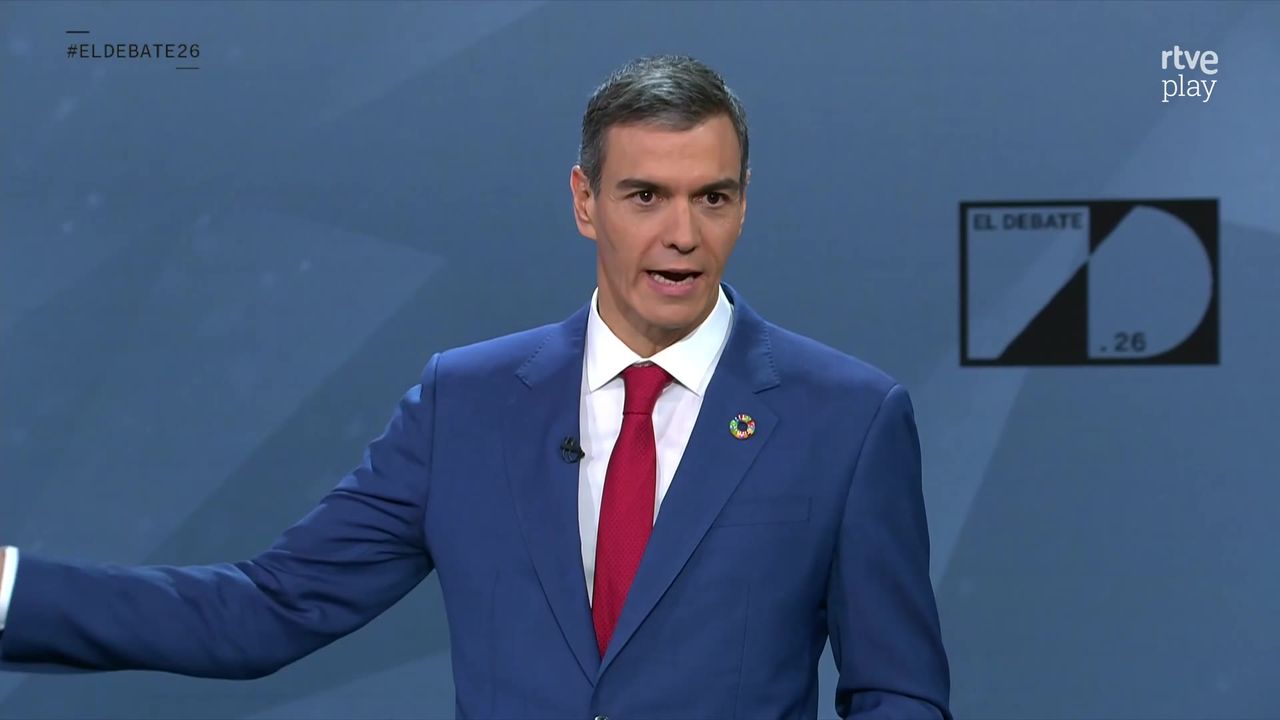 Genuine
Claims
✓ 3 true · ✕ 2 falsePedro Sánchez told Alberto Núñez Feijóo that he does not reproach Santiago Abascal for not condemning gender-based violence.124
“Usted no le reprocha a Abascal que no condene la violencia de género”
This is the line the caption is built on, and it holds up in two independent outlets that covered the debate live. LaSexta's report records Sánchez demanding that Abascal condemn gender-based violence, and El País describes Sánchez pressing Feijóo on why he does not ask Vox's leader to do so. El Periódico de España's reconstruction of the same exchange carries the same thrust: the whole confrontation begins because Sánchez is pushing Feijóo over Abascal's refusal. The paraphrase in the caption compresses several sentences spoken across a noisy argument into one, but it does not change their direction or meaning. Because the video itself is genuine broadcast footage, the decisive evidence is not just the clip but the written reports from newsrooms that watched the same feed — they were working from the debate as it happened, not from this post, so they corroborate rather than recycle it. A reader should weigh that consistency as the main support for this claim.
Santiago Abascal called Pedro Sánchez 'un sinvergüenza'.14
“Es usted un sinvergüenza”
This is the least ambiguous element of the whole post, because it is both heard on the clip and recorded by newsrooms that covered the debate. LaSexta's headline itself is built around it: the Vox leader called the Socialist candidate a 'sinvergüenza'. El País's review of the night's television moments reports the same. The insult is spoken directly on the recording, and lip-sync and audio match, so there is no question of misattribution. The reason this claim still matters for a fact-check is that the insult is accurate detail — it is what makes the post compelling and shareable. Its accuracy does not make every other statement in the clip true; the same exchange contains a statistic that is false, which we treat separately below. A reader can accept this claim and still treat the rest of the exchange with caution.
Sánchez had just called Abascal a 'sinvergüenza', so Abascal was returning an insult.2
“Me lo acaba de llamar”
This is the one part of the spoken exchange the record contradicts. El Periódico de España reconstructs the sequence closely: Sánchez said 'Pero qué vergüenza, señor Abascal' — an expression about the shamefulness of the situation — and Abascal treated it as a personal insult. Sánchez answered, on the record, 'Yo no le he llamado sinvergüenza'. The newspaper presents Abascal's attribution as a disputed claim or hoax rather than an established fact. The two phrases sound alike, which is exactly why the mishearing spread. The clip supports this finding: it contains both Sánchez's 'qué vergüenza' and his denial, so a viewer can follow the confusion without leaving the video. Note the limit of our evidence: the reconstruction comes from one outlet, so our confidence rests on a single detailed account plus the audible footage, not on multiple independent reconstructions of the exact second-by-second sequence.
Still open: Many accounts of the debate circulate with different punctuation of the exchange; we did not obtain a full official transcript of the segment.
Sexual assaults in Spain have tripled — up 247% — since Pedro Sánchez came to power.356
“Desde que usted llegó a un 247% han aumentado las agresiones sexuales”
This is the element inside the footage that turns an accurate clip into a mixed post. The number is spoken on camera, but official figures do not support it. Interior Ministry data quoted by La Opinión A Coruña show sexual offences rising from 10,727 in 2018 to 19,282 in 2025 — about a 79.8% increase, well short of a tripling. elDiario.es, fact-checking the same night, put the rise at roughly 64% comparing 2019's 11,694 with 2025. Newtral's earlier checks reached the same conclusion for the '250%' version: reported rapes went from 2,744 in 2018 to 5,206 in 2024, about 89.7%, not 250%. The sources differ slightly because they use different starting years and categories, but none of them comes close to 247% or a tripling — that is the decisive point. Newtral also explains why raw comparisons inflate: the 2022 'solo sí es sí' reform merged 'abuso sexual' into 'agresión sexual', and rising reporting rates lift the totals. The figure is wrong even where the underlying trend is real.
Still open: The published figures use different base years and categories, so the exact percentage depends on which comparison is chosen; none supports 247%.
Vox and Santiago Abascal have not condemned gender-based violence in Spain.4
This is a claim made on the podium, so we report it as a graded statement rather than a settled fact. El País's account of the debate notes that Abascal did not join the condemnation when pressed, and that Sánchez reproached Feijóo for failing to demand it. The footage shows the refusal happening within the exchange itself. But Vox disputes the framing: it says it condemns violence against women while rejecting the term 'violencia de género', which it treats as a political label. That dispute is about terminology as much as conduct. Our verdict is therefore LIKELY_TRUE rather than TRUE: accurate as to the specific condemnation at issue in the debate, where Abascal declined to use the phrase when asked repeatedly, but involving a definitional argument that a reader should know exists. We did not independently audit Vox's full public record on the subject beyond the debate coverage.
Still open: Vox's position rests on rejecting the term 'gender violence' rather than the act; we did not review its wider public statements beyond the debate reporting.
What was posted
XRTVE Noticias posted a short clip from its own broadcast of the four-candidate election debate held on 26 November 2026. The clip shows Pedro Sánchez pressing Alberto Núñez Feijóo over Vox's refusal to condemn gender-based violence, and Santiago Abascal replying with an accusation and an insult. The post asks readers to believe that this confrontation, and the words quoted in the caption, happened on air exactly as shown.
“#DebateA4RTVE | Pedro Sánchez (@sanchezcastejon), candidato del PSOE, cara a cara con Alberto Núñez Feijóo (@NunezFeijoo): “Usted no le reprocha a Abascal que no condene la violencia de género” Santiago Abascal: "Es usted un sinvergüenza" #29Nrtve”
“#DebateA4RTVE | Pedro Sánchez (@sanchezcastejon), PSOE candidate, face to face with Alberto Núñez Feijóo (@NunezFeijoo): "You don't reproach Abascal for not condemning gender-based violence" Santiago Abascal: "You are a scoundrel" #29Nrtve” — translated
Posted on X by the official RTVE Noticias account on the night of the debate, using the broadcaster's own hashtags for the event and for the 29 November election.
Who posted it
XAccount check
Estimates from public signals — account age, posting pattern, audience — not a judgement of the person behind the account, and separate from whether this post is true.
What stood out
- Handle @rtvenoticias is the genuine X account of RTVE Noticias, the news service of Spain's public broadcaster (Corporación RTVE); it is cited as the official channel in Spanish congressional records, by other media and by RTVE itself.
- Institutional account, not a persona: it operates alongside a verified-domain Bluesky account (@rtvenoticias.rtve.es) and matching Instagram/TikTok presences, indicating a coordinated official brand rather than an impersonator.
- Very high citation footprint — Spanish Congress questions, national press (The Objective, ABC, El Imparcial) and international outlets routinely quote its posts, consistent with a major newsroom account.
- RTVE operates VerificaRTVE, a fact-checking unit within the Eurovision News Spotlight network, but the @rtvenoticias account itself is not a fact-checking outlet and is not IFCN-signatory.
- Reliability caveats: a 28 July 2025 post calling it 'un año de la victoria de Maduro' was hit by an X Community Note and drew accusations of misinformation/whitewashing from the PP, which filed parliamentary questions; the post was reportedly not deleted or formally corrected.
- Further credibility criticism comes from a TVE Consejo de Informativos report (Jan 2026) on biased/false content in some RTVE programmes and from political disputes over RTVE's editorial independence under its current presidency.
- Metadata supplied is largely empty (no bio, no follower count, no creation date, isplatformverified=false, zero recent posts) — this looks like an incomplete scrape rather than evidence of an inauthentic account; no behavioural data available to assess cadence or automation.
- No evidence of coordinated inauthentic amplification, fake follower networks or impersonation associated with this handle.
Signals (9)+
- Platform verification
- False in supplied metadata, but account is demonstrably the official RTVE news handle
- Posting cadence
- Unknown (no recent posts provided); known externally as a high-volume breaking-news account
- Follower scale
- Large institutional audience (TikTok sibling account ~3.3M followers)
- Cross platform presence
- Bluesky rtvenoticias.rtve.es, Instagram, TikTok, rtve.es
- Notable news coverage
- Extensive — cited in Spanish Congress official bulletins, ABC, The Objective, El Nacional, El Imparcial
- Fact check history
- Own newsroom runs VerificaRTVE; its X account received a Community Note over the July 2025 'victoria de Maduro' headline
- Editorial controversy
- PP parliamentary questions (Aug 2025) alleging manipulation; Consejo de Informativos report (Jan 2026) on biased content in some RTVE programmes
- Affiliation
- Corporación RTVE (Spanish state public broadcaster)
- Metadata completeness
- Poor — bio, followers, creation date and posts all null/false
Account checked November 27, 2026, 03:06 UTC
The media
Video✓ What is genuine
The video, the speakers, the setting and the quoted exchange are all genuine broadcast material from the debate of 26 November 2026. What is not genuine is one figure spoken within it.
The tells
- ●●● Strong signal The visual content is continuous broadcast footage with consistent studio graphics naming the debate and election date.our visual review
- ●●● Strong signal Our detector scored the video 0.99999 as not AI generated and 0.04 as deepfake — no meaningful sign of synthetic generation.our detector
- ●●● Strong signal Names, speakers and the sequence of the argument match independent reporting of the same debate in every detail.our visual review
- ●●○ Supporting signal The disputed 247% statistic is a rhetorical assertion inside real footage, not a manipulation of the footage itself.our visual review
Synthetic-media detector
Detector ranThe claim stands or falls on whether the media is real, so the detector ran.
Scores are the detector’s estimate for the file as uploaded. A low score does not rule out editing, a spliced caption, or footage shown out of context — those are judged above. Model v3.
How we checked the media
- Our visual review of the clip: continuous multi-camera studio footage of four identifiable party leaders at podiums, with consistent on-screen graphics ('EL DEBATE 26', 'ELECCIONES GENERALES 29.11.26'), natural body language and matching lip-sync.
- Ran the clip through our media detector (hive-v3), which returned a 99.999% 'not AI generated' score and a deepfake score of 0.04.
- Compared the footage with independent same-night reporting and descriptions of the debate from LaSexta, El País, ABC, Público and El Periódico de España.
Sources
6 sources reviewed- 1Tenso choque entre Abascal y Sánchez: el líder de Vox le llama "sinvergüenza" y el presidente le reprocha su "falta de humanidad" ↗
LaSexta · lasexta.comUntiereduntiered — treated as signal only, never decisiveEvidence
Records the clash, the insult and the 247% remark as spoken at the debate.
- 2¿Llamó Sánchez 'sinvergüenza' a Abascal? La polémica (o el bulo) del debate ↗
El Periódico de España · epe.esUntiereduntiered — treated as signal only, never decisiveEvidence
Reconstructs the exact sequence: 'Pero qué vergüenza', the insult, and Sánchez's denial.
- 3Abascal miente al afirmar que las agresiones sexuales 'se han multiplicado por tres' ↗
elDiario.es · eldiario.esReputable outletLean LeftEvidence
Fact-checks the tripling claim using 2019 and 2025 figures — about 64%.
- 4Del 'amiga, date cuenta' al 'calladita' y el nivel de inglés: los momentos televisivos del debate electoral a cuatro ↗
EL PAÍS · elpais.comReputable outletLean LeftEvidence
Confirms Abascal did not join the condemnation and Sánchez pressed Feijóo over it.
- 5FACT-CHECK: Las denuncias por violación han crecido desde que Sánchez es presidente pero no un 250% como dice Abascal ↗
Newtral · newtral.esPrimary / fact-checkerIFCN + EFCSN; SpainEvidence
Shows reported rapes rose 89.7% between 2018 and 2024, and explains reclassification effects.
- 6Fact checking do debate a catro: da chegada de migrantes á corrupción ↗
La Opinión A Coruña · galego.laopinioncoruna.esUntiereduntiered — treated as signal only, never decisiveEvidence
Cites Interior Ministry data for a 79.8% rise from 2018 to 2025.
Further reading
- 3elDiario.es elDiario.es fact-checks the 247% claim the same night, with the ministry figures.
- 5Newtral Newtral explains why the raw figures look dramatic: the 2022 reform and rising reporting rates.
- 6La Opinión A Coruña A full regional fact-check of the debate, offering the 79.8% calculation from 2018.
- 2El Periódico de España The clearest reconstruction of who said 'sinvergüenza' to whom, and why the words got confused.
The full story
Spain's general election was three days away. On 26 November 2026, the four main candidates — Pedro Sánchez of the PSOE, Alberto Núñez Feijóo of the PP, Santiago Abascal of Vox and Ada Colau of the Frente Amplio — met in a televised debate, and the block on gender-based violence turned into the night's loudest exchange.
Sánchez challenged Feijóo over Vox's refusal to condemn gender-based violence. Pressed repeatedly, Abascal did not use the term; instead he linked sexual offences to immigration, said assaults had risen 247% since Sánchez took office, and called Sánchez a 'sinvergüenza'. Sánchez replied that he had not insulted Abascal — he had said 'qué vergüenza', a remark about the situation, not a name.
The clip RTVE posted is that exchange, unaltered. The false part is not the video but the statistic inside it. Ministry of the Interior figures show reported sexual offences rising from around 10,727 in 2018 to 19,282 in 2025 — a rise of roughly 64% to 80% depending on the base year, not a tripling. Newtral has traced how the inflated numbers circulate: a 2022 legal reform merged 'abuso sexual' into 'agresión sexual', and more people reporting pushes raw totals up, so comparisons across years mislead even when the figures are real.
That is why the post felt plausible. The confrontation happened, the insult happened, and the statistic was delivered with confidence in the middle of a real argument.
Kernel of truth
The debate, the clash and the insult are all real; Abascal's 247% figure is not supported by official data.
Timeline
November 26, 2026
Four-candidate televised election debate (Sánchez, Feijóo, Abascal, Colau); Sánchez presses Feijóo over Vox's refusal to condemn gender-based violence, and Abascal calls him a 'sinvergüenza'. RTVE Noticias posts the clip that night. 1LaSexta
November 26, 2026
elDiario.es fact-checks Abascal's claim that sexual assaults have 'multiplied by three' as false. 3elDiario.es
November 27, 2026
La Opinión A Coruña publishes a fact-check of the debate citing Interior Ministry data showing a 79.8% rise, not a tripling. 6La Opinión A Coruña
November 29, 2026
Spain's general election, three days after the debate.
How it was framed
Nothing in the post is fabricated: the footage is genuine, the insults were said, and the caption quotes them correctly. The problem sits inside the authentic material — Abascal's 247% claim, presented within a real argument as if the data backed it. The result is a misleading framing of the issue rather than invented content.
- Emotional language. The quote the caption chooses to lead with is the insult: "Es usted un sinvergüenza".
- Missing context. The quoted exchange omits the 247% statistic spoken in the same segment, which no official data supports.
- “Visual proof”. The post leans on broadcast footage of the confrontation as proof that the exchange happened exactly as described.
Posted on X by the official RTVE Noticias account, the public broadcaster's news arm, on the night of the debate, using its own hashtags for the debate and the 29 November election.
Bias
Leans critical of Vox / Santiago Abascal. The post is a straight excerpt of a public broadcast of the debate, but the selected 90 seconds showcase Abascal's refusal to condemn gender-based violence and his insult of Sánchez, without including the context Vox usually offers, which gives the clip a mildly adversarial framing toward Vox.
Bias describes how the post frames its message — the slant of the language, selection and emphasis — and is judged separately from whether the claim is true. A true claim can still be framed with a strong slant.
How we checked
1 min 12 s- 1
Searched for same-night coverage of the debate and for the specific exchange, its words and the disputed percentage.
- 2
Reviewed the clip itself: speakers, set, graphics, lip-sync and continuity of the broadcast footage.
- 3
Ran the clip through our media detector (hive-v3), which returned a 99.999% not-AI-generated score.
- 4
Compared the reported flow of the argument across LaSexta, El País and El Periódico de España.
- 5
Checked the 247% figure against elDiario.es, Newtral and La Opinión A Coruña, which cite Interior Ministry data.
✓ Claim checked✓ Media checked✓ Sources checked
Why 87% confidence
HighWe are confident the footage is genuine and the exchange happened as shown: several independent outlets covered it live, and the detector found no sign of synthesis. The mixed verdict comes from the false statistic inside the clip, which three fact-checks and official data contradict. Confidence is HIGH on the main claims, slightly lower on the claim about Abascal first being insulted, which rests mainly on one detailed reconstruction.
Limits. Pages opened and a full official transcript were not available to us, so the exact punctuation of the exchange and the base year used in each percentage rely on the published reporting we cite. We did not independently audit Vox's wider record on gender-based violence beyond the debate.
What we don’t know
- Whether Abascal deliberately used an inflated figure or repeated one he believed, and whether the 'sinvergüenza' attribution was a mishearing or deliberate.
- Which exact base year should be used to measure the change in sexual offences, given the 2022 legal reform that changed categories.
- Whether RTVE's clip was itself an excerpt chosen to highlight the insult rather than the surrounding policy argument.
Spot it yourself
Spot the fakeLooks suspicious, isn’t proof
- It comes from a broadcaster's own account, which may look like self-promotion rather than evidence — but the identity of the uploader is not what settles it either way.
- The tone is heated and the clip is short, which makes it feel like a selective hit piece — but short clips of real arguments are normal.
- A public figure is called a 'sinvergüenza' on air, which many people find implausible for a formal debate — but it did happen.
- The post is an excerpt from a day of coverage, which can suggest cherry-picking — but an excerpt can still be accurate.
The actual evidence
- Multiple independent Spanish outlets — LaSexta, El País, El Periódico de España and others — reported the same exchange the same night, matching the caption's words.
- Our detector scored the video as almost certainly not AI generated, and the footage's graphics and body language are consistent throughout.
- The statistic spoken inside the clip — that sexual assaults rose 247% — is contradicted by Interior Ministry figures and by two independent fact-checks.
- The claim that Sánchez insulted Abascal first is contradicted by Sánchez's own on-record reply, 'Yo no le he llamado sinvergüenza'.
- 1
Check who posted it
If the account is the broadcaster that aired the event, find the same moment described by a different outlet — two newsrooms covering the same live feed is stronger than one share.
- 2
Separate the clip from the claims inside it
Ask whether the post's caption is accurate and whether things said on camera by participants are accurate. In this case the first is true and one of the second is false.
- 3
Check any percentage against the official statistics
When a debater says assaults rose by a particular figure, look for the interior ministry's annual figures and see which base year is used; a rise across merged legal categories can look bigger than it is.
- 4
Watch for sound-alike phrases
'Qué vergüenza' and 'un sinvergüenza' sound close. Read the full exchange, not just the second half, before accepting that one person insulted the other first.
Takeaway
Real footage can carry false claims. Knowing who posted a clip and whether it was edited tells you the clip is genuine; it does not tell you that what the people in it say is true.
Questions people ask
Is the Abascal–Sánchez debate clip real?+
Yes. It is genuine RTVE broadcast footage from Spain's four-candidate debate on 26 November 2026, three days before the general election. Several independent outlets reported the same exchange the same night, and our detector found no sign of AI generation or manipulation.
Did Abascal really call Sánchez a 'sinvergüenza'?+
Yes. Multiple outlets covering the debate record Abascal saying 'Es usted un sinvergüenza' after Sánchez said 'Pero qué vergüenza, señor Abascal'. Sánchez then denied having insulted him first, saying 'Yo no le he llamado sinvergüenza'.
Is it true that sexual assaults have risen 247% in Spain?+
No. Interior Ministry figures cited by elDiario.es, Newtral and La Opinión A Coruña show increases of roughly 64% to 80% depending on the base year, not a tripling. Reporting rates and a 2022 legal reform that merged offence categories inflate raw comparisons.
Why does a real clip count as misleading?+
Because the footage is genuine but carries a false statistic spoken within it. Viewers who trust the clip because the pictures are real may also trust the number — which is exactly how authentic material can spread inaccurate claims.
What is 'solo sí es sí' and why does it matter here?+
It is the 2022 reform of Spain's criminal code that merged 'abuso sexual' into 'agresión sexual' and changed how offences are counted. That makes year-on-year comparisons of reported sexual offences harder to interpret, so figures that look dramatic can partly reflect how crimes are classified.
Go deeper
- Authenticity
- Whether a piece of media is the genuine recording it claims to be, as distinct from whether everything said within it is true.
- Base year
- The earlier year chosen as the starting point when calculating a percentage change, which can make a rise look larger or smaller.
- Reclassification
- Changing the legal category an offence falls under, so that counts before and after the change are not directly comparable.
- Fact-check
- An independent verification of a specific claim against primary data or authoritative sources.
- Detector score
- The probability, produced by a machine model, that a piece of media was generated or altered by AI; it supports but does not replace human review.
People also search for
For educators+
- If the video is real, should the post be treated as trustworthy? Where exactly does the line fall?
- Why might reported crime figures rise when the law changes how offences are counted, even if nothing else changes?
- How can short clips of a debate shape what audiences remember about an event, even when the broader context is not false?
About this check
- Platform
- X
- Posted by
- @rtvenoticias
- Posted
- November 26, 2026
- Age when checked
- Under 24 hours old when checked
- Where it spread
- Spain
- Audience
- UK & EU audience
- Language
- ES
- Status
- ● Post is live
- Verified
- November 27, 2026, 03:10 UTC
- Published
- November 27, 2026, 03:10 UTC
Reach. RTVE clip 32 likes; El Periódico de España ran '¿Llamó Sánchez sinvergüenza a Abascal? La polémica (o el bulo) del debate'; El País/OKdiario headlines on the exchange
This verdict was generated with AI from the sources shown. AI can make mistakes — check the sources before relying on it.
Check anything yourself, in seconds.
Share any social post or video to What the Fact and get the verdict, the confidence, and the receipts.