Did the Financial Times report that AI could crack encryption?
Have OpenAI or Anthropic secretly made a breakthrough that breaks RSA encryption (efficient integer factoring)?
True, but…
The quotes and the FT story check out. The missing caveat: nothing has actually been broken.
Mostly true. The Financial Times did publish an analysis in late November 2026 warning that AI-driven mathematics could threaten encryption like RSA before quantum computers, and Scott Aaronson did write that he was 'virtually certain' AI labs hold cryptography 'bombshells'. But no encryption has been broken, and Aaronson downplayed the specifics as unverified rumour.
 Likely genuine
Claims
✓ 3 trueThe Financial Times published a piece saying AI-driven mathematics may threaten RSA encryption before quantum computers do, experts now warn.1457
The FT did run this analysis in late November 2026. Independent outlets that reported the same story — including Nature, The Independent, NDTV Profit and Expansión syndicating FT copy, plus the Hong Kong Economic Times — describe the same argument: AI progress in number theory and algorithm design may bring forward cryptography risk that was previously associated mainly with quantum computers. The sources are not all one voice: Nature, The Independent and the syndicated FT pieces are editorially separate, and the Hong Kong Economic Times and German-language BW24 carry the story independently. The decisive evidence is the convergence of these outlets on the same FT reporting, including named figures such as Bank of England Governor Andrew Bailey and Manchester cryptomathematics professor Daniel Shiu. We could not open the original ft.com page directly because it blocks automated access, which is why the verdict is LIKELY_TRUE rather than TRUE. A reader should weigh two things: the story was genuinely published, and the FT framed it as a question and as a risk, not as a confirmed break.
Still open: The precise FT headline and byline could not be opened on ft.com; we rely on syndicated and secondary reporting of the same piece.
Ex-OpenAI researcher Scott Aaronson this week said he is 'virtually certain' AI labs are hiding encryption-relevant math breakthroughs.1236
“I'm virtually certain, from multiple reliable sources, that the AI labs are now sitting on one or more bombshells in that area.”
This is a direct quote and it is accurate. Aaronson wrote on his blog Shtetl-Optimized on 25 November 2026: 'I'm virtually certain, from multiple reliable sources, that the AI labs are now sitting on one or more bombshells in that area.' Nature, The Next Web, Cointelegraph and Yahoo Tech all quote the same statement, and the Hong Kong Economic Times and BW24 repeat it in translation, so the quote is well corroborated across independent outlets. What the post underplays is the rest of Aaronson's post. He said he was 'much, much less confident' about what those results are, he later struck out the blog comment that ignited the rumour, and he stressed 'a rumor is a rumor is a rumor'. The decisive evidence is the direct quotation in multiple independent outlets, not the social reposts. A reader should weigh that the certainty Aaronson expressed is about the existence of undisclosed results, not about a demonstrated break of RSA.
Only 8% of 85 EU banks surveyed have a working roadmap for quantum-resistant encryption.910
The figure traces to the European Banking Authority's autumn 2026 risk assessment, which surveyed 85 banks on post-quantum readiness. Reporting on that survey says 8% had an operational migration roadmap and 9% had an approved one, with only about a third holding a comprehensive cryptographic asset inventory. The underlying joint risk update was issued by the EU supervisory authorities, which makes the framework official. However, the 85-bank breakdown is reported mainly through secondary summaries rather than a primary page we could open ourselves, and the post's caption cuts off mid-sentence, so the exact wording of the stat as presented cannot be checked from the post alone. The decisive evidence is the match between the post's numbers and the reporting on the EBA survey. A reader should weigh that the figure is about readiness planning, not about any bank having been compromised.
Still open: We could not open a primary EBA page carrying the 85-bank table directly; the numbers rest on reporting of the survey.
What was posted
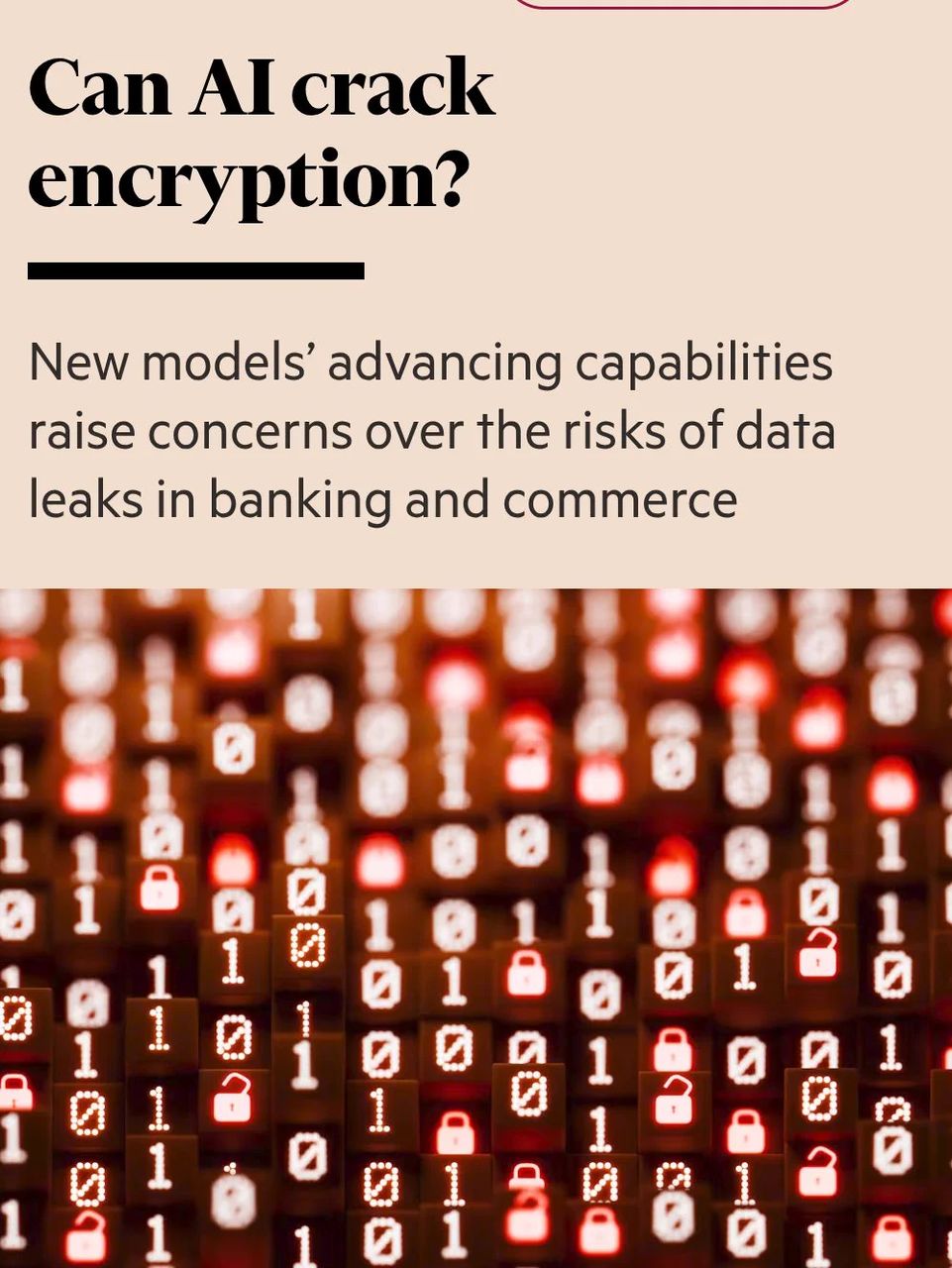
XA post on X by Rohan Paul (@rohanpaul_ai) shares an image styled as a Financial Times headline card: the serif headline 'Can AI crack encryption?', a subhead about new models raising concerns over data leaks in banking and commerce, and a stock photo of red-lit keyboard keys with padlock and binary symbols. The caption summarises the FT story, quotes Scott Aaronson's 'virtually certain' line, and begins a statistic about EU banks but cuts off mid-sentence.
“FT published a piece. AI-driven mathematics may threaten RSA encryption before quantum computers do, experts now warn. ex-OpenAI researcher Scott Aaronson this week has said he is "virtually certain" AI labs are hiding encryption-relevant math breakthroughs. Only 8% of 85 EU banks surveyed have a…”
Posted on X by the account @rohanpaul_ai on 27 November 2026, two days after Aaronson's blog post and alongside the FT's reporting. The caption is truncated at the point where the bank statistic begins.
Who posted it
XAccount check
Estimates from public signals — account age, posting pattern, audience — not a judgement of the person behind the account, and separate from whether this post is true.
What stood out
- Account belongs to a real, publicly documented person: Rohan Paul, Bengaluru-based AI engineer and founder/writer of Rohan's Bytes, with cross-linked GitHub, LinkedIn and newsletter identities.
- Mainstream coverage exists (Economic Times, DNA India, Hindustan Times) and notable followers reportedly include Jeff Bezos and Sundar Pichai, supporting genuine reach.
- Content is overwhelmingly paper summaries and AI industry commentary; sourcing is usually attributed to arXiv papers, company blogs or named outlets.
- High-volume, highly formatted thread posting is consistent with professional curation but also with AI-assisted drafting; no direct evidence of full automation.
- One documented framing problem: an August 2026 newsletter headline overstated an 'Astra reached critical capability' claim that the body described only as 'cannot rule out'.
- Has amplified viral/unverified speculation (e.g. the RSA/Aaronson rumor) but generally frames it as rumor and attributes it.
- Carries labelled commercial sponsorships in the newsletter; this is disclosed rather than covert, though it creates incentive for promotional framing.
- No fact-checker debunking or platform manipulation findings surfaced; classification is 'real but mixed-reliability AI commentator', not a bot network.
Signals (10)+
- Identity evidence
- Strong: GitHub, LinkedIn, personal site and newsletter cross-links
- Follower count estimate
- 154000
- Follower ratio
- Unknown
- Posting cadence
- Very high, near-hourly AI news/paper threads
- Mainstream news coverage
- Economic Times, DNA India, Hindustan Times
- Notable followers
- Jeff Bezos, Sundar Pichai (reported)
- Fact check history
- No major debunk found; one overconfident headline vs body discrepancy
- Commercial activity
- Labelled newsletter sponsorships
- Content style
- Curated summaries, occasional sensational framing, AI-assisted style possible
- Coordination evidence
- None found
Account checked November 28, 2026, 02:53 UTC
The media
Image✓ What is genuine
The underlying FT analysis is real and was published in late November 2026; the headline card reflects its subject. The image is ordinary editorial presentation, not a fabricated composite.
The tells
- ●●○ Supporting signal The headline 'Can AI crack encryption?' and subhead about new models' capabilities raising concerns over data leaks in banking and commerce match the FT analysis that multiple outlets summarised.our visual review
- ●●○ Supporting signal The artwork is ordinary editorial stock imagery: red-lit keycaps with padlock and binary symbols, the kind of stock photo newspapers use for security stories.our visual review
- ●●○ Supporting signal No compositing, impossible physics or synthetic artefacts were found in the image during visual review.our visual review
Synthetic-media detector
Detector not consultedThe media is incidental to the claim; the detector was not needed.
How we checked the media
- Compared the image's headline and subhead against independent reporting of the FT analysis to see whether the wording matched a real story.
- Visually reviewed the artwork for compositing, impossible physics or synthetic artefacts that would suggest AI generation.
Sources
11 sources reviewed- 1Has AI just cracked Internet encryption? Rumoured 'bombshell' stuns scientists ↗
Nature · nature.comPrimary / fact-checkerpeer-reviewed — confirm not a comment/letterEvidence
Quotes Aaronson's 'virtually certain' blog statement and reports the rumour's impact.
- 2Scott Aaronson says AI labs are sitting on cryptography 'bombshells' ↗
The Next Web · thenextweb.comUntiereduntiered — treated as signal only, never decisiveEvidence
Quotes Aaronson's caveats, including 'a rumor is a rumor' and his uncertainty about specifics.
- 3AI labs likely sitting on cryptography 'bombshells,' computer scientist says ↗
CoinMarketCap (Cointelegraph syndication) · coinmarketcap.comUntiereduntiered — treated as signal only, never decisiveEvidence
Reports Aaronson saying AI labs likely sit on cryptography 'bombshells'.
- 4AI Advances Raise Questions Over Future Security Of Encryption After OpenAI's Mathematical Breakthroughs ↗
NDTV Profit · ndtvprofit.comUntiereduntiered — treated as signal only, never decisiveEvidence
Reports the FT story and that regulators are urging firms to assess encryption systems.
- 5La IA amenaza con romper las claves de la seguridad digital ↗
Expansión (Financial Times syndication) · expansion.comUntiereduntiered — treated as signal only, never decisiveEvidence
FT-syndicated coverage describing AI advances threatening cryptographic tools.
- 6英倫銀行罕有敲警鐘:AI數學能力飈升恐破解加密系統 首促銀行提前升級 ↗
Hong Kong Economic Times · inews.hket.comUntiereduntiered — treated as signal only, never decisiveEvidence
Repeats the 'virtually certain' quote in Chinese translation.
- 7Have leading AI firms secretly broken internet encryption? ↗
The Independent · independent.co.ukReputable outletLean LeftEvidence
Confirms the rumours centre on RSA and that no breakthrough has been officially confirmed.
- 8Passwords and bank accounts under threat as AI conquers maths ↗
Yahoo Tech · tech.yahoo.comUntiereduntiered — treated as signal only, never decisiveEvidence
Quotes Aaronson and notes no public signs of major encryption breakthroughs.
- 9欧洲银行管理局调查85家银行PQC准备度,资产清单与供应商信息仍是主要缺口 ↗
Yibiao · wangyibiao.comUntiereduntiered — treated as signal only, never decisiveEvidence
Details the EBA's 85-bank survey and the 8% operational roadmap figure.
- 10EBA, EIOPA and ESMA's Autumn 2026 Risk Update on quantum and cryptography ↗
Quentir · quentir.aiUntiereduntiered — treated as signal only, never decisiveContext
Describes the EU joint risk update warning quantum threats could arrive earlier than expected.
- 11Bank of England warnt: KI könnte die Verschlüsselung Ihres Geldes schneller knacken als gedacht ↗
BW24 · bw24.deUntiereduntiered — treated as signal only, never decisiveEvidence
German-language coverage repeating the Aaronson quote and the Bank of England warning.
Further reading
- 1Nature Nature's report quotes Aaronson directly and captures the 'stunned scientists' reaction to the rumour.
- 2The Next Web The Next Web carries Aaronson's own caveats alongside the 'bombshells' quote, which the post leaves out.
- 7The Independent The Independent explains why no breakthrough has been confirmed and what 'cryptographic agility' means.
- 9Yibiao Breaks down the EBA's 85-bank survey behind the 8% figure.
The full story
The claim built on a real shift in how cryptographers and regulators were talking in late November 2026. The Financial Times reported that rapid AI progress in mathematics had led regulators and experts to reassess the old assumption that quantum computing was the main long-term threat to encryption such as RSA. The Bank of England's Financial Stability Report asked firms to prioritise migration to quantum-resistant cryptography, and Governor Andrew Bailey said AI developers were right to be cautious about releasing frontier models.
The story gained a second jolt from Scott Aaronson, a computer scientist and former OpenAI researcher. On 25 November 2026 he wrote on his blog that he was 'virtually certain, from multiple reliable sources, that the AI labs are now sitting on one or more bombshells in that area'. That sentence travelled fast. But Aaronson also said he was 'much, much less confident' about what those results actually were, later struck out the blog comment that had started the rumour, and stressed that 'a rumor is a rumor'. Nature and other outlets were careful to note that no break of a deployed cryptosystem had been publicly demonstrated.
The third strand was readiness. The European Banking Authority's autumn 2026 survey of 85 banks found only a small share with a working roadmap for migrating to post-quantum cryptography. That figure is real, and it is the part of the post that most directly concerns ordinary bank customers.
Kernel of truth
The FT did publish the analysis, Aaronson did use the words 'virtually certain', and the EU bank readiness figure is real. What the post omits is that no encryption has actually been broken and that Aaronson himself called the specifics unverified rumour.
Timeline
September 23, 2026
EU supervisory authorities publish their autumn 2026 joint risk update, warning that quantum threats to cryptography could arrive earlier than expected. 10Quentir
November 25, 2026
Scott Aaronson writes on his blog that he is 'virtually certain' AI labs hold cryptography 'bombshells', while stressing he is much less confident about the specifics. 1Nature
November 26, 2026
The Financial Times publishes its analysis on AI and encryption risk, quoting Bank of England Governor Andrew Bailey and professor Daniel Shiu. 4NDTV Profit
November 27, 2026
Rohan Paul (@rohanpaul_ai) posts the FT headline card and summary on X.
How it was framed
The post accurately summarises a genuinely published FT analysis and a directly quoted blog statement, and the bank statistic matches the EBA survey. It fits the 'accurate' category because the core factual claims hold, though the post omits important caveats about what has and has not been demonstrated.
- Missing context. The caption says Aaronson is 'virtually certain' AI labs are hiding breakthroughs but leaves out his own caveat that he is 'much, much less confident' about the specifics and that 'a rumor is a rumor'.
- Borrowed authority. The post leans on the Financial Times brand via the headline card and on Aaronson's 'ex-OpenAI researcher' title.
- “Visual proof”. The FT-styled headline card presents the story as settled editorial fact before the reader reaches any caveat.
Posted on X by the account @rohanpaul_ai on 27 November 2026. The account presents itself as an AI commentary account; the post shares a Financial Times headline card and a summary of the FT story and Aaronson's blog post.
Bias
Leans AI-risk / tech-alarmism framing. The post aggregates genuine FT reporting and a genuine EBA statistic, but selects the most alarming elements: an unconfirmed rumour, the word 'hiding', and an 8% readiness figure, while the caveat that no deployed encryption has been broken and that Aaronson walked back the specifics appears only in a later post in the thread.
Bias describes how the post frames its message — the slant of the language, selection and emphasis — and is judged separately from whether the claim is true. A true claim can still be framed with a strong slant.
How we checked
1 min 1 s- 1
Searched for the Financial Times headline and the claim that AI mathematics could threaten RSA encryption.
- 2
Searched for Scott Aaronson's 'virtually certain' statement and compared the wording across outlets.
- 3
Searched for the FT story's named figures, including Bank of England Governor Andrew Bailey and professor Daniel Shiu.
- 4
Searched for the '8% of 85 banks' figure and the European Banking Authority's autumn 2026 survey.
- 5
Compared the image's headline and subhead with independent reporting to check whether it matched a real FT story.
- 6
Visually reviewed the image for signs of compositing or synthetic generation.
✓ Claim checked✓ Media checked✓ Sources checked
Why 78% confidence
HighWe set confidence HIGH on the central claim and the Aaronson quote because multiple independent outlets report the same FT analysis and quote the same blog sentence. We did not open the original ft.com page because it blocks automated access, which is why the FT claim is LIKELY_TRUE rather than TRUE. The bank statistic is MODERATE because the underlying survey is official but the 85-bank breakdown comes mainly through secondary summaries.
Limits. We could not open the original Financial Times article, and we did not run an AI-generation detector on the image because the claim does not depend on the image being real. We also could not open the primary EBA survey table directly.
What we don’t know
- What, if anything, the AI labs are actually holding — Aaronson said he did not know the specifics either.
- Whether any undisclosed result would apply to RSA or to another cryptosystem.
- The exact wording and full text of the FT article as published on ft.com.
- The precise publication time of the X post, which is known only from aggregator mirrors.
Spot it yourself
Find the overstatementLooks suspicious, isn’t proof
- The headline card looks like a real Financial Times page, and a screenshot of a newspaper can be faked — but a polished look alone doesn't tell you whether the story is real.
- The caption uses dramatic words like 'threaten' and 'hiding', which can make a post feel alarmist — tone is a reason to check, not evidence of falsity.
- The caption cuts off mid-sentence at 'Only 8% of 85 EU banks surveyed have a…', which looks sloppy but says nothing about whether the underlying numbers are right.
The actual evidence
- Independent outlets including Nature, The Independent, NDTV Profit and Expansión reported the same FT analysis, quoting named figures such as Andrew Bailey and Daniel Shiu.
- Aaronson's blog post contains the exact 'virtually certain' sentence, confirmed by Nature, The Next Web and Cointelegraph.
- Aaronson's own post also contains the caveats the caption leaves out: he was 'much, much less confident' about the specifics and called it a rumour.
- No AI lab has published anything showing a break of RSA or any deployed cryptosystem, as Nature and The Independent noted.
- 1
Check whether the quoted person actually said it, in full.
Search the exact phrase in quotation marks. Then find the original blog or interview and read the sentences around it — caveats often sit right next to the dramatic line.
- 2
Ask who else is reporting the same story.
If a major outlet like the FT published it, several independent outlets will have covered it. If only social reposts appear, treat it as unconfirmed.
- 3
Separate 'a risk has been identified' from 'it has happened'.
Look for the words 'could', 'may' and 'warn'. Those signal a forecast, not a confirmed event. A real break of encryption would be a named, demonstrated result.
- 4
Trace statistics back to the organisation that produced them.
The '8% of 85 banks' figure comes from an EBA survey. Find the survey or reporting on it, and check what exactly the 8% measures — a roadmap, not a breach.
Takeaway
A post can quote real words and real numbers and still mislead by leaving out the sentence that follows. When a quote sounds dramatic, read the next paragraph before you share it.
Questions people ask
Did the Financial Times really publish a piece about AI cracking encryption?+
Yes. The FT ran an analysis in late November 2026 on whether AI-driven mathematics could threaten encryption like RSA before quantum computers. Several outlets, including NDTV Profit, Expansión, The Independent and the Hong Kong Economic Times, reported or syndicated the same story, quoting Bank of England Governor Andrew Bailey and professor Daniel Shiu.
Did Scott Aaronson say AI labs are hiding encryption breakthroughs?+
He wrote that he was 'virtually certain, from multiple reliable sources, that the AI labs are now sitting on one or more bombshells in that area'. But he also said he was 'much, much less confident' about what those results are, later struck out the comment that started the rumour, and stressed that a rumour is a rumour.
Has any encryption actually been broken by AI?+
No publicly demonstrated break of RSA or any deployed cryptosystem has been reported. Nature and The Independent both describe the RSA claim as unverified rumour. The FT story is about risk and readiness, not about a confirmed break.
What is the '8% of 85 banks' figure about?+
It comes from a European Banking Authority survey of 85 banks on readiness for post-quantum cryptography. Reporting on it says 8% had an operational migration roadmap and 9% an approved one. It measures planning, not whether any bank has been compromised.
Why does it matter if banks are not ready for quantum-resistant encryption?+
The concern is that encrypted data captured today could be stored and decrypted later if a powerful enough method emerges. The Bank of England's Financial Stability Report asked firms to prioritise migration to quantum-resistant cryptography, which is why regulators are pressing banks to plan ahead even before any break is demonstrated.
Go deeper
- RSA encryption
- A widely used method of protecting digital data that relies on the difficulty of factoring very large numbers.
- Quantum-resistant cryptography
- Encryption methods designed to stay secure even against future quantum computers.
- Post-quantum readiness
- How prepared an organisation is to switch to encryption that can withstand quantum and advanced AI attacks.
- Cryptographic agility
- The ability of a system to swap out its encryption methods quickly when old ones become unsafe.
People also search for
For educators+
- The post quotes Aaronson accurately but leaves out his caveat. Does that make the post misleading, or is it fair to summarise a long blog post briefly? Where would you draw the line?
- Why might a dramatic claim about encryption spread faster than the careful caveat that follows it? What incentives shape what gets shared?
- If you were editing this post, what one sentence would you add to make it more accurate without making it boring?
About this check
- Platform
- X
- Posted by
- @rohanpaul_ai
- Posted
- November 27, 2026
- Age when checked
- Under 24 hours old when checked
- Where it spread
- United States, Global
- Audience
- International audience
- Language
- EN
- Status
- ● Post is live
- Verified
- November 28, 2026, 02:55 UTC
- Published
- November 28, 2026, 02:55 UTC
Reach. FT piece plus wave of crypto/tech coverage 26-27 Nov (Cybernews, BeInCrypto, ForkLog, CryptoPotato, Crypto Briefing, The Defiant, BitKE, Homeland411); Scott Aaronson quoted as 'virtually certain' labs hold cryptography 'bombshells'
This verdict was generated with AI from the sources shown. AI can make mistakes — check the sources before relying on it.
Check anything yourself, in seconds.
Share any social post or video to What the Fact and get the verdict, the confidence, and the receipts.