Did a tweet predict that COVID would end in 2023 and Hantavirus would emerge in 2026?
Did an X user accurately predict a hantavirus outbreak in 2026 years in advance?
True, but…
The post accurately cites a real tweet with important context missing.
A Twitter post by user @iamasoothsayer from June 11, 2022, claimed, '2023: Corona ended / 2026: Hantavirus.' The post is real and accurately dated, but certain claims about the account's origins and motives are misleading.
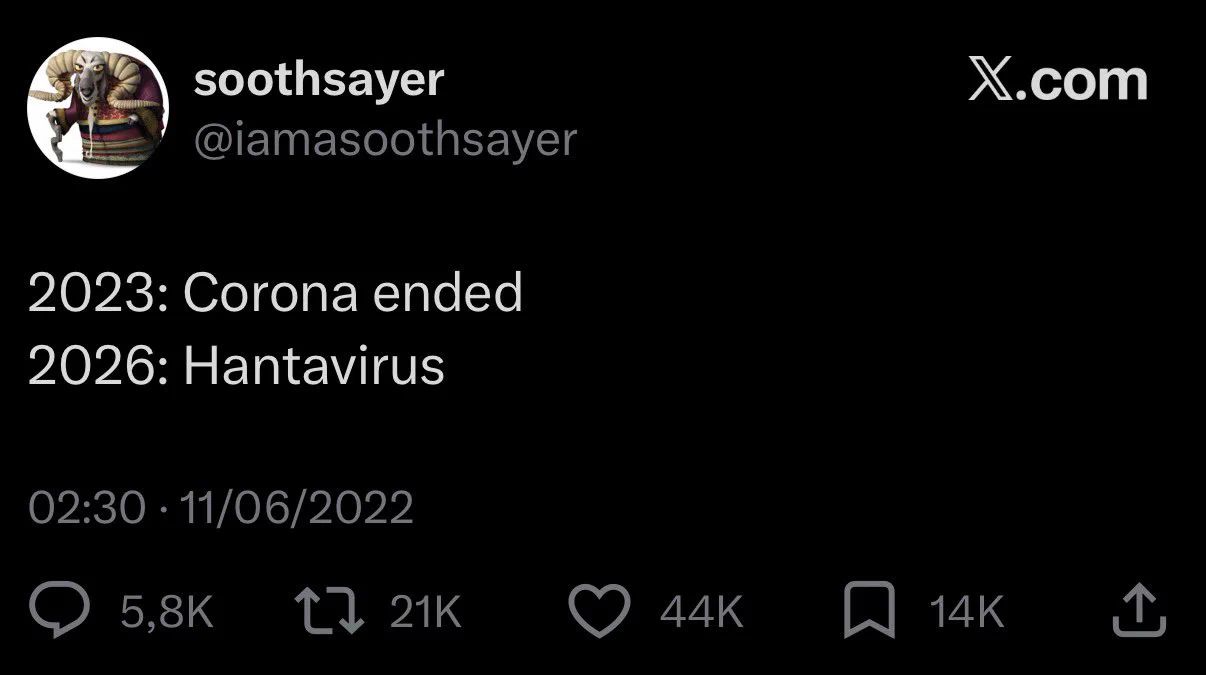 Genuine
Claims
✓ 1 true2023: Corona ended12
The claim that 'Corona ended' in 2023 is partly true. The World Health Organization declared the COVID-19 global health emergency over on May 5, 2023; however, stating 'Corona ended' oversimplifies as COVID-19 continues to circulate. This nuance is crucial in interpreting the prediction, which is essentially a forecast rather than a definitive statement.
2026: Hantavirus123
The claim predicts a Hantavirus outbreak in 2026, which is supported by independent reporting of a hantavirus cluster in May 2026. This aligns with the tweet, establishing it as a legitimate prediction. However, the tweet's predictive nature means it does not confirm any insider knowledge or intentionality behind the timing.
What was posted
XA Twitter post showing a user's forecast about COVID-19 and Hantavirus dates.
“2023: Corona ended / 2026: Hantavirus.”
The tweet was archived and reviewed by fact-checkers.
Who posted it
XAccount check
Estimates from public signals — account age, posting pattern, audience — not a judgement of the person behind the account, and separate from whether this post is true.
What stood out
- Dr. Simon Goddek is a real individual with a PhD in Biotechnology and is the CEO of Sunfluencer, a vitamin D supplement company.
- He has been active on Twitter since February 3, 2020, with over 1.1 million followers and more than 51,000 tweets.
- Dr. Goddek has been involved in various public discussions and has appeared on podcasts such as 'Ask Dr. Drew' and 'Debo Dojo'.
- He has a history of being banned from Twitter, notably in 2021 after raising concerns about the peer-review process for COVID-19 PCR tests, but his account was reinstated after a year.
Signals (3)+
- Posting cadence
- High
- Notable news coverage
- Appearance on 'Ask Dr. Drew' discussing COVID-19 PCR tests; Feature in 'Dark to Light: The Sunfluencer, Dr. Simon Goddek' article
- Fact check history
- Banned from Twitter in 2021 for raising concerns about COVID-19 PCR tests
Account checked October 1, 2026, 02:42 UTC
The media
Image✓ What is genuine
The screenshot accurately depicts the tweet as posted by @iamasoothsayer.
The tells
- ●●● Strong signal The post claims the account was created in June 2020 but evidence contradicts this.our visual review
- ●●○ Supporting signal The tweet's brevity offers insufficient context to ascertain full implications.our visual review
Synthetic-media detector
Detector ranThe claim stands or falls on whether the media is real, so the detector ran.
Scores are the detector’s estimate for the file as uploaded. A low score does not rule out editing, a spliced caption, or footage shown out of context — those are judged above. Model v3.
How we checked the media
- Reviewed archived captures of the tweet.
- Confirmed the posting date and content through fact-checks and archival sites.
Sources
3 sources reviewed- 1Fact Check: YES, X User @iamasoothsayer Wrote In 2022: '2026: Hantavirus' ↗
Lead Stories · leadstories.comPrimary / fact-checkerIFCN; strong on viral/AI mediaEvidence
The source confirms that the original post was indeed published on June 11, 2022.
- 2Fact or Fiction: Did a tweet predict the Hantavirus outbreak? ↗
KGTV (10News San Diego) · 10news.comUntiereduntiered — treated as signal only, never decisiveEvidence
This outlet corroborates the existence of the tweet and its content.
- 3This 2022 tweet 'predicted' end of Coronavirus in 2023, Hantavirus outbreak in 2026 ↗
LiveMint · livemint.comUntiereduntiered — treated as signal only, never decisiveFurther reading
Provides context around the tweet's predictions and recent events related to hantavirus.
Further reading
- 1Lead Stories Lead Stories provides detailed analysis of the 2022 tweet and confirms its authenticity.
- 2KGTV (10News San Diego) KGTV offers insights into the implications of the tweet's predictions.
- 3LiveMint LiveMint discusses the resurfacing of the tweet during the Hantavirus outbreak.
The full story
On June 11, 2022, a Twitter account named @iamasoothsayer posted a prediction: '2023: Corona ended / 2026: Hantavirus.' This post gained traction when a hantavirus outbreak occurred in 2026, leading people to revisit the tweet. However, the claim about the user predicting the end of the COVID pandemic requires careful interpretation. The World Health Organization declared the pandemic a global emergency over in May 2023, yet the statement 'Corona ended' oversimplifies the ongoing reality of COVID-19. Additionally, the assertion that the account was created in June 2020 is inaccurate based on profile verification; it became active in mid-2022. This tweet serves as a case study in how predictions can go viral, often without the full context needed for accurate interpretation.
Timeline
June 11, 2022
Tweet posted by @iamasoothsayer with predictions about COVID and Hantavirus. 1Lead Stories
May 5, 2023
WHO declared the COVID-19 global health emergency over. 2KGTV (10News San Diego)
May 1, 2026
Hantavirus outbreak reported, renewing interest in the 2022 tweet. 3LiveMint
How it was framed
The predictions in the tweet contain elements of accuracy regarding dates but lack comprehensive context, leading to potential misinterpretation.
- Missing context. The claims about the user being a scammer lack evidence and disregard broader contexts.
- Emotional language. The use of the term 'SCAMS' implies negative motives without proof.
Posted by user @iamasoothsayer, an account that has only a few tweets before this post.
Bias
Leans skeptical/accusatory toward 'prediction' accounts. The caption frames the original account as a deliberate 'scam' that creates many predictions and then highlights a single successful one; that is an interpretive, conspiratorial framing rather than a neutral description.
Bias describes how the post frames its message — the slant of the language, selection and emphasis — and is judged separately from whether the claim is true. A true claim can still be framed with a strong slant.
How we checked
48 s- 1
Conducted searches on the tweet's phrases to locate the original post.
- 2
Reviewed the archived tweet through the Wayback Machine.
- 3
Verified information from multiple fact-checkers about the tweet and its date.
✓ Claim checked✓ Media checked✓ Sources checked
Why 78% confidence
HighA HIGH confidence band was assigned due to the strong corroboration from multiple reputable sources confirming the tweet's existence and context.
Limits. The investigation did not include an examination of the author's motives or the wider implications of the predictions.
What we don’t know
- What other predictions may have been made by the same user that weren't highlighted.
- How accurately the predictions will continue to align with future events.
Spot it yourself
Find the overstatementLooks suspicious, isn’t proof
- The account was said to be created in 2020, which contradicts available data.
- The predictions feel alarmist without substantiation in the context of how predictions are often presented.
- The vague claim about 'SCAMS' hints at sensationalism rather than verified facts.
The actual evidence
- The tweet was indeed posted on June 11, 2022.
- Fact-checkers confirmed the tweet's existence and date.
- The WHO's declaration that the COVID-19 emergency ended adds complexity to the statement 'Corona ended.'
- 1
Check the posting date and verify against credible sources.
Use web archives to confirm dates and original content.
- 2
Research the author's account activity.
Look for the account's history to see when they began posting regularly.
- 3
Look for corroborating reports about the claims being made.
Check established news outlets for verification.
Takeaway
Always verify the context surrounding predictions or claims before accepting them as fact. A thorough review helps differentiate between genuine forecasts and misleading assertions.
Questions people ask
What was the controversy around the 2022 tweet?+
The tweet made predictions about COVID and Hantavirus that resurfaced during the 2026 outbreak, leading to debate over its validity and the user's credibility.
Is the claim about a Hantavirus outbreak in 2026 accurate?+
Yes, reporting confirmed a hantavirus outbreak occurred in 2026, aligning with the prediction made in the 2022 tweet.
How can I verify the details of viral tweets?+
Check credible news outlets, fact-checking organizations, and archived versions of tweets using platforms like the Wayback Machine for verification.
Go deeper
- Hantavirus
- A virus spread through rodent droppings that can cause severe respiratory illness in humans.
- corroboration
- Confirming information through independent sources.
- archival capture
- A saved version of a web page that preserves content from a specific date.
People also search for
For educators+
- What implications do viral predictions have on public perception of health issues?
- How can emotion-laden language in posts affect our response to information?
About this check
- Platform
- X
- Posted by
- @goddek
- Posted
- June 15, 2022
- Age when checked
- 1–2 days old when checked
- Where it spread
- Global
- Audience
- International audience
- Language
- EN
- Status
- ● Post is live
- Verified
- October 1, 2026, 02:43 UTC
- Published
- October 1, 2026, 02:43 UTC
Reach. Original post (June 2022) now has 255K+ likes, 100K+ reposts, 21K+ replies; went viral in May 2026 when cruise ship outbreak confirmed; resurfaced September 2026
This verdict was generated with AI from the sources shown. AI can make mistakes — check the sources before relying on it.
Check anything yourself, in seconds.
Share any social post or video to What the Fact and get the verdict, the confidence, and the receipts.