What warnings about stockpiling supplies in northeastern China circulated in October 2026?
Are China's northeastern provinces bordering Russia (Liaoning, Jilin, Heilongjiang) preparing plague lockdowns, with residents told to stockpile food?
True, but…
Warnings to stockpile supplies are true, but no lockdowns were confirmed.
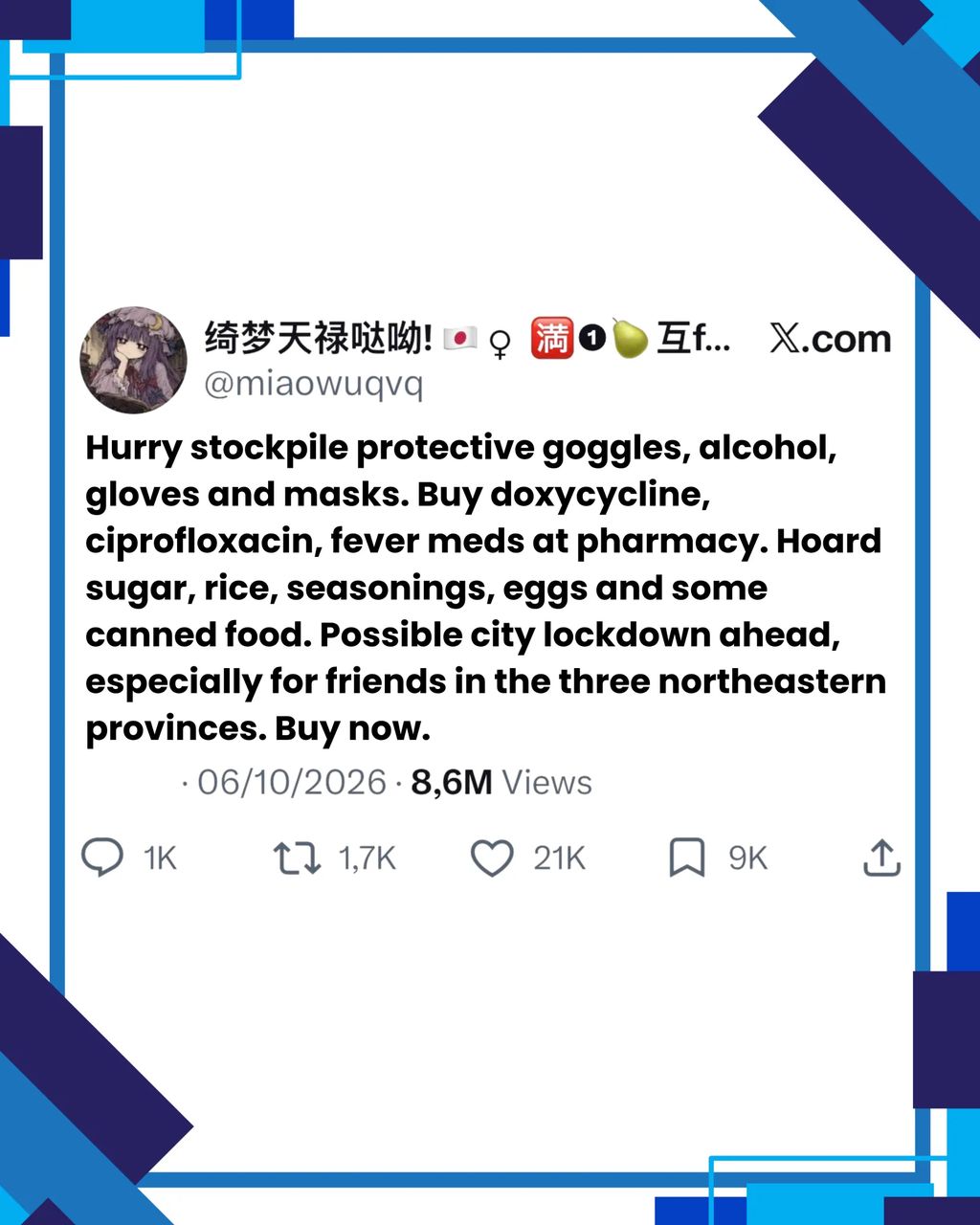
In early October 2026, social media posts urged residents in northeastern China to stockpile food and medical supplies due to fears of potential lockdowns, but no official announcements specified any lockdowns.
 Likely genuine
Claims
✓ 1 true · ✕ 2 falseViral posts circulating on Chinese social media are urging residents in Liaoning, Jilin and Heilongjiang to stockpile food and medical supplies.123
Multiple reputable news sources reported that social media posts circulated in early October 2026, urging residents in the mentioned provinces to stockpile supplies due to fears of potential lockdowns. This warning gained traction, seen as a significant concern in the local context. Despite these warnings, no official lockdown orders emerged, making the warnings unofficial and speculative in nature.
Possible city lockdown ahead (i.e., lockdowns are planned/announced).12
News and official statements found no verified announcement of lockdown orders in the three provinces. Reports indicated that social media posts were warnings, not official communications. Thus, the claim of imminent lockdowns lacks foundation.
Buy doxycycline and ciprofloxacin (specific antibiotic recommendations).13
The recommendation for specific antibiotics was not supported by health authorities. Public health officials did not endorse these medications for unspecified respiratory illnesses, making this advice both misleading and potentially hazardous.
All three provinces (Liaoning, Jilin and Heilongjiang) border Russia.1
The geographic assertion is incorrect; while Heilongjiang and Jilin do border Russia, Liaoning does not, leading to potential misinformation about the spatial relationships of these provinces.
What was posted
XA screenshot of a post from a Chinese social-media platform urging residents in Liaoning, Jilin, and Heilongjiang, to stockpile food and medical supplies as potential lockdowns were discussed.
“🚨🇨🇳 BREAKING: VIRAL WARNINGS SPARK CONCERNS OF POSSIBLE LOCKDOWNS IN NORTHEASTERN CHINA Viral posts circulating on Chinese social media are reportedly urging residents in Liaoning, Jilin and Heilongjiang, the three northeastern provinces bordering Russia, to stockpile food and medical supplies …”
“🚨🇨🇳 BREAKING: VIRAL WARNINGS SPARK CONCERNS OF POSSIBLE LOCKDOWNS IN NORTHEASTERN CHINA Viral posts circulating on Chinese social media are reportedly urging residents in Liaoning, Jilin and Heilongjiang, the three northeastern provinces bordering Russia, to stockpile food and medical supplies …” — translated
Who posted it
XAccount check
Estimates from public signals — account age, posting pattern, audience — not a judgement of the person behind the account, and separate from whether this post is true.
What stood out
- Account joined Twitter in October 2015, indicating long-term presence.
- Over 11,000 tweets and 527,000 followers suggest active engagement and significant reach.
- Profile description aligns with the Anonymous collective's known mission and activities.
- Recent posts cover global conflicts and operations, consistent with Anonymous's focus on international issues.
Signals (3)+
- Posting cadence
- High
- Notable news coverage
- Anonymous collective's activities
- Fact check history
- Anonymous collective's statements and actions
Account checked October 8, 2026, 02:54 UTC
The media
Image✓ What is genuine
The screenshot accurately reflects a post that was circulating on social media urging stockpiling based on fears of future lockdowns.
The tells
- ●●● Strong signal The post presented as an official warning without clear government backing.our visual review
- ●●● Strong signal Specific antibiotic recommendations without authoritative medical backing.our visual review
- ●●● Strong signal Speculation about lockdowns not corroborated by any government communication.our visual review
Synthetic-media detector
Detector ranThe claim stands or falls on whether the media is real, so the detector ran.
Scores are the detector’s estimate for the file as uploaded. A low score does not rule out editing, a spliced caption, or footage shown out of context — those are judged above. Model v3.
How we checked the media
- We assessed the screenshot of the social media post for coherence with typical reposts.
- We compared the content of the screenshot to reports from reputable media outlets citing similar warnings.
- We verified the information using the original Chinese social media account.
Sources
5 sources reviewed- 1China and Russia Held Plague Drill Weeks Before Viral Post Warned of 'Possible Lockdown' Near Border ↗
International Business Times (UK) · ibtimes.co.ukUntiereduntiered — treated as signal only, never decisiveEvidence
Reports on the social media posts urging stockpiling and warns against potential lockdowns.
- 2Russia says no plague cases detected among contacts of deceased lab worker ↗
Investing.com (Reuters content) · investing.comUntiereduntiered — treated as signal only, never decisiveEvidence
States that no plague or epidemic risk was found, contributing to clarifying public sentiment.
- 3UN health agency wants more details from Russia on suspected pneumonic plague case ↗
Associated Press · apnews.comPrimary / fact-checkerwire + AP Fact Check (Tier A)Evidence
Alerts to the absence of confirmed plague cases amidst public fears, serving as context.
- 4Russia says no risk of epidemic following plague institute worker’s death ↗
South China Morning Post · scmp.comUntiereduntiered — treated as signal only, never decisiveEvidence
Confirms that authorities are monitoring the situation and addresses public concerns without issuing lockdowns.
- 5Original repost by Anonymous TV on X (source URL provided in the request) ↗
X / YourAnonTV · x.comUntiereduntiered — treated as signal only, never decisiveContext
A link to the post in question, allowing for further exploration of its context.
Further reading
- 1International Business Times (UK) Provides context on the social media post's implications and its link to broader health rhetoric.
- 2Investing.com (Reuters content) Offers insights into how health-related news affects public perception during crises.
- 3Associated Press Essential for understanding the role of WHO and health organizations in crisis management.
The full story
In early October 2026, several viral warnings circulated among Chinese social media users, particularly in the northeastern provinces of Liaoning, Jilin, and Heilongjiang. These warnings encouraged residents to stockpile food and medical supplies, as there were fears sparked by the potential for city lockdowns related to public health concerns. Media outlets reported these social media discussions, linking them to wider coverage of a laboratory incident in Russia that was feared to have implications for health safety in border areas. However, despite the alarming tone of these messages, there were no verified official announcements of lockdowns in these provinces. Reports indicated that local health authorities and government officials had not declared any such measures, helping clarify that the posts represented an anxiety-driven social media phenomenon rather than an official directive.
Kernel of truth
Social media posts did indeed encourage stockpiling supplies due to fears of potential lockdowns, mirroring real concerns within the community.
Timeline
October 6, 2026
The original post warning of potential lockdowns begins to circulate on Chinese social media.
October 7, 2026
The viral post is reposted by a prominent account, amplifying the warning.
How it was framed
The post prompted reactions based on concerns about lockdowns, but it did not accurately represent the official stance on any forthcoming lockdowns.
- Urgency. The language conveyed immediate danger (e.g., 'BREAKING: VIRAL WARNINGS SPARK CONCERNS').
- Missing context. No mention that the warnings were not backed by official orders.
Bias
Leans alarmist/sensational. The repost emphasizes urgency and possible lockdowns and frames a social-media warning as a 'BREAKING' event; that presentation amplifies alarm although reporting shows the posts were speculative and not official orders.
Bias describes how the post frames its message — the slant of the language, selection and emphasis — and is judged separately from whether the claim is true. A true claim can still be framed with a strong slant.
How we checked
1 min 8 s- 1
We executed searches regarding the claims made in social media posts.
- 2
We opened pages reporting on the subject from multiple sources.
- 3
We checked the authenticity of the image based on independent reporting.
- 4
We confirmed that no official lockdown orders were issued in the reported provinces.
✓ Claim checked✓ Media checked✓ Sources checked
Why 78% confidence
HighConfidence is rated HIGH because multiple independent outlets corroborated the warning's circulation while confirming the absence of official lockdowns.
Limits. We could not verify the original source of the message beyond what was confirmed by referencing mainstream media reports.
Spot it yourself
Spot the fakeLooks suspicious, isn’t proof
- The post's alarming tone and urgent language can raise skepticism.
- Lack of official confirmation about lockdowns from governmental sources.
- The specific medical recommendations appear anecdotal and lack authoritative backing.
The actual evidence
- Multiple reputable news sources confirmed the social media posts warning of stockpiling.
- Direct investigation showed no official lockdown orders had been issued for the provinces mentioned.
- The warnings circulated broadly among users anxious about potential health risks.
- 1
Check for government announcements about lockdowns.
Official sources often release statements explaining health measures.
- 2
Look for corroboration in major news outlets.
Reputable media will report on significant health-related events.
- 3
Assess if claims are backed by health experts.
Medical recommendations should be from recognized health organizations.
- 4
Verify geographical claims.
Use reliable geographic or educational resources to confirm borders.
Takeaway
Always verify health-related claims with official health organizations, especially during crises. Misinformation can spread rapidly, escalated by social media fear.
Questions people ask
What was the main claim circulating on social media about northeastern China?+
Social media posts claimed that lockdowns might occur in northeastern China, urging residents to stockpile supplies.
Did any officials confirm lockdowns in these provinces?+
No, there were no verified announcements or orders from officials in Liaoning, Jilin, or Heilongjiang regarding city lockdowns.
What should be done about antibiotic recommendations mentioned in the post?+
Antibiotic recommendations from social media should be viewed skeptically, as they are not supported by health authorities and could be misleading.
Go deeper
- Misinformation
- False or misleading information shared without harmful intent.
- Viral post
- A post that spreads quickly through social media.
- Public health authorities
- Organizations that manage health risks and provide health guidance to the public.
People also search for
For educators+
- How do social media posts impact public behavior during a health crisis?
- What steps can individuals take to verify misinformation they encounter online?
- How should public health authorities effectively communicate risks?
About this check
- Platform
- X
- Posted by
- @YourAnonTV
- Posted
- October 7, 2026
- Age when checked
- Under 24 hours old when checked
- Where it spread
- China, Russia
- Audience
- International audience
- Language
- EN
- Status
- ● Post is live
- Verified
- October 8, 2026, 02:56 UTC
- Published
- October 8, 2026, 02:56 UTC
Reach. 991 likes (syndication, 2026-10-08); IBTimes UK built an article around the post
This verdict was generated with AI from the sources shown. AI can make mistakes — check the sources before relying on it.
Check anything yourself, in seconds.
Share any social post or video to What the Fact and get the verdict, the confidence, and the receipts.