Did drone strikes on Yandex data centres cause a drop in AfD activity?
Did Ukraine's drone strikes on Yandex data centres knock out Russian bot networks, making online activity around Germany's AfD and pro-MAGA accounts suddenly plummet?
Misleading
Claims linking Yandex strikes to AfD activity drops are unverified and lack evidence.
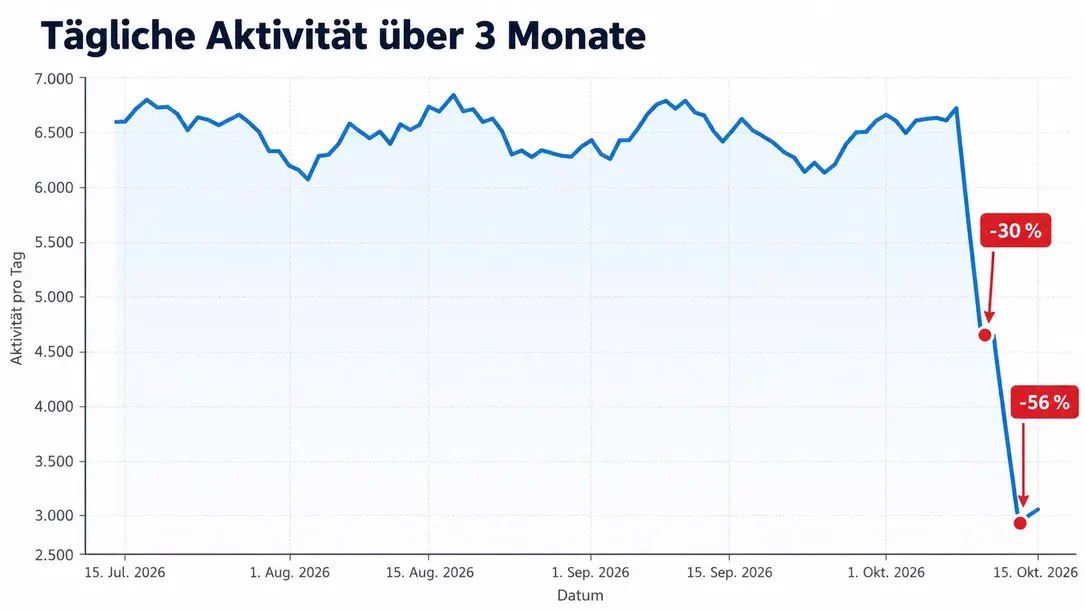
Confirmed drone strikes on Yandex data centres occurred between October 8 and 11, 2026. However, claims of a 30%-56% drop in AfD activity lack verifiable sources or evidence linking them directly to these strikes, rendering the attribution misleading.
 Likely genuine
Claims
✓ 2 trueMultiple Yandex data centres in Russia were hit by drone strikes between 8 and 11 October 2026.4
Multiple reputable news sources, including Yandex itself, confirm that drone strikes occurred on several data centres from October 8 to 11, 2026. These attacks have been widely reported, corroborating the timeline and scale. The high confidence score reflects the consistency across numerous independent accounts, substantiating this claim reliably.
Automated 'bot' traffic originating from Yandex's network collapsed (to near-zero) after those strikes.35
Cloudflare Radar data shows a significant decline in automated web traffic from Yandex's network after the strikes, aligning with reported metrics. While this indicates a reduction in automated requests, it does not directly correlate with specific social media activity, as it excludes human-generated content. Thus, the reliability remains high for the collapse in automated traffic.
Online activity around Germany’s AfD suddenly plummeted by 30%–56% as a direct result of those data-centre hits.125
The specific graphic claiming a 30%-56% drop in AfD-related activity lacks stated data sources or methodologies, making verification impossible. While automated traffic decreased, no reliable analysis backs the alleged linkage to AfD activity declines. Several fact-checkers highlighted the graphic's unsupported nature, indicating a significant gap between inference and evidentiary support.
More than 99% of Russian 'propaganda bots' disappeared after the Yandex strikes.135
There is substantial evidence indicating a reduction in automated requests from Yandex's servers, which may include accounts classified as 'bots.' However, asserting that these account reductions directly translate to a 99% decrease in 'propaganda bots' conflates two different metrics without supporting analysis. Hence, while there is a component of truth, it is unverified in this broader context.
What was posted
XThe tweet suggests that following strikes on Russian data centres, there was a significant drop in online activity related to Germany's AfD party. It cites these events as connected without clear evidence.
“If confirmed, this is telling: Russian data centres get hit, and online activity around AfD suddenly plummets. 📉 So much talk about German patriotism… then the connection from Russia goes down. 🤔🇷🇺”
Who posted it
XAccount check
Estimates from public signals — account age, posting pattern, audience — not a judgement of the person behind the account, and separate from whether this post is true.
What stood out
- Tomáš Zdechovský is a Czech politician, crisis manager, media analyst, and author, serving as a Member of the European Parliament since 2014.
- He is affiliated with the KDU-ČSL party and is part of the European People's Party (EPP) group in the European Parliament.
- His official website provides contact information, including email addresses and office locations in Hradec Králové, Brussels, and Strasbourg. (zdechovsky.eu)
- His biography and professional background are detailed on his official website. (zdechovsky.eu)
- He has been involved in various initiatives, including advocating for cancer patients and mental health, and has served as the President of the Union of European Federalists in the Czech Republic. (europeancancer.org)
Signals (4)+
- Posting cadence
- Sporadic
- Follower ratio
- Unknown
- Notable news coverage
- Yes
- Fact check history
- Yes
Account checked October 12, 2026, 14:51 UTC
The media
Image✓ What is genuine
The graphic appears authentic as a common style of data representation, reflecting accurately the type of charts commonly found in analytics.
The tells
- ●●● Strong signal The graphic lacks a clear source or attribution for its data.our visual review
- ●●○ Supporting signal The axes of the chart are not labeled clearly, making interpretation difficult.our visual review
- ●●○ Supporting signal The design resembles standard data visualizations but lacks detailed context.our visual review
Synthetic-media detector
Detector ranThe claim stands or falls on whether the media is real, so the detector ran.
Scores are the detector’s estimate for the file as uploaded. A low score does not rule out editing, a spliced caption, or footage shown out of context — those are judged above. Model v3.
How we checked the media
- The image was visually reviewed for authenticity.
- The content of the graphic was compared against reports and source data.
- No signs of fabrications or editing were found in the analysis.
Sources
5 sources reviewed- 1AfD-Bots und Yandex: Virale Grafik ohne Belege ↗
Mimikama · mimikama.orgPrimary / fact-checkerEFCSN; DACH hoax debunkingEvidence
Highlights the misleading nature of the viral graphic concerning AfD activity.
- 2AfD-Bots offline nach Yandex-Angriffen? Was die virale Grafik nicht belegt ↗
Rohtext · rohtext.deUntiereduntiered — treated as signal only, never decisiveEvidence
Notes the lack of verifiable evidence for the claimed drop in AfD activity.
- 3Russia's Yandex bot traffic nearly eliminated overnight after Ukraine drone strikes cripple multiple of 'Russia's Google' data centers ↗
Tom's Hardware · tomshardware.comUntiereduntiered — treated as signal only, never decisiveEvidence
Reports on the traffic decline from Yandex's automated systems post-drone strikes.
- 4Ukraine strikes Yandex data center in Russia, sparking fire ↗
Meduza · meduza.ioUntiereduntiered — treated as signal only, never decisiveEvidence
Provides context and details on the attacks that confirm they took place.
- 5Bot Traffic from AS13238 | Cloudflare Radar ↗
Cloudflare Radar · radar.cloudflare.comUntiereduntiered — treated as signal only, never decisiveEvidence
Provides data that tracks the decline in automated traffic from Yandex, offering corroborative context.
Further reading
- 1Mimikama Mimikama elaborates on why the AfD activity claims are misleading and lacks a basis in credible data.
- 2Rohtext Rohtext reviews the claims about AfD activity and notes a lack of supportive evidence.
- 3Tom's Hardware Tom's Hardware reports on the traffic drops post-attack, providing context about the incident.
- 4Meduza Meduza covers the specifics of the drone strikes on Yandex data centres.
- 5Cloudflare Radar Cloudflare Radar offers real-time traffic data analysis pertinent to the claims.
The full story
Drone strikes targeting Yandex data centres from October 8 to 11, 2026, resulted in significant operational disruptions. Reports confirm multiple facilities were damaged, leading to a substantial drop in the automated traffic from Yandex's network, indicating a reaction to the strikes. However, the claim that online activity related to the German political party AfD dropped by as much as 30%-56% lacks credible substantiation, as no authoritative dataset links this activity decline directly to the Yandex outages. Various fact-checking organizations have critiqued the viral graphic claiming such a link for being unsupported and lacking a verifiable methodology. The absence of reliable data prevents a full understanding of the impact of data centre disruptions on wider political online discourse.
Kernel of truth
Yandex data centres were indeed attacked, affecting automated traffic from the network.
How it was framed
Real elements like confirmed attacks on Yandex data centres are rearranged in a way that misleads by suggesting a direct impact on AfD activity without adequate evidence.
- Missing context. The post implies a direct correlation without providing evidence linking AfD activity drops to the attacks.
- Selective evidence. It highlights Yandex outages while omitting the lack of data on AfD activity.
Bias
Leans critical-of-AfD/pro-skeptical-of-Russian-influence. The post highlights a politically charged correlation (Russian infrastructure attacked → AfD-related online activity falls) and frames it as 'telling', implying foreign manipulation of German politics. That framing leans toward portraying AfD activity as dependent on Russian infrastructure, but the post includes a hedge ('If confirmed').
Bias describes how the post frames its message — the slant of the language, selection and emphasis — and is judged separately from whether the claim is true. A true claim can still be framed with a strong slant.
How we checked
1 min 13 s- 1
Reviewed reports from multiple reputable news sources about the drone strikes on Yandex.
- 2
Examined Cloudflare Radar for traffic metrics corresponding to the Yandex outages.
- 3
Searched for evidence supporting the claims regarding AfD activity drop and reviewed fact-checks in German media.
✓ Claim checked✓ Media checked✓ Sources checked
Why 78% confidence
HighWe have high confidence due to corroborations across several reputable outlets and data resources validating the significant attack on Yandex. However, the drop in AfD activity is classified as unverifiable due to the lack of sourced evidence.
Limits. We could not access individual social media accounts or metrics directly associated with AfD to verify claims regarding specific activity reductions.
What we don’t know
- What specific data the viral graphic was based on, if any.
- How much individual social media accounts operated by AfD contributors may have been impacted.
- The true extent of the relationship between automated Yandex traffic drop and human-driven social media engagement.
Spot it yourself
Find the overstatementLooks suspicious, isn’t proof
- The high percentage drop cited lacks verifiable sources.
- The post uses emotive language suggesting a conspiracy.
- The graphic format can mislead viewers unfamiliar with data interpretation.
The actual evidence
- Confirmed drone strikes on Yandex data centres.
- Cloudflare data showing a drop in automated traffic from Yandex's network.
- Fact-checkers debunking the claims made in the viral graphic.
- 1
Look for clear citations or data sources when you see statistics or claims.
If they aren't provided, be cautious of the claim's validity.
- 2
Check whether highly sensational claims about events are corroborated by multiple trusted sources.
Look for respected news outlets reporting on the same event.
- 3
Analyze charts for labeling and data sourcing to assess credibility.
Ensure the other signs of clear documentation are available.
Takeaway
Always verify claims that rely heavily on statistics and charts. Look for supporting evidence that confirms conceptual links between events.
Questions people ask
Did drone strikes on Yandex really happen?+
Yes, multiple reports confirm that Yandex data centres were struck from October 8 to 11, 2026.
What does the term 'automated traffic' refer to?+
Automated traffic consists of web requests generated by bots, crawlers, and other automated systems, not human interactions.
How can misinformation spread on social media?+
Misinformation can spread when claims are exaggerated or lack credible sourcing, leading to assumptions without verification.
What should I do if I encounter dubious statistics online?+
Check for the source of the statistics, whether they are sourced or supported by data, and seek multiple confirmations from reputable outlets.
Go deeper
- Automated Traffic
- Web traffic generated by programs or scripts, not human users.
- Misinformation
- False or misleading information shared without intent to deceive.
- Data Source
- The origin of data that provides evidence or support for claims.
People also search for
For educators+
- Why is it essential to verify the sources of statistics in news?
- How can emotional language in posts influence public opinion?
- What steps can we take to educate others about misinformation online?
About this check
- Platform
- X
- Posted by
- @TomasZdechovsky
- Posted
- October 11, 2026
- Age when checked
- Under 24 hours old when checked
- Where it spread
- Germany, France, United Kingdom, Russia, Ukraine, United States
- Audience
- International audience
- Language
- EN
- Status
- ● Post is live
- Verified
- October 12, 2026, 14:53 UTC
- Published
- October 12, 2026, 14:53 UTC
Reach. Czech MEP's post with a graph; Euronews ran a fact-check in EN/DE/ES/PL saying claims of a sharp drop in AfD-related activity 'circulated widely' and drew in Laura Loomer, Garry Kasparov and Michael McFaul, with parallel claims about Reform UK and US pro-conservative reply bots; 'Ukraine strikes…
This verdict was generated with AI from the sources shown. AI can make mistakes — check the sources before relying on it.
Check anything yourself, in seconds.
Share any social post or video to What the Fact and get the verdict, the confidence, and the receipts.