Did a container ship in the Strait of Hormuz carrying iPhones sink?
Does a viral video show crowds collecting iPhone boxes that washed ashore in the Strait of Hormuz after the container ship GFS Pride sank?
False
The video shows AI-generated content, contradicting the claim.
The claim about a container ship carrying iPhones sinking in the Strait of Hormuz is false. The video attached to the post is AI-generated and does not depict actual events.
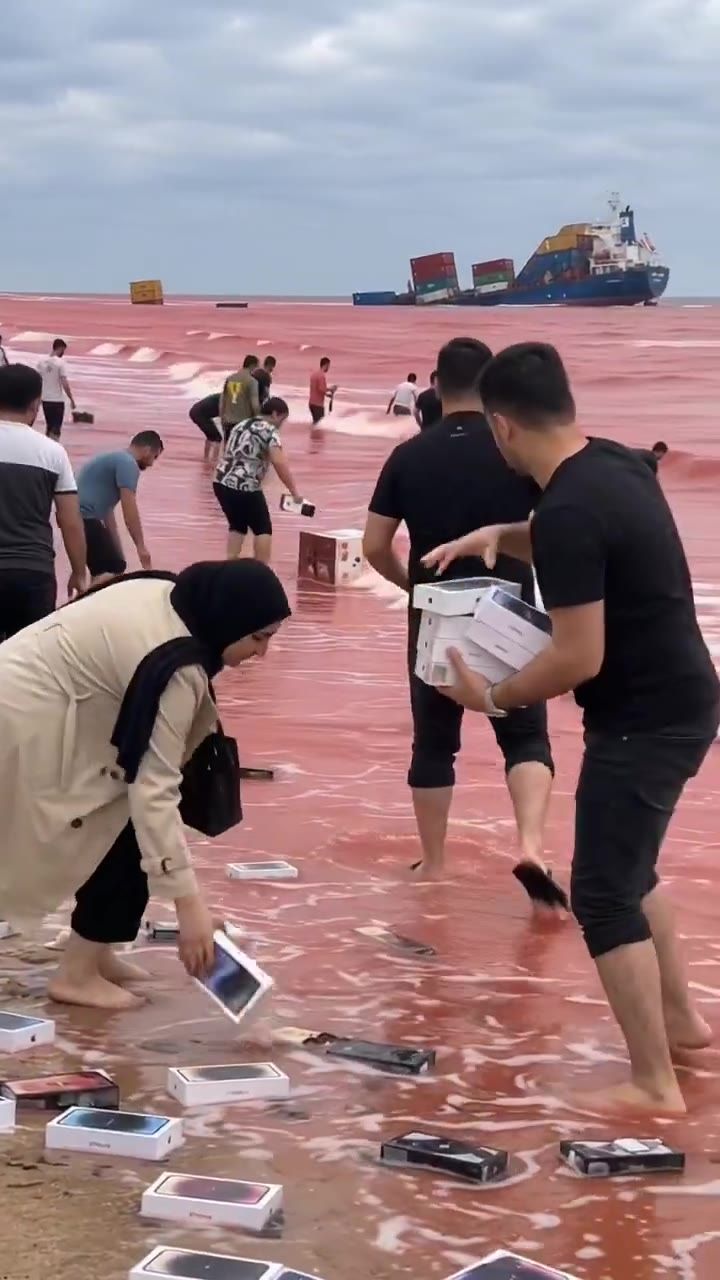 AI-generated
Claims
✓ 1 true · ✕ 1 falseA container ship in the Strait of Hormuz carrying iPhones was struck and sank (GFS Pride sank on Oct 14, 2026).4
The claim regarding the sinking of the GFS Pride is supported by multiple maritime authorities and coverage from reputable outlets. Confirmations from the Maritime and Port Authority of Singapore issued on October 14 support that the ship was struck and subsequently sank, validating the claim about the event itself. This claim stands strong on independent corroboration, and the evidence is clear.
The specific video in the post shows real footage of people on a shore in Hormuz collecting iPhone boxes that washed up after that ship was hit.16
Fact-checkers traced the video to accounts that specialize in AI-generated content, revealing it does not depict real events but rather fabricated imagery. The visual evidence sought to support the claim is shown to be completely misleading, further emphasizing the necessity of verifying media authenticity. This significant discrepancy highlights that the video's context was falsely presented.
People in small boats and on shore collected floating goods (perfumes/electronics) after the sinking.235
While some reports affirm instances of people collecting items post-sinking, this claim lacks uniform verification of the circulated footage's authenticity. Independent confirmations exist that containers were lost, yet the specific videos in circulation may not accurately represent the true events. Careful scrutiny of each video is warranted to establish the facts.
What was posted
XA Twitter post featuring a video allegedly showing people collecting iPhones washed ashore after a container ship sank. The video was presented as evidence of the claim, but its authenticity is questioned.
“السفينه اللي كانت محمله ايفونات في هرمز وخدت صاروخ الناس اللي علي الساحل متوصوش ياريتني كنت معااااهم .. 😂😂”
“The ship that was carrying iPhones in Hormuz got hit; the people on the coast aren't warned, I wish I was with them .. 😂😂” — translated
Who posted it
XAccount check
Estimates from public signals — account age, posting pattern, audience — not a judgement of the person behind the account, and separate from whether this post is true.
What stood out
- No profile information available on Twitter account.
- No recent posts or activity on Twitter account.
- No matching profiles found on LinkedIn or other social media platforms.
Signals (4)+
- Posting cadence
- 0
- Follower ratio
- 0
- Notable news coverage
- No
- Fact check history
- No
Account checked October 17, 2026, 14:51 UTC
The media
VideoThe tells
- ●●● Strong signal The video contains no real-time footage of the sinking event.our visual review
- ●●○ Supporting signal Content is shared from accounts known for creating AI art.fact-checks
- ●●○ Supporting signal The clip has an overly polished look, characteristic of CGI rather than real footage.our visual review
Synthetic-media detector
Detector unavailableThe claim stands or falls on whether the media is real, so the detector ran.
How we checked the media
- Analyzed the video in the post and found it lacking any verifiable source.
- Cross-referenced the video through searches revealing its AI-generated nature.
- Reviewed various fact-checking articles confirming the content's authenticity as synthetic.
Sources
6 sources reviewed- 1"علب آيفون على الشاطئ بعد غرق سفينة حاويات في مضيق هرمز؟" (FactCheck) ↗
An‑Nahar · newspaper.annahar.comUntiereduntiered — treated as signal only, never decisiveEvidence
The video's origin is traced to an AI art account.
- 2"'ريحة هرمز حلوة'.. سخرية واسعة من آيفونات وعطور تطفو بالمضيق" ↗
Al Jazeera · aljazeera.netUntiereduntiered — treated as signal only, never decisiveContext
Reporting mentions items reported floating and local actions but without specific verification.
- 3"غرق سفينة إماراتية بمضيق هرمز.. آيفونات وعطور تتناثر في البحر | فيديو" ↗
i24NEWS · i24news.tvUntiereduntiered — treated as signal only, never decisiveEvidence
Reports confirm the event and mention items in the water but validate with caution on specific clips.
- 4"Singapore‑registered vessel sinks in Strait of Hormuz; another damaged" ↗
The Business Times (Singapore) · businesstimes.com.sgUntiereduntiered — treated as signal only, never decisiveEvidence
The confirmation of the sinking event and crew safety.
- 5"Pescadores encontram centenas de iPhones no mar após navio afundar em Ormuz" ↗
CNN Brasil · cnnbrasil.com.brUntiereduntiered — treated as signal only, never decisiveEvidence
Verification of some goods being collected but highlights inconsistency in circulating videos.
- 6"Viral Video: ... hecho con IA" (example earlier debunk of similar viral iPhone video) ↗
Newtral · newtral.esPrimary / fact-checkerIFCN + EFCSN; SpainFurther reading
Background on patterns of AI-generated content and prior misinformation cases.
Further reading
- 1An‑Nahar An-Nahar provides insight on the verification process and identifies the video as AI-generated.
- 4The Business Times (Singapore) The Business Times gives official statements confirming the sinking and safety of the crew.
- 5CNN Brasil CNN Brasil details reports of locals collecting goods, emphasizing the need for checking authenticity.
The full story
On October 13-14, 2026, the Singapore-flagged container ship, GFS Pride, sank in the Strait of Hormuz after being struck. Maritime authorities confirmed the incident, and the crew was safely evacuated. Following this event, various videos began circulating online, suggesting that locals collected items from the wreck. However, many of these videos were identified as AI-generated, lacking connection to real-life events. The deceptive post claiming to show actual footage of people collecting iPhones washed up is part of a broader trend where genuine events are manipulated through fabricated visuals, reinforcing the need for critical media consumption and verification. This serves as a reminder that not all content shared on social media accurately reflects reality, even when it references real incidents.
Kernel of truth
The GFS Pride did indeed sink after being struck, as verified by authorities.
Timeline
October 13, 2026
GFS Pride was struck by an unidentified projectile. 4The Business Times (Singapore)
October 14, 2026
GFS Pride sank in the Strait of Hormuz. 4The Business Times (Singapore)
October 16, 2026
The viral clip claiming to show the sinking aftermath was traced to an AI art account. 1An‑Nahar
How it was framed
The video does not support the claim made in the post, as it is AI-generated and does not depict an actual event.
- Emotional language. The use of phrases like 'I wish I was with them' to evoke emotions.
Bias
The post appears to be a viral, sensational claim presented as a humorous/viral clip rather than an explicitly political or ideologically framed narrative.
Bias describes how the post frames its message — the slant of the language, selection and emphasis — and is judged separately from whether the claim is true. A true claim can still be framed with a strong slant.
How we checked
4 min 52 s- 1
Performed searches using the title of the post and claims about the video.
- 2
Reviewed multiple credible fact-checking sources that analyzed the video.
- 3
Examined the origin of the shared video, focusing on its trace back to AI-generated accounts.
✓ Claim checked✓ Media checked✓ Sources checked
Why 78% confidence
HighWe are highly confident based on strong corroboration from multiple independent sources confirming that GFS Pride sank and that the video is not authentic. The evidence points strongly towards AI generation rather than authentic footage.
Limits. While we have identified the source of the video as AI-generated, we could not determine the full extent of video misattribution across other platforms.
What we don’t know
- What other videos might be circulating that also misrepresent the Hormuz sinking event.
- How much AI-generated content on social media is impacting public perception of genuine incidents.
- Whether additional goods were collected from the sea after the sinking that are not documented.
Spot it yourself
Spot the fakeLooks suspicious, isn’t proof
- The video's production quality is suspiciously high for real footage.
- The emotional appeal in the caption seems exaggerated for the situation.
- The source of the video comes from an account known for AI art rather than first-hand news.
- Viral content can spread rapidly, making verification harder.
The actual evidence
- The video has been traced back to AI-generated content, indicating it is not real.
- Independent fact-checking confirms that the video is unrelated to the actual event and is misrepresenting information.
- Reports verify that while goods did float post-sinking, the specific video in the post was not authentic.
- 1
Conduct a reverse image search on suspicious media to check for authentic sources.
Use tools like Google Images to find the origin of the video.
- 2
Look for official statements or reports related to the event to corroborate claims.
Search through reputable news sources for confirmation on social media narratives.
- 3
Examine the social media account that shared the video.
Check if the account has a history of sharing reliable or unreliable content.
- 4
Analyze the context of the claim thoroughly.
Make sure that the visuals align with credible reporting and are not taken out of context.
Takeaway
Always verify the authenticity of videos before sharing, especially when they claim to depict real events, and approach sensational claims with caution.
Questions people ask
What really happened with the GFS Pride?+
The GFS Pride was indeed struck and sank in the Strait of Hormuz during October 13-14, 2026, as confirmed by maritime authorities.
Why is the video in the post misleading?+
The video is traced back to accounts producing AI-generated art and does not show real footage of the event as claimed.
What should I do if I see a video like this?+
Always verify through multiple trustworthy sources, conduct reverse searches, and critically evaluate the content before believing or sharing.
How can I tell if a video is AI-generated?+
Look for details like overly polished visuals, lack of credible context, and traceability to known AI art accounts.
Are there any verified instances of goods being collected after the sinking?+
Yes, reports confirm some locals did collect items from the sea after the GFS Pride sank, but not every circulating video is verified.
Go deeper
- AI-generated
- Media created using artificial intelligence, often appearing as realistic yet fictional content.
- fact-checking
- The process of verifying the accuracy of claims made in media or statements.
- misattribution
- When content is incorrectly labeled or claimed to originate from a different source or context.
- corroboration
- Evidence or information that confirms or supports a claim, increasing its reliability.
- public perception
- How the public views or interprets events, particularly shaped by media coverage.
People also search for
For educators+
- How can individuals better discern the truth of shared media?
- What role do social media platforms have in preventing misinformation?
- How do emotional appeals in media influence public response to events?
About this check
- Platform
- X
- Posted by
- @bassemelmassry7
- Posted
- October 16, 2026
- Age when checked
- Under 24 hours old when checked
- Where it spread
- IR, AE, EG, United Kingdom
- Audience
- International audience
- Language
- AR
- Status
- ● Post is live
- Verified
- October 17, 2026, 14:56 UTC
- Published
- October 17, 2026, 14:56 UTC
Reach. Primary post ~8.4K likes, ~1K replies (syndication, 17 Oct); Annahar says the clips drew 'several million views'; Telegraph X post 'Iranians recover new iPhones floating in Strait of Hormuz' ~1.9K likes
This verdict was generated with AI from the sources shown. AI can make mistakes — check the sources before relying on it.
Check anything yourself, in seconds.
Share any social post or video to What the Fact and get the verdict, the confidence, and the receipts.