Was Pakistan's ambassador to Iran attacked at a meeting in Tehran?
Was Pakistan's ambassador to Iran, Imran Ahmed Siddiqui, attacked by a crowd in Tehran and taken to hospital, as a viral video claims?
False
No attack took place in Tehran; the footage is a real brawl in Armenia's parliament.
False. Pakistan's embassy in Tehran said on 1 November 2026 that reports of an attack on Ambassador Imran Ahmed Siddiqui were "baseless and factually incorrect", and Iran's state media carried the same denial. The clip attached to the post is not from Tehran at all: it shows the 29 October 2026 brawl between lawmakers in Armenia's National Assembly in Yerevan.
 Genuine
Claims
✕ 3 falsePakistan's ambassador to Iran, Imran Ahmed Siddiqui, was attacked by several people during a meeting in Tehran1236
“تعرّض السفير الباكستاني لدى إيران، عمران أحمد صديقي، لهجوم في العاصمة الإيرانية طهران”
This claim fails at its most direct test: the institution with the most at stake and the best access to the facts said it did not happen. Pakistan's embassy in Tehran posted a statement on X on 1 November 2026 calling the reports "baseless and factually incorrect" and confirming the ambassador and his staff were safe, with diplomatic work continuing normally. That denial was then carried by Dawn, The Express Tribune, Pakistan Today, Daily Times and BOL News, and Iranian state media relayed the same rejection, saying the reports had no truth or credibility. These outlets are not independent of each other in the strict sense — nearly all are relaying one embassy statement — but the statement itself is a primary source from the party the rumour is about, and a denial of this kind is exactly what such a rumour would produce. The decisive check is the counter-search: an assault on an ambassador in a foreign capital, with a hospitalisation, is the kind of event every wire service and every regional foreign ministry would report. Our searches in English, Persian and Arabic found no such coverage anywhere. The only voices asserting an attack are social posts recycling the same clip.
Still open: Who first attached the Tehran caption to this footage, and whether it was one account or several working from the same template.
After the incident the ambassador was taken to a hospital46
“وعقب الحادث، نُقل إلى أحد المستشفيات”
The hospital detail is a supporting flourish, and it collapses with the main claim. An injury serious enough to require hospital treatment would leave a trace: a hospital statement, a foreign ministry briefing, a photograph of a convoy, or at minimum a named medical facility. None of that exists in our searches. Instead, the embassy said there was no security incident involving the ambassador and that he was in good health, and it later shared photographs of Siddiqui meeting the president of Pardis Technology Park — a normal working engagement, not a convalescence. That photograph is the strongest single piece of evidence here because it is visual, dated to the aftermath, and shows the man the post says was hospitalised doing his job. No credible source anywhere reported a hospitalisation. The claim's own vagueness — "one of the hospitals", never named — is the pattern of invented detail rather than reported fact.
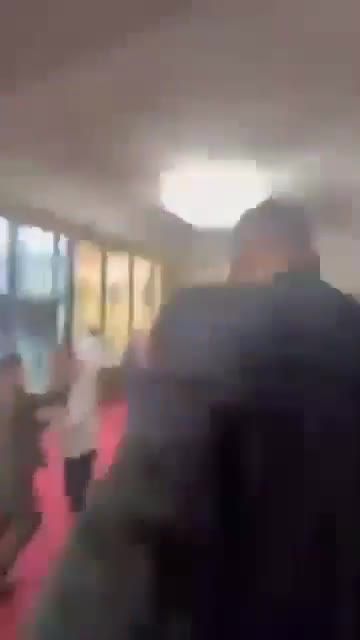
The attached video shows the attack on the Pakistani ambassador in Tehran7891011
The footage is real, which is what makes it persuasive, but it was filmed in a different country about a different quarrel. Several outlets identified it as the fight that broke out in Armenia's National Assembly in Yerevan on 29 October 2026 between the ruling Civil Contract party and the opposition Strong Armenia bloc, during a session that became a mass brawl. Coverage describes the same visual signature as the post: men in suits scuffling in a formal chamber, a chair hoisted and thrown, and the fighting spilling into the corridor outside the hall. Our media detector found no sign of AI generation or synthesis (a generated-content score of about 0.003, with deepfake at 0.0), which fits: nobody needed to fake the pictures, only to relabel them. HUM News made the same identification directly, noting the viral video was from the Armenian parliament clash two days earlier and was being falsely portrayed as a Pakistan–Iran incident. The deception therefore sits entirely in the caption, which moves real Armenian footage several borders west and attaches it to a named diplomat.
What was posted
XAn X account posting as Afghan news outlet "Afghanistan Now" published a short video of a chaotic scuffle between men in suits in a chandelier-lit hall, captioned as breaking news from Tehran. The caption tells readers that Pakistan's ambassador to Iran, Imran Ahmed Siddiqui, was attacked by several people during a meeting and then taken to a hospital. No date, venue or source for the "reports" is given.
“🚨 عاجل | تهران، إيران أفادت تقارير بتعرّض السفير الباكستاني لدى إيران، عمران أحمد صديقي، لهجوم في العاصمة الإيرانية طهران. ووفقاً للتقارير، كان السفير قد دُعي لحضور اجتماع، لكنه تعرّض لهجوم من قبل عدد من الأشخاص أثناء انعقاد الاجتماع. وعقب الحادث، نُقل إلى أحد المستشفيات”
“🚨 BREAKING | Tehran, Iran. Reports say Pakistan's ambassador to Iran, Imran Ahmed Siddiqui, was attacked in the Iranian capital Tehran. According to the reports, the ambassador had been invited to attend a meeting, but was attacked by a number of people while the meeting was taking place. After the incident, he was taken to one of the hospitals.” — translated
Posted on X by the account "Afghanistan Now" (أفغانستان الآن). The same clip was also re-uploaded with the false Tehran caption by other accounts, including the X account MOSSADil. The post gives no source for its "reports".
Who posted it
XAccount check
Estimates from public signals — account age, posting pattern, audience — not a judgement of the person behind the account, and separate from whether this post is true.
What stood out
- No web footprint whatsoever: searches for "AFGAl_Aan" / "Afgal Aan" return nothing but unrelated hits (a Galician migration research project, a Sitges LGBT association, unrelated PDFs).
- Profile supplies no bio, no display name, no follower count, no account creation date and zero recent posts — there is essentially no evidence of genuine human or organisational identity.
- Handle pattern ('AFG'-style country abbreviation + 'Analyst'-like suffix) mimics the naming convention of well-known Afghanistan OSINT accounts such as @AfghanAnalyst / @AfghanAnalyst2, which are widely cited by ISW, Jamestown and others — consistent with a lookalike/impersonation or place-holder sock handle.
- The handle uses a capital 'I' in place of a lowercase 'l' ('AFGAl'), a common homoglyph trick used in typosquatting/impersonation of established accounts.
- No verification badge and no corroborating news, fact-check or academic citation of this specific handle anywhere in searchable sources.
- Context: the Afghanistan/Pakistan information space has documented problems with fake army/Taliban-impersonating accounts (e.g. Vishvas News fact-check on a fake 'Afghanistan Army' account, Feb 2026), raising baseline risk for unvetted AFG-themed handles.
- Verification is impossible from the given data; treat any claim sourced solely to this account as unattributable.
Signals (7)+
- Posting cadence
- Unknown — zero posts supplied
- Profile completeness
- Empty (no bio, no display name)
- Web footprint
- None found
- Handle similarity to known accounts
- Resembles @AfghanAnalyst / @AfghanAnalyst2 (cited by ISW, Jamestown); 'AFGAl' uses capital-I homoglyph
- Notable news coverage
- None for this handle
- Fact check history
- None specific to this handle; broader ecosystem has documented fake Afghan military/Taliban-impersonation accounts (Vishvas News, 2026-02-25)
- Affiliation
- Unknown / unclaimed
Account checked November 2, 2026, 02:48 UTC
The media
Video✓ What is genuine
The video itself is authentic, unedited handheld footage of a real event: the mass brawl between ruling and opposition lawmakers in Armenia's National Assembly on 29 October 2026.
The tells
- ●●○ Supporting signal Formal chamber with chandeliers, red carpet and men in suits — a parliamentary hall, not a meeting venue in Tehran.our visual review
- ●●● Strong signal A chair is hoisted overhead and thrown, matching published descriptions of deputy speaker Vahagn Aleksanyan throwing a red chair in Yerevan.The Mirror and our visual review
- ●●● Strong signal No synthetic or composited artefacts; the detector scored AI generation at about 0.003 and deepfake at 0.0.our detector
- ●●● Strong signal The clip was broadcast from a live-streamed parliamentary session on 29 October 2026, two days before the Tehran caption appeared.provenance record and Sina/CCTV
Synthetic-media detector
Detector ranThe claim stands or falls on whether the media is real, so the detector ran.
Scores are the detector’s estimate for the file as uploaded. A low score does not rule out editing, a spliced caption, or footage shown out of context — those are judged above. Model v3.
How we checked the media
- Reviewed the footage visually for signs of compositing, cuts or synthetic artefacts.
- Ran our AI-generation detector (hive-v3) on the clip; it returned an AI-generated score of about 0.003 and a deepfake score of 0.0.
- Compared the scene in the clip with published coverage and descriptions of the 29 October 2026 brawl in Armenia's National Assembly.
- Searched for the clip's earliest appearances and for outlets identifying its real origin.
Sources
11 sources reviewed- 1Pakistan's embassy in Tehran refutes rumours of people 'attacking' its ambassador to Iran ↗
Dawn · dawn.comUntiereduntiered — treated as signal only, never decisiveEvidence
The embassy's categorical denial, with its exact wording that the reports are baseless and factually incorrect.
- 2Pakistan embassy rejects reports of attack on ambassador in Tehran as 'baseless' ↗
The Express Tribune · tribune.com.pkUntiereduntiered — treated as signal only, never decisiveEvidence
A second Pakistani outlet relaying the embassy's rejection of the reports about Ambassador Siddiqui.
- 3Pakistan embassy dismisses reports of attack on ambassador in Tehran ↗
Pakistan Today · pakistantoday.com.pkUntiereduntiered — treated as signal only, never decisiveEvidence
The embassy's statement that no incident took place and that staff were safe.
- 4Pakistan's embassy in Tehran refutes rumours of people 'attacking' envoy to Iran ↗
Daily Times · dailytimes.com.pkUntiereduntiered — treated as signal only, never decisiveEvidence
The embassy's clarification and the nature of the rumoured account's claim.
- 5Pakistan embassy breaks silence on social media reports of attack on ambassador in Tehran ↗
BOL News · bolnews.comUntiereduntiered — treated as signal only, never decisiveEvidence
An additional Pakistani outlet describing the embassy's dismissal of the allegations as false and misleading.
- 6Pakistan denies rumors that its ambassador was attacked ↗
Roya News · en.royanews.comUntiereduntiered — treated as signal only, never decisiveEvidence
Confirmation that the ambassador was in good health and performing his duties, with photographs of a working meeting.
- 7ایران میں پاکستانی سفیر سے متعلق گردش کرتی خبریں جھوٹی نکلیں، سفارتخانے کی تردید ↗
HUM News · humnews.pkUntiereduntiered — treated as signal only, never decisiveEvidence
Identification of the viral clip as footage from the Armenian parliament clash, not Iran.
- 8Brawl erupts in Parliament over 'Ministry of Sex' as fists fly and chair hurled ↗
The Mirror · mirror.co.ukUntiereduntiered — treated as signal only, never decisiveEvidence
Description of the Yerevan brawl, including the deputy speaker throwing a chair.
- 9Moment MP hurls chair as punches are thrown in brawl inside Armenia's parliament ↗
Daily Mail · dailymail.comUntiereduntiered — treated as signal only, never decisiveEvidence
Coverage of the moment MPs threw chairs and exchanged punches inside Armenia's parliament.
- 10Parliament Chaos: Armenia's Lawmakers Exchange Punches Inside Assembly ↗
ABP Live · news.abplive.comUntiereduntiered — treated as signal only, never decisiveEvidence
Reporting on the ruling-party versus opposition confrontation in the Armenian assembly and the spread of its footage.
- 11Armenia parliament fight coverage ↗
Sina/CCTV · news.sina.com.cnUntiereduntiered — treated as signal only, never decisiveEvidence
The date and details of the 29 October 2026 brawl, including fighting continuing into the corridor.
Further reading
- 1Dawn Dawn carries the embassy's own wording and notes that the embassy shared the rumoured video while rejecting it.
- 7HUM News HUM News draws the direct link between this viral clip and the Armenian parliament fight.
- 11Sina/CCTV A dated, detailed account of the 29 October 2026 brawl that supplies the footage's real setting.
The full story
Nothing in this story is invented from nothing. The pictures are real. The man named is real. The denial is real. The falsehood is the thread pulled between them.
On 29 October 2026, Armenia's parliament in Yerevan descended into a mass fight. Lawmakers from the ruling Civil Contract party and the opposition Strong Armenia bloc shoved and punched each other during a session, the deputy speaker hoisted a chair and threw it, and the scuffling continued out of the chamber and into the corridor. It was streamed, filmed and widely reported — exactly the kind of chaotic, camera-friendly footage that travels.
Two days later, on about 1 November, that footage reappeared on X with a new caption in Arabic: breaking news from Tehran, where Pakistan's ambassador to Iran, Imran Ahmed Siddiqui, had supposedly been attacked at a meeting and taken to hospital. Accounts sharing it included "Afghanistan Now" and MOSSADil. No source was given for the "reports".
Pakistan's embassy in Tehran answered quickly and flatly. The reports were "baseless and factually incorrect", it said; the ambassador and staff were safe, and diplomatic work went on as normal. Iranian state media carried the same denial. The embassy later posted photographs of Siddiqui meeting the president of Pardis Technology Park, a picture of a working diplomat rather than a hospital patient.
The pattern is not new for Pakistan's diplomatic service. The previous month it had denied reports that its envoy in London had been attacked with a white powder-like substance, calling that video fake and mislabelled. Real chaos footage, a real official's name, and a location swapped out: that is a cheap rumour to build, and a costly one to chase.
Kernel of truth
The footage is genuine: a real, violent brawl in Armenia's National Assembly on 29 October 2026, featuring a thrown chair — but in Yerevan, not Tehran.
Timeline
October 29, 2026
Lawmakers from Armenia's ruling and opposition parties brawl inside the National Assembly in Yerevan; a deputy speaker throws a chair and the fight continues into the corridor. 11Sina/CCTV
November 1, 2026
Pakistan's embassy in Tehran rejects reports that Ambassador Imran Ahmed Siddiqui was attacked, calling them baseless; Iranian state media relays the denial. 1Dawn
November 1, 2026
Outlets identify the circulating clip as the Armenian parliament brawl, not an incident in Tehran. 7HUM News
How it was framed
The video is genuine and unaltered; the falsehood is entirely in the caption, which relocates real Armenian parliamentary footage to Tehran and attaches it to a named ambassador. The hospital detail adds invented specificity that makes the whole post feel reported rather than rumoured.
- “Visual proof”. The post leads with a clip of a real, violent scuffle, so the scene itself appears to confirm the caption before a reader reads a word of the denial.
- Borrowed authority. "أفادت تقارير" ("reports say") and "وفقاً للتقارير" ("according to the reports") point to unnamed reports rather than any named outlet or official.
- Urgency. "🚨 عاجل" ("BREAKING") opens the post, discouraging readers from waiting for confirmation.
- Emotional language. An attack on a named ambassador, followed by a hospital transfer, is framed as a fast-moving security incident.
- Missing context. No date, venue, city street or source is given for the video, so the only context for the footage is the caption itself.
Posted on X by the account "Afghanistan Now" (أفغانستان الآن). The same clip was also uploaded with the false Tehran caption by other accounts, including the X account MOSSADil. The post cites no named source for its "reports".
Bias
Leans anti-Pakistan. An Afghanistan-focused news account pushes an urgent 'breaking' claim that a Pakistani ambassador was humiliated and injured in Tehran, using unrelated footage, at a moment of Pakistan–Iran mediation and Afghan–Pakistani tension. The framing invites hostility toward Pakistan without citing any named source.
Bias describes how the post frames its message — the slant of the language, selection and emphasis — and is judged separately from whether the claim is true. A true claim can still be framed with a strong slant.
How we checked
48 s- 1
Searched for reporting on an attack on Pakistan's ambassador in Iran, in English and Persian.
- 2
Searched for coverage of the 29 October 2026 brawl in Armenia's National Assembly.
- 3
Searched for fact checks and reporting specifically linking the circulating video to the Armenian parliament fight.
- 4
Reviewed the footage visually for signs of compositing or synthesis.
- 5
Ran our AI-generation detector (hive-v3) on the clip.
- 6
Compared the embassy's statements and the subsequent photographs of the ambassador with the claim's hospitalisation detail.
✓ Claim checked✓ Media checked✓ Sources checked
Why 90% confidence
HighHIGH. Two independent lines of evidence converge: a primary-source denial from the embassy at the centre of the claim, relayed by multiple Pakistani outlets and Iranian state media, and a separate identification of the footage as the 29 October 2026 Armenian parliament brawl. The absence of any credible reporting of an assault on an ambassador — an event that would be covered globally — removes the remaining doubt. Our detector also rules out AI synthesis, leaving mislabelling as the only explanation for the video. We stopped short of the top of the range only because we could not open the publisher pages directly and relied on their published excerpts.
Limits. We could not open the full publisher pages and worked from their published excerpts and search results. We did not trace the very first account to attach the Tehran caption, and we cannot say whether the accounts that shared it coordinated.
What we don’t know
- Which account first attached the Tehran caption to the Armenian footage, and whether "Afghanistan Now" wrote it or copied it.
- Whether the accounts that shared the clip — including MOSSADil — acted in concert or independently.
- Why the ambassador's name was chosen, and whether the post was aimed at an Afghan, Pakistani or Iranian audience in particular.
Spot it yourself
Spot the fakeLooks suspicious, isn’t proof
- The account presents itself as a news outlet for one country while covering another's diplomacy — a partisan or niche source is a reason to check, not proof of anything.
- The Arabic caption is polished and includes the "breaking news" siren emoji, but tone alone doesn't make a claim false; plenty of real breaking news is written this way.
- The clip is low-resolution and shaky, as phone footage usually is. Poor quality is not evidence of fakery.
- The post says "reports" without naming one. That is a red flag for sourcing, but you still need the counter-search to settle it.
The actual evidence
- The embassy of the country whose ambassador was supposedly attacked said the reports were baseless and that he was in good health — a primary source from the party at the centre of the story.
- The video matches published coverage of the 29 October 2026 brawl in Armenia's National Assembly, down to the thrown chair and the fight spilling into the corridor.
- No credible outlet anywhere reported an assault on the ambassador or a hospitalisation, though the event would have been covered worldwide.
- The embassy later shared photographs of the ambassador meeting the head of Pardis Technology Park, showing him at work rather than in hospital.
- Our detector found no sign of AI generation, confirming the deception was in the caption, not the pixels.
- 1
Ask who would be reporting this if it were true
An attack on an ambassador in a foreign capital would be covered by international wire services, both governments and local media in Tehran. Search for it in more than one language before believing a single post.
- 2
Find the official account
Look up the embassy or foreign ministry on X or its website. Here the Embassy of Pakistan in Tehran posted the denial directly, and Pakistani outlets relayed it within a day.
- 3
Treat the video as a separate question from the caption
The clip can be completely real and still be from somewhere else. Identify what building, uniform, flag or language appears in the footage before accepting the location in the caption.
- 4
Run a reverse image search on a still from the video
Take a screenshot of a distinctive moment — here, the chair being raised — and search it. Earlier coverage of the same frames shows you where and when they first appeared.
- 5
Check what a detection tool can and cannot prove
Our detector said the footage is not AI-generated. That tells you the pictures are real, not that the caption is true. Real footage gets mislabelled all the time.
Takeaway
Authenticity of the footage and truth of the caption are two separate questions; a genuine video with the wrong label is one of the most common and most convincing forms of misinformation.
Questions people ask
Was Pakistan's ambassador to Iran attacked in Tehran?+
No. Pakistan's embassy in Tehran said on 1 November 2026 that reports of an attack on Ambassador Imran Ahmed Siddiqui were baseless and factually incorrect, and that he was safe and working normally. Iranian state media carried the same denial, and no credible outlet reported any assault.
What is the video in the post actually showing?+
It shows the mass brawl between ruling Civil Contract and opposition Strong Armenia lawmakers inside Armenia's National Assembly in Yerevan on 29 October 2026. Coverage describes MPs punching each other, a deputy speaker throwing a chair, and the fight continuing into the corridor outside the chamber.
Was the ambassador taken to hospital?+
No. The embassy said there was no security incident involving the ambassador and that he was in good health. It later shared photographs of him meeting the president of Pardis Technology Park, and no hospital was ever named or reported.
How can I tell a real video with a false caption from a fake video?+
Check the footage and the caption separately. A detector can tell you whether images were generated, but only the original coverage can tell you where and when they were filmed. Compare distinctive details — the room, the language, the clothing — with earlier reporting.
Has Pakistan dealt with similar rumours before?+
Yes. The previous month Pakistan denied reports that its envoy in London had been attacked with a white powder-like substance, calling that video fake and mislabelled — the same pattern of real-looking footage attached to a false location and event.
Go deeper
- False context
- When genuine photos, video or audio are shared with a false date, location or description.
- Primary source
- Evidence from the people or institutions directly involved, such as the embassy statement here, rather than a later report about them.
- Reverse image search
- A search that takes a picture or a still from a video and finds where else it has appeared online.
- AI-generation detector
- A tool that estimates the probability that an image, video or audio clip was made or altered by artificial intelligence.
- Absence of expected coverage
- A verification test in which you check whether an event that would be covered widely is missing from credible outlets — a sign it likely did not happen.
People also search for
For educators+
- The video is completely real. Does that make the post more or less dangerous than a fully fabricated clip, and why?
- If a government denies an incident, should that be treated as proof? What other evidence would you want before accepting the denial in a different case?
- How would you design a classroom exercise that teaches students to separate what a video shows from what its caption says?
About this check
- Platform
- X
- Posted by
- @afgal_aan
- Posted
- November 1, 2026
- Age when checked
- Under 24 hours old when checked
- Where it spread
- IR, Pakistan
- Audience
- International audience
- Language
- AR
- Status
- ● Post is live
- Verified
- November 2, 2026, 02:49 UTC
- Published
- November 2, 2026, 02:49 UTC
Reach. At least 7 accounts posted it within about 5 hours (Misbar). English copy from @eaglepos: 687 likes (X syndication). Pakistan's embassy in Tehran issued a formal denial, reported by Dawn
This verdict was generated with AI from the sources shown. AI can make mistakes — check the sources before relying on it.
Check anything yourself, in seconds.
Share any social post or video to What the Fact and get the verdict, the confidence, and the receipts.