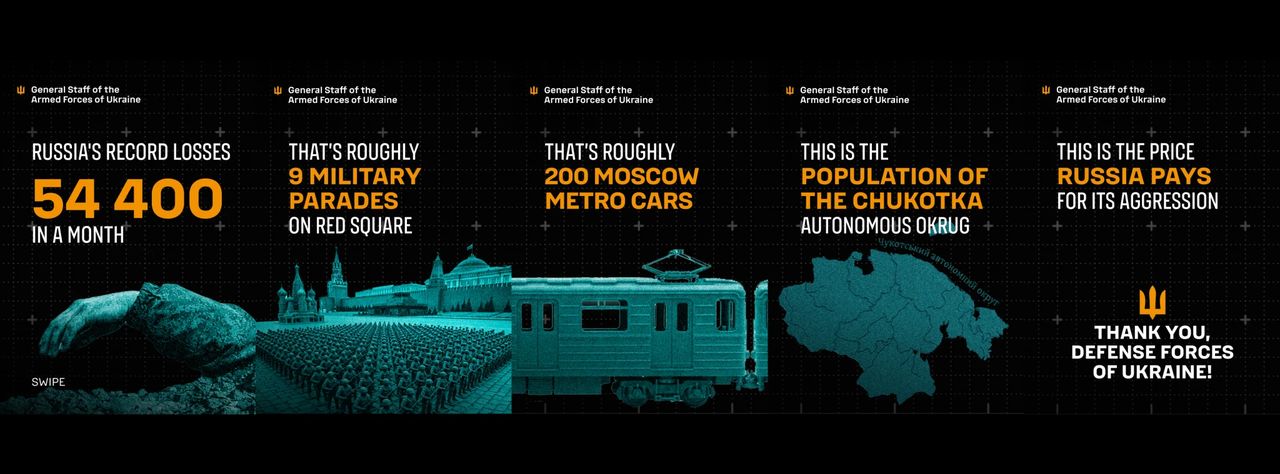
Did Russian forces suffer record losses in October 2026, with a big share in the Azov Corps' sector?
Did Ukraine recapture more territory than Russia seized in October 2026, as Zelensky claims?
True, but…
The monthly record is well reported; the Azov Corps' own kill counts rest on its word alone.
Mostly true, with a caveat. Ukraine's General Staff reported 54,400 Russian casualties for October 2026, the highest monthly total since February 2022, and President Zelensky repeated the record claim. The Azov corps' own figures — 5,017 killed, 1,820 wounded, 6 captured — match its press release and were relayed by Ukrainian outlets. All numbers are Ukrainian military counts, not independently audited.
Claims
✓ 2 trueIn October 2026, Russian forces suffered their highest personnel losses since 2022, the start of the full-scale invasion.12378
This is the claim the whole post rests on, and the published record supports it. Ukraine's General Staff put Russian personnel losses at 49,040 as of 29 October and 54,400 for the full month, according to Ukrinform's reporting of the General Staff briefing. That tops the previous monthly high of 48,670, recorded in December 2024, which UNITED24 Media identifies as the benchmark that was passed. President Zelensky repeated the record claim on 1 November and added that Ukrainian forces recaptured more territory than Russia took during the month, as the Kyiv Independent reported. Note how these outlets relate: Ukrinform, UNITED24 Media and the Kyiv Independent are all reporting the same underlying General Staff dataset, so they corroborate what was published rather than independently counting casualties. A separate check does point the same way, though. The Economist's study, published 30 October 2026 and summarised by RBC-Ukraine, estimates Russian killed and wounded at 1.4–2.1 million overall — a scale consistent with record monthly losses. The decisive point is that the monthly record is a documented, widely reported official figure; the caveat is that it is a military estimate, not an audited count.
Still open: No independent body publishes monthly Russian casualty totals, so the exact figure cannot be audited; only its scale is corroborated.
Enemy personnel losses in the 1st Azov Corps' area of responsibility in October were 5,017 killed, 1,820 wounded and 6 captured.145
These numbers are accurately relayed, but accuracy of relay is not the same as verification. Censor.NET carried the breakdown verbatim — 5,017 killed, 1,820 wounded, 6 captured — citing the corps' press service, and Vilne Radio published the same figures in Ukrainian. The Kyiv Independent summarised the corps' own accounting as 'over 6,800 killed, wounded and captured', which is consistent with the three figures added together. So the post is faithfully repeating what the unit released. What no source in our record does is confirm the count from outside the Ukrainian military. Unit-level kill tallies are compiled from drone footage, front-line reports and battlefield assessment; bodies are rarely recovered or counted by a neutral party, and the ICRC, UN monitors and media investigations do not produce sector-by-sector counts during active fighting. That makes these figures self-reported combat claims: plausible, internally consistent and published openly, but resting entirely on the corps' own records. A reader should treat them as a claim by a party to the war about its own performance, not as a measured outcome.
Still open: Whether the corps' internal counting method has been reviewed by anyone outside the unit is not known.
A significant portion of Russia's October losses occurred within the 1st Azov Corps' area of responsibility, one of the key axes of the Russian offensive (Dobropillia sector, Donetsk Oblast).16
Two separate pieces of reporting fit this claim together. First, the Kyiv Independent reports the corps' own statement that a significant share of Russia's October losses came from the Russian offensive toward Dobropillia. Second, and more useful because it comes from a different command, the same outlet reports Ukraine's Unmanned Systems Forces commander Robert Brovdi saying the largest increase in Russian drone-inflicted casualties in early October was recorded in the 1st Azov Corps' sector, covering Dobropillia–Pokrovsk in Donetsk Oblast. That independent-of-the-corps statement supports the idea that this sector was unusually costly for Russian forces in October. The arithmetic also holds up roughly: about 6,800 casualties inside the corps' sector against roughly 54,400 nationally is a meaningful slice of the monthly total, not a rounding error. The caveat is the same as elsewhere — the apportionment still rests on Ukrainian figures, and 'significant portion' is a loose phrase rather than a measured percentage.
Still open: No source gives an exact percentage of national losses attributable to this sector.
Enemy equipment destroyed or damaged in October: 5 armoured fighting vehicles, 47 artillery systems, 2 MLRS, 469 vehicles, 3,150 UAVs, 558 fortification structures and command posts; 9,944 attack UAVs suppressed by electronic warfare.4
This is the least checkable part of the post. The equipment tallies appear only in the corps' own release, relayed by Censor.NET without independent accounting, and they match the on-screen graphics in the video. They are internally consistent — the categories and totals line up with the personnel figures in tone and scale — but internal consistency is not external confirmation. Battlefield equipment counts are compiled from drone footage review and unit reporting, and neither side publishes verifiable loss registers during the war. The very high UAV and electronic-warfare numbers reflect the character of fighting on this sector, where drone losses are counted per engagement, but nothing in our record lets us test them. Treat them as the unit's own bookkeeping: detailed, specific and openly published, but not something a reader can check against an independent source.
Still open: Whether the corps publishes its counting methodology for equipment losses is not known.
What was posted
XThe 1st Corps Azov of Ukraine's National Guard posted a short video package on X summarising a month of combat results. On-screen graphics and voiceover text present October as Russia's worst month for personnel losses since 2022 and break down enemy losses inside the corps' area of responsibility, illustrated with FPV and thermal drone-strike footage carrying Azov branding. The post asks readers to accept the corps' figures — both the national monthly record and the unit's own kills, wounded and captured — as a summary of its October performance.
“A Month of Record Losses for Russian Occupiers In October, Russian forces suffered their highest personnel losses since 2022. A significant portion of these losses occurred within the area of responsibility of the 1st Corps of the National Guard of Ukraine “Azov”, one of the key”
Posted by the corps' own X account (@azov_media) around 30–31 October 2026. The same package was carried by Censor.NET on 30 October and by Vilne Radio, and the video carries 'AZOV.ARMY' and '1-Й КОРПУС НГУ «АЗОВ»' watermarks.
Who posted it
XAccount check
Estimates from public signals — account age, posting pattern, audience — not a judgement of the person behind the account, and separate from whether this post is true.
What stood out
- @ZelenskyyUa is the long-established official X/Twitter account of Volodymyr Zelenskyy, President of Ukraine; created April 2019 and publicly announced by his press service on 7 May 2019.
- Handle is routinely cited and quoted as the official presidential account by major outlets (Ukrinform, Denník N on 29 Oct 2026, ANI, eNCA, Royal Family posts, academic studies of digital diplomacy).
- Recent post attribution is consistent and current (e.g. condolence tweet about the Dnipro train strike, 29 October 2026), indicating an active, continuously operating account rather than a dormant or hijacked one.
- Known impersonation/parody ecosystem exists (e.g. @Zelenskyy_Uaa, flagged by fact-checker Facta in 2024) — the exact handle spelling 'ZelenskyyUa' is the genuine one, not the lookalikes.
- All supplied metadata fields (bio, followers, created_at, verification flag) are null/false, which looks like a failed scrape or API limitation rather than evidence about the account itself; identity should be confirmed from the live profile page.
- Caveat on use as a source: it is official government/presidential communication — reliable for Kyiv's stated positions, but inherently partisan framing of war events; treat claims as official statements requiring corroboration.
Signals (9)+
- Account created
- 2019-04
- Handle matches official
- Yes
- Official announcement
- Press service announcement, 7 May 2019 (Babel, NV, TSN, LIGA.net)
- Metadata completeness
- Very low (all key fields null) — probable collection failure
- Notable news coverage
- Extensive and ongoing; quoted by wire services through October 2026
- Impersonation risk
- Lookalike parody accounts exist (@Zelenskyy_Uaa) but are distinct handles
- Posting cadence
- High-volume official communications, likely staff-operated
- Source type
- State/government official channel
- Fact check history
- Account itself not a fact-check target; its tweets frequently used as primary quote source
Account checked October 29, 2026, 15:05 UTC
The media
Video✓ What is genuine
The drone-strike footage itself appears to be genuine Ukrainian FPV and thermal video, consistent with what drone units routinely publish and branded by the Azov corps' media arm. The statistical package around it is the unit's own real monthly release.
The tells
- ●●○ Supporting signal Grainy black-and-white first-person-view strike footage with green targeting reticles and a drone gun-camera date/time readout — the standard look of Ukrainian FPV footage.our visual review
- ●●○ Supporting signal Thermal palette frame consistent with drone thermal optics, not a rendered image.our visual review
- ●●○ Supporting signal 'AZOV.ARMY' and '1-Й КОРПУС НГУ «АЗОВ»' watermarks tie the footage to the unit's own media arm.our visual review
- ●○○ Weak signal Rainbow thermal palette and horizontal glitch/scanline transitions are post-production styling for the compilation, not signs of fabrication.our visual review
- ●●○ Supporting signal One keyframe carries a 26.09.2026 timestamp, so parts of the montage predate October — a dating issue for the compilation, not evidence of fakery.our visual review
Synthetic-media detector
Detector not consultedNo signal called for the detector, so it was skipped.
How we checked the media
- Reviewed the video's keyframes by eye for visual plausibility and signs of synthesis.
- Checked the on-screen overlays, timestamps, telemetry and watermarks against the format of standard Ukrainian drone-strike footage.
Sources
8 sources reviewed- 1Russia suffers record troop losses in October, its worst month since full-scale invasion, Ukraine says ↗
The Kyiv Independent · kyivindependent.comUntiereduntiered — treated as signal only, never decisiveEvidence
Reports the 54,400 October total, the Azov summary of over 6,800 killed, wounded and captured, and Zelensky's repetition of the record claim.
- 2Russia suffers record battlefield losses in October – General Staff ↗
Ukrinform · ukrinform.netUntiereduntiered — treated as signal only, never decisiveEvidence
Reports the General Staff figure of 49,040 losses as of 29 October, the highest monthly figure of the war.
- 3Russia's Military Losses Hit All-Time Monthly High as Ukraine Reports Over 49,000 in October ↗
UNITED24 Media · united24media.comUntiereduntiered — treated as signal only, never decisiveEvidence
Establishes the previous monthly record of 48,670 in December 2024.
- 4Record losses for Russian Federation: over 5,000 occupiers were eliminated in October within area of responsibility of 1st Corps of National Guard of Ukraine "Azov" ↗
Censor.NET · censor.netUntiereduntiered — treated as signal only, never decisiveEvidence
Relays the corps' exact breakdown of 5,017 killed, 1,820 wounded and 6 captured, plus the equipment tallies.
- 5Бійці «АЗОВУ» за жовтень 2026 року вбили на Добропільському напрямку понад 5 тисяч росіян ↗
Vilne Radio · freeradio.com.uaUntiereduntiered — treated as signal only, never decisiveEvidence
Independently carries the same three casualty figures in Ukrainian, attributed to the corps.
- 6Russian losses to Ukrainian drones surge in early October, Madyar says ↗
The Kyiv Independent · kyivindependent.comUntiereduntiered — treated as signal only, never decisiveEvidence
Reports a separate commander's statement that Russian drone casualties rose sharpest in the corps' Dobropillia–Pokrovsk sector.
- 72,250. The russian federation suffers its highest daily casualties since the start of the full-scale invasion ↗
Armed Forces of Ukraine · zsu.gov.uaUntiereduntiered — treated as signal only, never decisiveContext
Reports the highest single-day Russian casualty figure of the war on 21 October 2026.
- 8Russian military casualties could exceed 2 million killed and wounded - The Economist ↗
RBC-Ukraine · newsukraine.rbc.uaUntiereduntiered — treated as signal only, never decisiveFurther reading
Summarises The Economist's 30 October study estimating 1.4–2.1 million Russian killed and wounded.
Further reading
- 1The Kyiv Independent The fullest account of the October record figure, the Azov summary and Zelensky's statement.
- 6The Kyiv Independent A separate commander's view of the rise in Russian drone casualties in the Azov Corps' sector.
- 8RBC-Ukraine A summary of The Economist's independent casualty study, useful for judging scale.
The full story
The post works because two different claims travel together. One is a national statistic; the other is a unit's self-assessment. The national figure is the strong part. When October closed, Ukraine's General Staff put Russian personnel losses at 54,400 for the month, above the previous high of 48,670 set in December 2024, and President Zelensky repeated the record claim on 1 November, adding that Ukraine had recaptured more territory than Russia took. Several outlets reported it, though they were all drawing on the same military dataset rather than counting independently. A separate study by The Economist, published on 30 October and summarised by RBC-Ukraine, estimated total Russian killed and wounded at 1.4–2.1 million, a scale that fits the idea of a record month.
Inside that picture sits the Azov corps' own accounting. Its press service reported 5,017 Russian troops killed, 1,820 wounded and 6 captured in its sector in October, figures carried by Censor.NET and Vilne Radio and summarised by the Kyiv Independent as more than 6,800 killed, wounded and captured. The corps says a large share of Russia's October losses came from the Russian push toward Dobropillia, and a separate statement by Ukraine's Unmanned Systems Forces commander placed the sharpest rise in Russian drone casualties in that same Dobropillia–Pokrovsk sector in early October.
The kernel of truth is real: October does appear to have been Russia's costliest month, and this sector does appear to have been one of the most expensive places to be a Russian soldier. What the post does not say is that every number in it — national and unit-level — comes from Ukrainian military counting.
Kernel of truth
October 2026 was reported as Russia's worst month for personnel losses since the full-scale invasion, and the Azov Corps' Dobropillia sector was identified as a sector where Russian drone casualties rose sharply.
Timeline
October 21, 2026
Ukraine's Armed Forces report 2,250 Russian casualties in a single day, the highest daily figure since February 2022. 7Armed Forces of Ukraine
October 29, 2026
Ukraine's General Staff reports 49,040 Russian personnel losses for October so far, already the highest monthly figure of the war. 2Ukrinform
October 30, 2026
Censor.NET carries the Azov corps' October breakdown: 5,017 killed, 1,820 wounded, 6 captured; The Economist publishes its Russian casualty study the same day. 4Censor.NET
October 31, 2026
October closes with 54,400 reported Russian casualties, above the previous record of 48,670 in December 2024. 1The Kyiv Independent
November 1, 2026
President Zelensky repeats the record-loss claim and says Ukraine recaptured more territory than Russia took in October. 1The Kyiv Independent
How it was framed
The post's numbers match what the corps and Ukraine's General Staff actually published, and the national record claim is widely reported. The weakness is not falsification but sourcing: unit-level kill counts and equipment tallies rest on the unit's own records, and the post presents them without flagging that no independent body can confirm them.
- “Visual proof”. Drone-strike footage with targeting reticles and a gun-camera timestamp is intercut with the statistics, inviting the viewer to read the numbers as confirmed by the imagery.
- Missing context. The post gives exact figures without noting that all casualty and equipment counts originate from Ukrainian military reporting.
- Emotional language. The caption leads with 'A Month of Record Losses for Russian Occupiers'.
- Us vs. them. The framing is a unit scorecard of enemy losses — 'Russian Occupiers' against the corps' own results.
Posted by the 1st Corps Azov's own X account (@azov_media), a unit media channel. The same figures were relayed by Censor.NET and Vilne Radio and summarised by the Kyiv Independent. No outlet rating of the account is recorded in our sources.
Bias
Leans pro-Ukrainian military self-promotion. The video is produced by the Ukrainian National Guard's 1st Azov Corps' own media arm and is built around its own strike footage and its own casualty statistics, presented without any acknowledgement that the figures are self-reported and unaudited. It is combat-achievement messaging for a Ukrainian audience rather than neutral reporting, though the aggregate 'record losses' framing matches the Ukrainian General Staff's official line.
Bias describes how the post frames its message — the slant of the language, selection and emphasis — and is judged separately from whether the claim is true. A true claim can still be framed with a strong slant.
How we checked
16 s- 1
Ran searches on the October 2026 Russian casualty record, the specific Azov figures and the Dobropillia sector claim.
- 2
Compared the post's numbers with reporting by the Kyiv Independent, Ukrinform, UNITED24 Media, Censor.NET and Vilne Radio, and with the summary of The Economist's casualty study.
- 3
Checked whether the figures trace to one origin or to genuinely separate sources.
- 4
Reviewed the video's keyframes by eye for visual plausibility, watermarks and timestamps.
- 5
Did not run an automated media-authenticity detector, because the claim does not depend on the footage being real.
✓ Claim checked– Media not checked✓ Sources checked
Why 78% confidence
ModerateWe set MODERATE confidence overall. The national record claim is backed by a widely reported official figure and a consistent independent estimate, which is strong. The unit-level breakdown is accurate as a relay but cannot be independently verified, and the equipment tallies are unverifiable, which holds the whole package below HIGH.
Limits. We could not open the full articles in our record and worked from the recorded summaries. No independent body publishes monthly or sector-level Russian casualty counts, so the exact figures cannot be audited by anyone outside the war.
What we don’t know
- How the Azov corps compiles its kill, wounding and equipment counts, and whether that method has been reviewed outside the unit.
- The exact percentage of Russia's October losses that occurred in the corps' sector; 'significant portion' is the corps' own description.
- Whether all the drone footage in the compilation comes from October, given a 26.09.2026 timestamp on one frame.
- What proportion of the dead and wounded are counted from recovered bodies, drone review or front-line reports.
Spot it yourself
Find the overstatementLooks suspicious, isn’t proof
- The source is a military unit publicising its own results — a reason to check, but units do publish real figures.
- Slick production, watermarks and glitch transitions make it look like propaganda; branding is not evidence of false numbers.
- Exact figures like 5,017 and 9,944 look suspiciously precise; precision alone proves nothing either way.
- Grainy drone footage can look staged, but the visual quality reflects real FPV camera feeds.
The actual evidence
- Ukraine's General Staff reported 54,400 Russian casualties for October, above the 48,670 record from December 2024 — a published, checkable national figure.
- The corps' 5,017 / 1,820 / 6 breakdown appears verbatim in Censor.NET and Vilne Radio, attributed to the corps' press service, so the post is relaying a real release.
- A separate statement by the Unmanned Systems Forces commander placed the sharpest rise in Russian drone casualties in the same Dobropillia–Pokrovsk sector.
- An independent study by The Economist estimated Russian killed and wounded at 1.4–2.1 million, consistent with record monthly losses.
- 1
Separate the national figure from the unit's scorecard
Ask which numbers come from the General Staff and which from the unit itself. The first is checkable against multiple outlets; the second is the unit's own claim.
- 2
Find the original release
Search the exact figures. If they trace back to one press service and are then repeated by outlets, that is a relay, not independent confirmation.
- 3
Look for a second, different source
Here, a separate commander's statement about the same sector adds support. A second source quoting the same press release does not.
- 4
Check the media against the claim
The drone footage illustrates the post; it does not prove the numbers. Ask whether the statistics would stand if the video were removed.
- 5
Note the dates on the imagery
Check any on-screen timestamps. Footage from late September inside an October compilation is a dating quibble, but it matters if a post implies all clips come from October.
Takeaway
A post can repeat real, published figures and still overstate how solid they are. Before sharing, work out which numbers are independently reported and which are the source's own count — and treat self-reported battlefield tallies as claims, not confirmed outcomes.
Questions people ask
Did Russia really suffer record losses in October 2026?+
According to Ukraine's General Staff, yes. It reported 54,400 Russian personnel losses for October 2026, the highest monthly total since February 2022 and above the previous record of 48,670 in December 2024. President Zelensky repeated the claim. The figure is a Ukrainian military estimate and is not independently audited.
What were the Azov Corps' October losses figures?+
The 1st Corps Azov reported 5,017 Russian troops killed, 1,820 wounded and 6 captured in its area of responsibility in October 2026, roughly 6,800 in total. Censor.NET and Vilne Radio carried the figures from the corps' press service, and the Kyiv Independent summarised the same total. They are self-reported and not independently confirmed.
Is the drone strike video real?+
It appears to be. The footage has the standard look of Ukrainian FPV and thermal drone video, with targeting reticles, gun-camera readouts and Azov watermarks. The glitch transitions and thermal palette are post-production styling. One frame carries a 26.09.2026 timestamp, so parts of the compilation predate October.
Why is a battlefield casualty claim hard to verify?+
During active fighting, neither side opens its records to neutral observers. Kill counts are compiled from drone footage and front-line reports, and bodies are rarely recovered or counted independently. That makes unit-level figures claims by a party to the conflict rather than measured outcomes anyone can audit.
Does the video prove the statistics?+
No. The footage illustrates the post but does not support the numbers. The statistical claim stands on Ukrainian General Staff and Azov reporting. If the video were removed, the monthly record claim would be unchanged; the footage adds branding, not evidence.
Go deeper
- General Staff
- The central command of Ukraine's armed forces, which publishes daily and monthly estimates of Russian personnel and equipment losses.
- FPV drone
- A first-person-view drone flown by an operator wearing goggles, commonly used in Ukraine to deliver explosives at close range.
- Thermal imagery
- Camera footage that shows heat rather than visible light, allowing drones to spot targets at night or through smoke.
- Area of responsibility
- A defined stretch of front line that a particular unit is tasked with defending or attacking.
- Independent verification
- Confirmation of a claim by a party with no stake in it, using its own observation or records rather than repeating the original source.
People also search for
For educators+
- Several outlets reported the same General Staff figure. How many independent sources is that, and why does it matter?
- If you were the Azov corps' media officer, what context would you add to make the post more transparent without weakening it?
- Find a case where a self-reported statistic from any side of a conflict was later challenged. What would have helped you judge it at the time?
About this check
- Platform
- X
- Posted by
- @zelenskyyua
- Posted
- November 1, 2026
- Age when checked
- Under 24 hours old when checked
- Where it spread
- Ukraine, Russia
- Audience
- International audience
- Language
- EN
- Status
- ● Post is live
- Verified
- November 2, 2026, 02:50 UTC
- Published
- November 2, 2026, 02:50 UTC
Reach. 8,668 likes, 696 replies (X syndication); picked up by Ukrainska Pravda, Radio Svoboda, RMF24 and Kyiv Independent
This verdict was generated with AI from the sources shown. AI can make mistakes — check the sources before relying on it.
Check anything yourself, in seconds.
Share any social post or video to What the Fact and get the verdict, the confidence, and the receipts.