Did Russian aerial bombs hit a school used for humanitarian aid in Komyshuvakha?
Did Russian aerial bombs hit a school used as a humanitarian aid point in Komyshuvakha, Zaporizhzhia, on 2 November 2026, killing about 26 people?
True, but…
The strike and footage are real; the deliberate-targeting claim is Ukraine's inference, unanswered by Moscow.
Yes, with caveats. On 2 November 2026 Russian guided bombs struck a school used as a weekly aid-distribution point in Komyshuvakha, Zaporizhzhia region, killing 18 people at the time of Zelenskyy's post; the toll was later revised to 24 and then 26. The video is genuine State Emergency Service footage. Whether Russia deliberately targeted civilians is Ukraine's inference.
 Genuine
Claims
✓ 3 trueRussian aerial bombs struck the settlement of Komyshuvakha in the Zaporizhzhia region several times on 2 November 2026, hitting a school being used for humanitarian aid distribution.1235
This is the part of the post that is solidly established. Seven outlets in our source list describe the same strike on the same day at the same place: BBC, Reuters (published via ABC News), the Kyiv Independent, LIGA.net, ZMINA, la Repubblica and NRK. BBC and Reuters describe footage released by Ukrainian emergency services showing the crater and rescue work, matching what appears in the post. The governor of Zaporizhzhia region, Mykhailo Semikin, gave the same account, and the State Emergency Service counted two rescuers and four police officers among the dead. The sources are not fully independent of each other in one sense: several draw on the same Ukrainian official statements and the same DSNS video. But the basic physical event does not rest on a single origin — international broadcasters with their own reporting standards, a Norwegian public broadcaster and Ukrainian outlets all report the same strikes, and no outlet we found disputes that bombs hit Komyshuvakha on 2 November. The one thing missing is Russian confirmation, which is unsurprising: Moscow has said nothing publicly about this strike, and belligerents rarely confirm their own losses or mistakes, so silence neither confirms nor refutes.
Still open: Russia's military has not publicly commented, so there is no account from the side that launched the bombs.
After the first aerial bomb strike there was a double-tap strike with nine more bombs deliberately aimed at the shelter where people had taken cover.145
Two Ukrainian officials — Zelenskyy and acting regional head Mykhailo Semikin — describe the same sequence: a first hit, then a second wave on people who had taken shelter. LIGA.net reports Semikin saying at least nine FAB-3000 glide bombs, each around 3,000 kg, were used, and the State Emergency Service says rescuers were struck when they reached the scene. BBC and ZMINA both report the second strike on the shelter. That is consistent with a double-tap, a pattern in which a second strike is aimed at people responding to the first. Why only LIKELY_TRUE rather than TRUE? Because the specific sequencing — how many bombs, in what order, aimed at which spot — comes from Ukrainian official accounts. International outlets relay those accounts; they do not independently reconstruct the timing on the ground. The word 'deliberately' is doing extra work: aiming a second bomb at a shelter is an inference about intent drawn from the pattern, not a fact an observer can see. A pattern can be consistent with intent without proving it. The evidence is strong enough to say this probably happened as described; it is not strong enough to close the question of what the crews were aiming at.
Still open: No independent on-site reconstruction of the strike sequence has been published in the material we reviewed.
Eighteen people had been reported killed at the time of posting.1347
Eighteen was the count Zelenskyy gave when he posted, and the tally moved quickly afterwards. The State Emergency Service later put it at 24, and Zelenskyy later said 26; the Kyiv Independent reports the State Emergency Service figure of at least 26, including two rescuers and four police officers. NRK's headline at an earlier point carried 'minst 18', the same number as the post. This is the normal behaviour of a casualty count in the first hours after a mass-casualty strike: rescuers pull bodies from rubble over hours or days, and the number climbs. The post was accurate when it was written. Anyone sharing the figure today is sharing a snapshot, not the final toll. That matters for how readers should treat screenshots of such posts — a number that was true at 10am can look false at 10pm without anyone lying. LIGA.net's published update from 19:58, raising the toll to 24, shows the revision happening in public.
The Russians could not have been unaware that residents received humanitarian aid at that location every week, so the strike was a deliberate targeting of civilians.257
Split this sentence in two. The first half — that the site was a regular aid point — is documented. ZMINA and BBC both describe the school as a place where humanitarian aid was distributed, and ZMINA records that the Proliska humanitarian mission had operated there and was itself attacked in June 2026. So the location's use was not a secret, and a repeated weekly event is the kind of thing that becomes known locally. The second half — that Russian forces knew this and chose to strike civilians — is an inference about what was in the minds of the people who gave and carried out the order. Nothing in our sources lets us see that. No Russian official has commented publicly on the strike. NRK reported that the claim about the school being an aid point was not confirmed from independent sources, a reminder that even the first half rested on Ukrainian official accounts at the time. This is why the claim is rated PARTLY_TRUE at LOW confidence: half of it is documented, the conclusion drawn from it is not established. That does not mean the conclusion is wrong. It means a reader should treat it as an accusation, well-supported by circumstances, that has not been proven.
Still open: What Russian commanders knew about the site's use, and what they were aiming at, is not established by any source we found.
What was posted
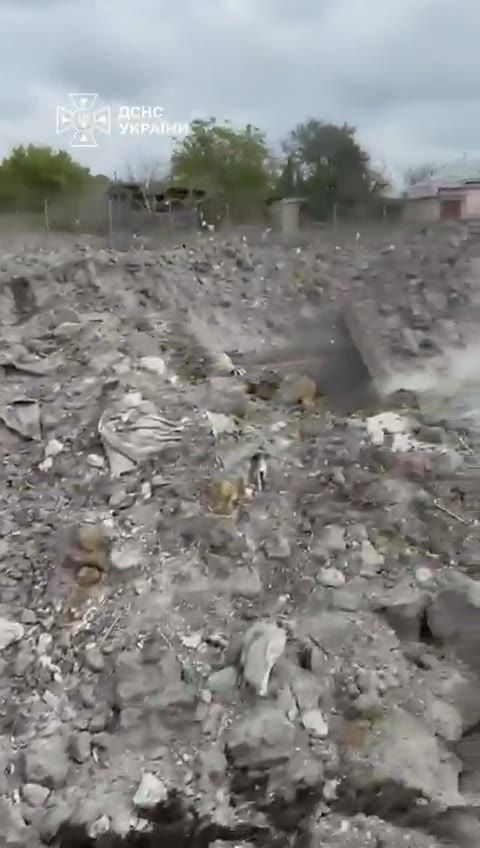
XUkrainian President Volodymyr Zelenskyy posted on X a video of the aftermath of an aerial-bomb strike on Komyshuvakha in the Zaporizhzhia region. The footage shows a large crater, flattened outbuildings and rescue work in darkness, and carries a State Emergency Service of Ukraine watermark. The caption tells readers the settlement was hit several times by aerial bombs that morning and that a school distributing humanitarian aid was struck.
“An utterly horrific Russian attack on the settlement of Komyshuvakha in the Zaporizhzhia region. Since this morning, the settlement has been hit several times by aerial bombs. The strikes targeted a school used for humanitarian purposes – people were receiving humanitarian aid”
Posted on the official X account of the Ukrainian president and released together with footage credited by BBC and Reuters to Ukraine's emergency services. It is a statement by a party to the conflict about an attack on its own territory.
Who posted it
XAccount check
Estimates from public signals — account age, posting pattern, audience — not a judgement of the person behind the account, and separate from whether this post is true.
What stood out
- @ZelenskyyUa is the long-established official X/Twitter account of Volodymyr Zelenskyy, President of Ukraine; created April 2019 and publicly announced by his press service on 7 May 2019.
- Handle is routinely cited and quoted as the official presidential account by major outlets (Ukrinform, Denník N on 29 Oct 2026, ANI, eNCA, Royal Family posts, academic studies of digital diplomacy).
- Recent post attribution is consistent and current (e.g. condolence tweet about the Dnipro train strike, 29 October 2026), indicating an active, continuously operating account rather than a dormant or hijacked one.
- Known impersonation/parody ecosystem exists (e.g. @Zelenskyy_Uaa, flagged by fact-checker Facta in 2024) — the exact handle spelling 'ZelenskyyUa' is the genuine one, not the lookalikes.
- All supplied metadata fields (bio, followers, created_at, verification flag) are null/false, which looks like a failed scrape or API limitation rather than evidence about the account itself; identity should be confirmed from the live profile page.
- Caveat on use as a source: it is official government/presidential communication — reliable for Kyiv's stated positions, but inherently partisan framing of war events; treat claims as official statements requiring corroboration.
Signals (9)+
- Account created
- 2019-04
- Handle matches official
- Yes
- Official announcement
- Press service announcement, 7 May 2019 (Babel, NV, TSN, LIGA.net)
- Metadata completeness
- Very low (all key fields null) — probable collection failure
- Notable news coverage
- Extensive and ongoing; quoted by wire services through October 2026
- Impersonation risk
- Lookalike parody accounts exist (@Zelenskyy_Uaa) but are distinct handles
- Posting cadence
- High-volume official communications, likely staff-operated
- Source type
- State/government official channel
- Fact check history
- Account itself not a fact-check target; its tweets frequently used as primary quote source
Account checked October 29, 2026, 15:05 UTC
The media
Video✓ What is genuine
The footage itself. It is emergency-service material from the site, and the physical damage it shows matches what international outlets describe.
The tells
- ●●● Strong signal The State Emergency Service of Ukraine emblem is watermarked across the footage, matching the agency BBC, Reuters and la Repubblica credit for it.our visual review, cross-checked with BBC, Reuters and la Repubblica
- ●●● Strong signal Our detector scored the clip as overwhelmingly not AI-generated: 0.998 for 'not AI generated' against 0.32 for 'AI generated', with a 0.0 deepfake score.our detector (hive-v3)
- ●●○ Supporting signal The frames show a crater wall, scattered aluminium and debris over churned earth and damaged outbuildings, all consistent with a large glide-bomb strike.our visual review
- ●●○ Supporting signal There are no generative artefacts: no morphing geometry, no garbled signage, no impossible hands or limbs in the rescue footage.our visual review
Synthetic-media detector
Detector ranThe claim stands or falls on whether the media is real, so the detector ran.
Scores are the detector’s estimate for the file as uploaded. A low score does not rule out editing, a spliced caption, or footage shown out of context — those are judged above. Model v3.
How we checked the media
- Reviewed the keyframes from the video ourselves: crater, churned ground, damaged outbuildings, night-time rescue work.
- Checked the visible watermark against the agency credited by BBC, Reuters and la Repubblica for the footage.
- Ran our AI-generation detector on the video.
- Compared the scenes described in the footage with how BBC and Reuters describe the emergency-service material.
Sources
7 sources reviewed- 1Russian bombing kills 26 people at humanitarian aid centre in Ukraine, Kyiv says ↗
BBC · bbc.comReputable outletCenter; light bias tagEvidence
Reports the strike, the second attack on the shelter and the toll of 26.
- 2Russian strikes on Ukrainian shelter and aid centre in Zaporizhzhia region kill 24 ↗
ABC News (Reuters) · abc.net.auUntiereduntiered — treated as signal only, never decisiveEvidence
Reuters reporting via ABC describing the emergency-service footage and the dead, including rescuers and police.
- 3'Exceptionally horrific strike' — Russian bombs hit school used as humanitarian aid center in Zaporizhzhia Oblast, killing 26 ↗
The Kyiv Independent · kyivindependent.comUntiereduntiered — treated as signal only, never decisiveEvidence
Reports the State Emergency Service figure of at least 26 killed.
- 4Russian guided bomb strikes kill dozens at civilian shelter in Zaporizhzhia Oblast – video ↗
LIGA.net · news.liga.netUntiereduntiered — treated as signal only, never decisiveEvidence
Reports Semikin's account of at least nine FAB-3000 bombs and the toll rising to 24.
- 5Russian strikes on aid distribution site and shelter in Komyshuvakha kill at least 24 ↗
ZMINA · zmina.infoUntiereduntiered — treated as signal only, never decisiveEvidence
Describes the sequence of strikes and the site's earlier attack in June 2026.
- 6Raid russo contro un centro aiuti a Zaporizhzhia: le immagini pubblicate da Zelensky ↗
la Repubblica · repubblica.itReputable outletLean LeftContext
An Italian outlet crediting the video to Zelensky and reporting at least 24 dead and five injured.
- 7Minst 18 drept i russiske angrep mot ukrainsk landsby ↗
NRK · nrk.noReputable outletCenter — Norwegian public serviceEvidence
Notes that the claim the strikes targeted an aid site was not independently confirmed at the time.
Further reading
The full story
On 2 November 2026, Russian forces hit the settlement of Komyshuvakha in Ukraine's Zaporizhzhia region with guided aerial bombs. The first strikes landed on a school that was being used as a weekly distribution point for humanitarian aid. People took cover nearby; a second wave of bombs hit the shelter where they had gathered. Rescuers who reached the scene were struck too — the pattern known as a double-tap.
Ukraine's State Emergency Service counted the dead as the rubble was cleared. The figure was 18 when Zelenskyy posted. It rose to 24, then to 26. Among them were two rescuers and four police officers, and five people were injured. Ukrainian authorities opened a war-crimes investigation and declared a day of mourning in the region.
The site's history matters to how the claim landed. The Proliska humanitarian mission had operated there, and it was attacked in June 2026 as well. A place that distributes aid every week, and has been hit before, makes a strike on it feel like more than an accident. That is the kernel of truth under the strongest version of the post: the location's use was known locally, and the same site had been struck before.
What is not in the record is Russia's side. Its military has issued no public comment on this strike, so the question of what the crews knew and what they were aiming at has no answer from the side that launched the bombs.
Kernel of truth
The school was a regular, known humanitarian aid distribution point, and the same site had been attacked before, in June 2026. That makes the strike on it more than an arbitrary hit — but it does not by itself prove what the bomb crews intended.
Timeline
June 2026
The Proliska humanitarian mission, which had operated at the site, is attacked in Komyshuvakha. 5ZMINA
November 2, 2026
Russian guided bombs strike the school used for aid distribution in Komyshuvakha, then a shelter where people had taken cover; the State Emergency Service later reports 26 dead, including two rescuers and four police officers. 1BBC
November 2, 2026
Zelenskyy posts footage of the aftermath on X, giving the death toll as 18. 1BBC
November 2, 2026
The death toll is revised upward to 24, then 26, as rescue work continues. 3The Kyiv Independent
How it was framed
The core claims in the post — the repeated guided-bomb strikes, the school used for aid distribution, the death toll at the time — are confirmed by multiple outlets. The one part that goes beyond the record is the assertion about Russian knowledge and intent, which is an accusation rather than a fabrication. The footage is genuine and correctly attributed.
- Emotional language. 'An utterly horrific Russian attack' opens the post and sets the tone before any detail is given.
- Ongoing-threat framing. 'Since this morning, the settlement has been hit several times' presents the strikes as continuing rather than as a completed event.
- Missing context. The post does not mention that the site had been attacked before, in June 2026, or that the toll was likely to rise — context that would matter to a reader forming a view.
- “Visual proof”. The video of the crater and rescue work is placed in the post to stand as evidence of the attack.
Posted on the official X account of Ukraine's president, a party to the conflict. The footage is credited by BBC, Reuters and la Repubblica to Ukraine's State Emergency Service. No outlet rating is recorded for this account in our source list.
Bias
Leans pro-Ukrainian. The footage is genuine and the core facts are corroborated, but it is released by the Ukrainian president and filmed by Ukraine's own State Emergency Service, a party to the conflict, and it frames the strike as a deliberate attack on civilians while Russia has issued no public response.
Bias describes how the post frames its message — the slant of the language, selection and emphasis — and is judged separately from whether the claim is true. A true claim can still be framed with a strong slant.
How we checked
43 s- 1
Ran three targeted searches on the Komyshuvakha strike, the Zelenskyy post and the emergency-service footage.
- 2
Reviewed the seven sources returned, from BBC and Reuters through Ukrainian outlets to NRK and la Repubblica.
- 3
Reviewed the video keyframes ourselves for physical plausibility and generative artefacts.
- 4
Ran our AI-generation detector on the video.
- 5
Compared the event as described in the post with the event as described by each outlet, checking dates, location and casualty figures.
✓ Claim checked✓ Media checked✓ Sources checked
Why 90% confidence
HighHIGH for the central claim and MODERATE for the double-tap, because several outlets with separate editorial standards report the same strike on the same date, and the footage is attributed to the same agency across them. The deliberate-targeting claim is only LOW confidence because it depends on intent, which no source we found establishes, and Russia has not responded.
Limits. We did not open the full text of the source pages during this check; our comparison rests on the search results and the material recorded in them. We could not obtain any Russian account of the strike.
What we don’t know
- What Russian commanders knew about the site's use as an aid-distribution point.
- Whether the second wave of bombs was aimed at the shelter on purpose or was part of a broader strike pattern.
- What weapon types were used beyond the FAB-3000 figure attributed to the regional official.
- The final death toll, which may still change as rubble is cleared.
Spot it yourself
Find the overstatementLooks suspicious, isn’t proof
- It was posted by a head of state who is a party to the war. That is a reason to check, not evidence the post is wrong — official accounts often post accurate material first.
- The language is charged ('utterly horrific'). Strong wording can accompany true facts.
- The death toll changed after posting. A rising toll is normal in rescue operations, not a sign of dishonesty.
- The video is released by one side's emergency service. Authentic footage can still be selective about what it shows.
The actual evidence
- BBC, Reuters, the Kyiv Independent, LIGA.net, ZMINA, la Repubblica and NRK all report the same strike, on the same day, at the same place.
- The video carries the DSNS watermark, and BBC, Reuters and la Repubblica credit the footage to that agency.
- Our AI-generation detector scored the clip as not AI-generated (0.998) with a deepfake score of 0.0.
- The State Emergency Service confirmed the identities of some of the dead, including two rescuers and four police officers.
- No Russian public statement exists to dispute the account with evidence.
- 1
Separate what happened from what it means
In this post, the bombing and the school's use are events; 'could not have been unaware' and 'deliberate' are conclusions. Ask of each sentence: is this something a camera or a record can show, or something someone is inferring?
- 2
Look for the same event in outlets that do not share a source
If only Ukrainian officials and outlets quoting them report a strike, treat it as a single source. Here, international broadcasters with their own standards carried it too, which raises confidence.
- 3
Expect casualty figures to move
Check the timestamp on any toll you share. A number can be accurate when posted and out of date an hour later, without anyone being wrong.
- 4
Check who released the footage
Find the watermark or credit line and see whether the news organisations using it name the same agency. A watermark can be faked, but when independent outlets name the same source, the attribution is doing real work.
- 5
Ask what the other side says — and notice if it says nothing
Silence from a belligerent is not a denial and not a confirmation. Note it as a gap, not as proof either way.
Takeaway
A post can be accurate in its facts and still overreach in its conclusion. The skill is to sort the sentences that describe what happened from the sentences that claim to know why.
Questions people ask
Did Russia bomb a school in Komyshuvakha?+
Yes. On 2 November 2026 Russian guided bombs struck a school in Komyshuvakha, Zaporizhzhia region, that was being used to distribute humanitarian aid. BBC, Reuters, the Kyiv Independent, ZMINA and others reported the strike, and Ukraine's State Emergency Service confirmed casualties including rescuers and police officers.
Is the Zelenskyy video of the Komyshuvakha strike real?+
Yes. The footage carries the State Emergency Service of Ukraine watermark, and BBC, Reuters and la Repubblica credit the video to that agency. Our AI-generation detector scored it as not AI-generated, with a deepfake score of zero, and the scenes match what the outlets describe.
How many people died in the Komyshuvakha strike?+
Eighteen when Zelenskyy posted. The State Emergency Service later raised the figure to 24, and then to 26, including two rescuers and four police officers, with five injured. In mass-casualty strikes, tolls commonly rise as rubble is cleared.
Was it a double-tap strike?+
Ukrainian officials, including Zelenskyy and regional head Mykhailo Semikin, say a second wave of bombs hit the shelter where people had taken cover, and the State Emergency Service says rescuers were struck at the scene. That fits a double-tap pattern, but the sequencing rests on Ukrainian accounts, so we rate it likely rather than confirmed.
Why does it matter that a toll changes after a post?+
Because a figure that was accurate when written can look wrong later, and screenshots of old posts circulate without timestamps. When someone shares a casualty number, the first thing to check is when it was published and whether a later official figure exists.
Go deeper
- Glide bomb
- A conventional bomb fitted with wings and guidance so it can be released far from the target and steered toward it.
- FAB-3000
- A Russian heavy aerial bomb of roughly 3,000 kg, one of the largest conventional bombs in use.
- Double-tap strike
- An attack in which a second strike hits the same location shortly after the first, often when rescuers and responders have arrived.
- DSNS
- The State Emergency Service of Ukraine, the agency that handles rescue work and released the footage of the strike site.
- Kernel of truth
- The real fact or facts a claim is built on or distorts, which often explains why the claim feels plausible.
People also search for
For educators+
- The post says Russia 'could not have been unaware' the site was an aid point. What evidence would be needed to turn that from an inference into a proven fact, and is that evidence realistically obtainable during a war?
- Seven outlets report this strike, but several rely on the same Ukrainian statements. How would you decide whether they count as independent confirmation?
- If a death toll is 18 at noon and 26 by night, how should a news organisation report the first figure so that readers are not misled later?
About this check
- Platform
- X
- Posted by
- @zelenskyyua
- Posted
- November 2, 2026
- Age when checked
- Under 24 hours old when checked
- Where it spread
- Ukraine, Russia
- Audience
- International audience
- Language
- EN
- Status
- ● Post is live
- Verified
- November 3, 2026, 03:00 UTC
- Published
- November 3, 2026, 03:00 UTC
Reach. 11,030 likes; embedded by Onet, Welt, Bild, tvn24, 20minutos, BFM; toll reported 18 -> 24 -> 26
This verdict was generated with AI from the sources shown. AI can make mistakes — check the sources before relying on it.
Check anything yourself, in seconds.
Share any social post or video to What the Fact and get the verdict, the confidence, and the receipts.