Was the Kyiv Independent newsletter hacked to send a fake email about a nuclear warhead on Kyiv?
Was the Kyiv Independent hacked so that subscribers received a fake newsletter saying Zelensky had launched a nuclear warhead at Kyiv?
True
The breach and the fake Russian-language email are confirmed; the email's nuclear-warhead story is fabricated.
TRUE. On the night of 3-4 November 2026, hackers gained access to The Kyiv Independent's content management system and one of its newsletter-sending services and emailed subscribers a Russian-language fake claiming Zelenskyy had launched a nuclear warhead at Kyiv. Editor-in-chief Olha Rudenko confirmed the breach, apologised to readers and said the content points to a Russian operation. No nuclear strike occurred.
 Genuine
Claims
✓ 2 true · ✕ 1 falseKyiv Independent's newsletter system was hacked and subscribers received a Russian-language email falsely saying Zelenskyy launched a nuclear warhead on Kyiv12357
This is settled by the outlet itself. The Kyiv Independent's editor-in-chief, Olha Rudenko, wrote to readers that hackers had gained access to the outlet's content management system and one of its newsletter-sending services and mailed Russian-language messages to its subscriber base. She said the newsroom did not send the email and apologised to readers. That first-party confirmation is the decisive evidence: the affected organisation is not denying the breach, it is describing it. Independent reporting from several Ukrainian outlets (hromadske, the Institute of Mass Information, TSN, NV, Kyiv24, Ekonomichna Pravda) and Sweden's Expressen describes the same set of facts on the same dates. Those outlets are not a single origin: Rudenko's letter is the common source, but each newsroom separately reported the hack, the language of the email and its content. The screenshot in the post matches what the coverage describes — Cyrillic body text and a Telegram attribution — and the post itself appears to be where the message surfaced first. A reader should weigh that the confirmation comes from the victim, which is what you want here, and that no source in the record disputes it.
Still open: Who exactly carried out the breach, and whether the same actor ran the earlier air-raid app fakes, has not been established.
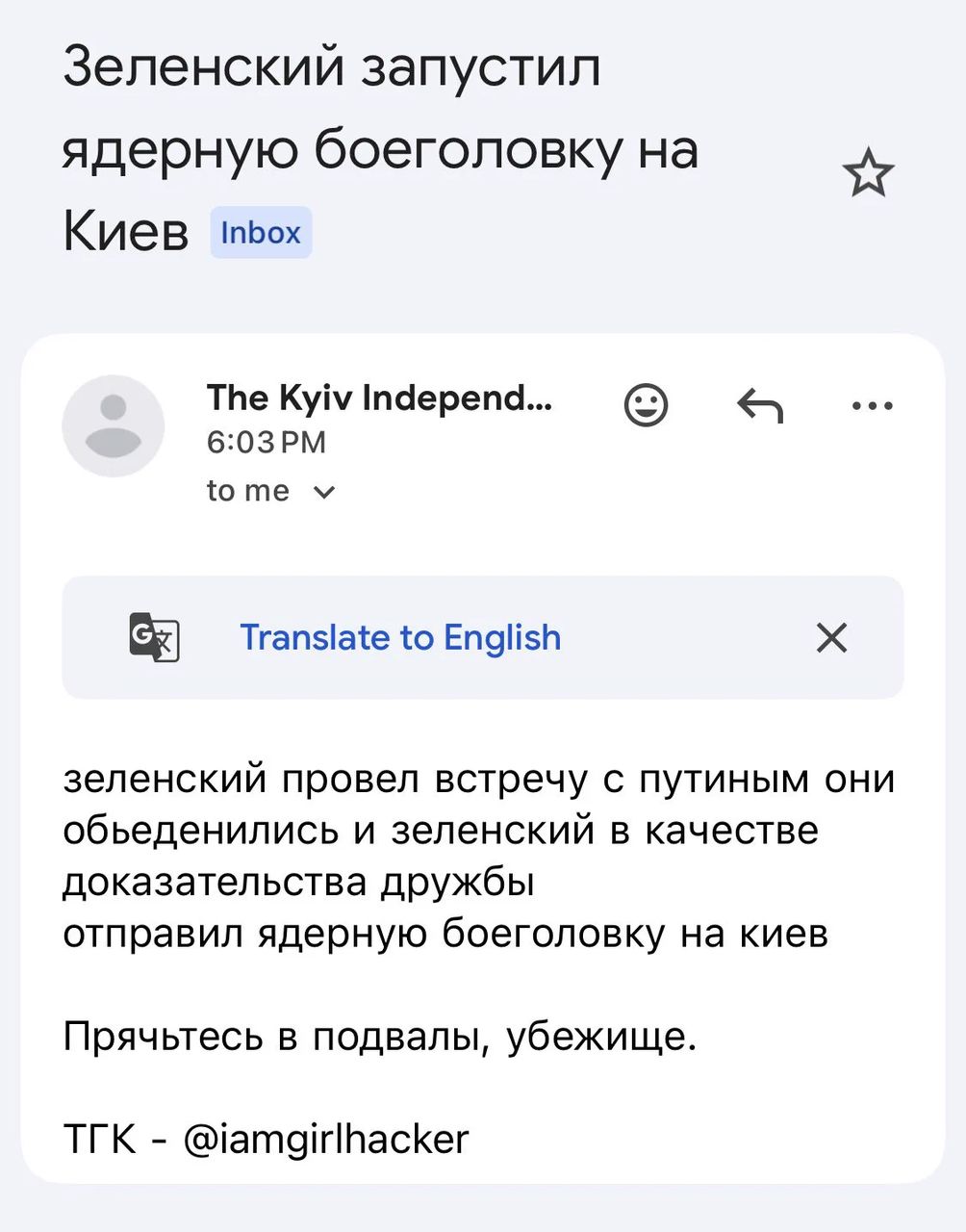
Ukrainian President Volodymyr Zelenskyy met with Vladimir Putin, the two united, and Zelenskyy fired a nuclear warhead at Kyiv as proof of friendship47
This is the content of the fraudulent email, not a real event. No nuclear strike on Kyiv took place: Ukrainian authorities and the outlet's own newsroom treated the message as a hostile hack, and the outlet's editor described it as an attack on the newsroom. Reporting names a hacker group signature — a Telegram handle, @iamgirlhacker — as publishing the message as a psychological operation. The claim is also implausible on its face: no reporting in the record describes any meeting between the two presidents of the kind described, and a nuclear detonation on a capital city would be instantly and universally detectable, not delivered first as a newsletter. That is the classic test for this sort of content: the more enormous the claimed event, the more independent traces it would leave. Here the only trace is the email itself, which is the thing under examination. A reader should treat an email's contents as a claim, not as evidence of what happened.
The hackers are most likely Russian26
“Ймовірно, російські хакери”
This is an assessment, and the person making it is careful about its limits. Rudenko said everything known, including the email's content, indicates a Russian operation, and she pointed to a resemblance with Russian-language fake alerts pushed through Ukraine's state air-raid alert app on 1 November 2026. She also said the outlet could not yet definitively confirm that the same actor was behind both. That is why this sits at LIKELY_TRUE rather than TRUE: the judgement comes from the targeted outlet, which knows its own systems, but it rests on the content and method of the attack rather than on a named group or a technical attribution the record shows us. Multiple outlets repeat the Russian attribution, but several are relaying Rudenko's statement rather than adding independent evidence, so they count as one line of reasoning, not many. The air-raid app comparison is the strongest supporting detail: a similar Russian-language fake with the same flavour had gone out days earlier through a different channel, which suggests a pattern even if it does not prove a single hand. Treat the attribution as a well-grounded assessment, not a closed finding.
Still open: Whether the same actor ran the earlier fake air-raid app alerts is not confirmed in the record.
What was posted
XA post on X by journalist Ostap Yarysh sharing a phone screenshot of an email in Russian, presented as a message sent to The Kyiv Independent's newsletter subscribers. The caption suggests the outlet was hacked by Russians and quotes the email's central claim about a nuclear warhead. The post asks readers to believe that subscribers received the fraudulent email and that a hack was behind it.
“Seems like @KyivIndependent was hacked by the Russians. Their newsletter subscribers just received an email in Russian saying, “Zelenskyy launched a nuclear warhead on Kyiv.””
Posted on X by journalist Ostap Yarysh. Multiple outlets credit his screenshot as the first public disclosure of the fake email.
Who posted it
XAccount check
Estimates from public signals — account age, posting pattern, audience — not a judgement of the person behind the account, and separate from whether this post is true.
What stood out
- Account belongs to Ostap Yarysh, a named Ukrainian journalist with a longstanding public identity across X and Facebook.
- Career verified by multiple independent outlets: Voice of America Ukrainian Service correspondent (2019–2025), Pentagon/US-Ukraine relations coverage; now Media Advisor at Razom for Ukraine Advocacy in Washington.
- Account is old and high-volume: joined October 2011, ~63,300 tweets, ~94,160 followers, ~803 following — consistent with a long-running human journalist account, not a sockpuppet.
- Cited as a first-hand source by reputable outlets (RBC-Ukraine, Hromadske, Kyiv24, Ukrainska Pravda, NV) for events he witnessed or broke, e.g. the November 2026 Kyiv Independent email hack.
- No fact-check findings or misinformation flags against him; he has himself debunked Russian disinformation (e.g. 'War On Fakes').
- Posts attributed by media match his known beat (US politics, Ukraine-US defense, Washington events), indicating consistent topical authenticity.
- Metadata is sparse (no bio/follower data supplied, platform verification marked false), but open-source evidence overwhelmingly confirms a real, established journalist.
- Note: he now works in Ukraine-advocacy communications, so content may carry an advocacy framing, though sourcing and factual track record remain strong.
Signals (10)+
- Account created
- 2011-10
- Followers
- 94160
- Following
- 803
- Tweets
- 63309
- Follower ratio
- 117.3
- Affiliation
- Razom for Ukraine Advocacy (Media Advisor); former Voice of America Ukrainian Service correspondent
- Notable news coverage
- Regularly quoted/cited by Ukrainian and international outlets
- Fact check history
- No adverse fact-check records; has publicly debunked Russian disinformation
- Posting cadence
- High-volume, sustained over many years
- Bot signals
- None observed
Account checked November 4, 2026, 15:09 UTC
The media
Image✓ What is genuine
The screenshot appears to be a genuine capture of the fraudulent email as received. What is genuine is the email's existence and delivery; the nuclear-warhead story inside it is fabricated.
The tells
- ●●○ Supporting signal The image is a phone capture of a mail client: sender name, a 6:03 PM timestamp, Cyrillic body text and a standard 'Translate to English' prompt, with no signs of compositing.our visual review
- ●●○ Supporting signal The Cyrillic wording matches what the outlet's editor and news reports say was mailed to subscribers.our visual review
- ●●● Strong signal The breach is confirmed independently of the image, so the screenshot is not the thing holding up the claim.Kyiv Independent editor-in-chief Olha Rudenko, per source 2
Synthetic-media detector
Detector not consultedThe media is incidental to the claim; the detector was not needed.
How we checked the media
- Compared the screenshot's layout, typography and rendering with what the reporting describes was sent.
- Checked the Russian wording in the image against the email content described in coverage.
Sources
7 sources reviewed- 1«Зеленський і путін об'єдналися». Kyiv Independent заявив про злам системи, через який читачі отримали лист про «ядерну боеголовку на Київ» ↗
Hromadske · hromadske.uaUntiereduntiered — treated as signal only, never decisiveEvidence
Reports that readers received the nuclear-warhead email and that the outlet said a system was hacked.
- 2Kyiv Independent зазнав хакерської атаки: читачам розіслали фейк про ядерний удар ↗
Institute of Mass Information · imi.org.uaUntiereduntiered — treated as signal only, never decisiveEvidence
Carries Rudenko's statement that the newsroom did not send the letter and that the content points to a Russian operation.
- 3Хакери зламали сайт The Kyiv Independent та розсилали фейкові повідомлення про «ядерну боеголовку на Київ» ↗
NV · nv.uaUntiereduntiered — treated as signal only, never decisiveEvidence
Describes access to the CMS and a mailing service and the second wave of emails on 4 November.
- 4"Ядерна боеголовка на Київ": читачі Kyiv Independent отримали дивні повідомлення — що насправді сталось ↗
TSN · tsn.uaUntiereduntiered — treated as signal only, never decisiveEvidence
Describes the fake about Zelenskyy and Putin 'uniting' and a nuclear warhead launch.
- 5Kyiv Independent har blivit hackade ↗
Expressen · expressen.seUntiereduntiered — treated as signal only, never decisiveContext
Independent Swedish reporting that a system was hacked and a Russian-language fake went to readers.
- 6Хакеры взломали The Kyiv Independent: какие последствия атаки ↗
Ekonomichna Pravda · epravda.com.uaUntiereduntiered — treated as signal only, never decisiveContext
Notes the resemblance between the newsletter emails and fake alerts pushed through the state air-raid app.
- 7Російські хакери зламали Kyiv Independent та поширили фейк про ядерний удар по Києву ↗
Kyiv24 · kyiv24.newsUntiereduntiered — treated as signal only, never decisiveEvidence
Identifies Yarysh's screenshot as the first public disclosure and the newsroom's denial.
Further reading
- 2Institute of Mass Information Carries the editor-in-chief's statement, the decisive first-party confirmation, including her caveat on attribution.
- 3NV Details the CMS and mailing-service breach and the second wave of fake emails on 4 November.
- 5Expressen A non-Ukrainian outlet's account, useful for seeing how the incident was reported outside Ukraine.
- 7Kyiv24 Explains the role of Yarysh's screenshot as the first public disclosure.
The full story
The claim rests on a real event with a false payload. Hackers did break into The Kyiv Independent's systems on the night of 3-4 November 2026, reaching the outlet's content management system and one of its newsletter-sending services. They used that access to email the outlet's subscriber list a Russian-language message that read, in effect, that Zelenskyy had met and united with Putin and launched a nuclear warhead at Kyiv as proof of friendship.
That is where the truth ends. No nuclear strike occurred. The outlet's editor-in-chief, Olha Rudenko, wrote to readers that the newsroom had not sent the email, apologised, and said everything known about it pointed to a Russian operation. She drew a line to Russian-language fakes pushed through Ukraine's state air-raid alert app on 1 November 2026, while cautioning that the same actor could not yet be confirmed. A second wave of emails in Russian and English followed on 4 November, and posts placed on the news site were quickly removed. The outlet said no financial data appeared compromised.
The screenshot in the post is the reason the story spread as fast as it did: it was the message as received, posted by a journalist and then credited by Ukrainian outlets as the first public disclosure. The pattern is worth remembering. A genuine breach produced a genuine email, and the email carried a fabricated claim. The channel was real; the contents were theatre.
Kernel of truth
The Kyiv Independent's systems really were compromised and subscribers really did receive a Russian-language email — but its story of a nuclear warhead on Kyiv was fabricated.
Timeline
November 1, 2026
Russian-language fake alerts are pushed through Ukraine's state air-raid alert app, a pattern the outlet later compares the newsletter email to. 2Institute of Mass Information
November 3, 2026
Journalist Ostap Yarysh posts a screenshot of the fake email on X, credited as the first public disclosure. 7Kyiv24
November 3, 2026
In the night of 3-4 November, hackers access the outlet's CMS and a newsletter service and mail subscribers the fake Russian-language message. 3NV
November 4, 2026
A second wave of Russian- and English-language fake emails follows; the outlet says no financial data appeared compromised. 3NV
How it was framed
The post itself is accurate about a real breach, but the material at its centre — the email — is genuine only as an object: a real message delivered through a real hacked system, carrying fabricated content. The fabricated element is the claim of a nuclear strike; the false context is presenting the email's contents as news of an event rather than as a hostile message.
- “Visual proof”. The post attaches a phone screenshot of the email, so readers see the message rather than only a description of it.
- Ongoing-threat framing. The caption ties the email to a state actor: 'hacked by the Russians'.
- Borrowed authority. The caption quotes the email's own words — 'Zelenskyy launched a nuclear warhead on Kyiv' — as the thing subscribers received.
Posted on X by journalist Ostap Yarysh. Multiple Ukrainian outlets credit his screenshot as the first public disclosure of the fake email.
Bias
The post reports a cyberattack on a news outlet and quotes the fraudulent email verbatim; the framing is hedged ('seems like') and is the same assessment given by the outlet's own editor-in-chief.
Bias describes how the post frames its message — the slant of the language, selection and emphasis — and is judged separately from whether the claim is true. A true claim can still be framed with a strong slant.
How we checked
42 s- 1
Searched for reporting on the Kyiv Independent newsletter hack and the claimed nuclear-warhead email.
- 2
Searched for the outlet's own statement and editor-in-chief Olha Rudenko's letter to readers.
- 3
Compared the screenshot in the post with the email content described in coverage.
- 4
Reviewed the image visually for signs of compositing or manipulation.
✓ Claim checked✓ Media checked✓ Sources checked
Why 93% confidence
ModerateHIGH on the central claim and on the falsity of the nuclear-warhead story, because the outlet itself confirmed the breach and the fake email, and several independent newsrooms reported the same facts. The Russian attribution sits at MODERATE because it is the outlet's assessment, supported by similarity to earlier fakes rather than a named actor. The image was assessed as AUTHENTIC by visual review; it was not pivotal, because the breach is confirmed without it.
Limits. We did not run a technical forensic analysis of the screenshot, and we did not independently examine the outlet's systems or the hacker infrastructure. The record does not name a specific group or individual behind the breach.
What we don’t know
- Who exactly carried out the breach.
- Whether the same actor was behind the earlier fake air-raid app alerts on 1 November 2026.
- The full technical method used to reach the newsletter service.
- Whether any other systems beyond the CMS and the named mailing service were accessed.
Spot it yourself
Why it looked fakeLooks suspicious, isn’t proof
- The email is in Russian, while the outlet publishes in English — an odd language choice that makes people suspect a fake, but here it was genuinely what was sent.
- A claim of a nuclear strike on a capital city reads as alarmist, which makes it easy to dismiss outright; alarmist content still has to be checked.
- The screenshot is a phone capture with a 'Translate to English' prompt, which some readers read as a sign of fabrication; it is just how a mail app renders foreign text.
The actual evidence
- The outlet's own editor-in-chief confirmed the breach and emailed subscribers about it, which is first-party confirmation.
- Multiple independent newsrooms reported the same hack on the same days, including one outside Ukraine.
- The screenshot's Russian wording matches what the reporting says was sent.
- No reporting anywhere in the record describes a nuclear strike, which is the kind of event that would be impossible to miss.
- 1
Ask who would be reporting this if it were true
A nuclear detonation would be covered by every major news organisation within minutes. If the only trace is one email, treat the email as the claim, not the proof.
- 2
Find the organisation's own statement
Go to the outlet's website and social accounts and look for a notice to readers. Here the editor-in-chief's letter is the thing that settles it.
- 3
Check the channel, not just the words
Ask whether the message really came through the outlet's system. A genuine send from a hacked account tells you the account was hacked, not that its contents are true.
- 4
Compare the media with the reporting
Look at the language, sender name and timestamp in a screenshot and check whether coverage describes the same details. Matching details support authenticity; they do not support the email's story.
- 5
Separate the two questions
Ask 'was there a hack?' and 'was there a strike?' separately. Here the first is true and the second is false, and mixing them is how the fake spreads.
Takeaway
A real breach can deliver a fake story. Confirm the channel and the contents separately — a genuine email from a hacked account proves the hack, never the headline inside it.
Questions people ask
Was the Kyiv Independent actually hacked?+
Yes. The outlet's editor-in-chief, Olha Rudenko, confirmed that hackers accessed its content management system and one of its newsletter-sending services on the night of 3-4 November 2026, and that a Russian-language email went to subscribers. The newsroom said it did not send the message and apologised to readers.
Did Zelenskyy launch a nuclear warhead at Kyiv?+
No. That claim came from the fraudulent email, not from any real event. No nuclear strike is reported anywhere in the record. Ukrainian authorities and the outlet's newsroom treated the message as a hostile hack, and the email's story is fabricated.
Who was behind the fake Kyiv Independent email?+
The outlet's editor-in-chief said everything known, including the email's content, points to a Russian operation, and compared it to Russian-language fake alerts sent through Ukraine's state air-raid alert app on 1 November 2026. She said the outlet could not yet confirm the same actor was behind both.
Why did the fake email spread so quickly?+
Because it came through a real channel. Subscribers really did receive it from the outlet's own newsletter system, and journalist Ostap Yarysh posted a screenshot that Ukrainian outlets credit as the first public disclosure. A genuine delivery made a fabricated story look credible.
What should I do if I get a suspicious newsletter email?+
Don't act on its contents or forward it as news. Check the organisation's website and official accounts for a statement, and treat the message as a claim until the sender confirms or denies it. Here the outlet's own notice to readers was the decisive source.
Go deeper
- CMS (content management system)
- The software a newsroom uses to write, edit and publish articles and other content to its website.
- Newsletter-sending service
- A third-party tool an outlet uses to mail its subscriber list, which is separate from the public website.
- Psychological operation
- A hostile action designed to influence how people feel and act, rather than to damage equipment or steal data.
- Attribution
- The judgement about who was responsible for an attack, which can range from a strong assessment to a confirmed finding.
- False context
- When genuine material — a real photo, video or message — is used in a way that gives it a false meaning.
People also search for
For educators+
- The email was genuinely sent, but its contents were false. How would you explain that distinction to someone who says 'but it came from their account'?
- The Russian attribution is described as 'most likely'. What makes an attribution strong enough to call confirmed rather than likely?
- If you saw a screenshot of an alarming email, what three checks would you run before sharing it?
About this check
- Platform
- X
- Posted by
- @ostapyarysh
- Posted
- November 3, 2026
- Age when checked
- Under 24 hours old when checked
- Where it spread
- Ukraine
- Audience
- International audience
- Language
- EN
- Status
- ● Post is live
- Verified
- November 4, 2026, 15:10 UTC
- Published
- November 4, 2026, 15:10 UTC
Reach. 172 likes on X (syndication, 4 Nov); covered by dev.ua and Hromadske; Kyiv Independent editor confirmed a breach
This verdict was generated with AI from the sources shown. AI can make mistakes — check the sources before relying on it.
Check anything yourself, in seconds.
Share any social post or video to What the Fact and get the verdict, the confidence, and the receipts.