Did Iran put up a billboard in Tehran reading 'We will kill Trump'?
Did Tehran put up a billboard threatening to kill Donald Trump on US midterm Election Day?
True
The billboard is real and was widely reported; the 'terrorists' label is opinion.
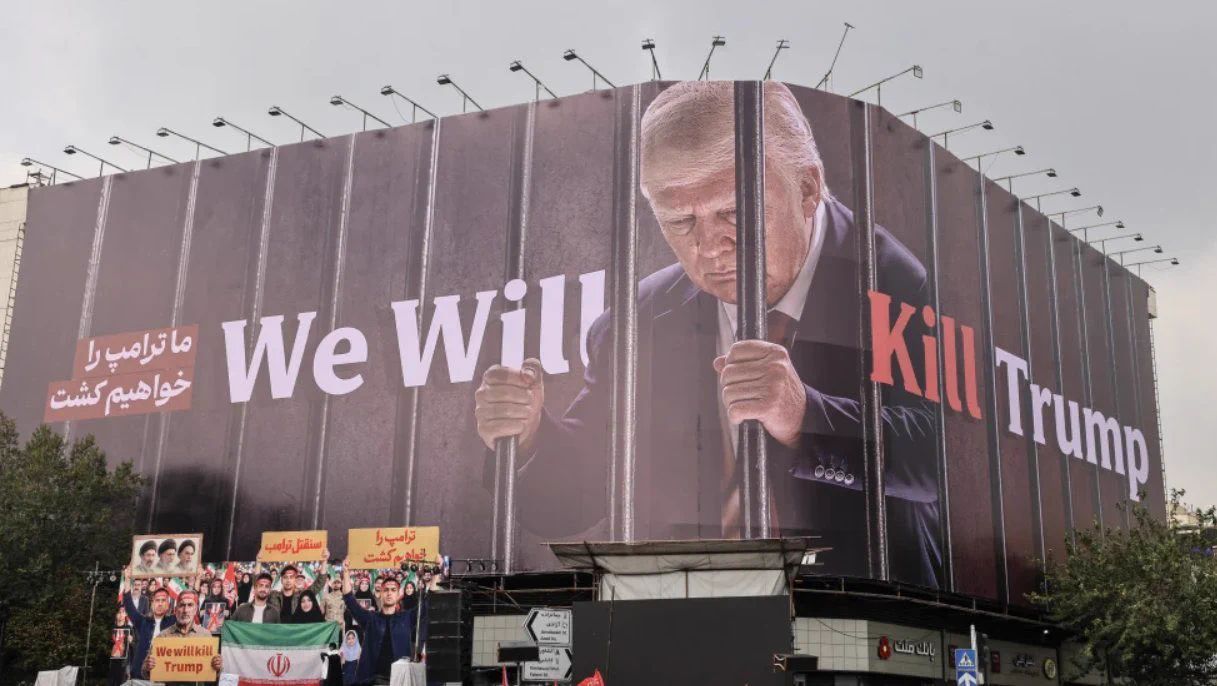
TRUE. On 3 November 2026, Iranian authorities unveiled a large billboard over Enghelab Square in central Tehran reading "We will kill Trump" and showing President Donald Trump behind bars with his head bowed, according to AFP and widespread international coverage. The photograph is genuine. The post's wording calling Iran's leaders "terrorists" is advocacy, not fact.
 Genuine
Claims
✓ 3 trueIranian authorities unveiled a huge billboard in Tehran's Enghelab Square reading "We will kill Trump" (in English and Persian), depicting Trump behind bars with his head bowed.12345
This is the claim the headline rests on, and it holds. AFP reported on 3 November 2026 that a massive billboard towering over Enghelab Square in Tehran read "We will kill Trump" and showed the US president behind bars with his head bowed. That dispatch was carried by a wide spread of outlets — NDTV, The Hindu, The Straits Times, Arab News, Malay Mail, L'Orient Today, MTV Lebanon and India Today among them — each describing the same wording, location and depiction. The decisive point is not the photograph in the post but the independent reporting: agencies and newspapers that did not rely on this account described the same display on the same day. The Persian caption on the billboard, "ما ترامپ را خواهیم کشت", translates to the same threat as the English slogan. Our separate search for fact-checks or reports calling the image fabricated or AI-generated found none. Because the core elements are confirmed by multiple outlets working from agency reporting, the confidence is high.
This is a fresh, renewed threat ("again") rather than an isolated incident.7
The word "again" is doing real work in the post, and it checks out. Coverage documents repeated state-sponsored Tehran billboards and installations mocking and threatening Trump since the war began on 28 February 2026. The clearest earlier example is a July 2026 billboard over the same Enghelab Square, reported by The New York Times, showing Trump in a coffin with white graffiti reading "We Will Kill Trump" in both Persian and English. So the November display is not a one-off poster but the latest in a series, and the post's "again" is accurate. The evidence here is thinner than for the central claim — one strong outlet for the July precedent rather than a dozen — but it directly corroborates the specific word the post chose. We rate it TRUE at high confidence because a single authoritative report of the earlier display is enough for a narrow point about repetition.
The display is state-backed and was mounted by Tehran's municipal authorities.16
The post does not spell out who put the billboard up, but its implication — that this is official Iranian messaging, not a private stunt — is supported. AFP describes state-sponsored billboards and murals as a fixture of Iranian public space, which is the context in which this display sits. The Daily Express and The Media Line report that Tehran's municipal authorities are behind the accompanying prison-cell installation campaign, and quote the authorities saying it is intended to highlight Iranian demands for justice. That gives us a named institutional actor and its own stated rationale. The caveat is that the sourcing for the municipal role is a tabloid report and a regional outlet rather than an official Iranian statement we could open directly. The claim is still TRUE, but at slightly lower confidence than the central claim because it rests on fewer, less weighty sources.
Still open: No official Iranian government or municipality statement was opened directly; the municipal role rests on secondary reporting.
The Iranian authorities are "terrorists occupying Iran".
This is not a checkable factual assertion but a political characterisation of the Iranian government. "Terrorists" is a label with legal and political meanings that vary by who is applying it, and "occupying" frames the government as illegitimate and foreign-imposed. Reasonable people and different governments disagree about both. We can check whether Iran's authorities put up the billboard; we cannot check whether they are "terrorists occupying Iran", because that is an argument, not an observation. Treating it as opinion does not make it false or illegitimate to say — it simply puts it in a different category from the billboard itself. The rest of the post is factual and holds up. A reader should weigh the two parts separately: accept the verified display, and recognise the "terrorists" phrase as the account's own advocacy framing.
What was posted
XA post on X from an account called Israel War Room shared a photograph of a large street billboard with the caption claiming Iran's leaders were threatening President Trump's life again. The image shows a billboard depicting Trump behind bars, with text in English and Persian, in an urban square with lamp posts, trees and a crowd holding placards. The post asks readers to see the display as a renewed, open threat by the Iranian government.
“🚨 The terrorists occupying Iran are openly threatening President Trump’s life again.”
Posted on X by the account @IsraelWarRoom. No posting date, user bio, engagement figures or group context was available in our input.
Who posted it
XAccount check
Estimates from public signals — account age, posting pattern, audience — not a judgement of the person behind the account, and separate from whether this post is true.
What stood out
- @IsraelWarRoom is a real, openly branded US-based pro-Israel advocacy organisation, not an anonymous fake persona; its website dates to around 2020 and it had roughly 250,000 X followers by late 2023.
- It is not an Israeli government body: Radio Free Asia's fact-check desk found no evidence it speaks for Israel, despite Chinese media describing it as 'Israeli official'.
- Media Bias/Fact Check rates it Right biased with 'Mixed' factual reporting and 'low credibility', citing poor sourcing, one-sided framing, and no transparency about funding or ownership.
- It has amplified false or misleading content, including a 2023 'Pallywood' claim about a slain Gaza child and an old 2021 Lebanon border video presented as current (later deleted).
- Some claims about it are themselves false: Reuters, PolitiFact and Check Your Fact found its helicopter-emoji post came after news of Raisi's crash broke, not before.
- Its output is extremely high-volume and around-the-clock, with long multi-tweet threads, consistent with a team-run advocacy operation rather than a single person or automated bot network.
- Profile metadata supplied here is sparse (no creation date, follower count or posts), and the 'not verified' flag conflicts with 2024-2026 captures showing a verification badge, so verification status is uncertain.
Signals (7)+
- Posting cadence
- Very high; 24/7 rapid-response posting and long threads (e.g. 64-tweet thread)
- Follower ratio
- ~250k X followers (Nov 2023); ~127k Instagram followers; following count not supplied
- Notable news coverage
- Reuters, PolitiFact, Radio Free Asia, Jewish Journal, Media Bias/Fact Check
- Fact check history
- Multiple misleading/false claims; also falsely accused of advance knowledge of Raisi crash
- Affiliation
- US-based pro-Israel advocacy nonprofit; not an Israeli government entity
- Transparency
- Low: founders, funding and ownership not clearly disclosed
- Bot network evidence
- None found; high cadence explained by team operation
Account checked November 4, 2026, 02:56 UTC
The media
Image✓ What is genuine
The photograph shows a real billboard that stood over Enghelab Square in Tehran on 3 November 2026, with the reported English and Persian wording and the depiction of Trump behind bars. Independent agency reporting confirms the display existed.
The tells
- ●●● Strong signal The Persian caption "ما ترامپ را خواهیم کشت" translates to the same threat as the English wording reported by AFP and other outlets.our visual review and AFP reporting
- ●●● Strong signal The street scene — lamp posts, trees, signage and a crowd holding placards — matches an ordinary Tehran square rather than a studio composite.our visual review
- ●●○ Supporting signal Lighting and perspective across the billboard and the street are consistent, with no visible edge artefacts or mismatched shadows.our visual review
- ●●○ Supporting signal No fact-checker or outlet claimed the imagery was fabricated; the only 'AI generated' text our searches surfaced was a stray site tag, not a claim about this billboard.our searches
Synthetic-media detector
Detector not consultedSources settled the claim on their own; the detector was not needed.
How we checked the media
- Reviewed the image visually for signs of compositing, mismatched lighting or generative artefacts.
- Compared the scene, wording and depiction against agency and newspaper reporting of the 3 November 2026 billboard.
- Checked the Persian caption against the reported English wording.
- Searched for any fact-check or report claiming the billboard or image was fabricated or AI-generated.
Sources
7 sources reviewed- 1Iran unveils huge billboard with threat against Trump's life ↗
L'Orient Today / AFP · today.lorientlejour.comUntiereduntiered — treated as signal only, never decisiveEvidence
AFP reports the billboard over Enghelab Square reading "We will kill Trump" and showing Trump behind bars with his head bowed, and describes state-sponsored displays as a fixture in Iran.
- 2"We Will Kill Trump": US President Behind Bars In Massive New Iran Billboard ↗
NDTV · ndtv.comUntiereduntiered — treated as signal only, never decisiveEvidence
NDTV independently reports the massive billboard and banners pledging to kill Trump across Tehran.
- 3Iran unveils huge billboard with threat against Donald Trump's life ↗
The Hindu · thehindu.comUntiereduntiered — treated as signal only, never decisiveEvidence
The Hindu reports the 3 November 2026 unveiling with the same pledge wording.
- 4'We will kill Trump': Iran unveils huge billboard threatening US president ↗
The Straits Times · straitstimes.comUntiereduntiered — treated as signal only, never decisiveEvidence
The Straits Times reports the 3 November unveiling of the billboard and banners.
- 5Iran unveils huge billboard with threat against Trump's life ↗
Arab News Japan / AFP · arabnews.jpUntiereduntiered — treated as signal only, never decisiveEvidence
Arab News Japan carrying AFP confirms the depiction of Trump behind bars over Enghelab Square.
- 6Iran unveils chilling 'Kill Trump' mural in central Tehran ↗
Daily Express · express.co.ukLow reliabilityRight — tabloidEvidence
Daily Express reports Tehran's municipal authorities are behind the prison campaign and their stated rationale.
- 7Central Tehran Billboard Depicts Trump in a Coffin ↗
The New York Times · nytimes.comReputable outletLean Left (AllSides) — distinguish news/opinionContext
The New York Times reported the July 2026 Enghelab Square billboard showing Trump in a coffin with "We Will Kill Trump", establishing the pattern.
Further reading
- 1L'Orient Today / AFP The AFP dispatch is the anchor report: it names the square, the slogan and the depiction in one place.
- 7The New York Times Shows the earlier July 2026 billboard in the same square, which is the evidence behind the word "again".
- 6Daily Express Reports the municipal authorities' role and their stated rationale for the prison-cell campaign.
The full story
The kernel of truth here is large and undeniable: a giant billboard really did tower over one of central Tehran's busiest squares, carrying the words "We will kill Trump" in English and Persian and showing the US president behind bars with his head bowed.
The display was part of a wider propaganda push. Alongside the main billboard, other Tehran displays mocked Vice President JD Vance, envoy Steve Witkoff and Israeli Prime Minister Benjamin Netanyahu. Crowds gathered waving red flags and demanding revenge for Ayatollah Ali Khamenei, who was killed in US-Israeli strikes on 28 February 2026. AFP and a long list of international outlets reported the scene as an escalation of state-sponsored anti-US messaging.
This was not a sudden departure. The New York Times reported a July 2026 billboard over the same square showing Trump in a coffin, already bearing the words "We Will Kill Trump". Tehran's municipal authorities are reported to be behind the accompanying prison-cell installation, which they describe as highlighting Iranian demands for justice.
That background explains why the post felt plausible to some and suspicious to others. A government putting a death threat on a billboard is unusual enough that people instinctively look for a catch. Here there was none: the catch was in the caption, not the picture.
Kernel of truth
Iran's authorities did unveil a real billboard over Enghelab Square on 3 November 2026 carrying the threat "We will kill Trump", continuing a series of state-sponsored displays since the war began on 28 February 2026.
Timeline
February 28, 2026
US-Israeli strikes kill Ayatollah Ali Khamenei; the war that frames later Tehran propaganda displays begins.
July 2026
A billboard over Enghelab Square shows Trump in a coffin with graffiti reading "We Will Kill Trump" in Persian and English, per The New York Times. 7The New York Times
November 3, 2026
Iran unveils a large billboard over Enghelab Square reading "We will kill Trump" and showing Trump behind bars, reported by AFP and many outlets. 1L'Orient Today / AFP
How it was framed
The post's factual content — the existence, wording and location of the billboard, and the fact that it is a renewed threat — is confirmed by independent reporting. The only non-factual element is the phrase "terrorists occupying Iran", which is opinion framing within an otherwise accurate post, not a disorder type in itself.
- Emotional language. "The terrorists occupying Iran" and the siren emoji framing the sentence as an urgent alert.
- Ongoing-threat framing. "openly threatening President Trump's life again" — the word "again" casts the display as part of a continuing campaign.
- “Visual proof”. The photograph of the billboard is attached as self-evident proof of the threat.
- Us vs. them. "The terrorists occupying Iran" sets the Iranian authorities apart as an illegitimate enemy rather than a government.
Posted on X by the account @IsraelWarRoom. No posting date, bio, follower figures or engagement data were available in our input, so we cannot describe the account's reach or history.
Bias
Leans anti-Iranian government / pro-Israel advocacy. The account is a pro-Israel advocacy outlet and frames the Iranian state as "the terrorists occupying Iran", loaded language that goes beyond the neutral reporting of the billboard that it illustrates. The underlying factual content is accurate, so the slant is in the characterisation rather than the facts.
Bias describes how the post frames its message — the slant of the language, selection and emphasis — and is judged separately from whether the claim is true. A true claim can still be framed with a strong slant.
How we checked
43 s- 1
Searched for the billboard using the slogan and location, in English and Persian transliteration.
- 2
Searched specifically for any claim that the billboard or image was fake or AI-generated.
- 3
Reviewed the image visually for compositing, lighting inconsistencies and generative artefacts.
- 4
Compared the image's scene, wording and depiction against agency and newspaper reporting from 3 November 2026.
- 5
Checked whether earlier Tehran displays used the same slogan, to test the post's 'again'.
✓ Claim checked✓ Media checked✓ Sources checked
Why 90% confidence
HighConfidence is HIGH because the central claim is confirmed by AFP and a wide spread of independent outlets describing the same billboard, location, wording and depiction on the same day. Our search for a debunking found none. The detector was not run; the assessment rests on visual review and the reporting record. We did not lower the band for the post's loaded language, because the factual claim does not depend on it.
Limits. We did not open the source pages directly; our comparison relied on search results and snippets. We could not find an official Iranian statement confirming the municipal role, and no detector was run on the image because independent reporting already resolved the claim.
What we don’t know
- Whether the billboard is still standing or was temporary.
- The exact budget, designer or approving official behind the display beyond the reported municipal role.
- Whether the account that posted the image has a track record of accurate or inaccurate posts; we had no account history in our input.
Spot it yourself
Why it looked fakeLooks suspicious, isn’t proof
- The source is an advocacy account with a clear side in the story. That is a reason to check the claim, not evidence the claim is wrong — accurate facts can come from partisan accounts, and false ones from neutral-looking ones.
- The display is unusually dramatic: a death threat on a giant billboard. Real governments do sometimes produce messaging that looks like a thriller prop, so how extreme something feels is not a test of whether it happened.
- The caption uses loaded words ("terrorists") and a siren emoji. Alarmist packaging tells you about the poster's tone, not about the billboard in the photo.
- The image looks almost too perfect as propaganda. A polished, professionally made billboard is exactly what a state campaign would produce; slickness is not a sign of fabrication.
The actual evidence
- AFP, a global news agency, reported on 3 November 2026 that a massive billboard over Enghelab Square read "We will kill Trump" and showed Trump behind bars — the same wording, location and depiction as the post.
- NDTV, The Hindu, The Straits Times, Arab News and others carried the same account on the same day, working from agency reporting rather than from this post.
- The Persian text on the billboard, "ما ترامپ را خواهیم کشت", translates to the same threat as the English, matching what reporters described.
- A July 2026 New York Times report of a similar Enghelab Square billboard showing Trump in a coffin with the same slogan shows this is a documented pattern, not a one-off fake.
- Our search for any fact-check or report calling the billboard or image fabricated found none.
- 1
Ask who else would be reporting this if it were real.
A giant public billboard in a capital city is exactly the kind of thing wire agencies cover. Search the exact slogan in quotation marks and see whether AFP, Reuters or major national outlets carry it. If only partisan accounts have it, be suspicious; here, many outlets did.
- 2
Check the official or agency version of the image.
Look for the same scene published by a news agency or major outlet. Match the buildings, lamp posts, signage and crowd against the version in the post. If they match, the image is not a composite built for social media.
- 3
Translate the non-English text.
Copy the Persian caption into a translation tool. If the translation contradicts the English slogan the post claims, that is a warning sign. Here it matched exactly.
- 4
Search for 'fake' alongside the claim.
Add words like 'fake', 'AI-generated' or 'fact check' to your search. If a fact-checker has already examined the display, you will usually find it. If the only hits are unrelated site tags, do not treat that as a debunking.
- 5
Separate the checkable claim from the label.
Underline the factual part ('a billboard reads X') and the opinion part ('the terrorists occupying Iran'). Verify the first; recognise the second as framing you can weigh but not fact-check.
Takeaway
A partisan messenger and dramatic imagery are prompts to verify, not verdicts. The question that settles most cases is simple: would independent reporters have seen this too, and did they?
Questions people ask
Did Iran really put up a billboard saying 'We will kill Trump'?+
Yes. On 3 November 2026, Iranian authorities unveiled a large billboard over Enghelab Square in central Tehran reading "We will kill Trump" in English and Persian and showing President Trump behind bars with his head bowed. AFP reported it, and outlets including NDTV, The Hindu, The Straits Times and Arab News carried the same account.
Is the billboard photo AI-generated or fake?+
No evidence supports that. The image matches agency reporting of the same display, the Persian caption translates to the same threat, and our search found no fact-check or outlet claiming it was fabricated. The only "AI generated" text we saw was an unrelated site tag, not a claim about this billboard.
Why does the post say 'again'?+
Because this is not the first such display. The New York Times reported a July 2026 billboard over the same Enghelab Square showing Trump in a coffin with the words "We Will Kill Trump" in Persian and English. Coverage documents repeated state-sponsored Tehran displays since the war began on 28 February 2026.
Is calling Iran's leaders 'terrorists occupying Iran' a fact?+
No, that is opinion. "Terrorist" is a political and legal label that different governments apply differently, and "occupying" frames the government as illegitimate. You can verify that the billboard exists; you cannot verify a characterisation like that in the same way. The post mixes a verified fact with advocacy framing.
What can a billboard like this tell us about a government's intentions?+
It shows that a state is willing to broadcast hostile messaging in public. It does not, by itself, prove a specific operational plan. Analysts treat such displays as propaganda signalling, which is why the reporting describes them as an escalation of state-sponsored messaging rather than as evidence of an imminent act.
Go deeper
- Wire agency
- A news organisation such as AFP that gathers and distributes reporting to many other outlets, which is why the same account appears across many newspapers.
- Advocacy framing
- Presenting facts in language that pushes a political position, such as calling a government "terrorists" rather than describing it neutrally.
- Propaganda display
- Public messaging such as a billboard or mural placed by a state or its agencies to signal a political position.
- Independent corroboration
- Confirmation of a claim by sources that did not get their information from the original post or from each other.
People also search for
For educators+
- The post contains one verified fact and one political label. How would you separate them, and why does the distinction matter for how you share the post?
- If a government puts a threat on a public billboard, what does that tell you and what does it not tell you?
- A story appears only on partisan accounts. What steps would you take before believing it, and how would those steps have played out here?
About this check
- Platform
- X
- Posted by
- @israelwarroom
- Posted
- November 3, 2026
- Age when checked
- Under 24 hours old when checked
- Where it spread
- IR, United States
- Audience
- International audience
- Language
- EN
- Status
- ● Post is live
- Verified
- November 4, 2026, 02:57 UTC
- Published
- November 4, 2026, 02:57 UTC
Reach. X post 1,381 likes, 52 replies with image (verify 2026-11-04); IBTimes UK headline 'Tehran Unveils We Will Kill Trump Billboard' 3 Nov
This verdict was generated with AI from the sources shown. AI can make mistakes — check the sources before relying on it.
Check anything yourself, in seconds.
Share any social post or video to What the Fact and get the verdict, the confidence, and the receipts.