Did a failed Houthi missile launch in Sanaa kill Iranian experts and dozens of civilians?
Did a Houthi ballistic missile fail on launch inside a Sanaa neighbourhood, killing Iranian experts and Houthi missile commanders, as a viral video claims?
Misleading
Real blast footage, recycled with a false time, place and casualty story.
The video is genuine blast footage, but it does not show Sanaa on 9 November 2026. Misbar traced the scenes to May 2025 footage of an Israeli air strike on the Amran cement factory, north of Sanaa. The claim that Iranian experts and Houthi missile commanders died in a failed launch inside a Sanaa neighbourhood is unsupported; no wire service reported it.
 Likely genuine
Claims
✕ 1 falseThe video shows a ballistic missile exploding today in the middle of a Sanaa neighbourhood after Houthi forces failed to launch it.18
“مقتل خبراء ايرانيين وقيادات حوثية متخصصة بالصواريخ اليوم في صنعاء بعد فشلهم إطلاق صاروخ باليستي من وسط حارة بمدينة صنعاء”
The decisive evidence is provenance, not the image itself. Misbar, the Arabic fact-checking outlet run by Al-Araby TV, published a check on 9 November 2026 finding that this family of clips was cut from footage circulated in May 2025 showing the Israeli air strike on the Amran cement factory in Amran province, north of Sanaa. That places the scene months before the claimed event and kilometres outside the capital. The footage is not synthetic — our detector scored it as almost certainly not AI-generated — so the falsehood sits in the date and the story attached to it, not in the pixels. On the claimed event, no wire service, Yemeni official statement or monitor reported a failed Houthi launch killing Iranian experts in Sanaa that day, and the same caption had already appeared verbatim on another X account on 6 November 2026. A same-day event of that scale would have been reported immediately across pan-Arab and international media. It was not.
Still open: We could not establish who first attached this specific clip to this caption, or how many accounts shared it before 9 November.
Iranian experts and Houthi commanders specialising in missiles were killed in Sanaa after the failed launch.567
“مقتل خبراء ايرانيين وقيادات حوثية متخصصة بالصواريخ”
This part is a recycled script. The wording closely mirrors accounts of two much older explosions: the June 2019 blast at al-Dailami air base north of Sanaa, where Iranian experts and Houthi officers were reported killed when a ballistic missile exploded before launch, and the August 2022 explosion at al-Hafa camp east of Sanaa, where six Iranian and Lebanese experts and dozens of Houthi members were reported killed while reassembling a missile. Both were reported by outlets describing specific past incidents. Those older reports are the template, not evidence for a new event. Separately, Yemen's Foreign Ministry has cited an Interior Ministry announcement that foreign experts, including IRGC members, work with the Houthis — but that general statement does not confirm who, if anyone, died in Sanaa on 9 November 2026. With no independent report of this specific incident, the claim cannot be verified either way.
Still open: Whether any Iranian personnel were present at a launch site in Sanaa in November 2026 is not established by the sources we have.
Dozens of civilians were killed and wounded and their homes destroyed by the explosion.34
“هناك ضحايا وجرحى بالعشرات من المدنيين وتهدم منازلهم نتيجة الانفجار”
Civilian casualties were real in early November 2026, but the sources attribute them to air strikes, not to a failed Houthi launch. The Associated Press, citing a Houthi-run Health Ministry spokesman, reported at least 27 killed and 36 wounded, mostly women and children, when air strikes hit homes in a village near Sanaa. NTV, citing AFP, reported at least 33 killed and 39 wounded in Saudi strikes on al-Shariya village east of Sanaa. Those figures are close to the 'dozens' in the post, which helps explain why the claim felt plausible. But no source ties those deaths to an explosion inside a Sanaa neighbourhood caused by a Houthi missile. The post borrows the scale of real air-strike casualties and reassigns them to a different cause.
Still open: Casualty figures from Houthi-run authorities in this period could not be independently confirmed by our sources.
What was posted
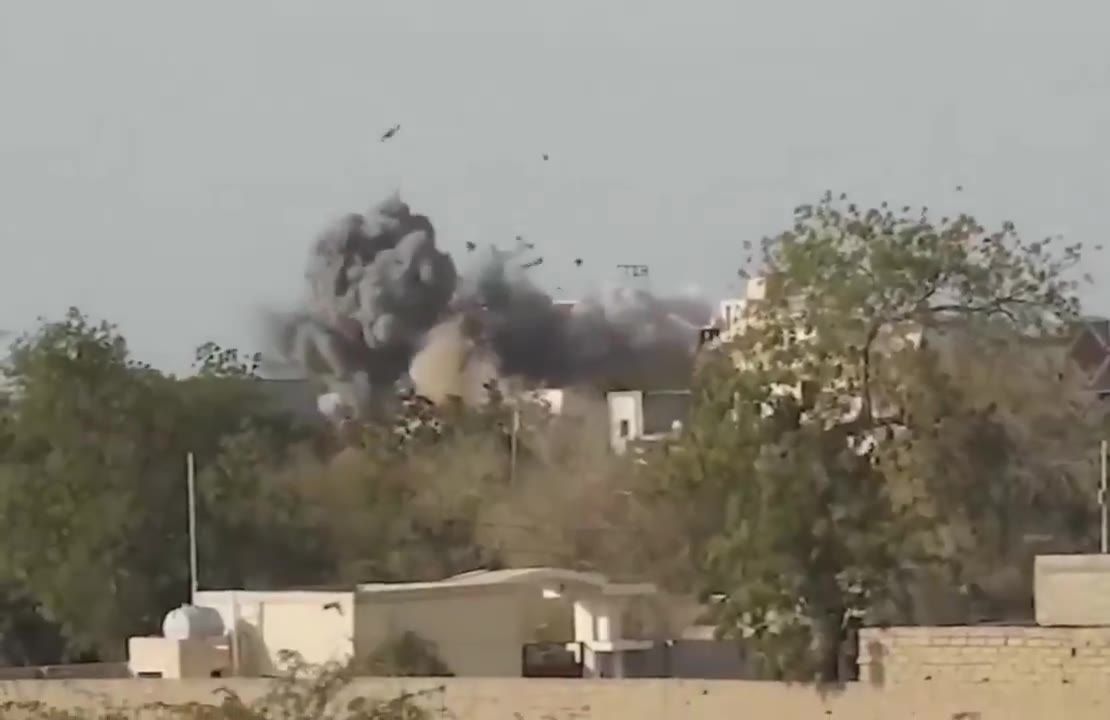
XAn Arabic-language post on X shares a short video of a large black smoke plume rising over low white buildings and trees, filmed from a distance. The caption presents it as an urgent, same-day event: a Houthi ballistic missile that failed to launch from inside a Sanaa neighbourhood and exploded, killing Iranian experts and Houthi missile commanders and causing dozens of civilian casualties. It uses the hashtag #الحوثي_يقتل_المدنيين (#HouthisKillCivilians).
“#عاااجل مقتل خبراء ايرانيين وقيادات حوثية متخصصة بالصواريخ اليوم في صنعاء بعد فشلهم إطلاق صاروخ باليستي من وسط حارة بمدينة صنعاء تنويه: هناك ضحايا وجرحى بالعشرات من المدنيين وتهدم منازلهم نتيجة الانفجار #الحوثي_يقتل_المدنيين”
“#URGENT Iranian experts and Houthi commanders specialising in missiles were killed today in Sanaa after they failed to launch a ballistic missile from the middle of a neighbourhood in Sanaa city. Note: there are dozens of civilian casualties and wounded, and their homes destroyed as a result of the explosion. #HouthisKillCivilians” — translated
The identical caption text had already appeared on another X account on 6 November 2026, three days before this post, indicating the wording was copied rather than written as fresh reporting.
Who posted it
XAccount check
Estimates from public signals — account age, posting pattern, audience — not a judgement of the person behind the account, and separate from whether this post is true.
What stood out
- Account exists and is active: display name 'سيف الدولة' (@AlhodelGhalep), ~15,000 posts, bio 'المخا مدينة الاحرار وموطن المهاجرين وقبلة المجاهدين' — a Mocha/west-coast Yemen focus.
- Content is wall-to-wall '#عاجل' war updates: Houthi missile launches, Saudi/UAE-backed 'National Resistance' and Brigade 17 advances at Al-Majza'a/Al-Mudaraba, Bab al-Mandab, Taiz, Kahboub, plus anti-Houthi commentary and civilian-casualty reports — a partisan activist/news-aggregator style account, not an institutional outlet.
- No verification badge, no real name or affiliation disclosed (pseudonym borrowed from a historic title); follower count and creation date not disclosed by the profile, so accountability/identity signals are weak.
- Documented as a claim source in Yemeni fact-checks: Misbar's Yemeni platform (مسند) lists 'سيف الدولة' among accounts spreading a video falsely claimed to show anti-Houthi protests in Sanaa (actually footage from Sept 2023) and a helicopter video falsely presented as reinforcements to Mahra (actually 2020 music-video footage). Handle match not 100% confirmed, but the content profile fits.
- Example of mislabeling on its own timeline: a May 2025 post on the Bajil cement-factory fire attributes the strike to 'American airstrikes' while the same day's reporting says Israeli strikes.
- Its posts are routinely scraped and embedded verbatim by Yemeni news aggregators (Aden News, 24-Post, NewsForMy, Sahafah24), which amplifies unverified frontline claims well beyond its own audience.
- Behaviour looks human-curated (varied topics, local detail, personal commentary) rather than automated; no evidence of a coordinated bot network, purchased followers or copied-identity impersonation.
Signals (9)+
- Posting cadence
- Very high; multiple breaking-news posts per day
- Follower ratio
- Unknown (follower count not published in retrieved profile view)
- Identity transparency
- Pseudonymous, no named individual or organisation
- Content type
- Partisan war/news aggregation, pro-Yemeni government / anti-Houthi, west-coast (Mocha) focus
- Fact check history
- Named among claim sources in at least two Misbar/مسند fact-checks (miscaptioned conflict videos, 2023-2024 era)
- Documented mislabeling
- Bajil cement factory fire attributed to 'American' rather than Israeli strikes (May 2025)
- Media pickup
- Tweets embedded by Aden News, 24-Post, NewsForMy, Sahafah24
- Affiliation indicators
- Amplifies UAE/Saudi-backed National Resistance and Brigade 17 war messaging
- Automation signals
- None observed; human-style commentary and varied content
Account checked November 9, 2026, 14:47 UTC
The media
Video✓ What is genuine
The explosion and smoke plume are real. The clip shows an actual blast filmed from a distance, and the underlying footage dates to May 2025 during the Israeli air strike on the Amran cement factory, north of Sanaa.
The tells
- ●●● Strong signal Our detector scored the video at 0.0017 probability of being AI-generated and 0.0 for deepfake, with 'not AI generated' at 0.9999.our detector
- ●●○ Supporting signal The footage looks like ordinary handheld filming: consistent camera shake, a dense smoke plume behind trees and low white buildings, birds scattering — no seams or impossible geometry.our visual review
- ●●● Strong signal Misbar traced the same scenes to footage published in May 2025 during the Israeli strike on the Amran cement factory, so the clip's real problem is its claimed date and location, not its pixels.Misbar (Al-Araby TV)
Synthetic-media detector
Detector ranThe claim stands or falls on whether the media is real, so the detector ran.
Scores are the detector’s estimate for the file as uploaded. A low score does not rule out editing, a spliced caption, or footage shown out of context — those are judged above. Model v3.
How we checked the media
- Ran the video through our AI-generation detector (Hive v3), which scored it as almost certainly not AI-generated.
- Reviewed the frames visually for signs of compositing, generation artefacts or mismatched lighting.
- Compared the clip with the provenance established by Misbar's fact-check, which traced the scenes to May 2025 footage of the Israeli strike on the Amran cement factory.
Sources
9 sources reviewed- 1هل الفيديو لقصف منصة للحوثيين لإطلاق الصواريخ الباليستية؟ ↗
Misbar · misbar.comUntiereduntiered — treated as signal only, never decisiveEvidence
Establishes that the video scenes were published in May 2025 during the Israeli strike on the Amran cement factory and rates the claim misleading.
- 2Coalition says it destroyed Houthi ballistic missile launch platform in Sanaa ↗
Bulgarian News Agency (BTA, citing Reuters) · bta.bgUntiereduntiered — treated as signal only, never decisiveContext
Shows the Saudi-led coalition said it destroyed a Houthi ballistic missile launch platform in Sanaa, the real event nearby in time.
- 3Airstrikes kill more than 2 dozen people near Yemen's capital, Houthis say ↗
Associated Press · kcau9.comUntiereduntiered — treated as signal only, never decisiveEvidence
Documents real civilian deaths from air strikes on a village near Sanaa, attributed to a Houthi-run ministry spokesman.
- 4Yemen'deki Husiler: Suudi Arabistan'ın Sana'ya düzenlediği saldırılarda 33 kişi öldü ↗
NTV (AFP) · ntv.com.trUntiereduntiered — treated as signal only, never decisiveEvidence
Documents further civilian casualties from Saudi strikes on al-Shariya village, showing what the real deaths were attributed to.
- 5Yemen Demands Iran Stop Arming Houthis and Withdraw Military Experts ↗
The Milli Chronicle · millichronicle.comUntiereduntiered — treated as signal only, never decisiveContext
Shows Yemen's Foreign Ministry cited an Interior Ministry announcement that foreign experts, including IRGC members, work with the Houthis.
- 6مقتل خبراء إيرانيين إثر انفجار صاروخ باليستي في صنعاء ↗
Kurdistan TV · kurdistantv.netUntiereduntiered — treated as signal only, never decisiveEvidence
Reports the 2019 al-Dailami air base explosion with the same template of Iranian experts killed before a missile launch.
- 7مقتل خبراء إيرانيين ولبنانيين بانفجار صاروخ باليستي أثناء إعادة تركيبه في معسكر للحوثيين بصنعاء ↗
Annahar · annahar.comUntiereduntiered — treated as signal only, never decisiveEvidence
Reports the 2022 al-Hafa camp explosion where Iranian and Lebanese experts died while reassembling a missile.
- 8الحجاج on X — identical claim text posted 6 November 2026 ↗
X · x.comUntiereduntiered — treated as signal only, never decisiveEvidence
Shows the identical caption posted on another X account on 6 November 2026, indicating a copied script.
- 9多条旧视频被“包装”成胡塞武装与沙特冲突最新画面 ↗
CRI (citing Misbar) · news.cri.cnUntiereduntiered — treated as signal only, never decisiveContext
Shows a pattern of old explosion videos being repackaged as current Houthi-Saudi conflict footage.
Further reading
- 1Misbar The original Misbar fact-check that traced the footage to May 2025 and rated the claim misleading.
- 8X Shows the identical caption on another X account three days earlier, evidence of a copied script.
- 3Associated Press AP's report on the real civilian deaths near Sanaa, which the post borrows and reassigns.
The full story
The kernel of truth here is that a large explosion really was filmed from a distance in Yemen, producing exactly the kind of smoke plume the post shows. In May 2025, an Israeli air strike hit the Amran cement factory in Amran province, north of Sanaa, and Yemeni accounts and media published footage of the aftermath. That footage is what appears in this post, months later and with a new story attached.
The story itself is older still. The claim that Iranian experts and Houthi missile commanders were killed when a ballistic missile failed to launch has circulated before, attached to different incidents. In June 2019, an explosion at al-Dailami air base north of Sanaa was reported as killing Iranian experts and Houthi officers when a missile blew up before launch. In August 2022, an explosion at al-Hafa camp east of Sanaa was reported as killing Iranian and Lebanese experts and dozens of Houthi members while a missile was being reassembled. The wording of this post follows those accounts closely.
Why it felt plausible: in early November 2026, Yemen was in a sharp escalation. Saudi-led air strikes hit al-Shariya village in Bani Hushaysh and a market in Taiz, killing dozens of civilians according to Houthi-run authorities, and the Saudi-led coalition said it destroyed a Houthi ballistic missile launch platform in Sanaa. Against that backdrop, a video of a big explosion and a claim about Iranian experts and dead civilians fits a familiar narrative. The post also carries the hashtag #الحوثييقتلالمدنيين (#HouthisKillCivilians), which shifts blame for blast deaths onto the Houthis rather than the air campaign. Real casualties, real footage, real tension — rearranged into a false account.
Kernel of truth
A real explosion was filmed in Yemen and real civilians were killed in early November 2026, but the footage is from May 2025 and the deaths were caused by air strikes, not by a failed Houthi launch.
Timeline
June 2019
An explosion at al-Dailami air base north of Sanaa is reported to have killed Iranian experts and Houthi officers when a ballistic missile exploded before launch. 6Kurdistan TV
August 2022
An explosion at al-Hafa camp east of Sanaa is reported to have killed six Iranian and Lebanese experts and dozens of Houthi members while a missile was being reassembled. 7Annahar
May 2025
Footage is published of an Israeli air strike on the Amran cement factory in Amran province, north of Sanaa. The clip in the post comes from this footage. 1Misbar
November 6, 2026
The identical Arabic caption appears on another X account, three days before this post. 8X
November 9, 2026
Misbar publishes a fact-check rating the video misleading and tracing it to the May 2025 Amran footage. 1Misbar
How it was framed
The video is genuine footage of a real explosion, but it is presented as a different event on a different date and in a different place, with a casualty story borrowed from other incidents. The hashtag also frames the Houthis as the killers of civilians, shifting blame away from the air campaign that the sources say caused the deaths.
- Urgency. The caption opens with '#عاااجل' ('#URGENT'), with the word stretched for emphasis.
- Emotional language. The post says there are 'dozens of civilian casualties and wounded' and that 'their homes were destroyed'.
- “Visual proof”. A dramatic video of a black smoke plume is presented as direct evidence of the claimed event.
- Missing context. The post does not say when or where the footage was filmed beyond 'today in Sanaa', and gives no source for the video.
- Us vs. them. The hashtag '#الحوثي_يقتل_المدنيين' ('#HouthisKillCivilians') assigns blame for civilian deaths to one side.
Posted on X by the account @AlhodelGhalep. The same Arabic caption had already appeared on another X account on 6 November 2026, suggesting the text was copied across accounts rather than written as fresh reporting.
Bias
Leans anti-Houthi / pro-Yemeni-government. The post pairs an unverified explosion with the hashtag #الحوثي_يقتل_المدنيين (the Houthis kill civilians) and frames the blast as the militia's own botched missile launch inside a residential district — a framing that shifts blame for civilian deaths away from the Saudi-led air campaign onto the Houthis, in line with Yemeni government messaging.
Bias describes how the post frames its message — the slant of the language, selection and emphasis — and is judged separately from whether the claim is true. A true claim can still be framed with a strong slant.
How we checked
1 min 38 s- 1
Searched in Arabic and English for reports of a failed Houthi ballistic missile launch killing Iranian experts in Sanaa on 9 November 2026, including the post's own hashtag.
- 2
Searched for fact-checks and provenance of the specific video, which led to Misbar's same-day check.
- 3
Opened and read Misbar's fact-check, which traced the footage to May 2025 and the Amran cement factory strike.
- 4
Ran the video through our AI-generation detector (Hive v3) and reviewed the frames visually for manipulation.
- 5
Searched for contemporaneous reporting on the November 2026 escalation to see what actually happened and what casualties were reported, finding AP and AFP reports on air strikes and a coalition statement about a destroyed launch platform.
- 6
Compared the post's wording with older reports of the 2019 al-Dailami and 2022 al-Hafa explosions.
✓ Claim checked✓ Media checked✓ Sources checked
Why 72% confidence
ModerateWe are highly confident the video is not from 9 November 2026 in Sanaa: a specialist Arabic fact-checker traced it to May 2025, and the caption had already circulated days earlier. We rate the headline verdict MODERATE rather than HIGH because the broader claim about Iranian experts mixes a demonstrably false video with elements (foreign experts present in Yemen) that are documented in general terms, so the overall picture is misleading rather than wholly fabricated.
Limits. We could not independently view the original May 2025 source footage or verify exactly who first paired this clip with this caption. Casualty figures from Houthi-run authorities could not be independently confirmed.
What we don’t know
- Who first attached this specific clip to this caption, and whether the same person or group runs multiple accounts sharing it.
- Whether any Iranian or Houthi personnel were present at a launch site in Sanaa on 9 November 2026.
- The exact number of civilian casualties from the early November 2026 air strikes, since the figures come from Houthi-run authorities and vary between reports.
Spot it yourself
Spot the fakeLooks suspicious, isn’t proof
- The source is an anonymous-looking X account with no stated newsroom or reporting record. That is a reason to check, not proof of anything.
- The caption is alarmist and uses '#URGENT' with stretched letters. Tone raises the stakes but does not make a claim false.
- The video is short and filmed from a distance, so details are hard to make out. Low detail is common in genuine eyewitness footage.
- The claim is 'too neat' — it matches a familiar story about Iranian experts and failed missiles. Familiarity is not evidence.
The actual evidence
- Misbar's provenance check traced the same scenes to May 2025 footage of the Israeli strike on the Amran cement factory, north of Sanaa.
- No wire service, Yemeni official statement or monitor reported a failed Houthi launch killing Iranian experts in Sanaa on 9 November 2026, despite it being the kind of event that would be reported immediately.
- The identical caption had already appeared on another X account on 6 November 2026.
- The claim's wording closely matches older reports of the 2019 al-Dailami and 2022 al-Hafa explosions.
- Civilian deaths in the period are attributed by AP and AFP to air strikes on al-Shariya village and a Taiz market, not to a failed Houthi launch.
- 1
Ask who would be reporting this if it were true.
A failed missile launch that killed Iranian experts and dozens of civilians in a capital city would be covered within hours by wire services and pan-Arab outlets. Search for the event in English and Arabic; if only anonymous social accounts have it, treat it with caution.
- 2
Check the video's real origin with a reverse image or video search.
Take a still frame and run it through a reverse image search tool, and search for key visual details like 'cement factory' or 'Amran' alongside the date. Misbar found the May 2025 source that way.
- 3
Look for the same wording on other accounts.
Search the exact caption text in quotation marks on X. If it appears on several unrelated accounts, especially days earlier, it is a copied script rather than a report from the scene.
- 4
Compare the claimed casualties with what other outlets report.
Check AP, AFP and Reuters for the same days. If the deaths they report come from air strikes in a different place, the post has borrowed real casualties for a different event.
Takeaway
A real video can still carry a false story. The question is not only whether the footage is genuine, but whether it shows what the caption says, where and when it says.
Questions people ask
Is the video of the explosion in Sanaa real?+
The explosion footage is real, but it is not from Sanaa on 9 November 2026. Misbar traced the scenes to May 2025 footage of an Israeli air strike on the Amran cement factory, north of Sanaa. Our detector found no sign the video was AI-generated or manipulated. The problem is the date and story attached to it.
Did a failed Houthi missile launch kill Iranian experts in Sanaa?+
No credible source reported such an incident on 9 November 2026. The claim's wording closely matches older reports of the 2019 al-Dailami air base explosion and the 2022 al-Hafa camp explosion. Yemeni officials have said foreign IRGC and Hezbollah experts are present in the country, but that does not confirm this specific event.
Were dozens of civilians killed in Sanaa in November 2026?+
Civilians were killed in early November 2026, but the sources attribute the deaths to air strikes, not a failed Houthi launch. AP reported at least 27 killed in air strikes on a village near Sanaa, and AFP reported at least 33 killed in strikes on al-Shariya village. The post borrows those real casualties for a different event.
Why did the post use the hashtag #HouthisKillCivilians?+
The hashtag frames the Houthis as responsible for civilian deaths. But reporting from the same days attributes the deaths to Saudi-led air strikes on al-Shariya village and a market in Taiz. The hashtag shifts blame away from the air campaign, which is one of the ways the post is misleading.
How can I tell if a video of an explosion is really from today?+
Check whether major news outlets are reporting the same event, run a still frame through a reverse image search, search the exact caption on social media to see if it appeared earlier elsewhere, and compare the footage with known events. A genuine video can still be presented with a false date and story.
Go deeper
- False context
- When genuine content, like a real photo or video, is shared with a false date, location or story attached.
- Provenance
- The origin and history of a piece of media — who first published it, when, and where.
- Reverse image search
- A tool that finds where else an image or video frame has appeared online, helping to trace its origin.
- AI-generation detector
- A tool that estimates whether an image or video was made or altered by artificial intelligence.
People also search for
For educators+
- If the video is real, why does it still mislead? What exactly is false about the post?
- The post uses real civilian casualties from air strikes but attributes them to a different cause. How does that change the way a reader understands the conflict?
- What would you search for to check a claim like this yourself, and what would you expect to find if it were true?
About this check
- Platform
- X
- Posted by
- @alhodelghalep
- Posted
- November 7, 2026
- Age when checked
- Older post, still live
- Where it spread
- YE, IR
- Audience
- International audience
- Language
- AR
- Status
- ● Post is live
- Verified
- November 9, 2026, 14:50 UTC
- Published
- November 9, 2026, 14:50 UTC
Reach. Copy-paste 'عاجل' text with explosion video spread by several Yemeni accounts; @AlhodelGhalep 950 likes, @Fajr__news 729 (syndication); Misbar fact-check published 9 Nov; autocomplete shows 'مقتل خبراء ايرانيين في اليمن'.
This verdict was generated with AI from the sources shown. AI can make mistakes — check the sources before relying on it.
Check anything yourself, in seconds.
Share any social post or video to What the Fact and get the verdict, the confidence, and the receipts.