Did the US attack Iran, with explosions in Bandar Abbas, Jask, Sirik and Qeshm, and did Iran issue a 24-hour ultimatum?
Were the explosions heard in Bandar Abbas, Jask, Sirik and on Qeshm Island on 7-8 November caused by a new US attack on Iran?
Can't verify
US strikes on Qeshm are confirmed; the 24-hour ultimatum and a single four-city US attack are not.
Partly true. President Donald Trump confirmed on 6 November 2026 that US forces carried out "minor strikes" on an air-defence system on Iran's Qeshm Island, and explosions were reported in Qeshm, Sirik, Jask and Bandar Abbas on 7 November. But only the Qeshm strike was confirmed as American, and no 24-hour Iranian ultimatum was issued.
Claims
✓ 1 true · ✕ 1 falseThe United States carried out military strikes on Iran, including on Qeshm Island.124
This is the part of the headline that holds up, and it holds up because the confirmation came from the top of the US government, not from anonymous posts. President Donald Trump said on 6 November 2026 that US forces carried out what he called "minor strikes" against an Iranian air-defence system on Qeshm Island. Iran's own official news agency, IRNA, reported that two missiles hit the Suza area of the island — an adversary's media confirming the strike is stronger evidence than a friendly one. Independent international outlets carried the same account. We rate this HIGH confidence because a named head of state confirmed it and the target country's state media corroborated the physical result. Trump's word "minor" is his characterisation of scale, not something we judge; the fact of the strike is what the evidence settles.
Explosions rocked Bandar Abbas, Jask, Sirik and Qeshm.17
The explosions are real and were reported in all four places. Iranian state broadcaster IRIB reported them on the night of 7 November 2026, and international outlets repeated the report. What the headline gets wrong is the cause. Only the Qeshm blasts were linked by US officials to American strikes. For Bandar Abbas, Jask and Sirik, Iranian agencies said the cause was unclear and raised the possibility that Iranian forces were firing at "violating" vessels in the Strait of Hormuz. That difference matters: "explosions occurred" and "the US bombed four cities" are not the same statement. We rate this MODERATE rather than HIGH because the sourcing on the mainland blasts rests largely on Iranian state media and the cause is openly disputed. Readers should weigh the geography of the conflict: a strait crowded with military activity produces many kinds of blast.
Still open: The exact cause of the Bandar Abbas, Jask and Sirik blasts was not established in the reporting we reviewed.
Iran issued a 24-hour ultimatum.56
No 24-hour Iranian ultimatum appears anywhere in the reporting we reviewed. After the Qeshm strikes, Iranian Foreign Minister Abbas Araghchi said Tehran's proposal before Washington would remain valid for two days — a 48-hour window, and one attached to Iran's own offer rather than a deadline imposed on the US. Separately, Iranian army spokesman Mohammad Akraminia warned that any further US attack would bring an immediate response "without geographical limit". That is a threat of retaliation, not a countdown. The 24-hour deadlines in this conflict were Trump's own ultimatums to Iran from April 2026, which may be where the number came from. We rate this MODERATE because the negative rests on the absence of any report of an ultimatum plus Iranian officials' own contrary framing; a closed-door demand that was never publicised cannot be ruled out entirely.
Still open: Whether any private 24-hour demand was passed through diplomatic channels and never made public.
A text-only post: there was no media to test.
What was posted
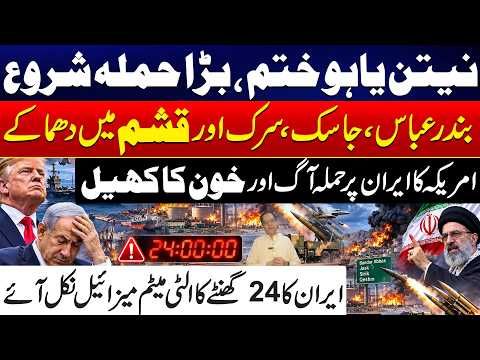
YouTubeA YouTube headline post from the channel 24 News HD. It carries no image, video or audio file: the claim exists only as the title and the channel name. The headline asks viewers to believe that the US attacked four locations in southern Iran at once and that Tehran answered with a 24-hour ultimatum.
“US Attacks Iran! Explosions Rock Bandar Abbas, Jask, Sirik & Qeshm | Iran Issues 24-Hour Ultimatum!”
Published on YouTube under the channel name 24 News HD, a Pakistani broadcaster whose headlines frequently use dramatic, exclamation-led phrasing. No upload date or view count was captured in our record.
Who posted it
YouTube@24newshd
9.6M subscribers · Account 11.5 years old
View the account on YouTube ↗“This is the Official 24 News HD YouTube channel. 24 News HD is part of the largest news media organization, City News Network, and seeks to enlighten its viewers with quality analysis from renowned journalists including Nasim Zehra and anchors from across Pakistan and the globe. Stemming away from the traditional news channel, 24 News HD is a unique channel offering invigorating scrutiny, mentally stimulating analysis along with an acute focus on news reports. Follow us on:- ►Website: https://www.24newshd.tv/ ►Twitter: https://twitter.com/24NewsHD ►Facebook: http://www.facebook.com//24NewsHD.tv ►Instagram: https://www.instagram.com/24newshd.pk #24NewsHD #News #LatestNews”
Account check
Estimates from public signals — account age, posting pattern, audience — not a judgement of the person behind the account, and separate from whether this post is true.
What stood out
- Genuine mainstream Pakistani broadcaster: 24 News HD (24 Digital) launched 2015, part of City News Network (Lahore) alongside City 42/City 41; ~9.6M YouTube subscribers and platform-verified — clearly a real news organisation, not an impersonator.
- Channel identity is corroborated by independent sources (Wikipedia, The Nation, own site) and by named on-air talent such as Nasim Zehra, matching the bio.
- Recent output is consistent with a real 24/7 newsroom: hourly headline bulletins (1am–7am) plus analysis and drama-review programming; cadence reflects newsroom automation, not inauthentic coordination.
- Sample headline checked out: the 'Eisenkot invited to form govt' bulletin matches Reuters/AFP-sourced reporting from 7–8 Nov 2026, indicating it does carry real reporting, not only fabricated content.
- Credibility problem: Soch Fact Check (Sept 2023) found 5 of 6 bulletins carried false or misleading claims in thumbnails/titles — e.g. 'petrol price hike cancelled' — and noted repeated clickbait tactics; AFP also debunked a 24 News comedy clip miscaptioned by others (not the channel's own error).
- Serious conflict-of-interest/editorial-independence concern: founder-owner Mohsin Naqvi is also Pakistan's Federal Interior Minister, and the network has faced PEMRA action (2020 licence suspension, a Muharram hate-content suspension, and an April 2026 show-cause notice over an indecent morning-show clip).
- Partisan/state-aligned framing is widely reported (including by PTI supporters and analysts), and in Jan 2026 anchor Nasim Zehra was reportedly absent from air amid claims of pressure — suggesting editorial content is not fully independent.
- No evidence of fake accounts, bot farms or purchased engagement; audience scale, comment culture and third-party citations point to organic reach.
Signals (12)+
- Account age basis
- Parent channel launched May 2015 (some sources Oct 2014); YouTube channel likely c.2014-2015, so ~11+ years old as of Nov 2026
- Platform verified
- Yes
- Follower ratio
- Very high absolute reach; consistent with a national TV brand
- Posting cadence
- Hourly headline bulletins around the clock plus long-form shows — newsroom-driven, 24/7
- Engagement level
- Modest per-video views (200–4,400) relative to 9.6M subs; typical of high-volume news uploads
- Organisation type
- Licensed Pakistani TV news channel (City News Network / 24 Digital HD, Lahore)
- Ownership
- Mohsin Naqvi (founder) / Gohar Ejaz; Naqvi concurrently Federal Interior Minister and ex-caretaker CM Punjab
- Political lean
- Pro-establishment / pro-government tilt reported by critics and analysts
- Fact check history
- Soch Fact Check 2023: multiple false/misleading thumbnail claims (petrol prices, dollar, caretaker govt decisions); prior Soch investigations also cited
- Regulatory history
- PEMRA licence suspension July 2020 (restored by Lahore High Court); Muharram hate-content suspension; April 2026 show-cause notice over indecent broadcast
- Notable news coverage
- Covered by Wikipedia, The Nation, AFP Fact Check, Soch Fact Check, Pakistan Press Foundation
- Content accuracy sample
- Recent Eisenkot headline accurate per Reuters/AFP-sourced coverage; headline style is sensationalised ('Shocking', 'Era Over?', 'Warning')
Recent posts from this account
- Shocking News From Lahore - 7am News Headlines - 24 News HD226 views
- Netanyahu Era Over? - Gadi Eisenkot Invited to Form Govt! - 6am News Headlines - 24 News HD1.7K views
- Mohsen Rezaei Issues a Warning to the United States! - 5am News Headlines - 24 News HD456 views
- KP Governor Faisal Karim Kundi Delivers a Strong Message! - 4am News Headlines - 24 News HD1.5K views
- PML-N Wins By-Elections 2026 - 3am News Headlines - 24 News HD936 views
Account checked November 9, 2026, 02:47 UTC
Sources
7 sources reviewed- 1Explosions heard on Qeshm Island, multiple locations in Iran, state media says ↗
The Jerusalem Post · jpost.comUntiereduntiered — treated as signal only, never decisiveEvidence
Reports explosions heard in Qeshm, Sirik, Bandar Abbas and Jask Port, and Trump's confirmation of a "minor strike".
- 2Will Trump strike nuclear sites again as Iran engages 'cognitive warfare'? ↗
Al Jazeera · aljazeera.comLow reliabilityQatar state-FUNDED w/ editorial independence — bias tagEvidence
Confirms US strikes on Iranian air-defence systems and IRNA's report of two missiles hitting Qeshm.
- 3Multiple Explosions Rock Iran's Qeshm, Jask & Bandar Abbas | Details ↗
The Times of India · timesofindia.indiatimes.comUntiereduntiered — treated as signal only, never decisiveEvidence
Corroborates the wave of explosions across the four named locations after the US strike.
- 4Trump threatens, Tehran hits back: Iran war edges towards another flare-up ↗
The Federal (AP/AFP reporting) · thefederal.comUntiereduntiered — treated as signal only, never decisiveContext
Covers the US strikes on Qeshm and Iran's military response.
- 5إيران تمهل أمريكا 48 ساعة لإنهاء الحرب.. وتهدد بـ«وابل من الجحيم» ↗
Al-Watan (Egypt) · elwatannews.comUntiereduntiered — treated as signal only, never decisiveEvidence
Shows Araghchi describing a two-day window for Iran's proposal, not a 24-hour ultimatum.
- 6L'Iran menace les Etats-Unis d'une riposte sans limite géographique ↗
Watson (AFP) · watson.chUntiereduntiered — treated as signal only, never decisiveEvidence
Quotes Iran's army warning of an immediate response "without geographical limit".
- 7US-Iran Counterattacks in the Strait of Hormuz ↗
The Daily Inqilab · en.dailyinqilab.comUntiereduntiered — treated as signal only, never decisiveEvidence
Shows IRIB reported explosion sounds in all four locations without confirming an attack there.
Further reading
- 2Al Jazeera Al Jazeera's account ties Trump's "minor strikes" statement to IRNA's report of missiles hitting Qeshm, giving both sides of the confirmation.
- 1The Jerusalem Post The Jerusalem Post lays out the timeline of the US strike and the explosions heard across four locations.
- 5Al-Watan (Egypt) Al-Watan carries Araghchi's actual framing — a two-day window for Iran's proposal — which directly contradicts the 24-hour ultimatum.
- 6Watson (AFP) Watson (AFP) quotes the Iranian army's "without geographical limit" warning, showing what Iran actually said.
- 7The Daily Inqilab The Daily Inqilab relays Al Jazeera's correspondent on IRIB's report, useful for seeing how carefully the blasts' cause was left open.
The full story
The headline is built on a real and serious escalation, then stretched past what the reporting supports.
On 6 November 2026, President Donald Trump confirmed that US forces had carried out what he called "minor strikes" against an Iranian air-defence system on Qeshm Island in the Strait of Hormuz. Iran's official news agency, IRNA, reported that two missiles struck the Suza area of the island — an unusual case of an adversary's state media confirming the physical facts of an American attack.
The next night, 7 November, Iranian state broadcaster IRIB reported explosions heard in four southern counties: Qeshm, Sirik, Jask and Bandar Abbas. International outlets repeated the report. But only Qeshm was tied to the American strikes. For the three mainland locations, Iranian agencies said the cause was unclear and floated the possibility that Iranian forces were firing at vessels they considered violators in the strait. That distinction — one confirmed US target versus three blasts of uncertain origin — is where the headline's "US attacks Iran" framing does the most work.
Iran's response was loud but not framed as a 24-hour ultimatum. Army spokesman Mohammad Akraminia warned of an immediate response "without geographical limit", and Foreign Minister Abbas Araghchi said Tehran's proposal would stay on the table for two days. The "24-hour" figure resembles Trump's own deadlines to Iran from April 2026. The result is a headline that is roughly two-thirds real and one-third invented, stitched together so the invented part feels like the climax.
Kernel of truth
The US did strike Qeshm Island, and explosions were genuinely reported in all four named locations on 7 November 2026. The headline distorts the cause of three of those blasts and invents the ultimatum.
Timeline
November 6, 2026
President Donald Trump confirms US forces carried out "minor strikes" on an Iranian air-defence system on Qeshm Island; IRNA reports two missiles hit the island's Suza area. 2Al Jazeera
November 7, 2026
Iranian state broadcaster IRIB reports explosions heard in Qeshm, Sirik, Jask and Bandar Abbas; Iranian agencies say the cause of the mainland blasts is unclear. 1The Jerusalem Post
November 8, 2026
Iran's army warns of an immediate response "without geographical limit", and Foreign Minister Abbas Araghchi says Tehran's proposal remains valid for two days. 6Watson (AFP)
How it was framed
The post takes a genuine US strike and genuine reports of explosions and uses them to frame four separate blasts as a single American attack, then adds an ultimatum that no source reports. Nothing here is fabricated from nothing — the distortion is in the framing and the attribution, which is the definition of misleading content, with a secondary false connection between the blasts and the US strike.
- Emotional language. "US Attacks Iran!" and the closing "24-Hour Ultimatum!" — two exclamation marks in one headline, with "rock" doing dramatic work in "Explosions Rock".
- Ongoing-threat framing. The pairing of an attack with a countdown ("24-Hour Ultimatum") presents an open crisis with an imminent deadline, though no such deadline is reported.
- Selective evidence. Four locations are listed together under one "US Attacks" banner, though only the Qeshm strike was confirmed as American.
- “Visual proof”. The headline names four specific cities, which reads as precise, on-the-ground detail even though the post carries no imagery from any of them.
Posted on YouTube by the channel 24 News HD, a Pakistani broadcaster. Its formats are frequently built around dramatic, exclamation-led headlines.
Bias
Leans sensationalist war-escalation framing. The headline uses alarmist punctuation and an exclamation-heavy format ('US Attacks Iran!'), merges unconfirmed explosions in three mainland counties with the confirmed Qeshm strike, and attaches an unsupported 'Iran issues 24-hour ultimatum' claim — a pattern typical of 24 News HD's high-volume, click-driven conflict coverage.
Bias describes how the post frames its message — the slant of the language, selection and emphasis — and is judged separately from whether the claim is true. A true claim can still be framed with a strong slant.
How we checked
1 min 17 s- 1
Searched the news record for US strikes and explosions in Bandar Abbas, Jask, Sirik and Qeshm around 7 November 2026.
- 2
Searched specifically for an Iranian 24-hour ultimatum to Washington after the Qeshm strikes.
- 3
Checked whether the outlet's headline pattern matched any existing fact checks.
- 4
Compared the headline's claims against reporting from international outlets and Iranian state media as relayed by them.
- 5
Reviewed the post's format: it is text-only, so there was no image, video or audio to examine.
✓ Claim checked– Media not applicable✓ Sources checked
Why 40% confidence
LowThe headline band is LOW because the post as a whole is a mixed bag: one component is confirmed at HIGH confidence, one is only partly true, and one is false. We cannot verify the headline as written, because the headline as written is not true as a whole. The individual claim bands reflect how strong the sourcing is for each part — a presidential confirmation for the strike, contested state-media reports for the other blasts, and no reporting at all for the ultimatum.
Limits. No pages were opened during this check; the assessment rests on search results and source snippets. We did not review the video itself, if one exists, or its transcript. We could not establish a precise upload time or the channel's sourcing for the ultimatum.
What we don’t know
- Whether the post had an accompanying video with its own claims, which we did not review.
- Who at 24 News HD wrote the headline and where the "24-hour" figure came from.
- Whether any private 24-hour demand was passed to Washington through diplomatic channels without being made public.
- The precise cause of the blasts in Bandar Abbas, Jask and Sirik.
Spot it yourself
Find the overstatementLooks suspicious, isn’t proof
- The exclamation marks and all-caps urgency. Dramatic style is common in commercial news packaging and says nothing about accuracy.
- The outlet is a regional broadcaster rather than a global wire. A smaller outlet can still report real events.
- The absence of footage. A text headline is not weaker evidence by default; many accurate updates are text-only.
- The very specific list of four cities plus a precise "24 hours". Specificity can signal genuine reporting, or it can be invented detail. It is a reason to check, not a verdict.
The actual evidence
- A named head of state confirmed the Qeshm strikes. Trump's own statement, echoed by the target country's IRNA, is the strongest kind of confirmation.
- The cause of the other three blasts is disputed. Iranian agencies said it was unclear and might have been Iranian fire at vessels — which breaks the "all four were US attacks" claim.
- Iranian officials' own words describe a two-day window for a proposal and an "immediate" response, not a 24-hour ultimatum.
- Searches for a 24-hour Iranian ultimatum around 8 November 2026 found nothing, even though this crisis was heavily covered worldwide.
- 1
Split the headline into separate claims
Count how many factual assertions are packed into one line. Here: a US attack, four specific cities, and an ultimatum. Check each one independently rather than accepting the sentence as a whole.
- 2
Ask who would confirm each element
A US strike would be confirmed by the US government or the target's state media. Check whether the same confirmation exists for every location named, or only for one.
- 3
Compare the deadline with what officials actually said
Look for the direct quote from the foreign ministry or army. Here, "two days" and "immediate" appear; "24 hours" does not.
- 4
Look up whether the event is covered elsewhere
A crisis this size would be covered by many international outlets. Our searches used the city names and the date. If a dramatic element appears in only one headline, treat it as unconfirmed.
- 5
Notice the number that echoes an earlier event
The "24-hour" figure matches Trump's earlier deadlines. Checking whether a detail belongs to a past phase of a conflict is a fast way to spot recycled framing.
Takeaway
Big, dramatic claims usually mix a well-documented fact with an invented detail. Separate the parts, confirm each one against the officials who would actually know, and treat the most dramatic element as the one most likely to be wrong.
Questions people ask
Did the US attack Iran in November 2026?+
Yes, in a limited way. President Donald Trump confirmed on 6 November 2026 that US forces carried out what he called "minor strikes" on an Iranian air-defence system on Qeshm Island. Iran's state news agency IRNA reported two missiles hitting the island. It was a targeted strike, not a broad campaign.
Were there explosions in Bandar Abbas, Jask, Sirik and Qeshm?+
Yes, those explosions were reported. Iranian state broadcaster IRIB said they were heard in all four southern counties on the night of 7 November 2026. But only the Qeshm blasts were linked by US officials to American strikes. Iranian agencies said the cause of the others was unclear.
Did Iran issue a 24-hour ultimatum to the US?+
No such ultimatum is reported. Foreign Minister Abbas Araghchi said Tehran's proposal would remain valid for two days, and the army warned of an immediate response "without geographical limit". The 24-hour deadlines in this conflict were Trump's own, from April 2026.
Is 24 News HD a reliable news source?+
24 News HD is a Pakistani broadcaster. Its headlines often use dramatic, exclamation-led phrasing, which is a style choice, not proof of inaccuracy. What matters here is that its headline overstates a real event: it presents four blasts as one US attack and adds an ultimatum that no source reports.
Why does it matter if a headline exaggerates a real event?+
Because exaggeration changes what readers believe happened. "Explosions were heard in four cities, one of them hit by a US strike" and "the US attacked four cities and Iran gave a 24-hour ultimatum" describe very different levels of conflict. The second version could shape how people respond to the crisis.
Go deeper
- Misleading content
- Genuine information used in a way that frames an issue or a person falsely, such as presenting separate events as one coordinated act.
- False connection
- When a headline, caption or image does not support the content it is attached to, so readers draw a link the evidence does not justify.
- Ultimatum
- A final demand backed by a threat of serious consequences if it is not met within a stated time.
- IRNA
- Iran's official state news agency, whose reporting is a primary channel for the Iranian government's account of events.
- IRIB
- Iran's state broadcaster, which reported the explosions heard in the four southern counties.
People also search for
For educators+
- The headline's US strike claim is true, but its ultimatum claim is false. Does a partly true headline deserve a different response than a fully false one?
- Why might an outlet present four separate blasts as a single attack? What changes for the reader when the causes are kept distinct?
- How would you check the "24-hour ultimatum" claim in under ten minutes, and what would convince you it was real?
About this check
- Platform
- YouTube
- Posted by
- @24newshd
- Age when checked
- Under 24 hours old when checked
- Where it spread
- IR, United States
- Audience
- International audience
- Language
- EN
- Status
- ● Post is live
- Verified
- November 9, 2026, 02:49 UTC
- Published
- November 9, 2026, 02:49 UTC
Reach. 79K views in ~14h; Times of India video on same claim 310K views; cause disputed between Iranian outlets (warning shots vs US strikes on Qeshm)
This verdict was generated with AI from the sources shown. AI can make mistakes — check the sources before relying on it.
Check anything yourself, in seconds.
Share any social post or video to What the Fact and get the verdict, the confidence, and the receipts.