Are IRGC helicopters and boats patrolling the Strait of Hormuz after sea mine collisions?
Does a viral video show IRGC helicopters patrolling the Strait of Hormuz and warning ships this week?
True, but…
Patrols and tanker fires are real; mines as the cause are unconfirmed.
IRGC helicopters and boats have genuinely patrolled the Strait of Hormuz and warned vessels, and tanker fires were reported in early-to-mid November 2026. But the 'massive sea mine collisions' cause comes only from Iranian statements, UK maritime monitors did not confirm mines, and nothing shows this clip was filmed during those patrols.
 Likely genuine
Claims
✓ 1 trueIranian IRGC helicopters and naval boats are monitoring southern Iran's islands and the Strait of Hormuz and issuing early-warning messages to vessels.123
Two independent strands of evidence back this part. The Institute for the Study of War's Iran Update for 8 November 2026 records that the IRGC Navy continued attacking and controlling vessels in and around the Strait of Hormuz. Separately, Iranian navy and IRGC statements carried by Anadolu and APA say Iranian forces are monitoring and controlling the eastern strait and urging shipowners to coordinate passage. Patrols by air and sea plus radio warnings fit that documented activity. Note that the operational picture rests on monitoring bodies and wire reporting, while the specific claim that forces are 'issuing early-warning messages' comes from Iranian statements themselves; the two strands are not fully independent, which is why this sits at HIGH rather than absolute. What a reader should weigh is that the activity is real and current, not that every detail of the caption's wording has been separately confirmed.
Still open: We could not establish how many vessels received warnings, on which days, or by which specific units.
There have been 'massive sea mine collisions' — multiple tankers exploding after striking sea mines in the Strait of Hormuz.12345
The incidents are real enough to be reported: Iranian authorities announced repeatedly in early-to-mid November 2026 that tankers on 'unauthorised' southern routes struck mines and caught fire, with more than ten vessels claimed in the first week alone, and VOV notes three more were announced on 8 November. But the cause rests almost entirely on Iran's own word. UKMTO logged parallel incidents — a projectile strike 19 nautical miles northeast of Limah, Oman, and a tanker on fire off Khasab — without confirming mines, and Arab Times notes the UKMTO advisory did not specify a cause. VOV reported that independent regional sources had not confirmed the information, and ISW assesses Iran's 'ships hitting mines' announcements as likely intended to raise shippers' and insurers' risk perception. That makes the sources here less independent than they look: several trace back to IRGC statements. The decisive point is that a real fire is not the same as a confirmed mine strike.
Still open: No independent investigation has established what caused the tanker fires, how many vessels were actually involved, or what cargo and crews were affected.
What was posted
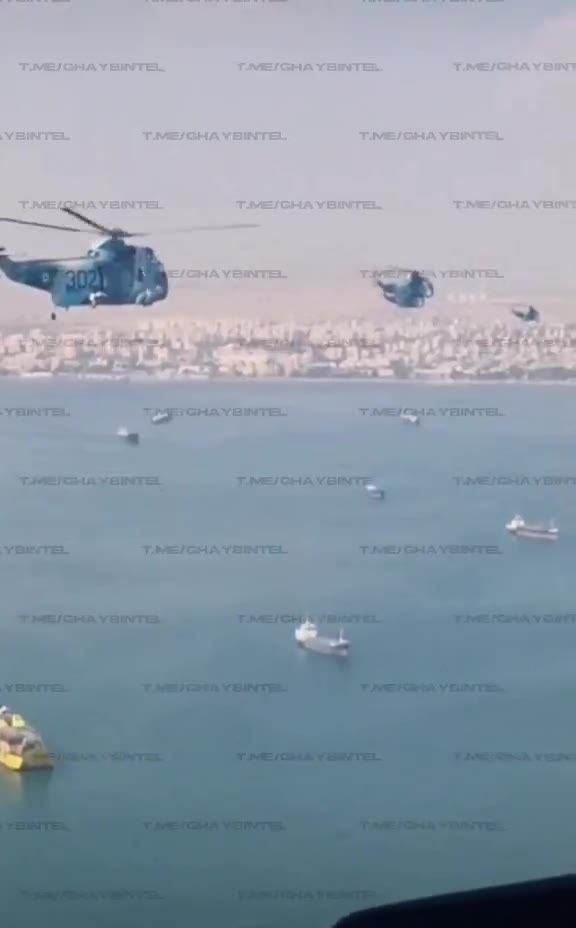
XA post on X from an account using the name RKM publishes a short video, framed as breaking news, that is said to show Iranian IRGC helicopters and naval boats monitoring southern Iran's islands and the strait. The caption asks readers to accept two things at once: that these patrols are happening now, and that they follow 'massive sea mine collisions' among vessels in the Strait of Hormuz.
“BREAKING 🇮🇷🇺🇸🇦🇪🇴🇲: Iranian IRGC helicopters and naval boats are monitoring southern Iran’s islands and naval blockade regions, issuing early warning messages to vessels in the Strait of Hormuz following reports of massive sea mine collisions."”
Posted on X by an account displaying the name RKM. Every frame of the clip carries a repeated watermark for a Telegram channel, t.me/GHAYBINTEL, so the video was circulated as a re-shared OSINT clip rather than published first by a news broadcaster. The post gives no filming date or location.
Who posted it
XAccount check
Estimates from public signals — account age, posting pattern, audience — not a judgement of the person behind the account, and separate from whether this post is true.
What stood out
- Account presents itself as a news outlet ('RKM', linking to rkmtimes.com, a GoDaddy-registered WordPress site since 2019 with undisclosed ownership and very low traffic), not as a person.
- Serial purveyor of debunked content: Lead Stories has fact-checked @rkmtimes at least four times in 2026 (Iranian 'nuclear test' that was 1957 Nevada footage; USS Fitzgerald collision footage passed off as a missile hit; 2016 RIMPAC sinking presented as an Iranian strike; AI-generated USS Abraham Lincoln 'sinking' image).
- Other fact-checkers have debunked it too: FactCheckHub (2025 Russian submarine off London), D-Intent Data (AI church wildfire image, AI Houthi airport-strike video), News Verifier Africa (false Burkina Faso and Egypt-Sudan strike claims), Aaj TV/Fake News Watchdog (false Pakistan airspace claim).
- Pushes conspiratorial and emotive narratives (Rothschild/'Great Satan', Bill Gates synthetic-food bans, 'Power of God' framing) with heavy flag/emoji formatting and 'JUST IN'/'BREAKING' headers.
- High-volume, templated posting across unrelated topics (Iran war, US politics, crypto, health, Africa) using recycled media and no sourcing — consistent with engagement-farming or coordinated inauthentic behaviour rather than reporting.
- Not platform-verified; no transparent ownership, editorial standards or corrections visible; site flagged by reputation tools as low-traffic/suspicious.
- Has cross-platform presence (Instagram, Binance Square mirroring) but appears to function as a content-distribution brand, not a reliable information source.
Signals (9)+
- Posting cadence
- Very high, templated 'JUST IN' posts across unrelated topics
- Known website
- Rkmtimes.com (registered 2019-04-23, GoDaddy/Cloudflare, low traffic, no ownership disclosure)
- Fact check history
- Multiple debunks by Lead Stories (Mar, May 2026), FactCheckHub (Jun 2025), D-Intent Data (Jan 2025, Jul 2025), News Verifier Africa (Oct-Nov 2025), Aaj TV / Fake News Watchdog (Jun 2025), Cancer Explained (Oct 2026)
- Misinformation types
- recycled old footage; AI-generated imagery; fabricated official claims; misleading military/geopolitical claims
- Notable news coverage
- Cited by Nice-Matin, Novinky and other outlets as an example of viral disinformation during the 2026 Iran conflict
- Content theme
- Anti-US/anti-Israel geopolitical 'breaking news', crypto, health claims
- Transparency
- No named editors, no corrections policy, no ownership disclosure
- Cross platform mirroring
- Instagram, Binance Square
- Profile metadata completeness
- Poor (no bio, follower count, creation date or verification supplied)
Account checked November 11, 2026, 15:08 UTC
The media
Video✓ What is genuine
The footage itself reads as real military aerial video of helicopters over busy shipping water, consistent with IRGC air and naval activity documented by ISW and reported by Anadolu and APA. What the clip cannot prove is when and where it was filmed.
The tells
- ●●● Strong signal The scene is physically ordinary: two blue Mi-17-type helicopters flying low over open water dotted with small craft and merchant ships, a hazy coastal city, and a cockpit shot with a pilot in fatigues, a squadron-style patch, standard instruments and a yellow 'NO STEP' placard.our visual review
- ●●○ Supporting signal Horizon line, shadows and sea texture stay consistent from frame to frame, and no generative artefacts appear.our visual review
- ●●○ Supporting signal A watermark grid for the Telegram channel t.me/GHAYBINTEL repeats across frames — a common repost stamp, not a manipulation sign.our visual review
- ●○○ Weak signal Low resolution and heavy watermarking point to a re-shared OSINT clip, not an original broadcast.our visual review
Synthetic-media detector
Detector not consultedThe media is incidental to the claim; the detector was not needed.
How we checked the media
- Reviewed keyframes from the clip by eye for physical plausibility and signs of manipulation.
- Compared visual detail across frames — horizon, shadows, sea texture, cockpit interior.
- Noted the repeated Telegram watermark across frames.
- Checked news and monitoring coverage of the described patrols and incidents through searches; no synthetic-media detector was run because the footage is not what the claim hinges on.
Sources
6 sources reviewed- 1Iran Update, November 8, 2026 ↗
Institute for the Study of War · understandingwar.orgUntiereduntiered — treated as signal only, never decisiveEvidence
Records the IRGC Navy operating in and around the Strait of Hormuz and assesses Iran's mine announcements as likely aimed at raising shipping risk perceptions.
- 2UK maritime agency reports incident involving tanker in Strait of Hormuz ↗
Anadolu Agency · xn--anadoluajans-d5b.gov.trUntiereduntiered — treated as signal only, never decisiveEvidence
Reports UKMTO logging a tanker incident and Iranian naval statements about a restricted area.
- 3Another tanker hits mine in Strait of Hormuz ↗
APA · en.apa.azUntiereduntiered — treated as signal only, never decisiveEvidence
Carries the IRGC account of a tanker striking a mine in the restricted eastern section of the strait.
- 4Thêm 3 tàu dầu bị trúng thủy lôi tại eo biển Hormuz ↗
VOV · vov.vnUntiereduntiered — treated as signal only, never decisiveEvidence
Reports the IRGC's 8 November mine claims and states independent regional sources had not confirmed them.
- 5Tanker Catches Fire After Hitting Sea Mine East of Strait of Hormuz ↗
Arab Times · arabtimesonline.comUntiereduntiered — treated as signal only, never decisiveEvidence
Notes that the UKMTO advisory did not specify a cause or confirm a mine strike.
- 6Fact Check: NO Evidence Video Shows Ships Stuck In Strait Of Hormuz In 2026 ↗
Lead Stories · hoax-alert.leadstories.comPrimary / fact-checkerIFCN; strong on viral/AI mediaFurther reading
Documents a previous viral Hormuz shipping video that was actually filmed at Chittagong, Bangladesh.
Further reading
- 1Institute for the Study of War The most detailed independent assessment of IRGC naval activity and of why Iran's mine claims may serve an informational purpose.
- 4VOV Shows the mine claim as Iran's own announcement and notes the absence of independent confirmation.
- 6Lead Stories A worked example of how Gulf shipping footage can be filmed somewhere else entirely.
The full story
The kernel of truth here is substantial. Since the US-Israeli war on Iran began on 28 February 2026, Iran has effectively closed the Strait of Hormuz, declaring southern routes near Omani waters unauthorised and mined. Through early and mid-November the IRGC Navy said its naval and air units were monitoring and controlling the strait, and that tankers using those routes after switching off their identification systems hit mines and caught fire. ISW's 8 November update records the IRGC Navy continuing to attack and control vessels in and around the strait, and Anadolu and APA carry Iranian statements urging shipowners to coordinate passage.
That is why the post feels plausible: the patrols exist, the fires exist, and the language of the caption — 'monitoring', 'naval blockade regions', 'early warning messages' — closely mirrors how Iranian forces have described their own operations.
Where it stretches is the causal leap. Iran is the source of the mine claim. The UK maritime monitoring body logged incidents without confirming a cause, and VOV reported that independent regional sources had not confirmed the mine account. ISW goes further, assessing that Iran's mine announcements likely aim to raise shippers' and insurers' risk perception. The post repeats the claim as established fact under the word 'BREAKING' and adds 'massive'.
Provenance adds a second gap. The clip is watermarked to a Telegram OSINT channel and carries no date or location. Videos of ships massed in the Gulf have been misattributed before in this conflict: Lead Stories found one 'ships stuck in Hormuz' clip was actually filmed at Chittagong, Bangladesh. So the situational claim stands on reporting; the video is illustration, not proof.
Kernel of truth
IRGC air and naval units really have been patrolling the Strait of Hormuz during November 2026, and tanker fires in the area were really reported. What the post cannot support is the mine cause or that this footage dates from these patrols.
Timeline
February 28, 2026
The US-Israeli war on Iran begins; Iran later moves to close the Strait of Hormuz, declaring southern routes near Omani waters unauthorised and mined. 1Institute for the Study of War
November 1, 2026
Iranian authorities begin announcing repeated tanker mine strikes, with more than ten vessels claimed in the first week of November. 4VOV
November 8, 2026
The IRGC says at least three tankers struck mines; VOV notes independent regional sources have not confirmed it. 4VOV
November 8, 2026
ISW's Iran Update records the IRGC Navy continuing to attack and control vessels around the Strait of Hormuz. 1Institute for the Study of War
November 11, 2026
The post is published on X, presenting the mine collisions as established fact.
How it was framed
The post uses real material — genuine-looking footage of IRGC helicopters and a real, reported maritime standoff — to frame the issue in a way the evidence does not support: unverified Iranian mine claims become 'massive sea mine collisions', and the clip carries no proof it belongs to these November 2026 patrols.
- Urgency. The caption opens with 'BREAKING' in capitals.
- “Visual proof”. An undated, watermarked clip is posted alongside the breaking-news caption, inviting readers to treat the footage as confirmation of the events described.
- Borrowed authority. The caption uses the formal military language of 'naval blockade regions' and 'early warning messages' as if reporting official operational detail.
- Missing context. No filming date, location or source credit is given; the only visible marker is the Telegram watermark t.me/GHAYBINTEL.
- Emotional language. The phrase 'massive sea mine collisions' magnifies incidents that Iran claims but monitors have not confirmed as mine strikes.
Posted on X by an account displaying the name RKM. The clip carries a repeated watermark for the Telegram channel t.me/GHAYBINTEL, indicating an OSINT re-share rather than a broadcaster original. No outlet rating is available for this account, and the post gives no other posting context.
Bias
Leans pro-Iran / amplifies IRGC narrative. The caption adopts IRGC terminology — 'naval blockade regions', 'massive sea mine collisions' — and presents Iranian military claims as established reporting, without noting that the mine attributions are unverified and that Iran is itself accused of attacking shipping to enforce control of the strait.
Bias describes how the post frames its message — the slant of the language, selection and emphasis — and is judged separately from whether the claim is true. A true claim can still be framed with a strong slant.
How we checked
55 s- 1
Searched for reporting on sea mine collisions in the Strait of Hormuz in November 2026.
- 2
Searched for coverage of IRGC naval and blockade activity in the strait.
- 3
Searched for existing fact checks of Hormuz tanker and mine videos.
- 4
Searched for whether IRGC helicopter footage from the strait has been recycled or misattributed.
- 5
Reviewed keyframes of the clip by eye for physical plausibility, manipulation signs and watermarks.
- 6
Weighed the sources: ISW monitoring, UKMTO advisories as reported by Anadolu and Arab Times, IRGC statements via APA and VOV, and prior fact checking by Lead Stories.
✓ Claim checked✓ Media checked✓ Sources checked
Why 62% confidence
ModerateHIGH on the patrol claim because an independent monitoring body (ISW) records the activity and wire reporting corroborates Iranian statements. MODERATE on the mine claim because incidents are widely reported but the cause comes from a single interested party, and monitors logged the fires without confirming mines.
Limits. We could not verify when or where the clip was filmed, and no synthetic-media detector was run because the footage is not what the claim depends on. We had no access to raw UKMTO advisories beyond what outlets quoted, and we could not independently inspect the damaged vessels.
What we don’t know
- When and where the clip was filmed, and whether it shows these November 2026 patrols.
- What actually caused the reported tanker fires, and how many vessels were genuinely involved.
- Whether any vessel received the early-warning messages the caption describes.
- Who operates the Telegram channel whose watermark appears on the footage.
- Whether the RKM account has a track record of accurate or inaccurate breaking-news posts.
Spot it yourself
Find the overstatementLooks suspicious, isn’t proof
- The account name RKM is unfamiliar and not an established newsroom — that says nothing about whether the events happened.
- The all-caps 'BREAKING' and heavy emoji flags create alarm, but alarmist packaging is used by careful and careless posters alike.
- Low resolution and a Telegram watermark suggest re-sharing; they are not evidence of fakery.
- The video looks 'too perfect' as military footage — clean cockpit, tidy formation — but ordinary scenes often look that way.
The actual evidence
- ISW's 8 November update independently records the IRGC Navy operating in and around the strait, which confirms the patrol claim.
- The mine claim traces back to Iranian statements; UKMTO logged incidents without confirming a cause, as Arab Times notes.
- VOV reported that independent regional sources had not confirmed the mine account, and ISW assesses Iran's mine announcements as likely aimed at raising risk perceptions.
- Lead Stories documented a previous Hormuz shipping clip that was actually filmed in Bangladesh, showing why undated footage needs provenance.
- Nothing in the post ties this clip to these specific patrols: no date, no location, no original source.
- 1
Separate the incident from the cause
Ask whether reports confirm what happened (a tanker fire) or why (a mine). Here fires were reported; mines were asserted by one side.
- 2
Trace who is the source
If every version of a detail quotes the same military statement, treat it as one source. Look for a monitoring body such as UKMTO saying the cause separately.
- 3
Check the official maritime advisory
Advisories from maritime trade operations centres describe incidents and often note when no cause is given — a quick way to spot a claim running ahead of the evidence.
- 4
Interrogate the video's provenance
Look for a date, location or original uploader. A watermark points to where it was re-shared, not where it was filmed; try a reverse image search on keyframes.
- 5
Be wary of recycled Gulf shipping footage
In this conflict, ship videos have been filmed elsewhere and relabelled. Verify a distinctive landmark, coastline or vessel before trusting the caption.
Takeaway
A real event can be wrapped around a claim its evidence never established. Check each part of a post separately — the incident, the cause, and the footage — because one sold part can carry an unproven one.
Questions people ask
Are IRGC helicopters and boats patrolling the Strait of Hormuz?+
Yes. ISW's Iran Update for 8 November 2026 records the IRGC Navy continuing to attack and control vessels in and around the strait, and Iranian statements carried by Anadolu and APA describe forces monitoring and controlling the eastern strait while urging shipowners to coordinate passage. The patrol activity is documented, even if this specific clip's date is not.
Have tankers really hit sea mines in the Strait of Hormuz?+
Tanker fires and incidents were widely reported in early-to-mid November 2026, but the mine explanation comes from Iranian authorities. UKMTO logged incidents without confirming a cause, VOV said independent regional sources had not confirmed the mine account, and ISW assesses the mine announcements as likely aimed at raising shipping risk perceptions.
Is the video real or AI-generated?+
Our visual review found no signs of generation: the helicopters, water traffic, coastline and cockpit detail are coherent, and the repeated Telegram watermark points to re-sharing rather than synthesis. The issue is not authenticity but provenance — nothing establishes when or where it was filmed.
Why do Hormuz shipping videos get misattributed?+
The strait is a global chokepoint, so dramatic footage of ships draws attention and spreads fast. Lead Stories found one viral 'ships stuck in Hormuz' clip was actually filmed at Chittagong, Bangladesh. Undated video with no landmark is easy to relabel.
What is an information operation in this context?+
It is when a side releases claims to shape how opponents, markets or the public perceive a situation. ISW assesses Iran's mine-collision announcements as likely intended to raise insurers' and shippers' risk perception — a real-world effect produced by messaging, not just by weapons.
Go deeper
- IRGC
- Iran's Islamic Revolutionary Guard Corps, a branch of the armed forces that also runs naval and air units in the Gulf.
- UKMTO
- The UK Maritime Trade Operations centre, which collects and circulates reports of incidents affecting shipping, often without stating a cause.
- OSINT
- Open-source intelligence: information gathered from publicly available material such as social media video and shipping data.
- Information operation
- Coordinated messaging intended to shape how a target audience perceives events, often to influence decisions or markets.
- Provenance
- The record of where a piece of media came from and when — who first published it and whether its date and place can be confirmed.
People also search for
For educators+
- The post's caption mixes one well-documented claim with one unproven claim. How does putting them in the same sentence affect how a reader judges each?
- If a government is the only source for the cause of an incident, what would you need to see before repeating it as fact?
- How would you check the date and location of a watermarked video with no landmarks? What would count as proof?
About this check
- Platform
- X
- Posted by
- @rkmtimes
- Posted
- November 9, 2026
- Age when checked
- Older post, still live
- Where it spread
- IR, AE, OM
- Audience
- International audience
- Language
- EN
- Status
- ● Post is live
- Verified
- November 11, 2026, 15:09 UTC
- Published
- November 11, 2026, 15:09 UTC
Reach. rkmtimes 331 likes, ghaybintel 119 likes (X syndication); fact-checked 11 Nov amid tanker-mine news
This verdict was generated with AI from the sources shown. AI can make mistakes — check the sources before relying on it.
Check anything yourself, in seconds.
Share any social post or video to What the Fact and get the verdict, the confidence, and the receipts.