Did ex-Army officer Pravin Sawhney call the Kulgam attack a 'false flag' in a Wire interview?
Did ex-Army officer Pravin Sawhney say in an interview with The Wire that the Kulgam attack on CRPF personnel was 'another false flag, just like Pulwama and Pahalgam'?
False
Genuine The Wire footage, but AI-cloned audio and a quote nobody said.
FALSE. The clip does not show Pravin Sawhney, and the quoted 'false flag' line was never spoken. Factly, BOOM and The Quint showed on 12 November 2026 that the video is a genuine 10 March 2025 The Wire interview with journalist Sushant Singh, with AI-generated audio added. It predates the 11 November 2026 Kulgam CRPF attack by about 20 months.
 Deepfake
Claims
✕ 4 falseEx-Army officer Pravin Sawhney said in a recent interview for The Wire: 'Another false flag, just like Pulwama and Pahalgam, this is a pattern.'123
“Pravin Sawhney in Recent Interview for Wire said, "Another false flag, just like Pulwama and Pahalgam,This is a pattern"”
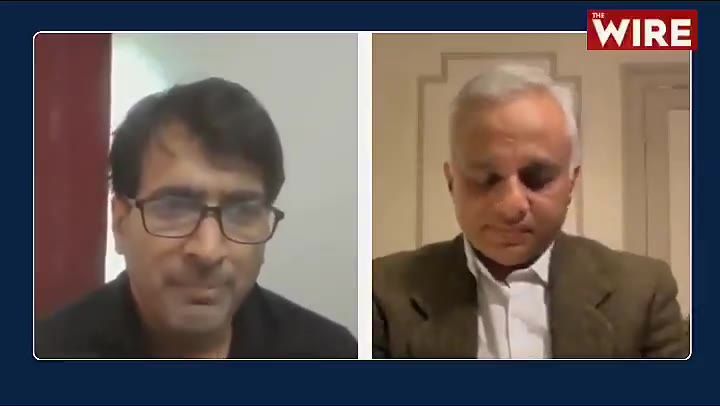
Nobody in the clip says these words. Two independent fact-checkers, Factly and BOOM, traced frames from the video back to a real interview The Wire published on YouTube on 10 March 2025, in which journalist Ashutosh Bhardwaj spoke to journalist Sushant Singh about the February 2019 Balakot air strikes. Pravin Sawhney does not appear. The line quoted in the caption is in English, while the interview speech we have is in Hindi and discusses entirely different questions. Most decisively, both men shown have publicly called the clip fake, and the original recording contains none of the remarks. When the person you can see on screen and the interviewer both deny the exchange, and the publisher's original upload is verifiable, there is nothing left of the quote. The audience-facing risk here is high, because an AI-cloned voice of a well-known defence commentator placed over genuine footage of a respected journalist is hard to dismiss at a glance.
Still open: We have not identified who first produced the manipulated audio or where it was first uploaded.
The video shows a former Army officer describing the 11 November 2026 Kulgam CRPF attack as another 'false flag' operation.245
The recording cannot show anyone commenting on the Kulgam attack because it was made roughly 20 months before that attack happened. The genuine footage is from March 2025; the Kulgam checkpoint shooting took place on 11 November 2026, as reported by The Hindu. Factly, BOOM and The Quint each found that the speech in the circulating clip had been synthesised with AI voice cloning, and our own detector flagged the audio as likely deepfake audio, even as it judged the images themselves real. That combination — authentic pictures, fabricated voice — is exactly what makes the clip persuasive. A reader who does not know when the original interview aired has no reason to doubt it, because two real journalists really are sitting there talking. The timing detail is therefore the single most useful fact for anyone trying to weigh this post.
The Pulwama (2019) and Pahalgam (2025) attacks were 'false flag' operations and part of a pattern.6
This assertion is not new; it is a long-running conspiracy claim that the video puts into a fabricated mouth. The Pulwama bombing was claimed by Jaish-e-Mohammed, and the Pahalgam attack by The Resistance Front, a front group for Lashkar-e-Taiba, according to the Network Contagion Research Institute's study of 'false flag' disinformation after attacks in India. The same study documents how Pakistani officials and aligned commentators promoted a 'false flag' narrative around Pulwama and, more recently, around Pahalgam. No credible investigation has established that either attack was staged by India. We rate the evidence here one notch below the deepfake finding for a straightforward reason: it rests largely on one research body's documentation rather than several independent forensic checks. Our confidence is MODERATE rather than HIGH for that reason.
Still open: We did not independently review primary investigative files on Pulwama or Pahalgam beyond this study and the contemporaneous attack claims.
Indian journalists and influencers are now openly questioning the government's narrative.1
It is true in general terms that Indian commentators sometimes criticise official accounts; that is ordinary public debate. What makes this caption misleading is its evidence: it holds up a quotation from a person who is not in the footage and who never said the words. The implied trend — a wave of insiders breaking ranks — rests on synthetic material, not on reporting. Readers should test such claims by asking who exactly said it, where, and when the interview aired. Here, none of those questions have a real answer: no publisher posted the line, no broadcast date exists, and neither the alleged speaker nor the two people visible in the video confirm it. The caption also blurs the speaker: it names Sawhney while the clip shows Sushant Singh, and treats both figures as interchangeable.
Operation Sindoor was launched on the pretext of false-flag operations and the Indian Army failed.1
This line appears in the Hindi audio of the manipulated clip, where it is presented as part of a question from an interviewer. It does not appear in the original The Wire interview, which, according to the fact-checkers, concerned the 2019 Balakot air strikes. The words were inserted over unrelated 2025 footage, so they are invented content rather than a real question and answer. The substantive sentence is also an opinion dressed as fact: the framing of a military operation's motives and the assessment of its outcome are claims that would need evidence, and the post supplies none. We treat the claim as FALSE specifically because the clip attributes it to a recording that never contained it. Its confidence band is MODERATE because it is judged principally on the fabricated-audio finding rather than on a separate examination of the underlying policy claims.
Still open: We did not attempt to evaluate the underlying opinion about Operation Sindoor's aims and results beyond observing that it is not supported here.
What was posted
XA video clip posted on X, presented as a recent The Wire interview in which former Army officer Pravin Sawhney calls the November 2026 Kulgam attack on CRPF personnel another 'false flag', like the 2019 Pulwama and 2025 Pahalgam attacks. The caption claims Indian journalists and influencers are now openly questioning the government's narrative. The audio is in Hindi.
“𝗘𝘅-𝗔𝗿𝗺𝘆 𝗢𝗳𝗳𝗶𝗰𝗲𝗿 𝗗𝗿𝗼𝗽𝘀 𝗕𝗼𝗺𝗯𝘀𝗵𝗲𝗹𝗹🚨: Pravin Sawhney in Recent Interview for Wire said, "Another false flag, just like Pulwama and Pahalgam,This is a pattern" Indian journalists and influencers are now openly questioning the government's narrative. The”
Posted on X by an account using the display name 'Red Vanguard' with the handle @RedDeFactoIND. The caption quotes an English line inside quotation marks and suggests the words were spoken in a 'recent' The Wire interview. We did not record engagement figures for the post.
Who posted it
XAccount check
Estimates from public signals — account age, posting pattern, audience — not a judgement of the person behind the account, and separate from whether this post is true.
What stood out
- Profile is essentially anonymous: no bio beyond a vague aphorism, no display identity, no verification, no follower/creation metadata — zero accountability for claims.
- Handle 'RedDeFactoIND' appears to be an India-facing spin-off/re-registration of the 'RedDeFacto' brand (same display name 'Red Vanguard' used by @RedDeFacto in Oct 2026), whose main handle was reported blocked in India on ~26 Oct 2026 over fake Arunachal Pradesh–China content — pattern consistent with ban evasion.
- The parent @RedDeFacto account was cited by The Quint, DFRAC and PIB for amplifying a deepfaked Ajit Doval video (3.8 lakh views) in Oct 2026; this handle continues the same 'deepfake + conspiracy caption' format.
- Recent posts push the debunked Kulgam 'false flag' narrative, including a clip attributed to Pravin Sawhney that FACTLY/BOOM showed is an AI-manipulated clip of Sushant Singh from a March 2025 Wire interview.
- Style is high-volume propaganda: heavy hashtag stuffing (#KulgamAttack, #CRPFCampAttack), bold all-caps headlines, rhetorical 'Exposed?' framing, and consistent anti-government conspiracy angles.
- No named author, editorial process, or sourcing standards despite a handle that reads like a fact-checking brand — deceptive branding that borrows credibility it has not earned.
- Content is not obviously bot-generated text (it is ideologically coherent and edited), but the amplification pattern matches the coordinated inauthentic networks flagged by the Indian Army's fact-check unit around the Kulgam attack.
Signals (10)+
- Platform verification
- No
- Bio transparency
- None — single aphorism, no identity or affiliation
- Post count observed
- 125
- Handle churn
- Mirrors 'RedDeFacto' branding; parent handle reported blocked in India Oct 2026
- Known fact check history
- Parent @RedDeFacto: Ajit Doval nude-photos deepfake debunked by The Quint, DFRAC, PIB (Oct 2026); Kulgam 'false flag' deepfakes (Praful Bakshi, 'Pravin Sawhney'/Sushant Singh) debunked by FACTLY, BOOM, The Quint, Newschecker, Indian Army Fact Check (11-12 Nov 2026)
- Content themes
- Anti-BJP/anti-Modi conspiracy framing, false-flag allegations, AI-manipulated interview clips
- Posting cadence
- Multiple posts within hours during breaking security news, hashtag-stuffed
- Coordination indicators
- Same deepfake assets circulating across multiple handles; listed alongside networks flagged for coordinated Kulgam narrative
- Notable news coverage
- Referenced by The Quint, DFRAC, News18 as source of viral deepfake content
- Brand impersonation risk
- Name resembles a fact-checking outlet while distributing fabricated media
Account checked November 13, 2026, 15:04 UTC
The media
Video✓ What is genuine
The visual base is genuine: it is a real The Wire interview in which journalist Ashutosh Bhardwaj speaks to journalist Sushant Singh about the 2019 Balakot air strikes. The setting, lighting and framing are unmanipulated; what is fake is the voice and the attribution.
The tells
- ●●● Strong signal Our detector scored the visual stream at 0.999998 on 'not_ai_generated' but flagged the deepfake and audio-tampering component, consistent with genuine pictures carrying a synthesised voice — so the frames do not prove the audio.our detector
- ●●● Strong signal The words in the caption are in English, while the speech in the clip is in Hindi and discusses Balakot and other questions, not the quoted line.our visual and audio review
- ●●● Strong signal The clip is made from a 10 March 2025 upload and cannot refer to an attack that took place on 11 November 2026.Factly and BOOM
- ●●○ Supporting signal Two people appear on a split-screen video call and neither is identified in the footage as Pravin Sawhney.our visual review
Synthetic-media detector
Detector ranThe claim stands or falls on whether the media is real, so the detector ran.
Scores are the detector’s estimate for the file as uploaded. A low score does not rule out editing, a spliced caption, or footage shown out of context — those are judged above. Model v3.
How we checked the media
- Reviewed the video visually and inspected its keyframes.
- Compared the frames against The Wire's original YouTube upload from 10 March 2025, identified by Factly and BOOM.
- Read the published voice-detection findings of Factly, BOOM and The Quint, which reported AI-generated speech in the clip.
- Ran our own detector model on the media: it scored the visual stream as almost certainly not AI-generated, while its deepfake component flagged manipulated audio.
Sources
6 sources reviewed- 1AI-manipulated video shared as ex-army officer calling the Kulgam terror attack a false flag ↗
Factly · factly.inUntiereduntiered — treated as signal only, never decisiveEvidence
Identifies the clip as an AI-manipulated deepfake and traces the footage to the March 2025 Wire interview.
- 2Deepfakes Targeting Indian Army Personnel Shared Amid Kulgam Attack ↗
BOOM FactCheck · m.dailyhunt.inUntiereduntiered — treated as signal only, never decisiveEvidence
Confirms the original 10 March 2025 upload, notes the absence of the attributed remarks and reports the voice-detector flag.
- 3WebQoof Recap: Of Misinformation Around Tripura BSF Attack, Deepfakes & More ↗
The Quint WebQoof · thequint.comUntiereduntiered — treated as signal only, never decisiveEvidence
Independently labels the Kulgam 'false flag' clip a deepfake and corroborates that the original lacks the claim.
- 4Defence Expert Praful Bakshi Didn't Call Kulgam Attack a 'False Flag Operation' ↗
The Quint WebQoof · thequint.comUntiereduntiered — treated as signal only, never decisiveEvidence
Supplies the Hive Moderation figure that the speech is 99.1% likely AI-generated and the Army fact-check unit's assessment of a related clip.
- 5Three CRPF jawans injured in terror attack in Kashmir's Kulgam ↗
The Hindu · thehindu.comUntiereduntiered — treated as signal only, never decisiveContext
Reports the 11 November 2026 Kulgam CRPF checkpoint attack and its injuries, establishing the clip's timing mismatch.
- 6From State Actors to Western Influencers: The Transnational Surge of 'False Flag' Disinformation After Terror Attack in India ↗
Network Contagion Research Institute · networkcontagion.usUntiereduntiered — treated as signal only, never decisiveContext
Documents the longer 'false flag' narrative around Pulwama and Pahalgam and the militant groups that claimed those attacks.
Further reading
- 1Factly The most detailed fact-check explaining how the frames were traced to the original Wire interview.
- 2BOOM FactCheck Shows the reverse image search step and the voice-detector finding in plain language.
- 6Network Contagion Research Institute Background on how 'false flag' narratives spread after attacks in India, including Pulwama and Pahalgam.
- 5The Hindu The news report on the actual Kulgam attack, which the fake clip was attached to.
The full story
On 11 November 2026, gunmen fired on a CRPF checkpoint near Mir Bazar in Kulgam district, Jammu and Kashmir. Three CRPF personnel were wounded, and police suspected Lashkar-e-Taiba commander Mohammad Latief Bhat, according to The Hindu. Indian forces in Kashmir are routinely targeted, and the attack came amid heightened attention on the region after the 2025 Pahalgam killings.
Into that moment came the clip. Its pictures are real, taken from a Wire studio conversation between Ashutosh Bhardwaj and Sushant Singh about the 2019 Balakot air strikes. That exchange was published on YouTube on 10 March 2025, well before the Kulgam attack existed. Factly and BOOM traced the frames there and found that the remarks in the circulating version never appear in the original. The Quint reached the same conclusion.
The claim also borrowed a name with weight. Pravin Sawhney is a known former Army officer and defence commentator, so a 'bombshell' from him about his own former service would travel far faster than a quote from an anonymous account. Yet he is not in the footage, and neither of the men who are has confirmed the conversation — both have called it fake.
Why it felt plausible: 'false flag' stories about attacks in India have circulated before, especially around Pulwama and Pahalgam, and mainstream questioning of official narratives does happen. This clip took a sliver of real life — the real attack, a real interview, a real public debate — and welded them together with a voice nobody used.
Kernel of truth
A real CRPF checkpoint attack occurred in Kulgam on 11 November 2026, and The Wire really did publish a 10 March 2025 interview between Ashutosh Bhardwaj and Sushant Singh. Both are genuine; only the speech and attribution are fabricated.
Timeline
March 10, 2025
The Wire publishes a YouTube interview in which journalist Ashutosh Bhardwaj speaks to journalist Sushant Singh about the 2019 Balakot air strikes. 1Factly
2025
The Pahalgam attack takes place; a 'false flag' narrative spreads around it alongside the earlier Pulwama claim. 6Network Contagion Research Institute
November 11, 2026
Gunmen fire on a CRPF checkpoint near Mir Bazar, Kulgam, injuring three personnel; a Lashkar-e-Taiba commander is suspected. 5The Hindu
November 12, 2026
Factly, BOOM and The Quint publish fact-checks identifying the circulated clip as an AI-manipulated deepfake. 3The Quint WebQoof
How it was framed
Real footage from a genuine 2025 The Wire interview was altered by inserting synthetic speech, then passed off as a new interview of a specific commentator. The added audio and false attribution also impersonate a broadcaster's output and a public figure, which is why imposter content applies as a secondary label.
- Emotional language. The caption opens with '𝗘𝘅-𝗔𝗿𝗺𝘆 𝗢𝗳𝗳𝗶𝗰𝗲𝗿 𝗗𝗿𝗼𝗽𝘀 𝗕𝗼𝗺𝗯𝘀𝗵𝗲𝗹𝗹🚨' and blows up the text into bold characters.
- Borrowed authority. The post relies on the identity 'Pravin Sawhney' as a former Army officer and on 'The Wire' as a recognised outlet, though neither is shown accurately.
- “Visual proof”. A video with two identifiable people on a video call is presented as self-evident proof that the quoted line was spoken.
- Missing context. The caption calls it a 'Recent Interview' and gives no date or link to a Wire broadcast, though the footage was published in March 2025.
- Us vs. them. The line 'Indian journalists and influencers are now openly questioning the government's narrative' sets a questioning public against the government without naming anyone.
The post was published on X by an account displayed as 'Red Vanguard' with the handle @RedDeFactoIND. We have not verified who operates the account and make no finding about its motives; the caption supplies no date, broadcast link or named outlet page for the claimed interview.
Bias
Leans anti-Indian government / pro-Pakistan 'false flag' narrative. The post uses a manipulated clip to assert that India's security forces stage attacks, presenting the fabrication as proof that Indian commentators are turning against the government. The framing mirrors the 'false flag' disinformation push documented around the Pulwama and Pahalgam attacks.
Bias describes how the post frames its message — the slant of the language, selection and emphasis — and is judged separately from whether the claim is true. A true claim can still be framed with a strong slant.
How we checked
1 min 1 s- 1
Searched for the claimed Pravin Sawhney 'false flag' quotation and for a The Wire interview matching it; found no such original broadcast.
- 2
Searched for fact-checks of the clip and the Kulgam attack, and read the findings of Factly, BOOM and The Quint published on 12 November 2026.
- 3
Compared the video's keyframes with The Wire's 10 March 2025 upload, which the fact-checkers had identified through reverse image search.
- 4
Reviewed the Hindi speech in the circulating clip against the reported content of the original interview.
- 5
Read reporting on the 11 November 2026 Kulgam attack and on 'false flag' narratives around Pulwama and Pahalgam.
- 6
Ran our own detector on the media, which scored the visual stream as almost certainly real while flagging the deepfake and audio-tampering component.
✓ Claim checked✓ Media checked✓ Sources checked
Why 93% confidence
HighOur verdict is HIGH confidence because three independent fact-checkers reached the same conclusion, the original upload and its date can be checked, the two men shown have publicly denied the exchange, and our own detector flagged manipulated audio over genuine visuals. Our confidence is not absolute: our detector's overall score is dominated by the real visual stream, and the strongest audio evidence comes from the published fact-checks rather than from a single technical test of our own.
Limits. We did not access the original YouTube file ourselves or run a laboratory audio analysis; we relied on the fact-checkers' published voice-detector results and our own detector model. We could not identify who created the manipulated audio or when it first appeared, because no page or post in our record establishes the first upload.
What we don’t know
- Who produced the synthetic audio and where the manipulated clip first appeared.
- How widely the clip spread before the fact-checks were published, and on which platforms beyond X.
- Whether the account that posted it operates as an individual or as part of an organised network; we made no finding on this.
Spot it yourself
Spot the fakeLooks suspicious, isn’t proof
- The account is anonymous-sounding and uses alarm emoji and bold caps; that is a style red flag but no proof the content is fake.
- The English caption and the Hindi speech do not match word for word; a loose translation could also produce that gap.
- The picture quality on social platforms is often low and the audio slightly out of sync; compression alone can make real video look off.
The actual evidence
- The original interview was uploaded on 10 March 2025 and predates the 11 November 2026 Kulgam attack by about 20 months.
- Factly and BOOM traced the frames to a The Wire interview with Sushant Singh, not Pravin Sawhney, and found none of the quoted remarks in the original.
- Factly, BOOM and The Quint each reported the audio as AI-generated or voice-cloned; a Hive Moderation check cited by The Quint put the speech at 99.1% likely AI-generated.
- Both men visible in the clip have publicly said the conversation is fake.
- No credible outlet published such a Sawhney interview; a statement this significant would have been widely reported.
- 1
Find the stated source before you accept the quote
Search The Wire's own site and YouTube channel for the alleged interview. If a viral clip names an outlet, the outlet should have it. Here there is no such upload.
- 2
Check the date of the underlying footage
Reverse image search a clear screenshot of the two faces, or search the visible names plus a topic word, and look at the original upload date before reading the claim.
- 3
Match the language of the caption to the language of the audio
If the post quotes an English sentence but the speech is in Hindi or another language, ask where the exact words come from and whether anyone has transcribed them.
- 4
Look for a public denial from the people on screen
Search the visible names plus 'deepfake' or 'fake'. In this case both men had publicly rejected the clip; that is strong evidence even before any technical check.
- 5
Remember a detector is a clue, not a judge
Voice and video detectors can be wrong in both directions. Use them together with the original source, the date and the denials — never on their own.
Takeaway
Real footage can carry a fake voice. Before sharing a 'bombshell' quote from a video, find the original upload and its date; if the person said it, the source that aired it will exist.
Questions people ask
Did Pravin Sawhney call the Kulgam attack a false flag on The Wire?+
No. Sawhney does not appear in the clip, and The Wire never published such an interview. Factly and BOOM traced the footage to a 10 March 2025 Wire conversation between Ashutosh Bhardwaj and Sushant Singh about the 2019 Balakot air strikes. The 'false flag' line was added with AI-generated audio.
Is the video completely fake?+
Not visually. The pictures come from a real The Wire interview. What is fake is the voice and the attribution: synthetic speech was layered over genuine footage, and the caption names a person who is not in it. That combination is what makes it convincing.
How can two people in a video not know they were recorded saying that?+
Because the speech is not theirs. AI voice cloning can generate new audio and fit it to existing video segments. Both Sushant Singh and Ashutosh Bhardwaj have publicly said the clip is manipulated, and the original recording contains none of the quoted remarks, per the fact-checks.
What actually happened at Kulgam on 11 November 2026?+
According to The Hindu, three CRPF personnel were injured when gunmen fired on a checkpoint near Mir Bazar around 2:15 p.m. Police suspected Lashkar-e-Taiba commander Mohammad Latief Bhat. This was a real attack; the false element is the claim that anyone described it as a false flag in a recent interview.
Have Pulwama and Pahalgam really been called false flags before?+
Yes, the narrative has circulated. A study by the Network Contagion Research Institute documents 'false flag' claims around Pahalgam and earlier Pulwama, including promotion by Pakistani officials and aligned commentators. That does not make the claims true: the Pulwama bombing was claimed by Jaish-e-Mohammed and Pahalgam by The Resistance Front.
Go deeper
- Deepfake
- Media in which AI is used to alter or generate a person's face, voice or both so that they appear to say or do something they did not.
- Voice cloning
- A technique that builds a synthetic copy of a real person's voice from recordings, allowing new speech to be generated in their style.
- False flag
- A conspiracy claim (and, rarely, a real tactic) that an attack was secretly staged by a government or group to justify action against someone else.
- Reverse image search
- A tool that finds where an image or video frame has appeared before, which can reveal an earlier, original version.
- CRPF
- Central Reserve Police Force, India's large paramilitary force often deployed on security duty in Jammu and Kashmir.
People also search for
For educators+
- The footage in the clip is real. Does that make the video more or less trustworthy than a fully fabricated one, and why?
- What single piece of information would you look for first to test this post, and where would you look for it?
- Why might a 'false flag' story about an attack be especially damaging during an active security situation?
About this check
- Platform
- X
- Posted by
- @reddefactoind
- Posted
- November 12, 2026
- Age when checked
- 1–2 days old when checked
- Where it spread
- India, Pakistan
- Audience
- International audience
- Language
- EN
- Status
- ● Post is live
- Verified
- November 13, 2026, 15:06 UTC
- Published
- November 13, 2026, 15:06 UTC
Reach. RedDeFactoIND post 598 likes; KaurUdhoke3 repost 12 Nov; companion Praful Bakshi 'false flag' deepfake post @HinduReformer 616 likes (11 Nov). Sushant Singh's 13 Nov rebuttal (118 likes) says the clip is an AI fake that gets his identity wrong. Debunked 12-13 Nov by Factly (x2), Newschecker, Quint,
This verdict was generated with AI from the sources shown. AI can make mistakes — check the sources before relying on it.
Check anything yourself, in seconds.
Share any social post or video to What the Fact and get the verdict, the confidence, and the receipts.