Was Colonel Dmitry Lobodin killed by a car bomb on Kolpino Highway in St Petersburg?
Was the Russian officer killed in the 12 November St Petersburg car bombing Colonel Dmitry Lobodin, chief navigator of the 6th Air and Air Defence Army?
True, but…
The bombing and the colonel's death are documented; only the official naming is missing.
Yes, with one caveat. A car bomb killed a colonel of Russia's 6th Air and Air Defence Army on Kolpinskoye Highway in St Petersburg's Shushary area around 07:00 on 12 November 2026. Kommersant and other outlets name him as Dmitry Lobodin, the army's chief navigator, but Russian authorities have not officially confirmed the name.
 Likely genuine
Claims
✓ 3 trueA car explosion occurred on Kolpinskoye Highway in St Petersburg (Shushary/Slavyanka, Pushkin district).1236
This is the part of the post that holds up without qualification. Multiple outlets working separately from each other describe the same morning event: an explosive device went off around 07:00 on 12 November 2026 on Kolpinskoye Highway near the Lenta store in Shushary, killing the driver. Kommersant, the independent outlets and the Italian wire ANSA agree on the location, the time and the method, and ANSA adds that the device detonated about 300 metres after the car set off. Most importantly, Russia's own Investigative Committee confirmed a serviceman was killed and opened a murder case. That is a state body acknowledging a death it would rather not publicise, which is hard to explain away. Fontanka adds the detail that the device was remotely triggered as the car left a courtyard. Because the confirmation comes from both state and independent sources that do not derive from one another, we rate this high confidence.
The victim was Colonel Dmitry Lobodin, chief navigator of the 6th Air and Air Defence Army.12457
Here the evidence is strong but stops one step short of certain. Kommersant states plainly that the victim was Colonel Dmitry Lobodin and that he held the post of chief navigator of the 6th Leningrad Army of the Air Force and Air Defence. Other outlets treat the same name as the leading version rather than a confirmed fact, and Novaya Gazeta Europe ties it to two activist projects that track Russian officers. Meduza and Astra say the identification rests on leaked registration data placing a person of that name about 400 metres from the blast. The gap is official silence: the Investigative Committee has confirmed a death and a murder case but has not released a name. It also matters that some Ukrainian channels briefly floated other names, which shows the identification moved through channels before settling. Several newsrooms reaching the same name independently is meaningful, but they may share the same leaked data, so this is not the same as a government statement.
Still open: Why did the Russian outlet 78.ru remove its initial report naming the victim, and did officials pressure it to do so?
Lobodin directly participated in Russia's full-scale invasion of Ukraine.14
This claim rests on a different kind of evidence, and it is weaker. The Ukrainian 'Book of Executioners' database lists Lobodin as having taken part in the invasion, and reporting notes that units of the 6th Guards Air Force and Air Defence Army have been involved in the war against Ukraine. That combination makes the claim plausible: an officer serving as chief navigator of an army whose units have fought in Ukraine would plausibly have had a role. But a database compiled by activists is not documentary proof of an individual's deployment, and the reporting we reviewed establishes the army's involvement rather than Lobodin's personal one. We therefore rate it likely true at moderate confidence, lower than the other claims. A reader should treat it as well-supported but not established to the standard of a court record.
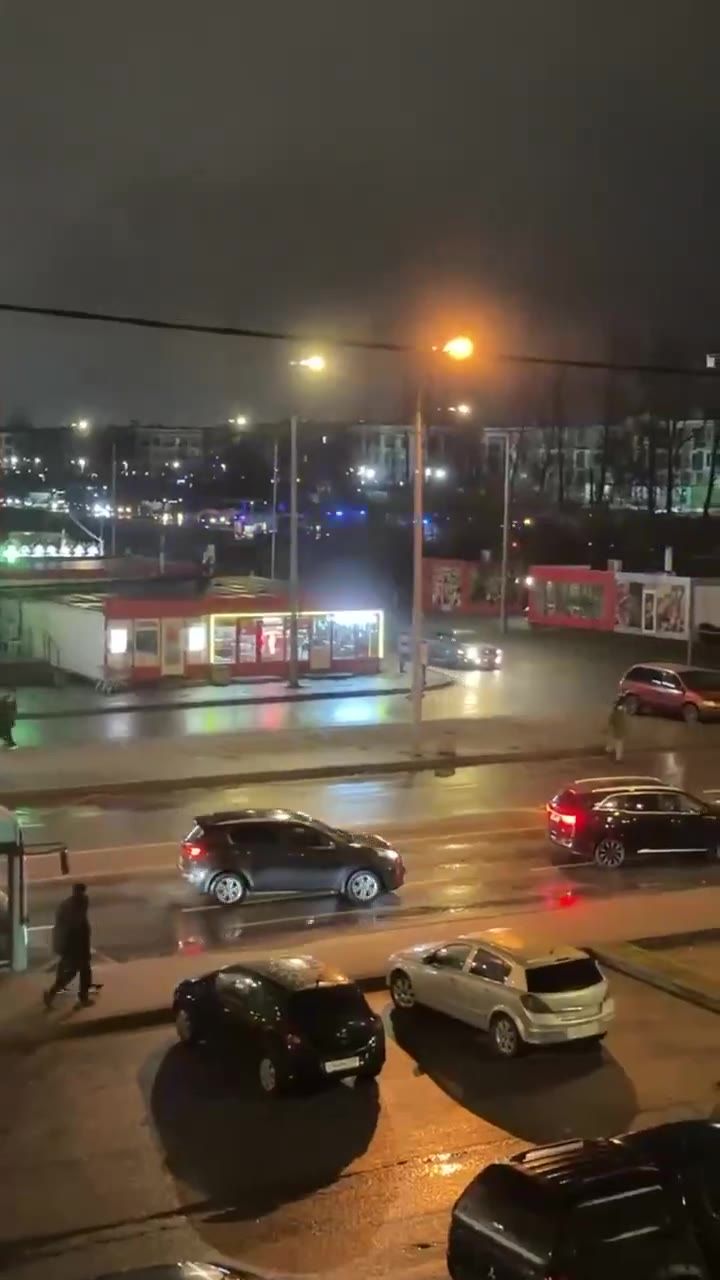
The attached clip shows the car explosion.3
The post attaches a short night-time clip as if it were the blast, but the footage we examined does not show one. Five evenly spaced frames from the 3.76-second video show ordinary traffic, a pedestrian and a lit shop front, with no fireball, smoke or wreckage. Meanwhile the moment of detonation that Russian outlets published came from a doorbell camera and was described as a flash in a parking area, which is not what this clip shows. The clip may well be genuine footage of the same street, filmed from a window, but the frames we sampled do not depict the attack. We cannot say the video was faked, and we have no reason to think it was; we can only say it does not demonstrate what the caption implies. Because the killing itself is documented elsewhere, this does not affect the main verdict.
Still open: Where exactly was the attached clip filmed, and was it recorded before, during or after the blast?
What was posted
XAn X post from a Ukrainian-aligned account shares a short, silent night-time video of a street with traffic, captioned as a car explosion on Kolpino Highway in St Petersburg that killed a Russian colonel. The post asks readers to accept both that the man died and that the clip shows the attack, and closes with an approving comment on his death.
“A car explosion on Kolpino Highway in St. Petersburg reportedly killed Colonel Dmitry Lobodin, chief navigator of the 6th Air and Air Defence Army. He directly participated in russia’s full-scale invasion of Ukraine. War has consequences.”
Posted on X by an account with a Ukrainian flag in its display name (UAVoyager). The blast footage it reposts had already circulated on Russian Telegram channels and been published by Fontanka and Piter.tv the same day.
Who posted it
XAccount check
Estimates from public signals — account age, posting pattern, audience — not a judgement of the person behind the account, and separate from whether this post is true.
What stood out
- Long-running, high-output Ukraine war aggregator: active under the handle @NAFOvoyager before rebranding to @CrimeanVoyager; posts referenced continuously from 2022 through November 2026.
- Consistently treated as a usable public source by secondary media: Espreso.tv cites 'public sources, such as UAVoyager on Twitter', and outlets including Defence24, Sloboden Pecat, makfax, Telegrafi, NRA.lv and others embed its posts — evidence of a real, monitored operator rather than a throwaway bot.
- Distinct human voice and editorial line (pro-Ukraine advocacy, NAFO subculture, emotive/ironic framing such as 'russian terrorists', 'ruzzia'), which is typical of an individual citizen-OSINT/advocacy account, not a state or automated persona.
- Anonymous and unverified: no platform verification, no disclosed operator identity, bio only 'Through My Lens News. Ukrainian voice for the world.'; handle changes (NAFOvoyager → CrimeanVoyager) reduce traceability.
- Documented video-verification failures: Nieuwscheckers rated a mass-drone-attack video it posted 'Onwaar' (untrue) — an Arma 3/AI clip it reposted to ~1,500 shares before conceding in replies it could not tell the difference; in December 2025 it posted another AI-generated 'ace shootdown' video that aviation analyst Tyler Rogoway publicly debunked.
- High-volume, rapid-fire posting schedule with breaking-claim framing ('right now', 'just dropped') that often outruns verification, and heavy amplification by NAFO-aligned networks — coordination-adjacent but not evidence of automation.
- No fact-checker or platform action found labelling the account itself as fabricated, impersonating, or part of a bot network; criticism centres on unreliability of some footage and partisan framing rather than inauthenticity of the persona.
- Overall: a genuine, widely-cited but anonymous and partisan conflict aggregator — treat its breaking video claims as leads requiring independent verification, not as confirmed fact.
Signals (12)+
- Platform
- Handle
- Crimeanvoyager
- Previous handle
- NAFOvoyager
- Display name observed
- UAVoyager🇺🇦
- Bio observed
- Through My Lens News. Ukrainian voice for the world. An admirer of peace and silence broken by ruzzia.
- Platform verification
- No
- Posting cadence
- Very high, multiple posts per day, real-time conflict coverage
- Follower ratio
- Unknown
- Media citation frequency
- High — cited or embedded by Espreso.tv, Defence24, Sloboden Pecat, NRA.lv, Telegrafi, makfax, 15minutes.gr, BosniaToday, Digg topic page
- Fact check history
- Nieuwscheckers (2025-02-27) rated one reposted drone-strike video 'Onwaar' (AI/Arma 3 footage, later acknowledged in replies); Aviation analyst Tyler Rogoway publicly debunked an AI 'ace shootdown' video it posted in December 2025
- Self correction behaviour
- Partial — conceded AI origin in comment threads after criticism rather than deleting/editing
- Political orientation
- Strongly pro-Ukraine, NAFO-affiliated, advocacy framing
Account checked November 13, 2026, 03:15 UTC
The media
Video✓ What is genuine
The footage looks like real handheld video of a Russian suburban street at night. It is the caption, not the pixels, that overstates what it shows.
The tells
- ●●○ Supporting signal Wet asphalt reflects streetlights consistently, traffic moves normally and a pedestrian walks past with no sign of alarm, which fits ordinary camera footage.our visual review
- ●●○ Supporting signal No warping, morphing or counting errors across the five sampled frames, which is what synthetic video often shows.our visual review
- ●●● Strong signal The frames contain no fireball, smoke or wreckage, so the clip does not show a detonation at all.our visual review
Synthetic-media detector
Detector not consultedThe media is incidental to the claim; the detector was not needed.
How we checked the media
- Reviewed five evenly spaced keyframes from the 3.76-second clip by eye for lighting, reflections, traffic, signage and any fire, smoke or wreckage.
- Compared what the frames show with Fontanka's description of the doorbell-camera footage of the actual blast.
Sources
7 sources reviewed- 1Russian colonel killed in St. Petersburg car bombing, three months after another military officer's car was blown up in the same area ↗
Meduza · meduza.ioUntiereduntiered — treated as signal only, never decisiveEvidence
Reports the explosion and the leading identification, and links the Killing to the earlier bombing on the same road.
- 2Взорвавший офицера в Санкт-Петербурге преступник скрылся в Кишиневе ↗
Kommersant · kommersant.ruUntiereduntiered — treated as signal only, never decisiveEvidence
Names Colonel Dmitry Lobodin and his position as chief navigator of the 6th Army.
- 3Момент взрыва машины военного в Шушарах попал на видео ↗
Fontanka · fontanka.ruUntiereduntiered — treated as signal only, never decisiveEvidence
Describes the doorbell-camera footage of the actual blast at 7:00 a.m. in Slavyanka.
- 4В Петербурге при взрыве автомобиля погиб полковник российской армии ↗
Novaya Gazeta Europe · novayagazeta.euUntiereduntiered — treated as signal only, never decisiveEvidence
Ties the identification to the Book of Executioners and Commanders of Failure projects.
- 5Russian chief navigator may have died in St. Petersburg car explosion ↗
The New Voice of Ukraine · english.nv.uaUntiereduntiered — treated as signal only, never decisiveEvidence
Notes the name first appeared in 78.ru, which later removed its report.
- 6Autobomba uccide un alto ufficiale a San Pietroburgo ↗
ANSA · ansa.itReputable outletItalian wire — CenterEvidence
Confirms the bombing independently, with timing and distance details.
- 7Military was blown up in his car in St. Petersburg ↗
Astra · astra.pressUntiereduntiered — treated as signal only, never decisiveEvidence
Shows an outlet describing the victim cautiously as an unnamed colonel while the name was still settling.
Further reading
- 2Kommersant Kommersant's report is the source that names Lobodin and his post in the clearest terms.
- 3Fontanka Fontanka describes the doorbell-camera footage of the actual blast moment, which lets you compare it with the attached clip.
- 1Meduza Meduza puts the killing in context, including the earlier bombing on the same road.
- 7Astra Astra shows how cautiously another outlet treated the identity before the name settled.
The full story
The claim worked because almost all of it is real. St Petersburg's Kolpinskoye Highway has seen this before: in late August 2026 a similar bomb killed another officer of the same 6th Air and Air Defence Army on the same road. That pattern makes a second attack in November immediately plausible to anyone following the war.
The event itself is well documented. Around 07:00 on 12 November 2026 a device attached to a car was remotely detonated as the car left a courtyard in the Slavyanka area of Shushary. The driver, a colonel, was killed and a relative in the car was injured. A passing bus had its windows blown out, but no passengers were hurt. Russia's Investigative Committee opened a murder case. Footage of the flash was captured by a doorbell camera and quickly spread on Russian Telegram channels before being picked up by outlets including Fontanka and Piter.tv.
What the post adds is a name and a motive. The name, Dmitry Lobodin, comes from reporting rather than an official announcement, which is why the post's confident phrasing runs slightly ahead of the record. Authorities have stayed silent on the identity. A suspect, a 31-year-old St Petersburg resident, reportedly left Russia for Turkey and then Moldova before the blast. So the post is accurate on the event, credible but unconfirmed on the name, and loose in presenting a street clip as the explosion.
Kernel of truth
A real, officially acknowledged car bombing in St Petersburg killed a senior officer of the 6th Air and Air Defence Army on 12 November 2026.
Timeline
August 2026
A similar car bomb kills another officer of the 6th Air and Air Defence Army on the same St Petersburg road. 1Meduza
November 12, 2026
Around 07:00 a remotely detonated device blows up a colonel's car on Kolpinskoye Highway in Shushary; the colonel dies and a relative is injured. 3Fontanka
November 12, 2026
Russia's Investigative Committee opens a murder case, confirming a serviceman was killed but not naming him. 1Meduza
November 12, 2026
Kommersant and other outlets identify the victim as Colonel Dmitry Lobodin, chief navigator of the 6th Army. 2Kommersant
How it was framed
The core of the post, a car bombing that killed a senior Russian officer in St Petersburg, is real and well documented. The secondary issue is the attached clip, which is presented alongside the claim in a way that implies it shows the explosion when the frames we sampled do not.
- Emotional language. "War has consequences." — a closing line that frames the killing approvingly rather than neutrally.
- Missing context. The clip is posted without noting that it does not show the moment of detonation, which outlets described from separate doorbell-camera footage.
- Us vs. them. The display name "UAVoyager" with a Ukrainian flag sets the post within one side of the war.
Posted on X by an account whose display name carries a Ukrainian flag and the handle CrimeanVoyager. The underlying footage circulated on Russian Telegram channels and was published by Russian outlets before the X repost.
Bias
Leans pro-Ukrainian / anti-Russian. The post adopts an openly partisan frame, describing the dead officer as having 'directly participated' in the invasion, calling him a war criminal in linked material, and closing with 'War has consequences' — presenting a targeted killing approvingly rather than neutrally reporting a death.
Bias describes how the post frames its message — the slant of the language, selection and emphasis — and is judged separately from whether the claim is true. A true claim can still be framed with a strong slant.
How we checked
48 s- 1
Searched in English and Russian for the victim's name, the location and the reported date.
- 2
Searched for coverage of the blast moment and the doorbell-camera footage.
- 3
Searched specifically for fact checks or debunks of the St Petersburg video.
- 4
Reviewed five evenly spaced keyframes from the attached 3.76-second clip by eye for lighting, reflections, traffic and any sign of fire or wreckage.
- 5
Compared the identification across Kommersant, Meduza, Fontanka, Novaya Gazeta Europe, Astra, The New Voice of Ukraine and ANSA, and noted where they agree and where they hedge.
✓ Claim checked✓ Media checked✓ Sources checked
Why 78% confidence
HighWe rate the headline high confidence because state and independent sources agree the bombing happened and a colonel died, and several newsrooms reach the same name. We do not go higher on the identity because no official statement names Lobodin, and the video claim stays unverifiable at low confidence because the frames we examined show no blast. Our visual assessment rests on frame review and sources, not on a synthetic-media detector.
Limits. We did not run a forensic or AI-detection tool on the video, so our judgement of it rests on visual review and published reporting. We could not watch the clip in full motion or trace its original upload, and we could not verify leaked registration data ourselves.
What we don’t know
- Why the Russian outlet 78.ru removed its initial report naming the victim.
- Whether the leaked registration data placing Lobodin near the blast is accurate.
- Where and when the attached clip was actually filmed.
- Whether officials will eventually name the victim, which would move the identity claim from likely to confirmed.
Spot it yourself
Find the overstatementLooks suspicious, isn’t proof
- The account is openly partisan and posts approvingly about a Russian officer's death. Tone tells you where the poster stands, not whether the event happened.
- The video is short, silent and filmed at night from a window, so detail is hard to see. Poor quality is not evidence of fakery.
- The caption says "reportedly", which signals the poster did not confirm the name themselves. Hedged wording can be honest caution or a way to avoid responsibility.
The actual evidence
- Russia's Investigative Committee confirmed a serviceman was killed and opened a murder case — a state body acknowledging the event.
- Several outlets working separately reported the same location, time and method for the bombing.
- Kommersant named Lobodin and his post, and other outlets reached the same name independently, though possibly from the same leaked data.
- The actual blast footage came from a doorbell camera and was described as a flash; the attached clip's sampled frames show ordinary traffic instead.
- 1
Ask who would be reporting this if it were true.
A bombing in a major Russian city would be covered by local outlets and acknowledged by investigators. Search the location and date; if only one partisan account has it, be cautious.
- 2
Separate the event from the identity.
Check whether the killing is confirmed before checking the name. Here the death is official; the name comes from journalism, which is a lower level of certainty.
- 3
Watch the video for the thing it claims to show.
Scrub through, not just the first frames. Look for fire, smoke, wreckage or people reacting. If none appear, the clip is probably the street, not the attack.
- 4
Compare the clip with how outlets describe the blast.
If reporting says the moment came from a doorbell camera, a different angle from a window does not match. Note it without assuming the clip is fake.
- 5
Treat activist databases as evidence, not proof.
A name on a tracking project is a lead. It tells you someone has been catalogued, not that a specific act is documented.
Takeaway
A post can be right about the event and still mislead you about its evidence. Check the claim and the visuals separately, and accept different levels of certainty for each.
Questions people ask
Did a Russian colonel really die in a car bombing in St Petersburg?+
Yes. Around 07:00 on 12 November 2026 a remotely detonated device blew up a car on Kolpinskoye Highway in Shushary, St Petersburg. Russia's Investigative Committee confirmed a serviceman was killed and opened a murder case. Independent and state-linked outlets report the same event.
Was the victim Colonel Dmitry Lobodin?+
Kommersant named Colonel Dmitry Lobodin, chief navigator of the 6th Air and Air Defence Army, and several other outlets treat that as the leading version. Russian authorities have not officially released his name, so the identification is very likely but not officially confirmed.
Does the video in the post show the explosion?+
Not in the frames we examined. Five evenly spaced frames from the short clip show ordinary night traffic and a pedestrian, with no fireball, smoke or wreckage. The actual blast moment was captured by a doorbell camera, according to Fontanka, and described as a flash in a parking area.
Has this happened before in the same area?+
Yes. Reporting notes that a similar bomb killed another officer of the 6th Air and Air Defence Army on the same St Petersburg road in late August 2026, about three months before this attack. That earlier killing helps explain why the November bombing was quickly believed.
What does 'true with caveats' mean here?+
It means the main facts of the post hold up: the bombing happened and a Russian colonel was killed. The caveats are that the victim's name is journalistic rather than official, his personal role in Ukraine rests on an activist database, and the attached clip does not itself show the explosion.
Go deeper
- Remotely detonated device
- An explosive fitted to a vehicle and triggered from a distance, rather than by the driver or on impact.
- Investigative Committee
- Russia's federal body that investigates serious crimes, including murders and bombings.
- Air and Air Defence Army
- A large Russian military formation that combines aircraft with ground-based air-defence units.
- Keyframe
- A still image sampled at regular points from a video so it can be examined without watching every frame.
- Book of Executioners
- A Ukrainian activist database that catalogues Russian officers and officials accused of involvement in the war.
People also search for
For educators+
- If officials confirm a death but not a name, how confident should a news report be in naming the victim?
- The clip looks real but shows no blast. Is it misleading to post it under this caption, and why?
- How would you explain the difference between 'we know this happened' and 'we know who it was' to a friend who shares posts quickly?
About this check
- Platform
- X
- Posted by
- @crimeanvoyager
- Posted
- November 12, 2026
- Age when checked
- Under 24 hours old when checked
- Where it spread
- Russia, Ukraine
- Audience
- International audience
- Language
- EN
- Status
- ● Post is live
- Verified
- November 13, 2026, 03:16 UTC
- Published
- November 13, 2026, 03:16 UTC
Reach. CrimeanVoyager 475 likes; Gerashchenko_en 880 likes; bayraktar_1love 2,564 likes (X syndication). Covered by Newsweek, Meduza, Moscow Times, UNITED24, Militarnyi and Euronews on 12 Nov.
This verdict was generated with AI from the sources shown. AI can make mistakes — check the sources before relying on it.
Check anything yourself, in seconds.
Share any social post or video to What the Fact and get the verdict, the confidence, and the receipts.