Did the IDF strike a senior Hamas commander at Nasser Hospital in Khan Yunis?
Was Hamas using Gaza's Nasser Hospital as a command centre, with its Khan Younis Brigade commander hiding inside, as the IDF said to justify its 12 November 2026 strike that killed six people including a surgeon?
True, but…
The strike is confirmed; the hospital-as-Hamas-hub justification is contested and unverified.
The strike happened. The IDF and Shin Bet say they targeted Hamas Khan Yunis Brigade commander Mohammed Abu Ismail and other operatives at Nasser Hospital overnight on 11–12 November 2026, and outlets including AFP and DW reported it. But the caption's claim that the hospital was a Hamas military hub is an IDF allegation released without public evidence, which Hamas denies.
 Likely genuine
Claims
✓ 1 trueThe IDF struck a senior Hamas terrorist and additional Hamas terrorists operating within Nasser Hospital in Khan Yunis to eliminate the threat they posed.123
This claim rests on the strike itself, and the strike is not in dispute. AFP reports that the Israeli military confirmed the attack, saying it targeted "a senior Hamas terrorist and additional terrorists from Hamas's military wing", and that a separate statement named Mohammed Abu Ismail, Hamas's Khan Yunis Brigade commander, as killed. The Times of Israel and DW carry the same confirmation. Palestinian health and civil defence officials put the toll at six dead, including a surgeon, with dozens wounded, and MSF confirms six killed including a child and a surgeon. Three independent outlets reporting the same military confirmation is meaningful corroboration: they did not simply repeat the IDF's post, they checked with the army and with local officials. What a reader should weigh is the gap between what is settled and what is not. That a strike happened and what the IDF said it was targeting are confirmed; whether the people hit were in fact operating from the hospital is a separate question, dealt with below.
Still open: Whether the specific individuals killed were the operatives the IDF says they were has not been independently established.
Hamas used the Nasser Hospital complex as a hub for military and terrorist activity, including storing weapons, operating command-and-control rooms, interrogations and torture, and sheltering operatives.356
This is the justification rather than the event, and the evidence is thinner and more mixed. DW states plainly that the military made the claim "without providing evidence". Against that, some independent reporting partly supports an armed presence: MSF documented armed men in different areas of the large compound, intimidation, arbitrary arrests of patients and "a recent situation of movement of weapons", and it suspended some activities there. But in the same reporting MSF says it does "not have sufficient evidence to conclude that the hospital was being used by armed groups for military purposes". Hamas denies military use and calls the strike a war crime. So the sources point in different directions rather than tracing to one origin: a humanitarian organisation observed real armed activity but declined to draw the conclusion the IDF draws. A reader should treat the specific claims — command rooms, interrogations, torture, weapons stores — as belligerent assertions that have not been publicly substantiated, while noting they are not invented from nothing. That mix is why the confidence here is low.
Still open: The IDF has not publicly released the intelligence behind its command-centre, interrogation and weapons-store claims.
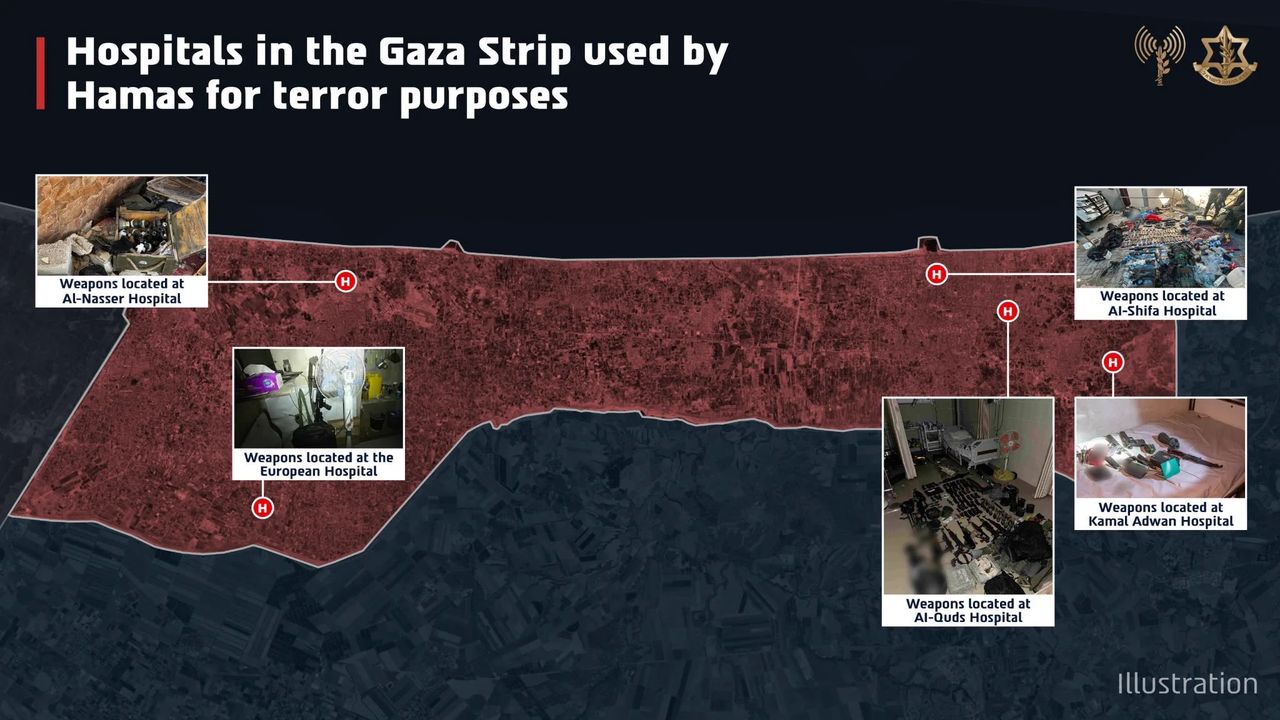
On-screen graphic: weapons were located at Al-Shifa, Al-Nasser, European, Al-Quds and Kamal Adwan hospitals, all used by Hamas for terror purposes.7
The image is an IDF composite built from the army's own photographs, and it carries its own caveat: a small "Illustration" credit. Weapons finds at Al-Shifa were announced by the IDF in 2023 and partly examined by journalists at the time, but the photographs said to come from the other four hospitals have not been independently verified. An investigation by Swiss public broadcaster SRF with +972 Magazine and the Viewfinder collective is directly relevant here: it found that the IDF's hospital and tunnel graphics are correctly labelled as illustrations yet still give an impression of factual authenticity, with many 3D elements not based on intelligence findings. That does not make these particular photographs false, but it does cap how much weight a single unverifiable graphic can carry. Combined with the previous claim, the honest reading is that some of the underlying facts may hold and others may not, and the post gives a reader no way to tell which is which.
Still open: No independent verification exists for the weapons photographs attributed to the European Hospital, Al-Quds, Kamal Adwan or Al-Nasser.
What was posted
XThe Israel Defense Forces posted an infographic on X alongside a caption announcing a strike on Nasser Hospital in Khan Yunis, southern Gaza. The caption lists reasons the army says the hospital complex served Hamas military purposes. The attached image is a satellite-style map of Gaza with pin markers and inset photographs, headed as showing hospitals in Gaza used by Hamas for terror purposes.
“🎯 STRUCK: A senior Hamas terrorist and additional terrorists operating within Nasser Hospital in Khan Yunis, southern Gaza, to eliminate the threat they posed. Hamas used the hospital complex as a hub for military and terrorist activities against IDF troops and Israel, including: • Storing weapon…”
Posted on the IDF's own verified X account, the same channel the military uses for operational announcements.
Who posted it
XAccount check
Estimates from public signals — account age, posting pattern, audience — not a judgement of the person behind the account, and separate from whether this post is true.
What stood out
- @IDF is the long-standing official English-language X account of the Israel Defense Forces; it is cited as such by the UN, Israeli state outlets and major wires, and is listed among the IDF's official channels (alongside @IDFSpokesperson, @idfonline, @TurkishIDF).
- Account is active as of 12 Nov 2026 (e.g., posts on the Nasser Hospital strike and Gaza winter aid coordination), so it is a live institutional channel rather than a dormant or spoof handle.
- No evidence the handle itself is an impostor; the IDF repeatedly warns about fake 'IDF' accounts and screenshots, and fact-checkers (BBC, Soch Fact Check) have debunked fabricated @IDF-style tweets — those fakes are distinct from this handle.
- Reliability as a source is weaker than its authenticity: the account has promoted claims later found false or retracted, notably the Nov 2023 'hostage-guardian list' at Al-Rantisi Hospital that was a weekday calendar (IDF later admitted a translation error but kept the post up), plus contested Al-Shifa 'Hamas HQ' material.
- It is a partisan state military spokesperson: statements are official/on-the-record and often verifiable, but framed through combatant messaging and rarely self-correcting — a known propaganda/hasbara channel, i.e. real but not neutral.
- Metadata in the supplied profile is empty (no bio, follower count, creation date, verification flag, or posts), so assessment rests on web corroboration; the nulls are a data gap, not evidence of a fake account — the real account has millions of followers and X verification.
- Posting cadence is institutional (high volume, multi-language, scheduled and staffed by spokespeople/reservists), which is coordinated but transparent, not covert bot behaviour.
Signals (12)+
- Account type
- Official state military spokesperson (institutional)
- Identified entity
- Israel Defense Forces, English-language official account
- Platform verification observed
- Verified in practice (historic X verification; millions of followers) despite null in supplied metadata
- Metadata completeness
- Very low (bio, followers, creation date, posts all null)
- Posting cadence
- High-volume, scheduled institutional posting in 7 languages
- Follower ratio
- N/a (millions of followers, institutional asymmetry)
- Primary sourcing
- IDF Spokesperson's Unit statements, operational briefings, released footage, COGAT data
- Fact check history
- Multiple disputed/false claims documented: Al-Rantisi 'calendar' hostage list (2023, IDF acknowledged translation error), contested Al-Shifa hospital claims; also frequent victim of forged screenshots
- Notable news coverage
- Cited by UN documents, Reuters/AP-tier outlets, Israeli and international press; regularly quoted as official voice
- Partisan alignment
- State/combatant party to the conflicts it reports on
- Coordination indicators
- Transparent multi-account network (@IDF, @IDFSpokesperson, @idfonline, @TurkishIDF) run by the same unit
- Impostor risk
- Handle itself appears genuine; lookalike accounts and fabricated screenshots are a separate documented problem
Account checked November 14, 2026, 03:05 UTC
The media
Image✓ What is genuine
The image is a real IDF infographic produced and published by the military itself, as part of its announcement of a strike that independent outlets confirm took place. The map is a schematic; the photographs within it are presented as the army's own finds.
The tells
- ●●● Strong signal IDF insignia and the army's standard infographic layout, including a small "Illustration" credit at bottom right.our visual review
- ●●○ Supporting signal The base layer is a schematic map with pin markers rather than a photograph of a scene, which is normal for this kind of military graphic and not itself a sign of faking.our visual review
- ●●○ Supporting signal The inset weapons photographs cannot be independently verified and are drawn from the army's own material.SRF / +972 Magazine / Viewfinder investigation, per source 7
Synthetic-media detector
Detector not consultedThe media is incidental to the claim; the detector was not needed.
How we checked the media
- Visual review of the image as published: a satellite-style map of the Gaza Strip with pin markers and five inset photographs, carrying IDF insignia and a small "Illustration" credit at bottom right.
- Compared the image's format and labelling against how the IDF routinely publishes operational graphics, as described in the SRF/+972/Viewfinder investigation.
Sources
7 sources reviewed- 1IDF targets top Hamas commander in strike on south Gaza hospital; 6 said killed ↗
The Times of Israel · timesofisrael.comUntiereduntiered — treated as signal only, never decisiveEvidence
Reports the strike, the target and the six dead including a surgeon.
- 2Israeli strikes kill 10, including 6 in Khan Younis hospital ↗
L'Orient Today (AFP) · today.lorientlejour.comUntiereduntiered — treated as signal only, never decisiveEvidence
Quotes the IDF confirmation and the separate statement naming Mohammed Abu Ismail as killed.
- 3Israel targets senior Hamas member in deadly Gaza hospital strike ↗
DW · dw.comReputable outletCenter — independent public intl broadcasterEvidence
Reports the strike and notes the military's hub claim was made without providing evidence.
- 4IDF: Hamas held dozens of hostages at Nasser Hospital, used it as military headquarters ↗
JNS · jns.orgUntiereduntiered — treated as signal only, never decisiveContext
Records the IDF's account of the hospital being used as a military headquarters and holding hostages.
- 5MSF condemns another deadly attack on Nasser hospital ↗
Médecins Sans Frontières · msf.orgUntiereduntiered — treated as signal only, never decisiveEvidence
Confirms the surgery building was hit, six killed including a child and a surgeon, and that no warning was given.
- 6Doctors Without Borders pulling out of key Gaza hospital after sighting gunmen ↗
CBC News · cbc.caUntiereduntiered — treated as signal only, never decisiveEvidence
Documents MSF's observation of armed men and weapons movement, and its statement that it lacked sufficient evidence of military use.
- 7Realistic fantasy: Israel's 3D propaganda ↗
SWI swissinfo.ch (SRF / +972 Magazine / Viewfinder) · swissinfo.chUntiereduntiered — treated as signal only, never decisiveEvidence
Finds IDF hospital and tunnel graphics are labelled illustrations but not verifiable.
Further reading
- 3DW DW sets out both the confirmed strike and the fact that the hub claim was made without evidence.
- 6CBC News The clearest account of what MSF saw inside Nasser Hospital, and where it stops short of the IDF's conclusion.
- 7SWI swissinfo.ch (SRF / +972 Magazine / Viewfinder) Explains why IDF hospital graphics can look authoritative while remaining unverifiable.
The full story
The kernel of truth is solid. Overnight on 11–12 November 2026, Israel struck the surgery building of Nasser Hospital in Khan Yunis, southern Gaza. The IDF and Shin Bet said they were targeting Mohammed Abu Ismail, Hamas's Khan Yunis Brigade commander, and other operatives, and the IDF later stated Abu Ismail was killed. AFP, the Times of Israel and DW all reported the strike and the military's confirmation of it.
What gives the claim its plausibility is the part that is genuinely documented. Nasser Hospital had already been a site of suspicion. In January, MSF reported armed men in different areas of the large compound, intimidation, arbitrary arrests of patients and a movement of weapons, and it suspended some activities there. Hostages have said they were held at the hospital, per the IDF account reported by JNS. So the idea that the compound was not a neutral space was not invented on 12 November.
What the post leaves out is equally important. MSF, while reporting those armed men, said it did not have sufficient evidence to conclude the hospital was being used by armed groups for military purposes. DW notes the army made its hub claim without providing evidence. Hamas denies military use and calls the strike a war crime. Palestinian officials reported six dead, including a surgeon and a child, with dozens wounded; MSF says no warning was given. The IDF caption mentions none of that.
The result is a post whose headline event is real but whose framing asks the reader to accept an unproven justification and skip the civilian cost. Both belong in the same picture.
Kernel of truth
A confirmed Israeli airstrike on Nasser Hospital that the IDF says targeted a senior Hamas commander — against a backdrop of earlier, independently reported armed activity inside the compound.
Timeline
November 12, 2026
Israeli airstrike hits the surgery building of Nasser Hospital in Khan Yunis overnight; the IDF and Shin Bet say they targeted Hamas commander Mohammed Abu Ismail and other operatives. 1The Times of Israel
November 12, 2026
Palestinian health and civil defence officials report six dead, including a surgeon, with dozens wounded; MSF later confirms six killed including a child and a surgeon. 5Médecins Sans Frontières
November 12, 2026
The IDF's X account publishes the strike announcement and satellite-style hospital graphic.
November 12, 2026
AFP reports a separate IDF statement that Mohammed Abu Ismail, Hamas's Khan Yunis Brigade commander, was killed in the strike. 2L'Orient Today (AFP)
How it was framed
The post uses a real event and a real military graphic, but frames them to assert a justification the army has not publicly evidenced and to frame the hospital entirely as a military target while omitting the civilian deaths. The graphic's five-hospital weapons collage also invites a conclusion about specific hospitals that its own "Illustration" label and unverified photographs cannot support.
- “Visual proof”. The post pairs the caption with a map-and-photograph graphic headed as showing hospitals in Gaza used by Hamas, giving the impression that the justification is documented.
- Missing context. The caption lists only military reasons and does not mention the six dead reported by Palestinian officials, including a surgeon and a child, or MSF's account that no warning was given.
- Ongoing-threat framing. The phrase "to eliminate the threat they posed" frames the strike as pre-emptive necessity.
- Borrowed authority. The post speaks as the Israel Defense Forces' official account, presenting contested allegations in the register of confirmed operational fact.
Posted on the IDF's own X account, the same channel it uses for operational announcements. The attached graphic carries IDF insignia and a small "Illustration" credit at bottom right.
Bias
Leans pro-Israel / pro-IDF. The post is the Israeli military's own communications product. It presents contested allegations about Hamas use of five named hospitals as established fact, shows only one side's photographic material, and omits that the strike killed six people including a surgeon and wounded dozens more, and that hospital officials and Hamas deny any military use. The framing is advocacy for the legality of the strike rather than neutral reporting.
Bias describes how the post frames its message — the slant of the language, selection and emphasis — and is judged separately from whether the claim is true. A true claim can still be framed with a strong slant.
How we checked
1 min 2 s- 1
Searched for the strike using the location, the hospital name and the target description, to see whether independent outlets reported it.
- 2
Searched specifically for the Nasser Hospital strike in November 2026 to confirm the date and the named commander.
- 3
Searched for MSF's statements about armed men and suspended activities at the hospital, to test the military-use allegation against a non-party source.
- 4
Searched for fact-checking and investigative work on IDF hospital graphics and their "Illustration" labelling.
- 5
Reviewed the image visually: layout, insignia, the inset photographs and the "Illustration" credit.
✓ Claim checked✓ Media checked✓ Sources checked
Why 80% confidence
HighThe headline verdict is HIGH because the event itself is confirmed by multiple independent outlets quoting the military directly and by casualty figures corroborated across Palestinian officials and MSF. The two supporting claims sit at LOW because they rest on belligerent assertions without public evidence, offset only partly by MSF's observation of armed men. We did not run an AI-generation detector on the image, because the graphic is not what the claim depends on and it plainly presents as an IDF-produced infographic.
Limits. We did not open the underlying pages, so we rely on the published snippets and summaries from each outlet. We have no access to the intelligence the IDF says underpins its claims, and no independent verification of the weapons photographs for four of the five hospitals named in the graphic.
What we don’t know
- Whether the individuals killed in the strike were the Hamas operatives the IDF says they were.
- What evidence, if any, the IDF holds for the command-centre, interrogation and weapons-store claims.
- Whether the inset weapons photographs from the European Hospital, Al-Quds, Kamal Adwan and Al-Nasser can be independently verified.
- The final, reconciled casualty count; figures reported range from 20 to 50 wounded.
Spot it yourself
Find the overstatementLooks suspicious, isn’t proof
- The source is a party to the conflict. That is a reason to check the claim against independent reporting, not proof the claim is false — the strike itself was confirmed.
- The graphic looks like propaganda. Military infographics often are, but they can still be built on real events; here the event happened.
- The caption is one-sided and omits casualties. Omission is a framing problem, not evidence that the strike did not occur.
- The image includes an "Illustration" label. That signals a schematic, not necessarily a fabrication of the underlying facts.
The actual evidence
- Independent confirmation of the strike and the target from AFP, the Times of Israel and DW, each attributed to IDF and Shin Bet statements.
- MSF's own reporting of armed men, intimidation and a movement of weapons in the compound — partial support for an armed presence, from a source with no stake in the IDF's case.
- MSF's explicit statement that it lacked sufficient evidence to conclude the hospital was used for military purposes, which limits how far that partial support goes.
- DW's note that the army made the hub claim without providing evidence, and Hamas's denial.
- The SRF/+972/Viewfinder finding that IDF hospital graphics are labelled illustrations but not verifiable.
- 1
Separate the event from the justification
Ask two questions: did the thing happen, and is the stated reason proven? Here the first is confirmed by multiple outlets; the second rests on the army's own word.
- 2
Look for the other side's numbers
If a post about a strike names no casualties, search the place and date plus "killed" to see what health officials and aid groups reported.
- 3
Check whether a humanitarian organisation was present
Aid groups working on site, like MSF here, often publish statements that both confirm details and set limits on what they can prove. Read the limits, not just the details.
- 4
Read a graphic's own labels
Find any word like "illustration" or "schematic". It tells you the image illustrates a claim rather than documenting it.
- 5
Trace who made the image
If the graphic comes from the party making the claim, its photographs are exhibits, not independent evidence, until someone outside that party verifies them.
Takeaway
When a confident official post mixes a verified event with an unverified reason, check each part separately; the truth of one does not carry over to the other.
Questions people ask
Did Israel actually strike Nasser Hospital in Khan Yunis?+
Yes. Overnight on 11–12 November 2026 Israel struck the surgery building of Nasser Hospital. The IDF and Shin Bet confirmed the strike and said they targeted Hamas Khan Yunis Brigade commander Mohammed Abu Ismail and other operatives. AFP, the Times of Israel and DW all reported the confirmation. Palestinian officials reported six dead, including a surgeon, and dozens wounded.
Was Nasser Hospital being used by Hamas?+
Partly documented, not proven. MSF reported armed men in different areas of the compound, intimidation and a movement of weapons, and suspended some activities there. But MSF also said it did not have sufficient evidence to conclude the hospital was used by armed groups for military purposes. The IDF's specific claims about command rooms and torture have not been publicly evidenced.
Is the IDF graphic an AI fake?+
No sign of that. It is an official IDF infographic — a satellite-style map with pin markers and inset photographs — carrying IDF insignia and a small "Illustration" credit. Its problem is evidentiary, not synthetic: the photographs are the army's own and have not been independently verified for most of the hospitals shown.
Why does the caption not mention the people killed?+
The post is written as a military announcement and lists only the reasons for the strike. It does not mention the six dead reported by Palestinian officials, including a surgeon and a child, or MSF's statement that no warning was given. That omission shapes how the reader sees the event.
What does "TRUE_BUT" mean here?+
It means the core factual claim holds — the strike happened and the IDF says it targeted a senior Hamas commander — but the post as a whole needs caveats. Its justification for the strike is contested and not publicly evidenced, and it leaves out the civilian casualties. The event is real; the framing is one-sided.
Go deeper
- Misleading content
- Using genuine information in a way that frames a person or event unfairly, for example by leaving out context that changes the picture.
- False connection
- When a headline, caption or image does not actually support the content it is attached to.
- Belligerent assertion
- A claim made by a party to an armed conflict about its own actions or its enemy's, which carries less weight than independent verification.
- Illustration credit
- A label on a graphic showing that it is a schematic or reconstruction rather than a photograph or direct record of events.
- Corroboration
- Confirmation of a claim by separate sources that did not simply copy each other.
People also search for
For educators+
- A post can be right that something happened and still mislead. How would you describe the difference to someone who says "but the strike was real"?
- MSF reported armed men at the hospital but said it could not conclude the hospital was used for military purposes. Why does that distinction matter for how the strike is judged?
- If a government publishes a graphic marked "Illustration", what should a reader assume it proves and what should they not?
About this check
- Platform
- X
- Posted by
- @idf
- Posted
- November 12, 2026
- Age when checked
- 1–2 days old when checked
- Where it spread
- Israel, Palestine
- Audience
- International audience
- Language
- EN
- Status
- ● Post is live
- Verified
- November 14, 2026, 03:06 UTC
- Published
- November 14, 2026, 03:06 UTC
Reach. @IDF post 1,776 likes (X syndication, 14 Nov). Wide pickup: Times of Israel, Ynet, JPost, JC, NBC, Al Jazeera; Hamas rejected the claim; Misbar/Alaraby TV published bomb-debris analysis (GBU-39) on 13 Nov.
This verdict was generated with AI from the sources shown. AI can make mistakes — check the sources before relying on it.
Check anything yourself, in seconds.
Share any social post or video to What the Fact and get the verdict, the confidence, and the receipts.