Did Aryna Sabalenka call Elina Svitolina a "f***ing Ukrainian b***h" at the WTA Finals?
Did Aryna Sabalenka call Elina Svitolina a 'f***ing Ukrainian b***h' during their WTA Finals match, as a viral lip-reading clip claims?
Misleading
Real clip, real swearing — but the specific anti-Ukrainian slur is an unverified lip-read.
Misleading. The video is genuine WTA Finals broadcast footage from Sabalenka's 13 November 2026 loss to Svitolina in Indian Wells. But the clip has no audible audio of Sabalenka, so the Russian insult comes only from lip-reading by a Ukrainian fan account. Sabalenka says her remark was aimed at rowdy spectators, not Svitolina, and no audio confirms the words.
 Genuine
Claims
✓ 2 trueJudging by her lip movements, Sabalenka said in Russian either "Those f***ing Ukrainians, for f***'s sake!" or "That f***ing Ukrainian b***h, for f***'s sake!"1256
This is the claim the whole post depends on, and it cannot be settled with what exists. The three-second clip carries no audible audio of Sabalenka; the only sound is the umpire's score call. The Russian phrases come entirely from lip-reading done by a Ukrainian tennis fan account, not from a broadcast microphone, a court-side recording, the WTA or an independent lip-reader. Lip-reading is an interpretation, not a transcript, and it is especially fragile in a short, silent clip at an angle, with a player speaking while moving. The outlets that covered the controversy were careful: the Associated Press and BBC Sport described footage that "appeared to show" Sabalenka swearing or reported that some commentators "interpreted" her words as an insult, rather than transcribing them as fact. One regional outlet, Sloboden Pecat, noted explicitly that the video has no sound and so the words cannot be confirmed. A second-hand reading by a partisan account, uncorroborated by audio or any official body, cannot establish exact wording. A reader should weigh this as an allegation, not a quote.
Still open: Why the broadcast audio did not pick up the words — whether Sabalenka was out of range of a court microphone or the clip was circulated without its audio track — is not established in the record.
The outburst occurred during Sabalenka's WTA Finals match against Elina Svitolina, in the third set13
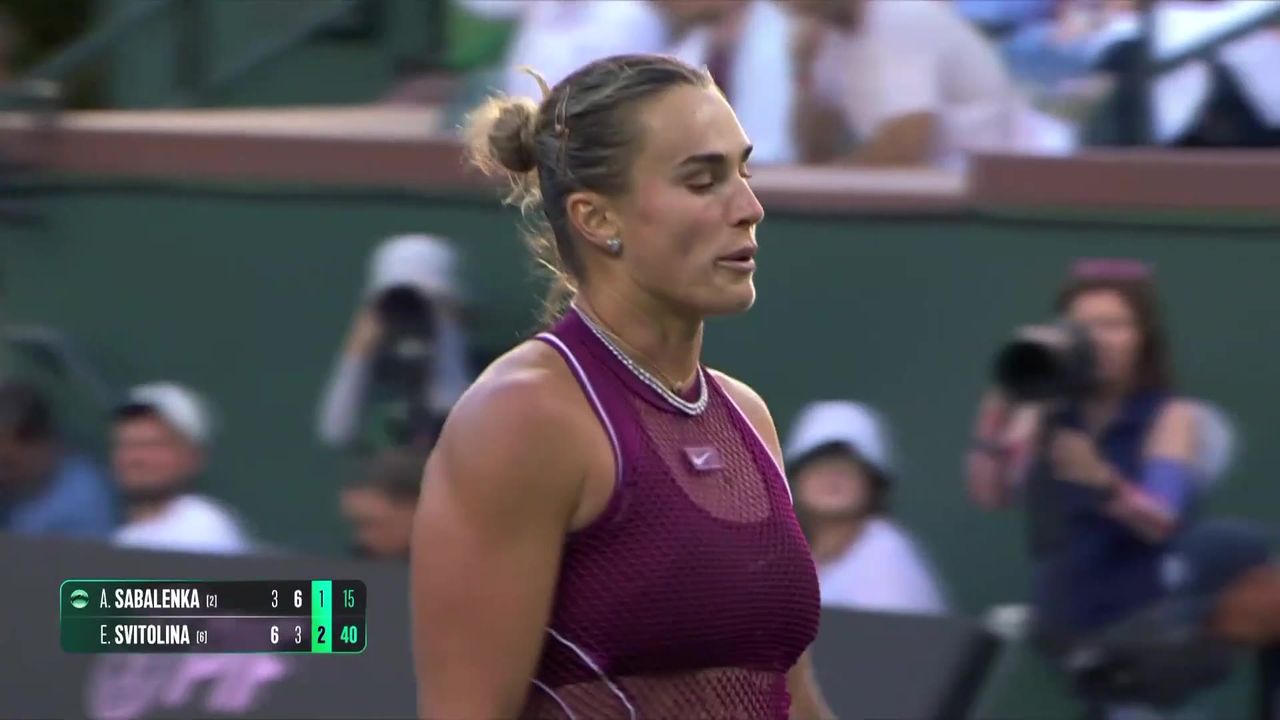
This part checks out fully. The match was a WTA Finals group-stage meeting at Indian Wells on 13 November 2026, and Elina Svitolina won 6-3 3-6 6-1, taking the last six games of the deciding set. Two independent match reports — the Associated Press and BBC Sport — give the same scoreline and date, and a second BBC report on Sabalenka's season ending describes her losing the final six games. The clip itself carries a WTA Finals on-screen scoreboard reading Sabalenka 3-6, 6-3, 1-2 with the game score around 15-40/30-40, which is consistent with the third set as reported. Our visual review found the stadium backdrop, the burgundy Nike kit and Sabalenka's appearance all match the broadcast. This is the firm factual anchor of the post, and it is why the core claim about when and where the outburst happened is rated TRUE with high confidence. The accuracy of the setting, however, does nothing to verify the words attributed to her — a real clip can carry an unsupported claim.
Sabalenka was swearing in Russian on court in frustration124
That Sabalenka swore in frustration is well supported, though not the specific words. The Associated Press and BBC Sport both reported widely shared footage of her angrily gesturing and swearing during the match, and ESPN covered her apology for an on-court outburst. Her own statement the next day apologised for an emotional reaction and to "anyone I offended", which is consistent with her having sworn. What she did not do is repeat the words, so the general fact of swearing is established while the precise content remains open. We rate this LIKELY_TRUE rather than TRUE because every account of the swearing ultimately traces back to the same silent clip and to her own acknowledgement of an outburst — there is no audio recording of the words themselves. Independent reporting confirms the visible behaviour and the apology; it does not and cannot confirm the Russian phrases. A reader should treat "she swore" as established and "she said these exact words" as not.
Still open: Her exact words remain unknown; no source in the record transcribes them from audio.
The obscenity was aimed at Svitolina and/or at Ukrainians124
This is the claim that turns a swearing incident into a political one, and it cannot be established either way. Sabalenka said on Instagram on 14 November — quoted verbatim by the Associated Press, BBC Sport and ESPN — that "my comment was not directed at Elina" and that she was frustrated with "a small group of spectators who were aggressively cheering my mistakes", adding she apologised to anyone she offended. That is a first-hand denial from the person involved, which carries real weight. Against it, there is no audio to test either account, and Svitolina's own comments were general rather than accusatory: she said she hoped their matches were respected and that on social media "things are turned around a little bit". Nobody in the record independently identified where Sabalenka was looking or who she was addressing. Because a denial exists but no audio settles the question, we rate the targeting UNVERIFIABLE rather than false. The post presents it as effectively decided; the evidence does not support that.
Still open: Who exactly Sabalenka was looking at, and whether any spectator footage exists, is not established in the record.
What was posted
XA post on X from a Ukrainian tennis fan account sharing a three-second, silent broadcast clip of Aryna Sabalenka during her WTA Finals match against Elina Svitolina. The clip shows Sabalenka gesturing and speaking as she walks to her chair between points. The caption offers two possible lip-read versions of a Russian obscenity — one referring to "those f***ing Ukrainians", the other to a "f***ing Ukrainian b***h" — and invites the reader to judge which she said.
“🤬“Those f***ing Ukrainians, for f***’s sake!” Or was it “That f***ing Ukrainian b***h, for f***’s sake!”? These are the words 🏳️ Aryna Sabalenka appears to be saying in Russian, judging by her lip movements during her WTA Finals match against 🇺🇦 Elina Svitolina. What a”
Posted by the account Ukrainian Tennis • BTU (@ukrtennis_eng) on X on 14 November 2026, the day after the match. The underlying footage is the host broadcaster's world feed. The caption uses the hedge "appears to be saying" before presenting the slur as a working conclusion.
Who posted it
XAccount check
Estimates from public signals — account age, posting pattern, audience — not a judgement of the person behind the account, and separate from whether this post is true.
What stood out
- Account is 'Ukrainian Tennis • BTU', the English-language X presence of the long-running Ukrainian tennis outlet 'Великий теніс України' / Большой Теннис Украины (btu.org.ua), founded as a Facebook page in 2012 and a full site from 2015 by editor Serhiy Kontorchik.
- Genuine, human-run newsroom: has a site, Telegram channel and podcast; cited by mainstream outlets (la Repubblica, FOCUS, Rzeczpospolita, News18, Punto de Break, Daily Mail/AAP wire, Zerkalo) for player quotes and match news.
- Long track record on X — posts recoverable from June 2022 through November 2026, contradicting the empty/absent profile metadata in the request (likely a scrape failure rather than a new or shell account).
- Editorially partisan pro-Ukraine outlet rather than a neutral wire: it frames stories around Ukrainian players' refusal to shake hands with Russian/Belarusian opponents and uses sarcasm in its posts.
- Credibility caveat: on 13–14 Nov 2026 it published a 3-second soundless clip and asserted, purely from lip-reading, that Aryna Sabalenka said 'f*ing Ukrainians / fing Ukrainian b**h'; the claim is unconfirmed by independent verification, and Sabalenka said the remark targeted heckling fans and apologised.
- Several outlets (la Repubblica, Quotidiano Sportivo) mislabelled the account as the official Ukrainian tennis federation; it is an independent media portal, not the national federation (ФТУ/UAF) — a recurring attribution error that inflates its apparent authority.
- No platform verification badge and no follower metrics supplied, so reach/verification cannot be confirmed; no evidence of coordinated inauthentic behaviour, bot amplification or fact-checker debunking found.
Signals (9)+
- Posting cadence
- Steady, news-driven; most recent sampled post 14 Nov 2026
- Recent posts supplied
- 0
- Follower ratio
- Unknown (follower_count null)
- Notable news coverage
- Cited by la Repubblica, FOCUS, Rzeczpospolita, Sport.cz, News18, Punto de Break, Daily Mail/AAP, Zerkalo, Sports.kz
- Affiliation
- Independent Ukrainian tennis portal BTU (btu.org.ua); NOT the national tennis federation, despite some media mislabelling
- Editorial stance
- Pro-Ukraine advocacy framing; sarcastic tone on Russia/Belarus-related tennis issues
- Fact check history
- No debunking record found, but Nov 2026 Sabalenka lip-reading claim is unverified/contested and was disputed by the player
- Bot behaviour indicators
- None observed; consistent editorial voice and original reporting/interviews
- Data completeness
- Profile metadata (bio, followers, creation date, posts) absent from supplied record
Account checked November 15, 2026, 02:52 UTC
The media
Video✓ What is genuine
The footage is genuine host-broadcaster footage of a real WTA Finals match. What is not genuine is the certainty of the caption: the clip carries no audible audio of Sabalenka (only the umpire's score call), so the words are supplied by the poster, not by the recording.
The tells
- ●●● Strong signal Detector found no sign of generation or face-swapping: not-AI score 0.999, deepfake 0.00036, alongside near-zero scores on every named generator class.our detector
- ●●● Strong signal The WTA Finals scoreboard (3-6, 6-3, 1-2, 15-40/30-40) is legible, internally consistent between frames and matches the reported third set.our visual review
- ●●○ Supporting signal Kit, stadium background, hair and facial features stay consistent frame to frame with no morphing or flicker.our visual review
- ●●○ Supporting signal Spectators and photographers in the background move naturally between frames.our visual review
Synthetic-media detector
Detector ranThe claim stands or falls on whether the media is real, so the detector ran.
Scores are the detector’s estimate for the file as uploaded. A low score does not rule out editing, a spliced caption, or footage shown out of context — those are judged above. Model v3.
How we checked the media
- Ran the clip through our AI-generation and deepfake detector (Hive), which scored it as not AI-generated (0.999 not-AI, deepfake score 0.00036).
- Reviewed the keyframes by eye for internal consistency: scoreboard text, kit, stadium backdrop and Sabalenka's features across frames.
- Compared the on-screen scoreboard and setting against independent match reports of the 13 November 2026 WTA Finals match.
Sources
6 sources reviewed- 1Sabalenka apologizes for on-court outburst in WTA Finals loss to Svitolina ↗
Associated Press · apnews.comPrimary / fact-checkerwire + AP Fact Check (Tier A)Evidence
Confirms the match result, the swearing footage and Sabalenka's verbatim denial that the comment was aimed at Svitolina.
- 2Sabalenka apologises & says viral comment 'not directed at Svitolina' ↗
BBC Sport · bbc.comReputable outletCenter; light bias tagEvidence
Corroborates the score, the outburst and the apology, and shows the words were attributed as interpretation.
- 3Sabalenka's season ended by Svitolina at WTA Finals ↗
BBC Sport · bbc.comReputable outletCenter; light bias tagEvidence
Independently confirms the 6-3 3-6 6-1 scoreline and the final-set collapse.
- 4Sabalenka sorry for on-court outburst in loss to Svitolina, says fans upset her ↗
ESPN · espn.comUntiereduntiered — treated as signal only, never decisiveEvidence
Corroborates the apology and Sabalenka's explanation about upset fans.
- 5VIDEO | Footage that caused reactions: Ukrainians accuse Sabalenka of severely insulting Svitolina ↗
Sloboden Pecat · slobodenpecat.mkUntiereduntiered — treated as signal only, never decisiveEvidence
Notes the clip has no sound, so the exact words cannot be confirmed.
- 6Accuse a Sabalenka. Per la federtennis di Kiev ha offeso Svitolina ↗
la Repubblica · repubblica.itReputable outletLean LeftContext
Reports that the Russian translation circulating is not confirmed by official bodies or independent verification.
Further reading
- 1Associated Press The fullest account of Sabalenka's statement and the match, from a wire service that quoted her verbatim.
- 2BBC Sport Shows how a public broadcaster handled the same silent footage, using attributed interpretation rather than transcription.
- 5Sloboden Pecat A regional outlet that states plainly the video has no sound and the words cannot be confirmed.
The full story
The kernel of truth here is solid. On 13 November 2026, Elina Svitolina beat Aryna Sabalenka 6-3 3-6 6-1 at the WTA Finals in Indian Wells, taking the last six games of the deciding set. During that final set, Sabalenka was visibly furious, gesturing and swearing. Broadcast cameras caught it, the clip spread, and the next day she apologised, saying her comment was not directed at Svitolina but at a small group of spectators who were aggressively cheering her mistakes.
That is the ground the post built on — and it is genuinely fertile ground. The two players come from neighbouring countries on opposite sides of a war, and their matches carry a political charge that neither controls. A silent clip of a frustrated player muttering in Russian is exactly the raw material that invites projection: viewers who already suspect hostility will see it in the lips, and a fan account with a stake in the story supplies the translation. The caption even hedges — "appears to be saying" — before asking the reader to share the outrage.
The mainstream coverage shows how careful newsrooms handled the same footage: "appeared to show" swearing, "some commentators interpreted" it as an insult. The clip is real. The sound is missing. The meaning was added.
Kernel of truth
Sabalenka did visibly swear in frustration during a real WTA Finals loss to Svitolina on 13 November 2026, and she apologised for it the next day.
Timeline
November 13, 2026
Svitolina beats Sabalenka 6-3 3-6 6-1 in a WTA Finals group match at Indian Wells; Sabalenka is filmed visibly swearing in frustration in the deciding set. 1Associated Press
November 14, 2026
Ukrainian tennis account @ukrtennis_eng posts a silent three-second clip on X claiming, by lip-reading, that Sabalenka used an anti-Ukrainian obscenity. 5Sloboden Pecat
November 14, 2026
Sabalenka says on Instagram her comment was not directed at Svitolina but at a small group of spectators, and apologises to anyone she offended. 1Associated Press
How it was framed
The footage is real and so is the swearing, but the post supplies words the clip does not contain and frames an unverified lip-read as the substance of the story, steering readers toward a political conclusion the evidence cannot carry. The hedging language in the caption is undercut by the way the post is presented and circulated.
- Emotional language. Opens with the 🤬 emoji and a quoted obscenity, and closes with "What a …", inviting outrage before any evidence is offered.
- Us vs. them. Sets the Belarusian flag and Sabalenka against the Ukrainian flag and Svitolina, turning a player's frustration into a national insult.
- “Visual proof”. Offers lip movements in a silent clip as the proof of what was said.
- Missing context. Omits that the clip has no audible audio of Sabalenka and presents no alternative explanation for who she was addressing.
Posted on X by Ukrainian Tennis • BTU (@ukrtennis_eng), an account covering Ukrainian tennis, on 14 November 2026, the day after the match. The underlying clip is the host broadcaster's world feed. No engagement metrics were recorded.
Bias
Leans pro-Ukrainian, anti-Sabalenka. The post comes from a Ukrainian tennis fan account, presents an unverified lip-reading as the words Sabalenka was speaking, and closes with a sarcastic political framing about handshakes with Russian and Belarusian players. It is advocacy commentary built around a contested interpretation rather than neutral reporting.
Bias describes how the post frames its message — the slant of the language, selection and emphasis — and is judged separately from whether the claim is true. A true claim can still be framed with a strong slant.
How we checked
1 min 7 s- 1
Searched for coverage of the lip-reading allegation and the WTA Finals match itself.
- 2
Searched for the match result and score.
- 3
Searched for Sabalenka's apology and Instagram statement about spectators.
- 4
Searched for any published fact-check of the alleged insult.
- 5
Read the Associated Press report on the outburst and her statement.
- 6
Ran the video clip through our AI-generation and deepfake detector.
- 7
Reviewed the clip's keyframes by eye against independent match reports and the on-screen scoreboard.
✓ Claim checked✓ Media checked✓ Sources checked
Why 75% confidence
HighWe set the headline at MISLEADING with HIGH confidence because the decisive facts are solid and independently reported: the match, score and date are confirmed by AP and BBC, and Sabalenka's own statement is quoted verbatim by AP, BBC and ESPN. The confidence is not absolute — the individual lip-reading and targeting claims carry MODERATE or HIGH bands depending on what evidence supports each — but the overall finding that the post arranges real elements to imply an unproven conclusion rests on multiple independent sources.
Limits. The clip contains no audio of Sabalenka, so we could not test the words directly, and no independent lip-reader was available in the record. We could not see who Sabalenka was looking at in the wider footage, and there are no engagement metrics or posting timestamps to analyse how the post spread.
What we don’t know
- Why the clip has no audible audio of Sabalenka — microphone range, crowd noise or the way the clip was edited is not established.
- Whether any longer or differently angled footage exists that would show who she was addressing.
- Whether the WTA reviewed the incident or considered any disciplinary action.
- Exactly which Russian words she used, since no audio or independent transcript is in the record.
Spot it yourself
Spot the fakeLooks suspicious, isn’t proof
- The account is openly partisan, run by Ukrainian tennis fans. That is a reason to check carefully, not evidence the clip is fake — in this case the clip itself was real.
- The caption is angry and profane, with emojis. Alarmist tone tells you nothing about whether the footage is genuine.
- The video is short, silent and low-resolution. Poor quality raises questions but does not by itself prove manipulation.
The actual evidence
- The clip has no audible audio of Sabalenka, only the umpire's score call — so the quoted words come from the poster, not the recording.
- The person allegedly insulted, Sabalenka, gave a first-hand explanation the next day: the comment was aimed at rowdy spectators, not Svitolina.
- Mainstream outlets that covered the same footage used hedged language ("appeared to show", "some commentators interpreted") rather than reporting the words as fact.
- No WTA ruling, audio analysis or independent lip-reading confirmed the exact wording.
- The genuine elements — match, date, kit, scoreboard — were all accurate, which is exactly why the added interpretation looked credible.
- 1
Check whether a silent clip actually contains the words quoted
Turn the sound on and listen. If you only hear crowd noise or an official's voice, the words in the caption are an interpretation by whoever posted it, not a recording. Ask: who did the lip-reading, and are they neutral?
- 2
Ask what the person says about it themselves
Search the athlete's name plus "statement" or "apologised" within a day or two. Here, Sabalenka's own account of who she was addressing came from her, not from critics.
- 3
Look at how careful newsrooms phrased it
Compare a wire service or public broadcaster's wording. Words like "appeared to" and "interpreted" signal that the outlet could not confirm the claim — copy that caution.
- 4
Establish what the genuine core actually is
Here the match, score and swearing check out; only the specific slur and its target do not. Separate the verified setting from the unverified addition before you share.
Takeaway
A real clip plus a confident caption is the most common shape of misleading content: the footage earns your trust, and the words do the work. If the audio cannot carry the quote, treat the quote as a claim by the poster, not by the video.
Questions people ask
Did Sabalenka call Svitolina a "f***ing Ukrainian b***h"?+
Not established. The clip has no audible audio of Sabalenka, so the phrase comes only from lip-reading by a Ukrainian fan account. Sabalenka said her comment was not directed at Svitolina but at rowdy spectators, and no audio, WTA ruling or independent lip-reading has confirmed the exact words.
Is the Sabalenka–Svitolina video real or AI-generated?+
The video is real. Our detector scored it as not AI-generated (about 0.999) with a near-zero deepfake score, and our visual review found the scoreboard, kit and stadium consistent with the 13 November 2026 WTA Finals match. It is genuine footage carrying an unverified interpretation in the caption.
Who won the match and when was it played?+
Elina Svitolina beat Aryna Sabalenka 6-3 3-6 6-1 in a WTA Finals group match at Indian Wells on 13 November 2026. The Associated Press and BBC Sport both give that scoreline, and Sabalenka lost the final six games of the deciding set.
What did Sabalenka say in her apology?+
In an Instagram statement on 14 November 2026, quoted by AP, BBC Sport and ESPN, Sabalenka said "my comment was not directed at Elina" and that she was frustrated with "a small group of spectators who were aggressively cheering my mistakes". She added that she apologises to anyone she offended.
Why does a silent clip make misleading claims more likely?+
Without audio, the meaning of a clip has to be supplied by whoever shares it, and lip-reading is an interpretation rather than a transcript — especially in a short, angled video. Viewers can project what they already expect onto the moving lips, which is why newsrooms describe such footage as "appearing to show" rather than quoting it.
Go deeper
- Lip-reading
- Working out spoken words from the visible movements of a speaker's mouth and face, which is an interpretation rather than a recording and is unreliable in short or angled clips.
- Misleading content
- Genuine information used in a way that frames an issue or person falsely, as opposed to content that is entirely invented.
- False context
- When real, authentic material is shared alongside information that misrepresents what it actually shows or when it was captured.
- Deepfake detector
- A tool that analyses a video or image for signs that a face or scene was generated or altered by artificial intelligence.
- Hedging language
- Words such as "appears to" or "reportedly" that signal a claim is not fully confirmed — careful journalism uses them deliberately.
People also search for
For educators+
- The post says Sabalenka "appears to be saying" the words. Does that hedge change your view of how honest the post is? Why or why not?
- If you had no audio, what evidence would you need before sharing a claim about what someone said on camera?
- How does a genuine, accurate detail — like a correct scoreboard — make an unverified claim next to it feel more trustworthy?
About this check
- Platform
- X
- Posted by
- @ukrtennis_eng
- Posted
- November 14, 2026
- Age when checked
- Under 24 hours old when checked
- Where it spread
- Ukraine, BY, United States
- Audience
- International audience
- Language
- EN
- Status
- ● Post is live
- Verified
- November 15, 2026, 02:54 UTC
- Published
- November 15, 2026, 02:54 UTC
Reach. Origin post ~15,390 likes / 912 replies (X syndication, 15 Nov 02:42Z); Latushka repost ~2,230 likes; covered by BBC, NYT Athletic, Guardian, Kyiv Independent, Flashscore 14 Nov; UA Google Trends 'еліна світоліна' 5000+.
This verdict was generated with AI from the sources shown. AI can make mistakes — check the sources before relying on it.
Check anything yourself, in seconds.
Share any social post or video to What the Fact and get the verdict, the confidence, and the receipts.