Did the US attack Tehran with a powerful missile, as this video shows?
Does a viral video show a powerful US missile strike on Tehran this weekend?
False
The footage is authentic, but it records a Dagestan gas fire, not any attack on Tehran.
The video is real, but the caption is false. It shows a gas distribution station fire in Novy Sulak, Kizilyurt, Dagestan, Russia, on 9 June 2026, not a US missile strike on Tehran. No US strike on Tehran occurred around 16 November 2026; the last confirmed US attack on Iran was a limited strike on an air-defence site on 6 November 2026.
 Genuine
Claims
✓ 1 true · ✕ 1 falseThe United States attacked Tehran with an extremely powerful missile about an hour before this post, and the video shows the explosion.1234
“An hour ago, US attacked Tehran with an extremely powerful missile! Sound of an explosion!”
The decisive point is not what the video looks like but where and when it was filmed. An Anadolu Agency fact-check published on 16 November 2026 identified the clip as the 9 June 2026 fire at the Novy Sulak gas distribution station in Kizilyurt, Dagestan. Three Russian outlets independently reported that same incident: three explosions, a gas flame reaching about 15 metres, roughly 140 people evacuated and no casualties. Those reports predate the post by five months, which places the footage far from Tehran and far from November. Equally important is what is missing. A US missile strike on Tehran would be the leading story worldwide within minutes; our searches found no credible report of any such strike on 16 November 2026. The last confirmed US strike was a limited 6 November 2026 attack on an air-defence site in southern Iran, and by 14-15 November Reuters was reporting that Trump might suspend strikes altogether. The evidence contradicts the claim rather than merely failing to confirm it.
An explosion sound accompanies the blast shown.1
“Sound of an explosion!”
This part holds up, which is exactly why the post is effective. The scene really is a large gas fire, and Russian reporting records three explosions at the site on 9 June 2026. The audio of a blast is therefore authentic to the event being filmed. But authenticity of the sound does not validate the caption: the same reporting places that event in Kizilyurt, Dagestan, not in Tehran, and five months before the post. A true detail can sit inside a false frame, and here the genuine noise of an explosion lends credibility to a claim about a strike that never happened. Readers should treat a real sound or a real flame as evidence about the incident, not about the caption's claim of who attacked whom.
What was posted
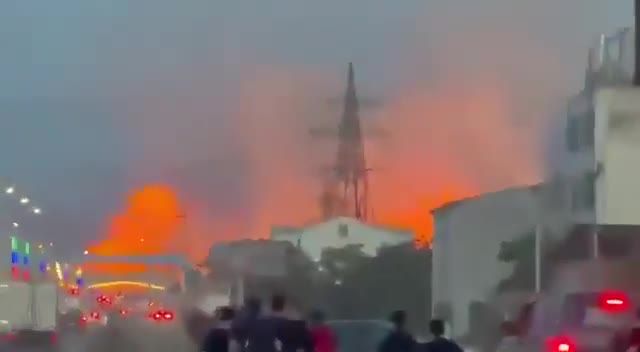
XA post on X from the account "America Force" shared a short video of a large fire with an orange flame and heavy smoke behind a transmission tower, with bystanders filming from a street. The caption presents it as breaking news of a US missile attack on Tehran an hour earlier. It asks readers to believe the clip captures the moment of the strike and the sound of the explosion.
“🚨 Breaking: An hour ago, US attacked Tehran with an extremely powerful missile! Sound of an explosion!”
Posted on X by an account using the display name "America Force"; no post date, engagement figures or group context were recorded in our input.
Who posted it
XAccount check
Estimates from public signals — account age, posting pattern, audience — not a judgement of the person behind the account, and separate from whether this post is true.
What stood out
- Profile metadata is almost entirely missing: no bio, follower count, account creation date, display name, or recent-post sample provided.
- The account is not platform-verified and has no identifiable real-person or organisation identity in the supplied data.
- A post attributed to @Americatwisst circulated a claim that a US missile strike killed 250 Iranian soldiers at a Tehran airbase.
- Pengpai News (The Paper) fact-checked that exact claim on 30 Oct 2026 and found the video was recycled footage of a 2022 attack on oil facilities in Jeddah, Saudi Arabia — not a Tehran airbase strike.
- The fabricated casualty figures and old video were also duplicated across blogs and Threads, indicating participation in a viral misinformation chain.
- No evidence of automated behaviour was found, but the anonymous, content-aggregator pattern and lack of sourcing raise coordination concerns.
Signals (7)+
- Posting cadence
- Unknown
- Follower ratio
- Unknown
- Notable news coverage
- Cited by a Portuguese-language blog as the source of a viral Iran strike video
- Fact check history
- Pengpai News 'Mingcha' fact check dated 2026-10-30 debunked the Tehran airbase video as 2022 Saudi Jeddah footage
- Misinformation events
- 1
- Profile completeness
- Minimal
- Content type
- Anonymous video aggregator/reposter
Account checked November 16, 2026, 14:48 UTC
The media
Video✓ What is genuine
The fire itself: a real gas distribution station blaze at Novy Sulak in Kizilyurt, Dagestan, on 9 June 2026, with genuine explosions and a large flame, filmed by bystanders.
The tells
- ●●○ Supporting signal The clip looks and moves like ordinary handheld phone footage of an industrial fire, with no generative artefacts such as morphing structures or garbled signage.our visual review
- ●●○ Supporting signal Our detector scored the video as not AI-generated with very high confidence (AI-generated score about 0.001).our detector
- ●●● Strong signal The real-world scene matches independent Russian reporting of a gas fire at Novy Sulak in Dagestan on 9 June 2026.Rossiyskaya Gazeta, Izvestia and RTVI
Synthetic-media detector
Detector ranThe claim stands or falls on whether the media is real, so the detector ran.
Scores are the detector’s estimate for the file as uploaded. A low score does not rule out editing, a spliced caption, or footage shown out of context — those are judged above. Model v3.
How we checked the media
- Ran our AI-generation detector on the video; it scored the clip as not AI-generated with very high confidence.
- Reviewed the visual content: a tall orange flame and heavy smoke behind a transmission pylon, bystanders filming, ordinary street lighting and traffic.
- Compared the footage with reporting on the 9 June 2026 Novy Sulak gas distribution station fire in Dagestan, which matches the scene.
- Searched for any credible report of a US missile strike on Tehran around 16 November 2026 and found none.
Sources
4 sources reviewed- 1МЧС: На газораспределительной станции в Кизилюрте произошло три взрыва ↗
Rossiyskaya Gazeta · rg.ruUntiereduntiered — treated as signal only, never decisiveEvidence
Reports three explosions and a large fire at the Novy Sulak gas distribution station in Kizilyurt on 9 June 2026.
- 2An explosion occurred on a gas pipeline in Dagestan. What is known ↗
Izvestia · en.iz.ruUntiereduntiered — treated as signal only, never decisiveEvidence
Describes the explosion and fire at the Metan gas station in Novy Sulak, Kizilyurt, on 9 June.
- 3В Дагестане взорвался газопровод, эвакуированы десятки человек ↗
RTVI · rtvi.comUntiereduntiered — treated as signal only, never decisiveEvidence
Reports three explosions, a 15-metre flame and about 140 people evacuated on 9 June.
- 4Reuters: Trump may temporarily suspend strikes on Iran ↗
APA (citing Reuters) · en.apa.azUntiereduntiered — treated as signal only, never decisiveEvidence
Reports that Trump was considering suspending strikes on Tehran in mid-November 2026.
Further reading
- 1Rossiyskaya Gazeta Russian reporting that documents the actual Dagestan gas fire, showing what the footage really depicts.
- 4APA (citing Reuters) Reuters reporting, via APA, that Trump was considering suspending strikes on Iran, which contradicts the claim of an unannounced attack.
The full story
The kernel of truth here is a real and dramatic event: a gas fire at the Novy Sulak gas distribution station in Kizilyurt, Dagestan, Russia, on 9 June 2026. Russian outlets reported three explosions at the station, a flame reaching about 15 metres, and the evacuation of nearly 140 people. No one was killed. Bystanders filmed it from the street, which is why the footage has the shaky, handheld look of a genuine witness clip.
That genuine footage was later lifted and re-captioned. In November 2026, as tensions between Washington and Tehran were in the news, a post presented the Dagestan fire as a US missile strike on the Iranian capital an hour earlier. The timing made it feel plausible: there had been a real, limited US strike on an air-defence site in southern Iran on 6 November 2026. But by 14-15 November, Reuters was reporting that Trump might suspend strikes on Tehran altogether. No strike on the capital occurred, and no credible outlet reported one.
The post works because every element except the caption is real. The flame is real, the explosions are real, the panicked filming is real. Only the place, the date and the attacker were swapped. That is a common and effective pattern: authentic imagery, false context.
Kernel of truth
A real gas distribution station fire with explosions at Novy Sulak in Dagestan on 9 June 2026, filmed by bystanders.
Timeline
June 9, 2026
Three explosions and a large gas fire at the Novy Sulak gas distribution station in Kizilyurt, Dagestan; about 140 people evacuated, no casualties. 1Rossiyskaya Gazeta
November 6, 2026
Last confirmed US strike: a limited attack on an air-defence site in southern Iran.
November 14, 2026
Reuters reports that Trump may temporarily suspend strikes on Iran. 4APA (citing Reuters)
November 16, 2026
Anadolu Agency publishes a fact-check identifying the viral clip as the Dagestan gas fire; the post claims a US missile strike on Tehran an hour earlier.
How it was framed
The video is genuine footage of a real gas fire in Dagestan, but the caption attaches it to a completely different place, date and event: a supposed US missile strike on Tehran. The imagery is not altered; its context is fabricated.
- Urgency. "Breaking" and "An hour ago" frame the clip as live news demanding immediate attention.
- “Visual proof”. The dramatic flame and smoke are presented as self-evident proof of the strike.
- Ongoing-threat framing. The caption places the viewer in the middle of an active attack on a capital city.
- Missing context. No location, date or original source for the footage is given; the Dagestan origin is omitted.
Posted on X by an account displaying the name "America Force". No further posting history or account details were recorded in our input.
Bias
Leans sensationalist, pro-US-military framing. An account styled as a US military fan page pushes an unverified 'breaking' war escalation narrative, pairing genuine footage of a Russian industrial fire with an alarmist claim of a US missile strike on Tehran. The framing is designed to maximise shock and engagement rather than inform.
Bias describes how the post frames its message — the slant of the language, selection and emphasis — and is judged separately from whether the claim is true. A true claim can still be framed with a strong slant.
How we checked
41 s- 1
Searched for reports of a US attack on Tehran with a missile in November 2026 and found none.
- 2
Searched for the Novy Sulak gas distribution station fire in Dagestan in June 2026 and found matching reporting from Rossiyskaya Gazeta, Izvestia and RTVI.
- 3
Searched specifically for a US strike on Tehran on 16 November 2026 and found no credible report.
- 4
Reviewed the video visually and ran our AI-generation detector, which scored it as not AI-generated with very high confidence.
- 5
Compared the footage with the identified Dagestan fire and with reporting on US-Iran tensions in November 2026, including Reuters reporting on a possible pause in strikes.
✓ Claim checked✓ Media checked✓ Sources checked
Why 92% confidence
HighConfidence is HIGH because two independent lines of evidence contradict the claim: reporting on the actual Dagestan fire dates the footage to 9 June 2026, and the absence of any credible report of a strike on Tehran is decisive for an event that would be covered worldwide. The detector also found no sign of AI generation, supporting the conclusion that the footage is real but mislabelled.
Limits. We did not open the original pages ourselves; our assessment rests on the search results and source snippets recorded in our input. We could not verify the account's identity or posting history, and we did not review the full original video frame by frame.
What we don’t know
- Who first attached the false Tehran caption to the Dagestan footage, and whether they knew its real origin.
- Whether the account "America Force" is a person, a group or an automated account.
- Whether the same clip has been used with other false captions elsewhere.
Spot it yourself
Spot the fakeLooks suspicious, isn’t proof
- The account name "America Force" sounds partisan or jingoistic, but a patriotic handle proves nothing about whether a specific clip is real.
- The caption uses alarmist wording and emojis; tone is a reason to slow down, not evidence of falsity.
- The video is shaky and filmed by a crowd, which can look like a fake, but that is exactly what genuine witness footage often looks like.
The actual evidence
- Independent reporting from three Russian outlets places a gas fire with three explosions at the Novy Sulak station in Kizilyurt on 9 June 2026, matching the footage.
- Anadolu Agency's fact-check published on 16 November 2026 identified the same clip as that Dagestan fire.
- No credible outlet reported a US missile strike on Tehran around 16 November 2026, despite the event being one that would dominate global news within minutes.
- Reporting from 14-15 November said Trump was considering suspending strikes on Iran, which cuts against an unannounced attack on the capital.
- 1
Ask who would be reporting this if it were true
A US strike on Tehran would be on the front page of every major news organisation within minutes. If you can only find it in one social post, treat that as a warning sign.
- 2
Check the claimed timing against official and agency reporting
Search for the specific event and date, and look for wires such as Reuters or the major broadcasters. Look also for statements that contradict the claim, such as talk of a pause in strikes.
- 3
Trace the footage to its earliest appearance
Look for the first uploads and any fact-checks that identify the original event. A clip that appeared months earlier cannot show something that happened an hour ago.
- 4
Separate the imagery from the caption
Even when a video is genuine, ask whether the caption's claim of place, date and actor is supported by what you can see and by independent sources. Authentic footage can carry a false story.
Takeaway
A real video can tell a false story. When a dramatic clip is captioned as breaking war news, check where and when it was filmed before you check how it looks.
Questions people ask
Did the US attack Tehran with a missile in November 2026?+
No. No credible report of a US missile strike on Tehran exists for 16 November 2026 or the surrounding period. The last confirmed US strike was a limited 6 November 2026 attack on an air-defence site in southern Iran, and by mid-November Washington was reportedly considering a pause in strikes.
Where is the video of the explosion actually from?+
It shows a gas distribution station fire at Novy Sulak in Kizilyurt, Dagestan, Russia, on 9 June 2026. Russian outlets reported three explosions, a flame reaching about 15 metres and the evacuation of nearly 140 people, with no casualties. Anadolu Agency's fact-check matched the clip to that incident.
Is the video AI-generated?+
No. Our detector scored the clip as not AI-generated with very high confidence, and the scene is consistent with real handheld footage. The problem is not the video but the caption, which moved a real fire in Russia to a fictional attack on Iran.
Why do people fall for this kind of post?+
Because the imagery is real. A genuine fire, genuine explosions and genuine panic look convincing, and the caption arrives at a moment of real US-Iran tension. The false part is only the place, date and attacker, which are hard to check from the video alone.
What kind of misinformation is this?+
It is false context: authentic content presented with a false place, date and event. It is not a deepfake or a fabricated video, which is why visual inspection alone cannot debunk it. You have to check the origin of the footage.
Go deeper
- False context
- When genuine content is shared with incorrect information about where, when or why it was created.
- AI-generation detector
- A tool that estimates whether media was produced by artificial intelligence, based on patterns in the file.
- Absence of expected coverage
- A finding that an event which would certainly be widely reported has no credible coverage, suggesting it did not happen.
- Provenance
- The history of where a piece of media came from and how it has been shared over time.
People also search for
For educators+
- If the video is genuine, why is the post still false? What exactly is false about it?
- How would you check where a dramatic clip was filmed before sharing it?
- Why might a real explosion sound make a false caption more convincing?
About this check
- Platform
- X
- Posted by
- @americatwisst
- Posted
- November 14, 2026
- Age when checked
- 1–2 days old when checked
- Where it spread
- IR, United States
- Audience
- International audience
- Language
- EN
- Status
- ● Post is live
- Verified
- November 16, 2026, 14:49 UTC
- Published
- November 16, 2026, 14:49 UTC
Reach. @Americatwisst 1.4K likes; identical copy-paste posts by several accounts through 15 Nov; Misbar fact-check 16 Nov
This verdict was generated with AI from the sources shown. AI can make mistakes — check the sources before relying on it.
Check anything yourself, in seconds.
Share any social post or video to What the Fact and get the verdict, the confidence, and the receipts.