Did Dutch arms maker Destinus' RUTA missiles hit the Kerch Bridge, and is The Hague joining the conflict?
Did missiles made by the Dutch company Destinus (RUTA) help destroy part of the Kerch (Crimean) Bridge, and does that make the Netherlands a party to the war, as Russia's embassy in The Hague suggests?
Misleading
The strike and the company statement are real; the leap to 'The Hague joining the conflict' is not.
The screenshot is a genuine capture of Netherlands-based arms maker Destinus' 17 November 2026 statement that its RUTA missiles hit the Kerch Bridge on two consecutive days and that seven hits collapsed a span, corroborated by Reuters, NOS and Ukrinform. The Russian Embassy's caption spins that corporate statement into a supposed Dutch state 'confession' of joining the war, which the Dutch government disputes.
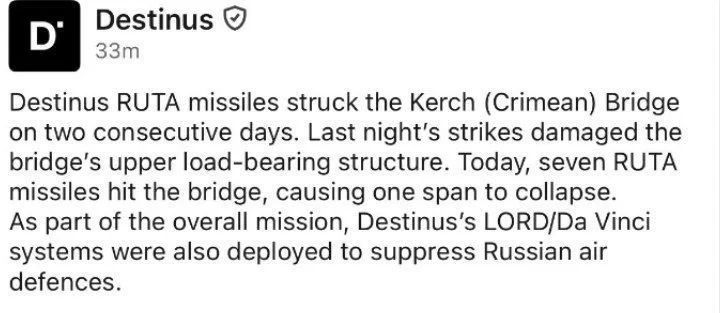 Likely genuine
Claims
✓ 3 trueBecause a Dutch-based company's missiles were used, The Hague is openly joining the conflict / the Netherlands is involved as a party.121112
“Moscow has been duly informed of the NL involvement. The confession has been well noted. Is The Hague openly joining the conflict?”
The strike was planned and carried out by Ukrainian forces, using weapons sold by a private company headquartered in the Netherlands. No Dutch official said the state took part. Foreign Minister Tom Berendsen said his ministry had no further details about Destinus' role, and described such Russian messages as attempts to divide the West, according to Nederlands Dagblad and EFE. The Netherlands is a major supplier of arms and funding to Ukraine, but that is not the same as the state openly joining the war. The embassy's caption takes a real corporate statement and arranges it to imply a state decision that the evidence does not show. The gap between 'a Dutch company made the weapon' and 'The Hague joined the conflict' is where the misleading framing sits.
Still open: The full extent of any Dutch government contracts with Destinus for RUTA missiles is not established in the sources we reviewed; social-media claims of around 700 missiles funded by the Dutch state were not confirmed by a Tier-A source.
Destinus RUTA missiles struck the Kerch (Crimean) Bridge on two consecutive days, on 16 and 17 November 2026.5810
“Ракети RUTA ... упродовж двох днів поспіль завдавали ударів по Керченському (Кримському) мосту”
Ukrainian forces struck the Kerch Strait Bridge on the nights of 16 and 17 November 2026, and Destinus publicly confirmed its RUTA cruise missiles were used. President Zelensky named RUTA among the weapons in the operation, and the company's president Oleksandr Danyliuk repeated the claim to Reuters and Bloomberg. The Institute for the Study of War recorded strikes on the bridge for the second consecutive day on 17 November. The sources are not all independent of the company's statement — several defence outlets quote the same LinkedIn post — but the Ukrainian General Staff and ISW independently confirm the strikes themselves, and Reuters quotes the company president directly. That combination settles the core fact: the missiles were used on both days.
Strikes the previous night damaged the bridge's upper load-bearing structure.9
The 16 November strike damaged the road section and the bridge arch, and damage to the upper structure was reported before the 17 November collapse. Ukraine's General Staff confirmed the arch and a road span collapsed after the overnight strike on 17 November. Attribution of that specific damage to RUTA rather than to the many other drones and missiles used in the operation is the manufacturer's own claim. That makes the broad picture likely true while the precise weapon attribution is less certain. A reader should treat the damage as confirmed and the credit as the company's account.
Still open: Which specific weapon caused the upper-structure damage on 16 November is not independently established.
On 17 November, seven RUTA missiles hit the bridge, causing one span to collapse.78
Destinus president Oleksandr Danyliuk told Reuters that nine RUTA Block 1 missiles were launched and seven hit the bridge, and Ukraine's General Staff confirmed that an arch and road span collapsed. But it is contested which weapon actually brought the span down. Fire Point says its FP-5 Flamingo delivered the final blow, and Zelensky also credited Flamingo with the decisive strike while listing 11 weapons used. So the 'seven hit' figure and the causal claim are the manufacturer's own account. The collapse is confirmed; the credit for it is not settled between competing manufacturers. That is why the claim is partly true rather than true.
Still open: Which weapon system caused the final span collapse remains disputed between manufacturers.
Destinus LORD/Da Vinci systems were deployed to suppress Russian air defences during the operation.36
Zelensky's list of the 11 weapons used in the seven-stage operation included Da Vinci drones, the Ukrainian designation for Destinus' LORD long-range attack drone, and the company confirmed the systems were used for suppression of Russian air defences around the bridge. Two separate strands support this: the Ukrainian president's own account and the company's statement. Because Zelensky's list is a government account independent of the company's marketing, the deployment is well supported. What remains the company's own claim is the specific effectiveness of that suppression. The deployment itself is confirmed.
What was posted
XThe Russian Embassy in the Netherlands posted an image on X that reproduces a LinkedIn post from the Dutch-headquartered arms maker Destinus. The Destinus text says its RUTA missiles struck the Kerch Bridge on two consecutive days and that seven hits on 17 November caused a span to collapse, with its LORD/Da Vinci drones suppressing Russian air defences. The embassy's own caption in English asks whether The Hague is 'openly joining the conflict'.
“Moscow has been duly informed of the NL involvement. The confession has been well noted. Is The Hague openly joining the conflict?”
Posted on X by the verified account of the Russian Embassy in the Netherlands on 18 November 2026, the day after Destinus published its statement and the second day of strikes on the bridge.
Who posted it
XAccount check
Estimates from public signals — account age, posting pattern, audience — not a judgement of the person behind the account, and separate from whether this post is true.
What stood out
- Handle @rusembassynl is the genuine, long-standing official account of the Russian Embassy in The Hague — activity documented from at least 2017–2018 (Kommersant 2018, The Hill 2018) through to posts dated 17–18 Nov 2026 on the Crimea-bridge/Destinus story.
- The account is a real organisation account, not a fake/impersonator: Dutch and international media (DutchNews.nl, Times Now, Caliber.Az, NOS, NL Times) routinely quote @rusembassynl posts by that exact handle.
- However, it is a documented state propaganda channel: Justice for Prosperity's Sept 2026 analysis of 200 posts found ~40% fit the pattern of coordinated foreign information manipulation (FIMI) and ~45% directly intervene in Dutch domestic affairs, against Vienna Convention Art. 41.
- It is the seed account for the '#NietOnzeOorlog / Russia is not my enemy' campaign (1 Sept 2026 post, 1.3M views; ~20M account views in 10 months), amplified by 'local amplifiers' such as ON! podcaster Jan Bennink (50+ shares).
- History of sourcing failures: in March 2022 it amplified Ambassador Shulgin's false 'crisis actors' claim about the Mariupol maternity hospital bombing on the day AP reported a death there; Eliot Higgins publicly called for Russian embassy accounts to be removed.
- Long record of attacking critical journalists by name (NOS/Villamedia 2019: accused Volkskrant correspondent Tom Vennink and NRC of 'lying'/'fake news'); in 2026 it announced revocation of a Dutch journalist's accreditation in retaliation.
- Dutch Foreign Minister Berendsen has publicly stated Russian embassies are used to push Kremlin narratives — i.e., official Dutch government assessment that its claims should be read as propaganda.
- Metadata supplied is sparse (no bio, follower count, creation date) and reports isplatformverified=false, contradicting reporting that X labels it as a government account — likely a data-collection gap rather than evidence of impersonation.
- Behaviour is staff-written and reactive to news cycles (multiple posts per week, statement-style), with no evidence of automated posting — coordination occurs at the narrative/amplification level, not via bots on this account.
Signals (11)+
- Identity verification
- Confirmed by repeated media citation and X government-account label per JfP report; contradicted by supplied is_platform_verified=false field
- Posting cadence
- Regular, news-reactive, statement-driven (est. several posts/week; ~200 posts analysed over 10 months)
- Follower ratio
- Unknown (not supplied)
- Reach
- ~20 million views in 10 months; single campaign post 1.3M views; statement posts 2.6M views
- Notable news coverage
- DutchNews.nl, NL Times, NOS, Times Now, Caliber.Az, Polskie Radio, 31mag — frequent citation as embassy spokesperson channel
- Fact check history
- Documented amplification of false Mariupol maternity-hospital 'crisis actors' claim (2022); Novichok denials (2018); attacks on journalists accused of 'fake news' (2019)
- Affiliation
- Russian Ministry of Foreign Affairs diplomatic mission (official state actor)
- Fimi assessment
- JfP Sept 2026: ~40% of posts match coordinated information manipulation patterns; ~45% interfere in host-state domestic politics
- Amplification network
- Domestic amplifiers incl. @superjan / @Rumpelstunzchen (Jan Bennink, 70k+ combined followers, 50+ shares)
- Platform moderation
- Spared EU sanctions/RT-style bans due to diplomatic status and verified government labelling
- Bot indicators
- None on-account; automation likely only on amplifier side
Account checked November 18, 2026, 14:51 UTC
The media
Image✓ What is genuine
The screenshot reproduces a real statement published by Destinus on LinkedIn on 17 November 2026. The company's claim that its RUTA missiles hit the bridge and its Da Vinci drones suppressed air defences is independently reported by Reuters, NOS and Ukrinform.
The tells
- ●●● Strong signal The text in the screenshot matches, almost verbatim, the Destinus LinkedIn statement quoted by multiple outlets.our comparison with source reporting
- ●●○ Supporting signal The screenshot shows a plain LinkedIn-style company post with coherent, legible text and no visible generative artifacts.our visual review
- ●●● Strong signal Destinus confirmed to NOS that it published such a statement for the first time.NOS
Synthetic-media detector
Detector not consultedThe media is incidental to the claim; the detector was not needed.
How we checked the media
- Compared the wording in the screenshot with the Destinus statement as quoted by Ukrinform, Defence Industry Europe, Defence Blog and Infobla.
- Checked reporting from NOS, which says Destinus confirmed it had published such a statement for the first time.
- Reviewed the image visually for signs of alteration or generation artifacts.
Sources
13 sources reviewed- 1Russian embassy responds to NL role in Crimea bridge attack ↗
DutchNews.nl · dutchnews.nlUntiereduntiered — treated as signal only, never decisiveEvidence
Documents the Russian Embassy's post and the Dutch response to it.
- 2Russia Asks if Netherlands Is Joining Ukraine War After Dutch Company's Missiles Used in Bridge Attack ↗
The Moscow Times (Reuters) · themoscowtimes.comUntiereduntiered — treated as signal only, never decisiveEvidence
Reuters reporting via The Moscow Times describes Destinus as a Dutch-headquartered startup and its missiles as the only foreign-made weapons used.
- 3Nederlandse wapenfabrikant laat wereld weten: onze raketten troffen Krimbrug ↗
NOS · nos.nlReputable outletCenter — Dutch public serviceEvidence
NOS reports Destinus saying Ukraine used its rockets and drones in the bridge attack and that the company had not made such a claim before.
- 4Russische ambassade reageert op Krimbrugaanval, 'doet Den Haag mee aan conflict?' ↗
NOS · nos.nlReputable outletCenter — Dutch public serviceEvidence
NOS reports the Russian Embassy's reaction and the Dutch foreign ministry's initial silence.
- 5Нідерландський виробник зброї заявив, що для удару по Кримському мосту були застосовані його ракети ↗
Ukrinform · ukrinform.uaUntiereduntiered — treated as signal only, never decisiveEvidence
Ukrinform quotes the Destinus statement that RUTA missiles hit the bridge on two consecutive days and that its systems suppressed air defences.
- 6Destinus says seven Ruta cruise missiles hit the Kerch Bridge on the second day of strikes, causing a span to collapse ↗
Defence Industry Europe · defence-industry.euUntiereduntiered — treated as signal only, never decisiveEvidence
Defence Industry Europe quotes the Destinus statement on RUTA hits and the span collapse.
- 7Destinus says seven RUTA missiles hit Putin's bridge ↗
Defence Blog · defence-blog.comUntiereduntiered — treated as signal only, never decisiveEvidence
Defence Blog notes Fire Point's FP-5 Flamingo claim and Zelensky's list of 11 weapons, showing which weapon caused the collapse is contested.
- 8European 'Ruta' missiles strike the Kerch Bridge ↗
Vijesti (Reuters) · en.vijesti.meUntiereduntiered — treated as signal only, never decisiveEvidence
Reuters quotes Danyliuk on nine RUTA Block 1 missiles launched and seven hitting the bridge.
- 9Arch and road span collapse: General Staff confirms results of strike on Crimean Bridge ↗
Ukrinform · ukrinform.netUntiereduntiered — treated as signal only, never decisiveEvidence
Ukraine's General Staff confirms the collapse of an arch and road span after the 17 November strike.
- 10Russian Offensive Campaign Assessment, November 17, 2026 ↗
Institute for the Study of War · understandingwar.orgUntiereduntiered — treated as signal only, never decisiveEvidence
ISW records Ukrainian strikes on the Kerch Strait Bridge for the second consecutive day on 17 November.
- 11Berendsen: geen details bekend over rol Destinus bij aanval Krim ↗
Nederlands Dagblad · nd.nlUntiereduntiered — treated as signal only, never decisiveEvidence
Nederlands Dagblad reports Foreign Minister Berendsen saying no further details of Destinus' role were known and that Russian messages aim to divide the West.
- 12Rusia cuestiona papel de Países Bajos en guerra tras ataque ucraniano al puente de Crimea ↗
Infobae (EFE) · infobae.comUntiereduntiered — treated as signal only, never decisiveEvidence
EFE reports Berendsen rejecting the Russian insinuations and advising they be read as attempts to divide the West.
- 13Dutch arms maker takes public credit for Crimea bridge strike ↗
DutchNews.nl · dutchnews.nlUntiereduntiered — treated as signal only, never decisiveEvidence
DutchNews reports Destinus told NOS seven of its RUTA missiles hit the bridge and that it was the first public claim of a role in a specific strike.
Further reading
- 3NOS NOS explains what Destinus said and confirms the company had not previously made such a public claim.
- 8Vijesti (Reuters) Reuters quotes Destinus president Danyliuk with the specific missile figures, the clearest primary account of the company's claim.
- 11Nederlands Dagblad Nederlands Dagblad reports the Dutch foreign minister's response, which is central to the misleading verdict.
The full story
The kernel of truth here is a genuine and unusually blunt corporate statement. On 17 November 2026, the Netherlands-headquartered arms maker Destinus publicly said its RUTA cruise missiles had struck the Kerch Strait Bridge on two consecutive days, that seven of nine hit on the second day, and that a span collapsed. Its president, Oleksandr Danyliuk, repeated the figures to Reuters. President Zelensky named RUTA and the Da Vinci drone among 11 systems used in a seven-stage operation. The strikes themselves are confirmed by Ukraine's General Staff and recorded by the Institute for the Study of War: an arch and a road span of the automobile section came down, and the railway section was damaged.
What the Russian Embassy did with that statement is the misleading part. It took a private company's public claim and relabelled it a Dutch 'confession' of state involvement, then asked whether The Hague was 'openly joining the conflict'. The Dutch foreign ministry said it had no further details about Destinus' role, and Foreign Minister Tom Berendsen said such Russian messages are intended to divide the West. The Netherlands is a major supplier of weapons and funding to Ukraine, which is why the insinuation lands with some readers. But supplying arms through a company is not the same as a state planning or joining an attack. The post works precisely because every visible element — the company, the country, the bridge — is real; only the conclusion is imported.
Kernel of truth
Destinus, a Dutch-headquartered company, really did state that its RUTA missiles hit the Kerch Bridge on 16 and 17 November 2026, and the strikes and span collapse are independently confirmed.
Timeline
November 16, 2026
Ukrainian forces strike the Kerch Strait Bridge for the first time in the operation, damaging the road section and bridge arch. 9Ukrinform
November 17, 2026
A second night of strikes collapses an arch and road span of the automobile section; Ukraine's General Staff confirms the damage. 9Ukrinform
November 17, 2026
Destinus publishes a statement on LinkedIn saying its RUTA missiles hit the bridge on both days and its Da Vinci drones suppressed Russian air defences. 5Ukrinform
November 18, 2026
The Russian Embassy in the Netherlands posts a screenshot of the Destinus statement on X, asking whether The Hague is 'openly joining the conflict'. 1DutchNews.nl
How it was framed
The screenshot and the underlying strike are real, but the embassy's caption reframes a private company's statement as a Dutch state confession of joining the war. The genuine content is used to support a conclusion it does not carry.
- Emotional language. The caption uses 'confession' and 'duly informed', casting a corporate statement as an admission of guilt.
- Missing context. The caption does not mention that the strike was planned and carried out by Ukrainian forces, or that Destinus is a private company.
- Us vs. them. The question 'Is The Hague openly joining the conflict?' frames the Netherlands as a party to the war against Russia.
Posted on X by the verified account of the Russian Embassy in the Netherlands, a state diplomatic mission, on 18 November 2026, the day after Destinus published its statement.
Bias
Leans pro-Kremlin / anti-NATO (anti-Dutch). A diplomatic mission of Russia frames a private arms manufacturer's public statement as a Dutch state 'confession' and poses a loaded question about The Hague 'openly joining the conflict'. The framing converts a commercial arms sale into alleged NATO state belligerence, in line with the Kremlin's messaging against European weapons makers supplying Ukraine, without noting that Ukraine conducted the strike or that the Dutch government denied any operational role.
Bias describes how the post frames its message — the slant of the language, selection and emphasis — and is judged separately from whether the claim is true. A true claim can still be framed with a strong slant.
How we checked
1 min 13 s- 1
Searched for reporting on the Destinus RUTA missile claim and the Kerch Bridge strikes of 16–17 November 2026.
- 2
Compared the screenshot wording with the Destinus statement as quoted by Ukrinform, Defence Industry Europe, Defence Blog and Infobla.
- 3
Reviewed reporting from Reuters, NOS, DutchNews, EFE, Ukrinform and the Institute for the Study of War on the strikes and the Dutch response.
- 4
Checked the Russian Embassy's post against coverage by Reuters, NOS, DutchNews and EFE.
- 5
Reviewed the image visually for signs of alteration or generation artifacts.
✓ Claim checked✓ Media checked✓ Sources checked
Why 80% confidence
HighWe are highly confident in the MISLEADING verdict because the underlying event and the company statement are corroborated by multiple independent outlets, including Reuters, NOS and ISW, and the Dutch government's rejection of the framing is on the record. The media verdict is LIKELY_AUTHENTIC because the screenshot matches the quoted statement and Destinus confirmed publishing it, though we did not run a forensic detector.
Limits. We did not run an AI-generation detector on the image; our assessment rests on visual review and comparison with source reporting. We also could not establish the exact scale of Dutch state contracts with Destinus for RUTA missiles.
What we don’t know
- The full extent of any Dutch government contracts with Destinus for RUTA missiles; social-media claims of around 700 missiles funded by the Dutch state were not confirmed by a Tier-A source.
- Which weapon system — RUTA or FP-5 Flamingo — actually caused the final span collapse on 17 November.
- Whether the Russian Embassy coordinated its post with other Russian state messaging, which we cannot establish from the public record.
Spot it yourself
Spot the fakeLooks suspicious, isn’t proof
- The poster is a state embassy account with an obvious interest in the story, which makes the framing worth checking but does not by itself make the screenshot fake.
- The caption's alarmist tone ('confession', 'openly joining the conflict') is a reason to read carefully, not evidence that the image was altered.
- The image is a screenshot of a social-media post, a format that is easy to fabricate but also the normal way real statements get shared.
The actual evidence
- The text in the screenshot matches, almost verbatim, the Destinus statement quoted by Reuters, NOS, Ukrinform, Defence Industry Europe and Defence Blog.
- Destinus confirmed to NOS that it had published such a statement for the first time, which anchors the screenshot to a real source.
- Ukraine's General Staff and the Institute for the Study of War independently confirm the bridge strikes and the span collapse, so the event behind the statement is real.
- The Dutch foreign ministry and Foreign Minister Berendsen said no further details of Destinus' role were known and rejected the framing, which shows the state-involvement implication is disputed.
- 1
Check whether the quoted text appears in independent reporting.
Search a distinctive phrase from the screenshot, such as 'seven RUTA missiles', and see whether major outlets quote the same wording from the same company.
- 2
Separate the company from the state.
Ask whether the actor in the screenshot is a government or a private firm. A company selling weapons is not the same as a country deciding to fight.
- 3
Look for the official response.
Search for the foreign ministry or government reaction. Here, Berendsen's comments were reported by Nederlands Dagblad and EFE.
- 4
Check who is asking the question in the caption.
Identify the account and its interests. A diplomatic mission posting about a war involving its own country is a source to read with care, not to take at face value.
Takeaway
A screenshot can be entirely genuine and still be used to sell a false conclusion. Always check whether the caption's leap is supported by the text inside the image, not just by the image being real.
Questions people ask
Did Dutch-made missiles really hit the Kerch Bridge?+
Yes. The Netherlands-headquartered arms maker Destinus said its RUTA cruise missiles struck the Kerch Strait Bridge on 16 and 17 November 2026, and its president told Reuters that nine were launched and seven hit on the second day. Ukraine's General Staff and the Institute for the Study of War confirm the strikes and the collapse of an arch and road span.
Is the Netherlands joining the war against Russia?+
No. The strike was planned and carried out by Ukrainian forces using weapons sold by a private Dutch-headquartered company. The Dutch foreign ministry said it had no further details about Destinus' role, and Foreign Minister Tom Berendsen described such Russian messages as attempts to divide the West. The Netherlands supplies arms and funding to Ukraine but has not declared itself a party to the conflict.
Is the screenshot of the Destinus statement fake?+
No. The screenshot reproduces, almost verbatim, a statement Destinus published on LinkedIn on 17 November 2026. The wording matches quotes carried by Ukrinform, Defence Industry Europe, Defence Blog and Infobla, and Destinus confirmed to NOS that it had published such a statement for the first time.
Why is the Russian Embassy's post misleading if the screenshot is real?+
Because the caption draws a conclusion the screenshot does not support. It calls a private company's public claim a Dutch 'confession' and asks whether The Hague is 'openly joining the conflict'. A real corporate statement about weapons exports is not evidence that the Dutch state planned or joined the attack.
What does 'misleading content' mean in a fact-check?+
It describes information that uses real elements but frames them to support a false or unsupported conclusion. Here the strike, the company and the statement are all real; the misleading part is the claim that they amount to the Dutch state entering the war.
Go deeper
- Misleading content
- Information that uses genuine elements but frames them in a way that supports a false or unsupported conclusion.
- False context
- Genuine content that is shared with incorrect contextual information, such as a false caption or implication.
- RUTA
- A cruise missile produced by the Netherlands-headquartered arms maker Destinus, according to the company's own statement.
- Kerch Strait Bridge
- A bridge linking Russia to occupied Crimea, also known as the Crimean Bridge, which Ukrainian forces struck on 16 and 17 November 2026.
People also search for
For educators+
- The screenshot is genuine. Does that make the post trustworthy? What else would you need to check before believing the caption's conclusion?
- Why might a diplomatic account choose to ask a question rather than make a statement? What effect does that have on the reader?
- If a company in your country sold weapons used in a conflict abroad, would you describe your country as 'joining the conflict'? What distinctions matter?
About this check
- Platform
- X
- Posted by
- @rusembassynl
- Posted
- November 18, 2026
- Age when checked
- Under 24 hours old when checked
- Where it spread
- Netherlands, Ukraine, Russia
- Audience
- UK & EU audience
- Language
- EN
- Status
- ● Post is live
- Verified
- November 18, 2026, 14:53 UTC
- Published
- November 18, 2026, 14:53 UTC
Reach. Wide Dutch pickup 18 Nov (NOS, ANP, Hart van Nederland, DutchNews); Bloomberg on Destinus 17 Nov; 'moskou' Google Trends NL 2000+
This verdict was generated with AI from the sources shown. AI can make mistakes — check the sources before relying on it.
Check anything yourself, in seconds.
Share any social post or video to What the Fact and get the verdict, the confidence, and the receipts.