Is the Iraqi army attacking Tehran-backed militias for the first time since Saddam fell?
Does a viral video show the Iraqi army moving to besiege pro-Iran militias (Kataib Hezbollah) at Jurf al-Sakhar 'for the first time since Saddam fell'?
Misleading
Real deployment, but the video is recycled and the 'first since Saddam' line is wrong.
The standoff is real. On 15–16 November 2026 Prime Minister Ali al-Zaidi ordered Iraq's army into Jurf al-Sakhar, a Kataib Hezbollah stronghold in Babil province, with a 20 November deadline. But the video is a months-old clip of Iraqi special forces, not this deployment, and the army has moved against Iran-aligned militias before, notably in 2008.
 Likely genuine
Claims
3 checkedThe Iraqi army is moving against Tehran-backed militias and has begun to besiege Iranian militia headquarters.1234
“يتحرك #الجيش_العراقي ضد مليشيات #طهران الجيش العراقي يبدأ بمحاصرة مقرات المليشيات الإيرانية”
The core of the claim checks out. On 15–16 November 2026 Prime Minister Ali al-Zaidi ordered the armed forces into Jurf al-Sakhar (also called Jurf al-Nasr) in Babil province, a district held for around 12 years by Kataib Hezbollah, following an inquiry into alleged oil smuggling. AFP, The New Arab and The National all report tanks, armoured vehicles, federal police and counter-terrorism units massing around the district. A Defence Ministry spokesman quoted by Iran International said the army was 'awaiting zero hour' to take control. What makes the claim only partly true is the word 'besiege': the army had not entered, the area remained in militia hands, Kataib Hezbollah refused to withdraw, and a deadline of Friday 20 November was still running with Iranian mediation under way. The sources are independent news organisations with their own reporting from the ground, not repetitions of one press release, which is why we rate the core finding with high confidence. A reader should take away that a serious standoff is under way, but not that a siege has been completed.
Still open: Whether the army would actually enter after the 20 November deadline, and how the mediation by IRGC Quds Force commander Esmail Qaani would end, was still open when this check was published.
This is the first time since the fall of Saddam Hussein's government that the Iraqi army has moved against Tehran's militias.27
“لأول مره منذ سقوط حكومة #صدام_حسين يتحرك #الجيش_العراقي ضد مليشيات #طهران”
Post-2003 Iraqi governments have used the army against Iran-aligned Shiite militias before. The 2004 fighting with the Mahdi Army in Najaf was one case; the more direct precedent is the 2008 'Charge of the Knights' operation in Basra and Baghdad, a state offensive against the Sadrist militia. Asharq Al-Awsat notes in its coverage that internal fighting has been mostly avoided since the 2003 US-led invasion, which is a different statement from saying the army has never moved against these groups. The Jurf al-Sakhar deployment is serious and is described as the first major test of the new government's resolve to disarm non-state armed groups — but 'first since Saddam' is an overstatement. We rate this with moderate confidence because the historical comparison rests on a single source in our file (source 2's coverage and the context carried by source 7), rather than several independent accounts of the earlier operations. A reader should weigh the deployment as significant without accepting that it is unprecedented.
Still open: The input does not include a dedicated historical source on the 2004 and 2008 operations; the comparison relies on how the news coverage frames the current standoff.
The video shows the Iraqi army's current deployment to encircle Jurf al-Sakhar.56
“الجيش العراقي يبدأ بمحاصرة مقرات المليشيات الإيرانية (مرفق بفيديو)”
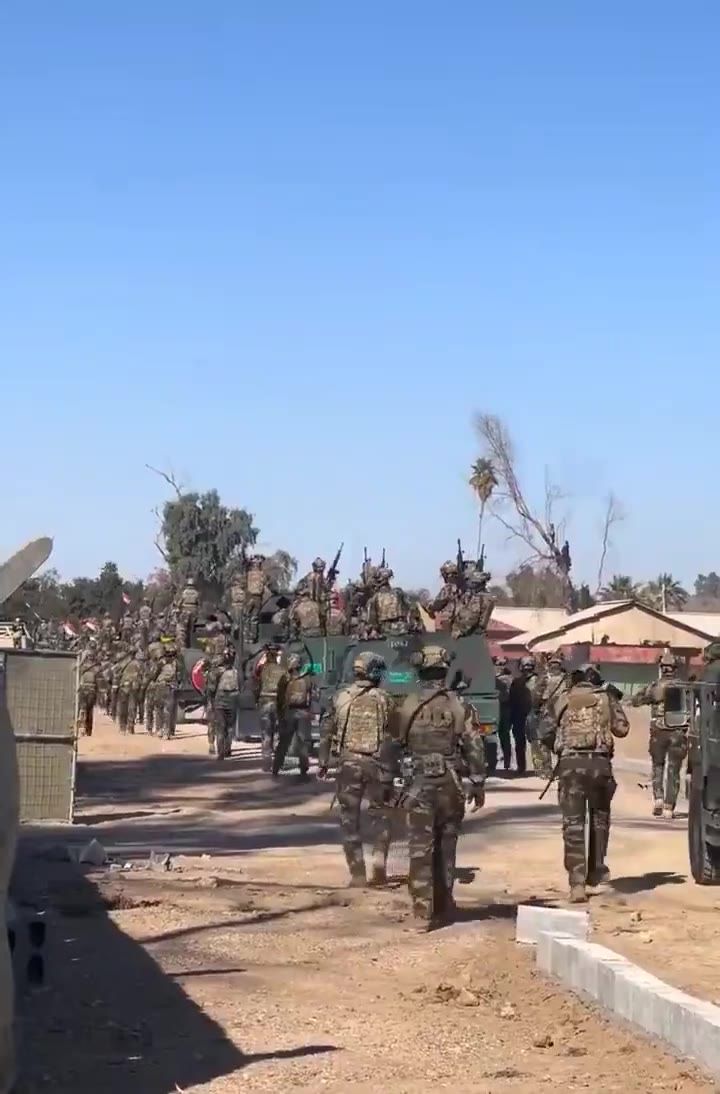
The clip shows genuine Iraqi security-force vehicles, but it cannot be tied to this week's deployment in Babil province. Al Jazeera's open-source unit examined three widely shared videos said to show troops moving on Jurf al-Sakhar and traced them to postings from August and September 2026 in unrelated contexts: a security deployment in Dora, Baghdad after an officer was killed, an operation in Kirkuk, and a special-forces convoy on a Mansour street in Baghdad. Misbar separately rated the claim misleading, matched the vehicles and insignia to the Iraqi Counter-Terrorism Service (the Golden Division), and found the clip circulating since August 2026. The video in this post shows the same kind of vehicles. We could not independently establish the exact original date of this particular file, so we rate the finding moderately rather than highly confident. The point is not that the footage is fake — it is real — but that it is being used as evidence of an event it does not show.
Still open: The exact original upload of this specific file could not be confirmed; we know the same convoy and unit markings were circulating months earlier.
What was posted
XA short video clip posted on X shows a convoy of Iraqi security-force vehicles — Humvees with troops riding on top — moving along a dirt road past palm trees and low buildings. The caption presents it as the Iraqi army encircling Iranian militia headquarters. The Arabic hashtags name Saddam Hussein's fall and 'Tehran's militias', asking readers to believe that this is the first time the Iraqi army has turned on Iran-backed armed groups since 2003.
“📍لأول مره منذ سقوط حكومة #صدام_حسين يتحرك #الجيش_العراقي ضد مليشيات #طهران الجيش العراقي يبدأ بمحاصرة مقرات المليشيات الإيرانية. #العراق_بصورة_أوضح”
“📍For the first time since the fall of #Saddam_Hussein's government, the #Iraqi_Army is moving against #Tehran's militias. The Iraqi army has begun to besiege the headquarters of the Iranian militias. #Iraq_in_a_Clearer_Picture” — translated
Posted on X by the account @SPECTAT0R__ (Abu Saud). The same style of convoy clip was already circulating on TikTok, Facebook and Instagram in August and September 2026, according to Al Jazeera's open-source unit and Misbar.
Who posted it
XAccount check
Estimates from public signals — account age, posting pattern, audience — not a judgement of the person behind the account, and separate from whether this post is true.
What stood out
- Profile data is essentially empty: no display name, bio, follower count, creation date, or posts supplied — nothing to corroborate a real person or organisation.
- No web trace of an X/Twitter account using the exact handle @SPECTAT0R__; searches only return unrelated gaming/forum usernames (Steam, osu!, Codeforces, TF2) and the well-known but distinct @spectatorindex.
- Handle styling (leetspeak '0' plus trailing double underscore) is typical of look-alike/impersonation or burner handles designed to mimic aggregation accounts such as @spectatorindex.
- No platform verification, no news coverage, no fact-checker references — zero reputation footprint as an information source.
- Because the account leaves no history, it cannot be treated as a reliable or attributable source; the absence of content also prevents confirming organic (non-automated) behaviour.
Signals (7)+
- Posting cadence
- Unknown — zero posts provided
- Notable news coverage
- None found
- Fact check history
- None found
- Web presence of handle
- No matching X account surfaced; only unrelated game/forum profiles
- Handle lookalike risk
- High — resembles 'spectator' aggregation-brand handles
- Bio and display name
- Absent
- Data completeness
- Very low (metadata fields null, empty recent_posts)
Account checked November 19, 2026, 02:49 UTC
The media
Video✓ What is genuine
The footage itself is real Iraqi security-force video: the vehicles, uniforms and terrain are consistent with Iraqi special forces, and the detector found no synthetic manipulation. What is not genuine is the label attached to it — the clip does not document this week's Babil deployment.
The tells
- ●●● Strong signal Detector score of 0.00018 for AI generation and 0.000015 for deepfake — far below any threshold for synthetic media.our detector
- ●●○ Supporting signal Consistent vehicle geometry, shadows and markings across frames; Humvees match Iraqi Counter-Terrorism Service equipment described by Misbar.our visual review
- ●●● Strong signal Identical or near-identical convoys were already posted in August and September 2026, months before the Jurf al-Sakhar deployment.Al Jazeera open-source unit and Misbar
- ●○○ Weak signal The audio is an indistinct chant that cannot be linked to the scene or the location, so it adds nothing to the claim.our visual review
Synthetic-media detector
Detector ranThe claim stands or falls on whether the media is real, so the detector ran.
Scores are the detector’s estimate for the file as uploaded. A low score does not rule out editing, a spliced caption, or footage shown out of context — those are judged above. Model v3.
How we checked the media
- Reviewed the video frame by frame, checking vehicle geometry, shadows, signage and whether the scene looks physically plausible.
- Ran our AI-generation detector (hive-v3) on the clip, which returned a 0.00018 probability of AI generation and a 0.000015 deepfake score — effectively no sign of synthetic content.
- Compared the vehicles and unit markings against the descriptions in Al Jazeera's and Misbar's verification work on the same viral clips.
- Searched for the clip's earlier appearances and found matching convoy footage reported in August and September 2026 postings.
Sources
7 sources reviewed- 1Iraq readies to reclaim Jurf Al-Sakhr from Kataib Hezbollah after 12 years ↗
The New Arab · newarab.comUntiereduntiered — treated as signal only, never decisiveEvidence
The New Arab reports the order to restore army control over Jurf al-Sakhr and the deployment of tanks and troop carriers from Baghdad and Mussayib.
- 2Military reinforcements mass outside Kataeb Hezbollah stronghold in Iraq as standoff escalates ↗
Arab News / AFP · arabnews.comUntiereduntiered — treated as signal only, never decisiveEvidence
AFP reports reinforcements arriving in Babil province, Kataib Hezbollah's refusal to leave and the Friday deadline.
- 3Iraq masses troops outside Kataib Hezbollah stronghold amid oil-smuggling inquiry ↗
The National · thenationalnews.comUntiereduntiered — treated as signal only, never decisiveEvidence
The National reports Iraqi units moving toward Jurf al-Sakhar and air support ready after the 20 November deadline.
- 4Baghdad readies for 'zero hour' at militia stronghold after IRGC Qaani visits Iraq ↗
Iran International · iranintl.comUntiereduntiered — treated as signal only, never decisiveEvidence
Iran International quotes the Defence Ministry spokesman saying the army is awaiting 'zero hour' to take control.
- 5ما حقيقة مشاهد متداولة عن دخول الجيش العراقي إلى جرف الصخر؟ (Al Jazeera open-source verification) ↗
Al Jazeera (republished by Italia Telegraph) · italiatelegraph.comUntiereduntiered — treated as signal only, never decisiveEvidence
Al Jazeera's open-source unit traced three viral Jurf al-Sakhar videos to August and September 2026 postings in unrelated contexts.
- 6هل الفيديو لإعادة انتشار القوات العراقية تمهيدًا لتطويق جرف الصخر؟ ↗
Misbar · misbar.comUntiereduntiered — treated as signal only, never decisiveEvidence
Misbar rated the video claim misleading and identified the vehicles as Counter-Terrorism Service equipment already circulating in August 2026.
- 7Kataib Hezbollah Warns Iraqi Forces Against Entering Jurf al-Sakhar ↗
Kataeb / Asharq Al-Awsat · en.kataeb.orgUntiereduntiered — treated as signal only, never decisiveContext
Asharq Al-Awsat describes the standoff as the first major test of the new government's resolve to disarm non-state armed groups while noting internal fighting has been mostly avoided since 2003.
Further reading
- 5Al Jazeera (republished by Italia Telegraph) Al Jazeera's open-source unit explains how it traced the viral Jurf al-Sakhar videos to their original, unrelated postings.
- 6Misbar Misbar's fact check identifies the vehicles and gives the August 2026 circulation date for the convoy footage.
- 2Arab News / AFP AFP's reporting gives the clearest account of the deployment stage, the deadline and Kataib Hezbollah's refusal to leave.
The full story
The kernel of truth here is that something serious is happening at Jurf al-Sakhar. On 15–16 November 2026, Prime Minister Ali al-Zaidi ordered the armed forces into the district, also called Jurf al-Nasr, in Babil province. Kataib Hezbollah, an Iran-aligned armed group, had held the area for about 12 years, and the order followed a government investigation into alleged oil smuggling worth tens of millions of dollars.
By the time this video was posted, tanks, armoured vehicles, federal police and counter-terrorism units had massed around the district. The Defence Ministry said the army was waiting for 'zero hour'. Kataib Hezbollah refused to withdraw — its commander Abu Taleb al-Saidi said it would not happen 'even over our dead bodies' — and the government set a Friday 20 November deadline. Iran's Quds Force commander, Esmail Qaani, flew to Baghdad to mediate.
That is a genuine and significant confrontation. It is also exactly the kind of moment when old footage gets pulled out and relabelled. Al Jazeera's open-source unit found that three widely shared videos supposedly showing the move on Jurf al-Sakhar had already been posted in August and September 2026, from a security deployment in Dora after an officer was killed, an operation in Kirkuk, and a convoy on a Mansour street in Baghdad. Misbar matched the vehicles to the Counter-Terrorism Service and reached the same conclusion.
The post then adds a second distortion: 'for the first time since the fall of Saddam Hussein's government'. Iraqi forces fought the Mahdi Army in 2004 and, most clearly, in the 2008 Charge of the Knights in Basra and Baghdad. The current standoff may be the most serious in many years, but it is not the first.
Kernel of truth
Iraq's army really did mass around the Kataib Hezbollah stronghold of Jurf al-Sakhar in mid-November 2026, with a 20 November deadline for the militia to withdraw.
Timeline
August 2026
Convoy videos later used as 'Jurf al-Sakhar' footage are posted from unrelated incidents, including Dora in Baghdad and Kirkuk, according to Al Jazeera and Misbar. 5Al Jazeera (republished by Italia Telegraph)
September 27, 2026
A further posting of comparable Iraqi special-forces convoy footage appears, still months before the Jurf al-Sakhar deployment. 5Al Jazeera (republished by Italia Telegraph)
November 15, 2026
Prime Minister Ali al-Zaidi orders the armed forces into Jurf al-Sakhar; tanks and troop carriers deploy from Baghdad and Mussayib. 1The New Arab
November 16, 2026
Reinforcements continue arriving in Babil province around Jurf al-Sakher as Kataib Hezbollah vows not to leave; a Friday 20 November deadline is set. 2Arab News / AFP
November 18, 2026
Misbar publishes its fact check rating the Jurf al-Sakhar video claim misleading and identifying it as old footage. 6Misbar
How it was framed
The video is genuine Iraqi security-force footage, but it is presented as this week's deployment to Jurf al-Sakhar when the verification work places it months earlier in unrelated locations. The added 'first since Saddam' framing compounds the distortion by erasing earlier state operations against Shiite militias.
- “Visual proof”. The post leads with a video of armed vehicles and asks the reader to accept it as evidence of the encirclement of militia headquarters.
- Borrowed authority. The caption uses the Iraqi army's name and the hashtag #الجيش_العراقي to lend official weight to the clip.
- Emotional language. The phrase 'لأول مره منذ سقوط حكومة #صدام_حسين' (for the first time since the fall of Saddam Hussein's government) marks the moment as historic and dramatic.
- Missing context. Neither the caption nor the video states when or where the footage was filmed, and it omits the 2004 and 2008 operations against Shiite militias.
Posted on X by the account @SPECTAT0R__ (display name Abu Saud). The account's bio and follower count were not captured. The same convoy footage had already circulated on TikTok, Facebook and Instagram in August and September 2026, as documented by Al Jazeera's open-source unit and Misbar.
Bias
Leans anti-Iran / anti-militia. The caption uses loaded framing ('militias of Tehran', 'first time since Saddam fell') and an unrelated recycled army clip to dramatise an already dramatic real standoff, pushing a narrative of a decisive Iraqi state showdown with Iran's proxies that the footage does not itself document.
Bias describes how the post frames its message — the slant of the language, selection and emphasis — and is judged separately from whether the claim is true. A true claim can still be framed with a strong slant.
How we checked
1 min 33 s- 1
Searched in Arabic and English for reporting on the Iraqi army's movement against Iranian-backed militias in November 2026.
- 2
Opened and read the Al Jazeera open-source verification (republished by Italia Telegraph) and the Misbar fact check on the Jurf al-Sakhar videos.
- 3
Compared the details in those verifications with the convoy shown in this post.
- 4
Reviewed the video visually, frame by frame, for signs of manipulation or synthetic generation.
- 5
Ran our AI-generation detector (hive-v3) on the clip.
- 6
Checked the news agencies' accounts of the deployment stage and the 20 November deadline.
✓ Claim checked✓ Media checked✓ Sources checked
Why 65% confidence
ModerateWe rated the overall verdict MODERATE. The real-world standoff is well documented by several independent outlets, which supports the PARTLY_TRUE rating on the central claim at high confidence. But the video's exact original date could not be independently confirmed, and the 'first since Saddam' comparison rests on a limited set of sources in our file, so those two findings are rated moderate. The media itself is likely authentic — our detector found no synthetic content — but authentic footage used in the wrong context is exactly what this post does.
Limits. We could not establish the exact first upload of this particular video file, only that matching convoys were circulating months earlier. We did not have a dedicated historical source on the 2004 and 2008 operations, relying on how the current news coverage framed them. The audio could not be matched to the scene.
What we don’t know
- The exact date and location of the original filming of this specific clip.
- Whether the account @SPECTAT0R__ created the caption itself or copied it from another post.
- How the standoff will end after the 20 November deadline and whether Iranian mediation will produce a withdrawal.
- The full details of the oil-smuggling investigation that triggered the deployment.
Spot it yourself
Spot the fakeLooks suspicious, isn’t proof
- The account name @SPECTAT0R__ and the use of multiple hashtags may look partisan, but a partisan poster can still share accurate material.
- The dramatic 'first time since Saddam' line is a reason to slow down, but dramatic language alone does not make a claim false.
- The video is short and lacks a clear location sign, which makes verification harder, but that is not evidence of fabrication.
- The Arabic audio chant is indistinct and does not match a news soundtrack; that is odd but not proof either way.
The actual evidence
- Open-source verification by Al Jazeera and Misbar traced the same convoy clips to August and September 2026 postings in Dora, Kirkuk and Mansour, months before the Jurf al-Sakhar deployment.
- Misbar identified the vehicles as Iraqi Counter-Terrorism Service equipment, which is real but not tied to Babil province this week.
- Our AI detector found no sign of synthetic generation, so the question is not whether the video is fake but what it actually shows.
- News agencies reporting from the ground (AFP, The New Arab, The National) confirm the deployment but describe troops massing and waiting, not a completed siege.
- Historical reporting on the 2008 Charge of the Knights shows the army has moved against Shiite militias before, contradicting the 'first since Saddam' framing.
- 1
Ask who would be reporting this if it were true.
A major army deployment in Babil province would be covered by international agencies with reporters on the ground. Check whether AFP, Reuters or major regional outlets are reporting the same movement; if only social accounts have the video, treat it with caution.
- 2
Run a reverse image search on a clear frame from the video.
Pause on a frame where vehicles and markings are visible, crop it, and search it through Google Lens or a similar tool. If the same convoy appears in posts from months earlier, the clip is recycled.
- 3
Look at the visual details that identify a unit.
Zoom in on vehicle markings, uniforms and terrain. In this case the Humvees matched Counter-Terrorism Service equipment. That tells you the footage is real but not necessarily from this event.
- 4
Check the official account for the area or the ministry.
The Iraqi Defence Ministry and the prime minister's office publish statements. A spokesman quoted by Iran International said the army was 'awaiting zero hour' — that is a different stage from a completed siege.
- 5
Separate the historical claim from the news claim.
The phrase 'first since Saddam' can be checked against known operations like the 2008 Charge of the Knights. If a post bundles a checkable historical claim with a video, check them separately.
Takeaway
Real footage can still be used to tell a false story. When a video is offered as proof of a dramatic event, the question to ask is not only 'is this fake?' but 'when and where was this filmed, and does it actually show what the caption says?'
Questions people ask
Is the Iraqi army really moving against Tehran-backed militias?+
Yes. On 15–16 November 2026 Prime Minister Ali al-Zaidi ordered the armed forces into Jurf al-Sakhar, a Kataib Hezbollah stronghold in Babil province, following an oil-smuggling inquiry. Tanks, armoured vehicles and counter-terrorism units massed around the district, and a 20 November deadline was set for the militia to withdraw. The army had not entered when this check was published.
Is the video in the post real?+
The footage appears to be genuine Iraqi security-force video — our detector found no sign of AI generation. But Al Jazeera and Misbar traced the same convoy clips to August and September 2026 postings in unrelated locations, including Dora in Baghdad and Kirkuk. So the video is real, but it is not evidence of this week's deployment.
Has the Iraqi army ever moved against Iran-backed militias before?+
Yes. Iraqi forces fought the Mahdi Army in 2004 and, most clearly, launched the 2008 Charge of the Knights operation in Basra and Baghdad against the Sadrist militia. The current standoff may be the most serious in many years, but the claim that it is the first since Saddam Hussein's fall is inaccurate.
Why do old videos spread during breaking news?+
When a dramatic event is unfolding, people search for visuals and share the first footage that seems to match. Old clips of the same country, army or type of vehicle can look convincing. Verification teams check upload dates and locations before treating a video as evidence of a current event.
What is Jurf al-Sakhar and why does it matter?+
Jurf al-Sakhar, also called Jurf al-Nasr, is a district in Babil province that Kataib Hezbollah has held for about 12 years. The government's order to enter it is seen as a major test of the new prime minister's resolve to disarm non-state armed groups, and it prompted Iranian mediation.
Go deeper
- Kataib Hezbollah
- An Iran-aligned armed group in Iraq that has controlled the Jurf al-Sakhar district for about 12 years, according to reporting on the standoff.
- Jurf al-Sakhar (Jurf al-Nasr)
- A district in Babil province, Iraq, that is the focus of the November 2026 army deployment.
- False context
- A type of misinformation in which genuine content is shared with false information about when, where or why it was created.
- Reverse image search
- A technique that uses a picture or video frame to find earlier or related copies online, helping establish when and where content first appeared.
- Charge of the Knights
- A 2008 Iraqi military operation in Basra and Baghdad against the Sadrist militia, cited as a precedent for state action against Shiite armed groups.
People also search for
For educators+
- The video is real but mislabelled. Does that make the post a lie, or something else? How should platforms label it?
- Why might a person share old footage during a breaking news event without intending to deceive? What responsibility do sharers have?
- How would you check the claim 'for the first time since Saddam Hussein' using only publicly available sources?
About this check
- Platform
- X
- Posted by
- @spectat0r__
- Posted
- November 16, 2026
- Age when checked
- Older post, still live
- Where it spread
- IQ
- Audience
- International audience
- Language
- AR
- Status
- ● Post is live
- Verified
- November 19, 2026, 02:51 UTC
- Published
- November 19, 2026, 02:51 UTC
Reach. 2,629 likes on primary (X syndication, 19 Nov); same claim posted by many accounts; two Misbar checks on 18 Nov
This verdict was generated with AI from the sources shown. AI can make mistakes — check the sources before relying on it.
Check anything yourself, in seconds.
Share any social post or video to What the Fact and get the verdict, the confidence, and the receipts.