Did an explosion near Chmielek, Biłgoraj County, get caught on CCTV?
Does CCTV footage show an explosion near Chmielek in eastern Poland on 20 November 2026, when Russian missiles and a drone fell on Polish territory?
True
Polish radar data matched the CCTV footage of the blast near Chmielek, officials say.
TRUE. The CCTV video is a genuine recording. Poland’s Armed Forces Operational Command said the footage matched its radar data, and a Biłgoraj district official confirmed an explosion after an object entered Polish airspace during a large Russian missile and drone attack on Ukraine on the morning of 20 November 2026. The defence minister later identified the object as a Kh-101 cruise missile.
 Genuine
Claims
✓ 2 trueAn explosion was captured on CCTV at approximately 6:35 AM near Chmielek, in Biłgoraj County, eastern Poland.1456
This is the claim the post rests on, and several independent lines point the same way. A military spokesman, Lt Col Jacek Goryszewski of the Operational Command, said the circulating CCTV recording corresponded with Polish radar readings and that the object that crossed the border may be the one seen exploding. A civilian official, Biłgoraj district governor Andrzej Szarlip, confirmed an explosion and that something fell in the county. Polish outlets — Interia, TVP Info and Słowo Podlasia — treated this very clip as the Chmielek blast footage; Słowo Podlasia traced it to a farm in Kopki and placed the flash between Chmielek and Nowy Lipowiec. The decisive evidence is the comparison with radar: it links the image people were sharing to a tracked object rather than to a generic explosion. These are not copies of one another — the military, the district governor and the newsrooms describe the event from different vantage points. The only gap is timing: officials say it happened around or after 6:30, which is a rounding issue rather than a contradiction.
Still open: Officials gave the time as around or after 6:30 rather than exactly 6:35. The CCTV overlay itself reads 06:33–06:34, consistent with the reported window.
Chmielek is located approximately 97 km from Lublin in a straight line.47
This is a secondary locator, not the point of the post, and it is harder to pin down than the blast itself. Interia repeated GeoInsider’s own figure — about 97 km from Lublin as the crow flies, 110–120 km by road — which fits the geography of Biłgoraj County. We did not independently measure the distance, so we cannot call it exact. More importantly, the number is not the one that matters operationally: officials more often described the site as roughly 45 km from the Ukrainian border, because that is the distance that explains how the object got there. A small locational slip here would not undermine the main claim, which is why we treat it as a supporting detail with a lower confidence band.
Still open: We have not independently measured the straight-line distance from Lublin to Chmielek.
What was posted
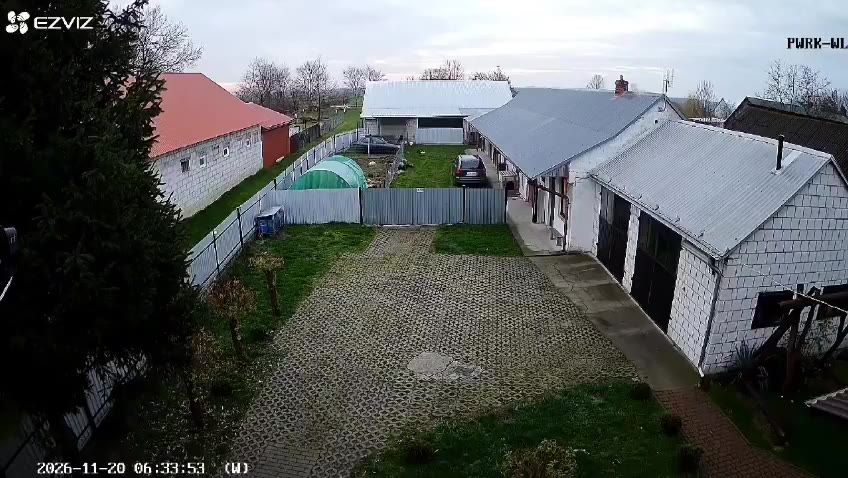
XThe GeoInsider account on X posted a short CCTV clip of a farmyard, with a sudden flash on the right side of the frame, and said it showed an explosion at about 6:35 AM near Chmielek in Biłgoraj County, eastern Poland. The caption places the scene roughly 97 km from Lublin. It asks the reader to accept that this domestic camera recorded the blast connected to the morning’s reported airspace violation.
“An explosion was captured on CCTV at approximately 6:35 AM near Chmielek, in Biłgoraj County, eastern Poland. The explosion is visible on the right-hand side of the footage, which appears to show a sudden flash followed by a blast. Chmielek is located approximately 97 km from”
Posted as the blast was being reported. Polish outlets identified this same GeoInsider clip as the Chmielek footage the same morning. The caption’s distance (97 km from Lublin) echoes the account’s own wording; officials more often put the site about 45 km from the Ukrainian border.
Who posted it
XAccount check
Estimates from public signals — account age, posting pattern, audience — not a judgement of the person behind the account, and separate from whether this post is true.
What stood out
- @InsiderGeo ('GeoInsider') is a well-established OSINT/geopolitical research account with a public track record dating back at least to 2024 and active through November 2026.
- It functions as a small research collective rather than a single anonymous poster: posts reference a 'local Polish team member', joint investigations with @SONARROW_OSINT, and original geolocation/satellite-imagery work.
- Its work is cited by credible outlets: The Insider (satellite imagery of Russian military loading at Kaliningrad, Oct 2026), NV/Ukraine, Defence24 (Poland), and Polish/Russian media relaying its geolocation of the November 2026 Biłgoraj explosion.
- The account publishes methodological detail (coordinates, IMO numbers, timestamps, imagery) and explicitly cautions followers about misinformation, panic-mongering and the need to correct errors — behaviour typical of a genuine OSINT analyst.
- It sometimes posts fast, single-source breaking claims ahead of official confirmation (e.g. the GAS HUSKY tanker strike report, early attribution of the Poland explosion), which carries inherent reliability risk even for a legitimate account.
- No platform verification badge and no bio/follower metadata available in the provided profile snapshot, so identity cannot be independently tied to a named person or organisation.
- No evidence of coordinated inauthentic behaviour, bot-like cadence, or fact-checker debunking found in search; critical coverage is about premature sourcing, not fabrication.
Signals (7)+
- Posting cadence
- High-volume, event-driven breaking-news threads
- Known affiliations
- Collaborates with @SONARROW_OSINT; cross-posted by @DefenceGeek and OSINT community
- Media citations
- The Insider; NV (Ukraine); Defence24.pl; Polish/Russian telegram relays
- Original reporting
- Satellite imagery analysis, ship tracking/IMO identification, geolocation of footage
- Fact check history
- No debunks found; self-corrects and publicly criticises unacknowledged errors by larger accounts
- Notable news coverage
- Kaliningrad military loading (Oct 2026), Black Sea tanker strikes (Nov 2026), Biłgoraj explosion geolocation (Nov 2026)
- Metadata completeness
- Very low - no bio, follower count or creation date supplied
Account checked November 20, 2026, 14:39 UTC
The media
Video✓ What is genuine
The CCTV recording itself is genuine footage of a real flash and blast. Polish media and the military treated the same clip as footage of the incident, and the defence minister later said the object at Nowy Lipowiec was a Kh-101 cruise missile.
The tells
- ●●● Strong signal The Operational Command spokesman said the CCTV recording corresponded with Polish radar readings.DORSZ via Interia
- ●●○ Supporting signal The on-screen CCTV timestamp stays consistent through the clip (20-11-2026, 06:33–06:34), and lighting and shadows across the scene do not shift between frames.our visual review
- ●●○ Supporting signal The scene is an ordinary farmyard recorded on a domestic EZVIZ camera, with a stable overlay; nothing morphs or flickers, and nothing in it is physically impossible.our visual review
- ●●○ Supporting signal Słowo Podlasia traced the clip to a farm in Kopki and placed the flash between Chmielek and Nowy Lipowiec, matching the officials’ account.Słowo Podlasia
Synthetic-media detector
Detector not consultedSources settled the claim on their own; the detector was not needed.
How we checked the media
- Reviewed the video frame by frame for visual consistency: the timestamp, lighting, shadows and scene detail.
- Checked whether Polish officials and outlets treated this exact recording as genuine footage of the Chmielek blast.
Sources
10 sources reviewed- 1Nieznany obiekt spadł w Polsce. „Naruszenie przestrzeni powietrznej” ↗
TVP Info · tvp.infoUntiereduntiered — treated as signal only, never decisiveEvidence
TVP Info reports the confirmed airspace violation and describes the explosion footage on farm buildings.
- 2Tusk o upadku obiektu w Chmielku: obecnie nie ma zagrożenia, na miejscu działają służby ↗
Polska Agencja Prasowa (PAP) · pap.plUntiereduntiered — treated as signal only, never decisiveEvidence
PAP reports the Operational Command’s airspace-violation statement and Prime Minister Tusk’s comments on the Chmielek object.
- 3Rzecznik DORSZ o obiekcie, który spadł na Lubelszczyźnie. "Rakieta manewrująca albo dron odrzutowy" ↗
Polska Agencja Prasowa (PAP) · pap.plUntiereduntiered — treated as signal only, never decisiveEvidence
PAP reports the DORSZ spokesman saying the fallen object could be a Kh-101 cruise missile or a jet-powered drone.
- 4W sieci krąży nagranie z Lubelszczyzny. "Widoczna jest eksplozja" ↗
Interia · wydarzenia.interia.plUntiereduntiered — treated as signal only, never decisiveEvidence
Interia identifies the GeoInsider clip as the Chmielek footage and quotes the military spokesman on the radar match.
- 5"Rzeczywiście coś spadło". Starosta potwierdził eksplozję na Lubelszczyźnie ↗
Polsat News · polsatnews.plUntiereduntiered — treated as signal only, never decisiveEvidence
Polsat News quotes Biłgoraj district governor Andrzej Szarlip confirming an explosion and that something fell in the county.
- 6Ktoś nagrał moment eksplozji pocisku. W Lipowcu został znaleziony obiekt [FILM] ↗
Słowo Podlasia · slowopodlasia.plUntiereduntiered — treated as signal only, never decisiveEvidence
Słowo Podlasia traces the recording to a farm in Kopki and places the blast between Chmielek and Nowy Lipowiec.
- 7Poland probes mystery object crash near eastern border as Russia bombards Ukraine ↗
TVP World · tvpworld.comUntiereduntiered — treated as signal only, never decisiveContext
TVP World reports the search in Biłgoraj district near Chmielek after the suspected airspace violation.
- 8Pologne : chute d'un objet volant pas encore identifié dans l'est du pays ↗
RTBF (AFP) · beta.rtbf.beUntiereduntiered — treated as signal only, never decisiveContext
RTBF, using AFP, reports that an object fell near Chmielek in Biłgoraj district.
- 9Polonia, un sibilo poi l'esplosione: oggetto non identificato cade vicino al confine con l'Ucraina ↗
la Repubblica · repubblica.itReputable outletLean LeftContext
la Repubblica reports CCTV capturing a flash and explosion and that the object was probably a missile fragment.
- 10F-16 ścigały rakietę na polskim niebie? NASK ostrzega: to deepfake ↗
Polskie Radio 24 · polskieradio24.plUntiereduntiered — treated as signal only, never decisiveContext
Polskie Radio 24 reports NASK’s warning about a separate AI-generated F-16 image, distinguishing it from the genuine CCTV clip.
Further reading
- 4Interia Interia directly ties this GeoInsider clip to the Chmielek blast and quotes the military spokesman on the radar comparison.
- 2Polska Agencja Prasowa (PAP) PAP gives the official account of the airspace violation and Prime Minister Tusk’s statement.
- 10Polskie Radio 24 Polskie Radio 24 reports the separate AI-generated F-16 image that NASK warned about, useful for telling real footage from fakes.
The full story
The kernel of truth is simple: a real explosion was recorded on a private CCTV camera, and it really was connected to a serious security incident. On the morning of 20 November 2026, during a large Russian missile and drone attack on Ukraine, Poland’s airspace was violated. An object came down in fields beside a forest near Nowy Lipowiec and Chmielek in Biłgoraj County, caught fire and was heard as a loud blast by residents. Search teams were sent, and air-raid alerts for Lublin and Podkarpackie were later lifted. No casualties were reported.
Officials gave the event a shape. The Armed Forces Operational Command reported a suspected airspace violation and a possible impact near Chmielek, and its spokesman said the CCTV footage circulating online matched radar readings. Biłgoraj district governor Andrzej Szarlip confirmed the blast. Interior Minister Marcin Kierwiński listed three impact sites — Rudnik nad Sanem, Mołodyncz/Mołodycz and Nowy Lipowiec. Defence Minister Władysław Kosiniak-Kamysz said the object at Nowy Lipowiec was a Kh-101 cruise missile, and Prime Minister Donald Tusk said there was no ongoing air threat and that services were on site.
The clip spread fast because it was real and alarming, and because it appeared while people were still trying to work out what had crossed the border. That is also the kind of moment when false material travels alongside true material: the same day, the national body NASK warned about an AI-generated image of F-16s “chasing a missile.” That fake was a separate item from this genuine recording. Keeping the two apart is the whole job.
Kernel of truth
A real object crossed into Polish airspace during a mass Russian strike on Ukraine and exploded near Chmielek on the morning of 20 November 2026; the CCTV clip is genuine footage of that blast, and officials said it matched their radar data.
Timeline
November 20, 2026
During a large-scale Russian missile and drone attack on Ukraine, Poland’s airspace is violated and an object crashes near Chmielek/Nowy Lipowiec in Biłgoraj County, causing a blast and fire; no casualties are reported. 2Polska Agencja Prasowa (PAP)
November 20, 2026
The GeoInsider account posts a CCTV clip of the blast on X, and Polish outlets including Interia, TVP Info and Słowo Podlasia pick it up the same morning. 4Interia
November 20, 2026
Biłgoraj district governor Andrzej Szarlip confirms the explosion; Interior Minister Marcin Kierwiński lists three impact sites; Defence Minister Władysław Kosiniak-Kamysz says the object at Nowy Lipowiec was a Kh-101 cruise missile. 3Polska Agencja Prasowa (PAP)
November 20, 2026
The national body NASK warns that a separate image of F-16s “chasing a missile” is an AI-generated deepfake. 10Polskie Radio 24
How it was framed
The post’s content is accurate: the recording is genuine and the event happened as described. It is not an example of manipulated or fabricated media. The only distortion is a minor rounding in the time and an unverified distance figure, which do not change what the post asks readers to believe.
- “Visual proof”. The post offers the CCTV clip itself as the evidence: “The explosion is visible on the right-hand side of the footage.”
- Missing context. The caption says an explosion happened at “approximately 6:35 AM” but gives no indication that officials had confirmed an airspace violation or identified the object.
Posted on X by the GeoInsider account. The same clip was identified by Polish outlets, including Interia, as the Chmielek footage on the morning of 20 November 2026.
Bias
The caption is a straight descriptive account of what the CCTV recording shows and where, without attributing blame or pushing a political narrative.
Bias describes how the post frames its message — the slant of the language, selection and emphasis — and is judged separately from whether the claim is true. A true claim can still be framed with a strong slant.
How we checked
49 s- 1
Searched for reporting on an explosion near Chmielek in Biłgoraj County, including Polish-language queries.
- 2
Searched for any fact-checks or warnings about this specific CCTV clip being fake or AI-generated.
- 3
Compared the post’s claims with statements from the Polish Armed Forces Operational Command and local officials reported by Polish outlets.
- 4
Reviewed the video for visual consistency, including the timestamp and scene detail.
- 5
Checked whether the clip was the same one Polish newsrooms identified as the Chmielek footage.
✓ Claim checked✓ Media checked✓ Sources checked
Why 87% confidence
HighWe rated this HIGH because a military spokesman linked the footage to radar data and a local official confirmed the blast, with several independent Polish and international outlets reporting the same event. The only soft spot is the exact time and the distance figure, neither of which affects the central claim.
Limits. We did not run an automated media-forensics detector on this clip; our assessment of the footage rests on visual review and the statements of officials and Polish outlets. We also did not independently measure the distance from Lublin to Chmielek.
What we don’t know
- The precise second of the blast: officials said around or after 6:30, and the CCTV overlay reads 06:33–06:34.
- The full technical chain that brought the object down — officials initially described it as possibly a Kh-101 cruise missile or a jet-powered drone before the defence minister named the missile.
- Whether any earlier or higher-quality version of the clip exists from another camera.
Spot it yourself
Why it looked fakeLooks suspicious, isn’t proof
- It was shared by an account on X rather than by an official government channel. Who posts a video is a reason to check, not evidence that the video is fake.
- The alarmist tone and the speed of posting can make a clip feel like war-time rumour. Urgency is not proof either way.
- A grainy night-time CCTV image with a timestamp overlay looks easy to fake. Low quality is common in genuine domestic cameras and proves nothing on its own.
The actual evidence
- The Operational Command spokesman said the recording corresponded with Polish radar readings — that ties the image to a tracked object, not just to an anonymous upload.
- A local official, the Biłgoraj district governor, independently confirmed an explosion and that something fell in the county.
- Several Polish newsrooms, including Interia, TVP Info and Słowo Podlasia, identified this same clip as the Chmielek blast, and Słowo Podlasia traced it to a specific farm.
- The defence minister later said the object at Nowy Lipowiec was a Kh-101 cruise missile, which fits a real object coming down in the area.
- 1
Check whether officials confirm the event, not just the video
Look for a statement from the country’s armed forces or local government. Here, the Operational Command and the district governor confirmed an airspace violation and an explosion.
- 2
Look for the same clip in established outlets
If several independent newsrooms publish the same recording and attribute it to the same place, that is stronger than any single account’s caption.
- 3
Check the timestamp against the official timeline
The CCTV overlay reads 06:33–06:34; officials said around or after 6:30. A small mismatch in rounding is normal; a large one would be worth questioning.
- 4
Separate real footage from fakes circulating at the same time
During fast-moving incidents, genuine and AI-generated material spread together. Here a fake F-16 image was also circulating; check each item on its own.
Takeaway
A video can look like a rumour and still be true. The question to ask is not “who posted this?” but “has anyone with direct knowledge confirmed the event the video shows?”
Questions people ask
Was the Chmielek explosion video real?+
Yes. The CCTV recording is genuine footage of an explosion near Chmielek in Biłgoraj County on 20 November 2026. Poland’s Armed Forces Operational Command said the clip corresponded with its radar readings, and the Biłgoraj district governor confirmed that something fell and a blast was heard.
What caused the explosion in eastern Poland?+
An object entered Polish airspace during a large Russian missile and drone attack on Ukraine. Defence Minister Władysław Kosiniak-Kamysz said the object found at Nowy Lipowiec was a Kh-101 cruise missile. Officials listed three impact sites, and no casualties were reported.
Was there also fake footage from the same incident?+
Yes, but it was a different item. Poland’s NASK warned about an AI-generated image of F-16s “chasing a missile.” That deepfake was separate from this genuine CCTV recording, and the two should not be confused.
How far is Chmielek from Lublin and from Ukraine?+
Interia repeated the post’s figure of about 97 km from Lublin in a straight line, or 110–120 km by road. Officials more often described the site as roughly 45 km from the Ukrainian border, which is the distance that matters for how the object arrived.
How can I tell a real blast video from a fake one?+
Look for confirmation of the event rather than the clip alone. Check whether the armed forces or local officials confirm an incident, whether several independent outlets carry the same footage, and whether the timestamp fits the official timeline. A video shared by an anonymous account can still be genuine, and an official-looking one can still be fake.
Go deeper
- DORSZ
- The Operational Command of the Polish Armed Forces, the military body that reported the airspace violation.
- Kh-101
- A Russian air-launched cruise missile, the type the defence minister said was found at Nowy Lipowiec.
- Deepfake
- An image, video or audio clip generated or altered with AI to show something that did not happen.
- Airspace violation
- When an object such as a missile or drone enters a country’s airspace without permission.
- CCTV
- Closed-circuit television, a fixed camera system often used for security on private property.
People also search for
For educators+
- Why might a real video and an AI-generated image spread at the same time during a single incident, and how would you tell them apart?
- If an anonymous account posts a clip and officials later confirm it, does that change how much you trust the account in future? Why or why not?
- Which single piece of evidence in this story would be hardest to fake, and why?
About this check
- Platform
- X
- Posted by
- @insidergeo
- Posted
- November 20, 2026
- Age when checked
- Under 24 hours old when checked
- Where it spread
- PL, Ukraine, Russia
- Audience
- International audience
- Language
- EN
- Status
- ● Post is live
- Verified
- November 20, 2026, 14:41 UTC
- Published
- November 20, 2026, 14:41 UTC
Reach. 510 likes per X syndication; the incident is covered by Kyiv Independent, Notes from Poland, El País, Moscow Times and Spiegel; Poland's digital minister ordered extra information monitoring; NASK flagged a fake F-16 photo
This verdict was generated with AI from the sources shown. AI can make mistakes — check the sources before relying on it.
Check anything yourself, in seconds.
Share any social post or video to What the Fact and get the verdict, the confidence, and the receipts.