Did Anthropic's Levent Alpöge and Claude really solve the Generalized Riemann Hypothesis?
Has Anthropic's Claude produced a verified proof of the (Generalized) Riemann Hypothesis, making it the second Millennium Prize problem solved by AI, as viral posts claim?
Misleading
The claim that Alpöge made the proof claim is real; calling it a solved Millennium Prize is not.
Anthropic mathematician Levent Alpöge did publish a note on 20 November 2026 claiming that, working with Claude, he had found a proof of the Riemann and generalized Riemann hypotheses, released as a Lean formalisation. But the post calls it the second Millennium Prize 'solved by AI' — no such solution has been verified or accepted.
 Likely genuine
Claims
✓ 3 true · ✕ 1 falseLevent Alpöge of Anthropic claimed that he and Claude discovered a proof of the (generalized) Riemann hypothesis136
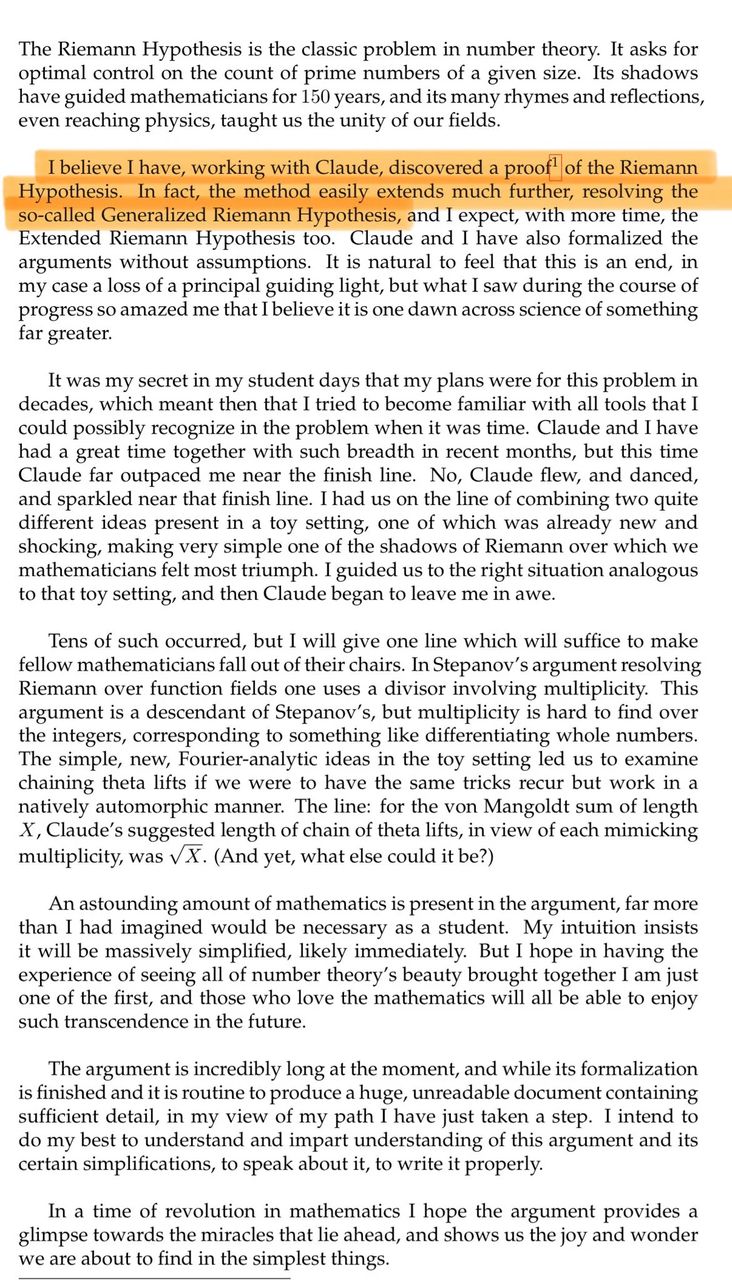
This is the part of the post that holds up. Alpöge's own four-page note, published on his personal site on 20 November 2026, states in the first person that he believes he has, working with Claude, discovered a proof of the Riemann Hypothesis and that the method extends to the Generalized Riemann Hypothesis. The wording is quoted verbatim by Simon Willison's blog and matches what the New York Times, New Scientist, Scientific American, The Independent and AFP/FT reported. The screenshot in the post is a genuine page from that note, not a mocked-up document. Our confidence is high because the primary document and multiple independent newsrooms agree on the same sentence — that is not a chain of outlets copying one another, since the note itself is public. What a careful reader should weigh is the difference between 'claimed' and 'proved': the post's first word-choices are accurate, but a claim is not a verified result, and at the time of writing the mathematics was still under review.
The proof is 250,000+ pages long27
The page count checks out as a description of the full written draft. Alpöge's note puts a complete text at more than 250,000 pages, and New Scientist and Futurism repeat that figure. What the post does not explain is that Alpöge did not release those 250,000 pages as a paper. Instead he published a 14-part Lean archive of 175,187 files and roughly 17.4 million lines — a machine-checkable formalisation rather than prose. So the number is accurate but easy to misread: a reader may picture a quarter of a million pages of conventional mathematical argument sitting on a website, when what is actually public is a very large body of computer-verified code. The distinction matters because the code is what independent mathematicians can check, and the prose is what they cannot yet read in full. Our confidence is high because the primary note and independent coverage agree on the figure.
The Lean formalisation has been released5
The Lean archive is genuinely public. It sits on Alpöge's site as lean.tar.gz in parts 01 through 14 and has been mirrored to GitHub. More importantly for verification, MIT's Andrew Sutherland published independent build and kernel checks showing that the source compiles without errors and that the five headline theorems depend only on the three standard axioms. That is a real, checkable artefact, and it is the strongest reason the story is not fabricated. But a clean build is a statement about the code, not about the mathematics: it shows the formalisation is internally consistent and uses no hidden assumptions, not that the theorem it encodes is the Riemann hypothesis in the full sense people mean. Sutherland's page also notes that 'GRH' in the archive refers to Dirichlet L-functions only. Our confidence is high because the primary verification page is public and specific.
GRH is the 2nd of 6 Millennium prizes solved by AI, after Navier-Stokes48910
This is the sentence that makes the post misleading rather than accurate, and the evidence against it is decisive. The Clay Mathematics Institute still listed the Riemann hypothesis as unsolved on the day of the release, and it lists Navier-Stokes as unsolved too. Only the Poincaré conjecture has ever been officially solved, by Grigori Perelman. Clay's rules require publication in a qualifying journal plus at least two years of general acceptance, so no AI 'solved' Millennium Prize exists yet — not one, let alone two. On top of that, the Alpöge result was contested on the day: a PhilArchive preprint dated 20 November 2026 argued that the formalisation's central witnesses are vacuously true, meaning the final hypothesis bundle is satisfied trivially rather than substantively. A separate human-only GRH draft by Alessandro Masullo also surfaced that day. The post takes a genuine, unverified claim and re-labels it as a prize already won. Our confidence is high because the Clay Institute's own listing, the rules, and a published rebuttal all point the same way.
Still open: Whether the formalisation dispute is settled. At the time of writing, mathematicians were still reviewing both the Lean archive and the rebuttal.
This may be the biggest AI math result of all time1
This is an evaluative judgement, not a checkable fact. Several mathematicians quoted in the coverage described the result in comparable terms, which makes the opinion understandable, but 'biggest of all time' cannot be verified or falsified by evidence in the way the other claims can. We mark it OPINION rather than TRUE or FALSE because it is a ranking statement, and rankings depend on criteria nobody has agreed. The confidence band is moderate because the line between opinion and hype is a judgement call: a reader could reasonably see the post as using an opinion to smuggle in the false prize claim that precedes it. Our advice is to treat the sentence as colour, not as a finding, and to judge the story on the verifiable claims above.
What was posted
XA post on X by @deedydas shares a screenshot of text from Levent Alpöge's four-page note, with an orange highlight over the sentence claiming a proof of the Riemann Hypothesis. The caption tells readers that Alpöge 'just claimed Claude has resolved the General Reimann Hypothesis', that the proof runs to 250,000+ pages, and that the Lean code has been released. It then frames this as the second of six Millennium Prize problems solved by AI, after Navier-Stokes.
“Holy shit. Levent Alpöge from Anthropic just claimed Claude has resolved the General Reimann Hypothesis!!! Proof is 250,000+ pages long. Lean is released. GRH is the 2nd of 6 Millenium prizes solved by AI, after Navier-Stokes. This may be the biggest AI math result of all time.”
Posted on X on the same day Alpöge's note went up on his personal site. The screenshot reproduces the note's real wording with an added highlighter overlay.
Who posted it
XAccount check
Estimates from public signals — account age, posting pattern, audience — not a judgement of the person behind the account, and separate from whether this post is true.
What stood out
- Identity strongly corroborated: @deedydas is Debarghya 'Deedy' Das, Partner at Menlo Ventures (firm's own site and press release link to this handle), ex-founding team Glean, ex-Google Search/Facebook, Cornell CS.
- Account is long-established (~Aug 2011, ~15 years old) with ~246k followers (top ~0.5% of X) per third-party tracker; profile metadata supplied here is largely null, so this rests on external evidence.
- Denied platform verification in supplied metadata, but third-party data shows an X Premium subscription since Apr 2025 and a 'Gold' organisation affiliation badge tied to Menlo Ventures — marks influence, not editorial reliability.
- Primarily a human-authored commentary/analysis account (long-form threads, own blog, podcast appearances) — no signs of automated or coordinated posting.
- Track record is mixed on sourcing rigor: frequently posts 'back of the envelope' estimates and viral statistical threads (e.g., Indian-origin CEO backtest, 10k AI employees >$20M, OpenRouter API-share figures) that are aggregator guesses rather than disclosed data.
- 2024 controversy: his EB-1A immigration guide describing firms drafting/publishing scholarly articles in an applicant's name was widely condemned as advising 'scientific fraud'; he clarified and revised the post.
- Tends to amplify unverified claims quickly (e.g., framing a claimed Claude/GRH proof and AI math results as settled 'biggest results of all time'), which lowers reliability despite real expertise.
- Also does legitimate accountability work (H-1B renewal statistics vs layoff narratives, AI-image detection on official CBSE post) and has been cited by WSJ-adjacent/tech press; no record of platform bans or fact-checker 'false' ratings found.
- Verification churn: third-party tracker reports ~33 username changes over the account's life (previously @debarghya_das), a minor anomaly but consistent with a long-lived personal account.
Signals (12)+
- Account created
- 2011-08
- Follower count approx
- 246300
- Follower tier
- Top 0.5%
- Platform verification
- No blue check in supplied metadata; X Premium since 2025-04 and Menlo Ventures gold affiliation badge per third-party tracker
- Identity confirmation
- Menlovc.com team page, GlobeNewswire press release, LinkedIn, personal site debarghyadas.com
- Affiliation
- Menlo Ventures (Partner, since 2024-03); Anthology Fund with Anthropic
- Posting cadence
- Near-daily since ~2020 per self-report; ~1,900 threads with 100+ likes, 750M+ views
- Content type
- Personal commentary, AI/VC analysis, viral statistical threads, AI-generated video demos
- Notable news coverage
- Business Standard; Mint; Economic Times; Times of India; Hindustan Times; Yahoo Finance; GlobeNewswire (Menlo); Firstpost
- Controversies
- 2024 EB-1A 'scientific fraud' advice backlash (later clarified/revised); 2026 Indian-origin CEO backtest claim clarified as correlation not causation; claimed AI/GRH breakthrough amplification
- Fact check history
- No formal fact-checker rulings found; criticized for cherry-picked/unsourced estimates
- Username changes
- 33
Account checked November 21, 2026, 02:43 UTC
The media
Image✓ What is genuine
The underlying document is real: it is a page from Alpöge's four-page note, and the quoted sentences are his own words. The highlight is an emphasis added by the poster, but it does not alter the text beneath it.
The tells
- ●●● Strong signal The text in the screenshot matches the published note word for word, including the sentence about the Generalized Riemann Hypothesis.our visual review
- ●●○ Supporting signal The orange block over the key sentence is an added highlighter overlay, not part of the original document layout.our visual review
- ●●○ Supporting signal Nothing in the page shows the rounded letterforms or smudged glyphs that often mark AI-rendered text.our visual review
Synthetic-media detector
Detector not consultedThe media is incidental to the claim; the detector was not needed.
How we checked the media
- Compared the screenshot's wording with the passages quoted verbatim by New Scientist, The Independent, Yahoo and Simon Willison's blog.
- Checked the screenshot against Alpöge's published note at alpo.ge/remark.pdf.
- Reviewed the image visually for signs of editing or AI rendering.
Sources
10 sources reviewed- 1Anthropic Mathematician Claims to Solve Riemann Hypothesis With Help From Claude ↗
The New York Times · nytimes.comReputable outletLean Left (AllSides) — distinguish news/opinionEvidence
Reports that Alpöge posted a note claiming a Claude-assisted proof of the Riemann hypothesis.
- 2Anthropic mathematician claims AI-assisted proof of the Riemann hypothesis ↗
New Scientist · newscientist.comUntiereduntiered — treated as signal only, never decisiveEvidence
States the unpublished version ran past 250,000 pages and quotes Kevin Buzzard's caution about compiling.
- 3What the Riemann hypothesis proof really means about AI and the future ↗
Scientific American · scientificamerican.comUntiereduntiered — treated as signal only, never decisiveEvidence
Confirms the claim is for the generalized Riemann hypothesis and that verification was ongoing.
- 4Anthropic mathematician claims to have solved 167-year-old Riemann Hypothesis using Claude AI ↗
The Indian Express · indianexpress.comUntiereduntiered — treated as signal only, never decisiveEvidence
Notes the claim was unverified and that Clay still listed the Riemann hypothesis as unsolved on the day.
- 5Verification files for the Lean proof of the Riemann Hypothesis ↗
MIT Mathematics (Andrew Sutherland) · math.mit.eduPrimary / fact-checkerprimary/official source (by domain)Evidence
Provides independent Lean build checks showing the code compiles with standard axioms, while narrowing the GRH scope.
- 6A quote from Levent Alpöge ↗
Simon Willison's Weblog · simonwillison.netUntiereduntiered — treated as signal only, never decisiveEvidence
Quotes Alpöge's own sentence claiming the proof with Claude, matching the screenshot.
- 7Has Claude Actually Proven the Riemann Hypothesis? ↗
36Kr · eu.36kr.comUntiereduntiered — treated as signal only, never decisiveEvidence
Reports the 250,000-page figure and that community verification was still needed.
- 8OpenAI says its AI has solved the Navier-Stokes Millennium Prize problem ↗
Daily Pioneer · dailypioneer.comUntiereduntiered — treated as signal only, never decisiveEvidence
Shows Clay continued to list Navier-Stokes as unsolved and that only Poincaré has been solved.
- 9Anthropic Mathematician Claims Riemann Hypothesis Proof With Claude ↗
ShiftDelete · shiftdelete.netUntiereduntiered — treated as signal only, never decisiveContext
Explains Clay's publication and two-year acceptance rules for a Millennium Prize solution.
- 10Invalidity of the Alpoge Proposed Proof of the Riemann Hypothesis ↗
PhilArchive · philarchive.orgUntiereduntiered — treated as signal only, never decisiveEvidence
Presents the objection that the formalisation's central witnesses are vacuously true.
Further reading
- 5MIT Mathematics (Andrew Sutherland) MIT's independent Lean build page is the closest thing to a technical verification record and explains the narrower scope of 'GRH' in the archive.
- 10PhilArchive The same-day rebuttal preprint sets out the objection that the formalisation's witnesses are vacuous.
- 3Scientific American Scientific American puts the claim in context and explains what the generalized Riemann hypothesis is.
- 9ShiftDelete Explains Clay's rules for what counts as a solved Millennium Prize, which is the crux of the false framing.
The full story
The kernel of truth here is substantial. On 20 November 2026, Levent Alpöge, a mathematician at Anthropic, published a four-page note on his personal site. In it he wrote that he believed he had, working with Claude, discovered a proof of the Riemann Hypothesis, and that the method extended to resolve the so-called Generalized Riemann Hypothesis. Rather than release a conventional paper, he published a 14-part Lean formalisation — about 175,000 files and 17 million lines — and said a full written draft would run past 250,000 pages.
The story was real enough that the New York Times, New Scientist, Scientific American, The Independent and AFP/FT all covered it. MIT's Andrew Sutherland published independent build checks showing the Lean code compiles cleanly using only standard axioms, which is a meaningful sign the formalisation is not slapdash. That is why the post's first three claims check out.
Where it goes wrong is the leap from 'claimed' to 'solved'. The Clay Mathematics Institute still listed the Riemann hypothesis as unsolved on the day of the release, and it lists Navier-Stokes as unsolved too. Only the Poincaré conjecture has ever been recognised, and Clay requires a qualifying publication plus two years of general acceptance before a solution counts. On the same day, a PhilArchive preprint argued that the formalisation's central witnesses are vacuously true, and a separate human-only GRH draft by Alessandro Masullo surfaced. So the post took a genuine, contested, unverified claim and dressed it as the second AI-won Millennium Prize.
Kernel of truth
Alpöge really did claim, with Claude's help, a Lean-formalised proof of the Riemann and generalized Riemann hypotheses, and the code really was released.
Timeline
November 20, 2026
Levent Alpöge publishes a four-page note on alpo.ge claiming a Claude-assisted proof of the Riemann and generalized Riemann hypotheses, and releases a 14-part Lean archive. 6Simon Willison's Weblog
November 20, 2026
A PhilArchive preprint argues the formalisation's central witnesses are vacuously true; a separate human-only GRH draft by Alessandro Masullo also surfaces. 10PhilArchive
November 20, 2026
The @deedydas post on X shares a highlighted screenshot of the note and calls GRH the second Millennium Prize solved by AI.
November 20, 2026
MIT's Andrew Sutherland publishes independent Lean build checks showing the code compiles with only standard axioms, noting the GRH scope is Dirichlet L-functions. 5MIT Mathematics (Andrew Sutherland)
How it was framed
The post uses genuine material — a real note, a real Lean release, real news coverage — but frames an unverified claim as the second Millennium Prize solved by AI. That is misleading use of true information to push a false conclusion, with a secondary element of false context in the prize framing.
- Emotional language. Opens with 'Holy shit' and closes with 'This may be the biggest AI math result of all time.'
- “Visual proof”. A screenshot of the note with an orange highlight over the key sentence, presented as the proof's substance.
- Unsourced statistic. The '2nd of 6 Millennium prizes solved by AI' line is stated without a source or link to Clay.
- Missing context. No mention that Clay still lists the problem as unsolved or that verification was incomplete.
Posted on X by @deedydas on the same day Alpöge's note appeared. The post reproduces the note rather than linking directly to it.
Bias
Leans pro-AI-industry hype. The post is a tech-enthusiast reaction ('Holy shit', 'biggest AI math result of all time') that presents an unverified claim plus a false Millennium-prize tally as settled facts, amplifying the significance while omitting that verification was pending and disputed.
Bias describes how the post frames its message — the slant of the language, selection and emphasis — and is judged separately from whether the claim is true. A true claim can still be framed with a strong slant.
How we checked
1 min 11 s- 1
Searched for coverage of Alpöge's claim and read reports from the New York Times, New Scientist, Scientific American, The Indian Express, 36Kr and others.
- 2
Opened Alpöge's note at alpo.ge/remark.pdf to read the original wording.
- 3
Compared the screenshot's text with verbatim quotes published by New Scientist, The Independent, Yahoo and Simon Willison's blog.
- 4
Searched for the verification record, including MIT's Lean build page and the PhilArchive rebuttal preprint.
- 5
Searched for the status of the Millennium Prize problems, including Clay's own listing and its acceptance rules.
✓ Claim checked✓ Media checked✓ Sources checked
Why 82% confidence
HighWe are highly confident in the overall MISLEADING verdict because the central claim is documented in a primary source and multiple independent newsrooms, while the 'second Millennium Prize' line is contradicted by the Clay Institute's own listing, its published rules and a same-day rebuttal preprint. Four of the five claims are backed by strong, independent evidence; the fifth is an opinion. That combination supports a HIGH band rather than moderate.
Limits. We could not independently review the 250,000-page draft, which was not released in full. We did not run a media detector on the image; our assessment of the screenshot rests on visual review and comparison with the published note. The mathematics itself was still under review when we published.
What we don’t know
- Whether the PhilArchive rebuttal is correct. Mathematicians were still reviewing both the Lean archive and the objection.
- Whether the full written draft will ever be released and whether it matches the Lean formalisation.
- What relation, if any, Alessandro Masullo's separate human-only GRH draft has to the Alpöge result.
- Whether Clay will consider the Lean formalisation at all under its publication rules.
Spot it yourself
Spot the fakeLooks suspicious, isn’t proof
- The breathless tone ('Holy shit', 'biggest AI math result of all time') makes the post feel like hype, but tone alone tells you nothing about whether the underlying claim is real.
- A screenshot with an orange highlighter looks like a social-media edit, and it is — but the text under the highlight is genuine.
- The misspelling of 'Riemann' as 'Reimann' and 'Millennium' as 'Millenium' is a reason to slow down, not a reason to dismiss the claim.
The actual evidence
- Alpöge's own note is public and says what the post says he said — the central claim is documented, not invented.
- The Lean archive is public and MIT's Andrew Sutherland published independent build checks showing it compiles cleanly with only standard axioms.
- Clay Mathematics Institute still listed the Riemann hypothesis and Navier-Stokes as unsolved on the day, and only the Poincaré conjecture has ever been accepted.
- Clay's rules require a qualifying publication plus two years of general acceptance, so no AI-solved Millennium Prize exists yet.
- A PhilArchive preprint published the same day disputed the formalisation, arguing its key witnesses are vacuously true.
- 1
Find the primary document before trusting the screenshot.
Search for the person's name and the theorem. Here, Alpöge's note is on his own site and the Lean archive is public. If a viral post cites a claim, the original should be findable within minutes.
- 2
Check the prize body, not the poster, for 'solved' claims.
Go to the Clay Mathematics Institute's problem pages. If a problem were solved, Clay would say so. A post saying 'solved by AI' while Clay says 'unsolved' is the tell.
- 3
Separate 'the code compiles' from 'the theorem is proved'.
Look for an independent build report. Here MIT's page confirms the Lean compiles, but also notes the GRH scope is narrower than the headline. A clean build is evidence of rigour, not of truth.
- 4
Search for the rebuttal as well as the announcement.
Search the theorem name plus 'invalid' or 'dispute'. A serious claim in mathematics will draw public objections within days, and those objections are part of the story.
Takeaway
A post can be right about what someone claimed and wrong about what that claim means. Always separate 'this person said X' from 'X is now established' — and check the awarding body, not the excited poster.
Questions people ask
Did Claude really solve the Riemann hypothesis?+
No solution has been verified or accepted. Anthropic mathematician Levent Alpöge claimed on 20 November 2026 that, working with Claude, he had found a proof of the Riemann and generalized Riemann hypotheses and released it as a Lean formalisation. The code compiles, per MIT's checks, but the mathematics was still under review and a same-day preprint disputed it.
Is the Riemann hypothesis one of the Millennium Prize problems?+
Yes. It is one of the seven Millennium Prize problems, each carrying a $1 million award from the Clay Mathematics Institute. Only the Poincaré conjecture has ever been officially solved. Clay still listed the Riemann hypothesis as unsolved on the day of Alpöge's release, and it requires a qualifying publication plus two years of acceptance.
What is Lean and why does it matter here?+
Lean is a proof assistant: software that checks a mathematical argument line by line against a strict logical foundation. Alpöge released his argument as Lean code rather than a paper, which lets other mathematicians verify it mechanically. MIT's Andrew Sutherland reported that the code compiles without errors and uses only standard axioms, though it covers a narrower form of the generalized hypothesis.
Was Navier-Stokes solved by AI?+
No. OpenAI made a claim about Navier-Stokes, but the Clay Mathematics Institute continued to list the problem as unsolved, and only the Poincaré conjecture has ever been recognised. The post's line that GRH is the '2nd of 6' AI-solved Millennium prizes depends on treating that unrecognised claim as a solved prize.
Why would someone post a misleading version of a real story?+
We cannot know the poster's intent, and we do not speculate. What we can say is that the post mixes real elements — a genuine note, a real Lean release, real coverage — with a false framing. That pattern often happens when a real, exciting claim gets compressed into a shareable post and the caveats fall away.
Go deeper
- Riemann hypothesis
- A 167-year-old conjecture about where a certain mathematical function equals zero, whose truth would clarify how prime numbers are distributed.
- Generalized Riemann hypothesis
- A broader version of the Riemann hypothesis applying to a wider family of functions; Alpöge's claim was technically about this form.
- Lean
- A proof assistant: software that checks a mathematical argument step by step against a formal logical system.
- Millennium Prize problems
- Seven famously hard mathematical problems, each with a $1 million award from the Clay Mathematics Institute for a accepted solution.
- Vacuous truth
- A statement that is technically true only because the condition it depends on is never met — like 'all unicorns in this room are blue' when there are no unicorns.
People also search for
For educators+
- The post's first three claims are true. Does that make the overall post trustworthy? Where exactly does it cross from accurate into misleading?
- If a proof is released as computer code rather than a paper, what would it take for you to accept it? Who would you trust to check it?
- Why might a poster leave out the fact that the Clay Institute still lists the problem as unsolved? Consider innocent and less innocent explanations.
About this check
- Platform
- X
- Posted by
- @deedydas
- Posted
- November 20, 2026
- Age when checked
- Under 24 hours old when checked
- Where it spread
- United Kingdom, United States
- Audience
- International audience
- Language
- EN
- Status
- ● Post is live
- Verified
- November 21, 2026, 02:45 UTC
- Published
- November 21, 2026, 02:45 UTC
Reach. 3,931 likes on the post (syndication, 21 Nov 02:25 UTC); YouTube videos on the claim at 478K (Numberphile), 168K and 82K views within about 10 h; covered by Daily Mail, IBTimes UK, Irish Times-trending ('the riemann hypothesis' 2,000+ in IE Google Trends RSS)
This verdict was generated with AI from the sources shown. AI can make mistakes — check the sources before relying on it.
Check anything yourself, in seconds.
Share any social post or video to What the Fact and get the verdict, the confidence, and the receipts.