Did two missiles and a drone fall on Poland and did residents get no RCB alerts?
Were Poland's RCB emergency alerts and sirens only triggered after Russian missiles and a drone had already hit Polish territory on 20 November 2026, as opposition politicians claim?
True, but…
The impacts are confirmed; the claim of a total warning failure is contested.
The core facts are right: on 20 November 2026 two Russian missiles and a jet-powered drone came down at Nowy Lipowiec (Lublin region), Rudnik nad Sanem and Mołodycz (Podkarpacie). But the claim that residents got no RCB alerts and heard sirens only afterwards is only partly true. Some alerts were missing or late; the interior ministry says alerts and sirens came minutes before each impact.
 Likely genuine
Claims
✓ 2 trueTwo missiles and a drone fell on Polish territory in the Lublin region and Podkarpacie on 20 November 2026.18910
“Dwie rakiety i dron spadły dziś na Lubelszczyznę i Podkarpacie”
The physical event is not in dispute. Poland's defence ministry and interior ministry, through PAP, confirmed three Russian objects came down in the night of 19-20 November 2026 at Nowy Lipowiec (Lublin voivodeship), Rudnik nad Sanem and Mołodycz (Podkarpacie). One was identified as a Kh-101 cruise missile, a second was also a missile and the third most likely a jet-powered drone. Reuters-sourced Polskie Radio 24 reported the same three locations and added that nobody was hurt, while TOK FM placed the impacts in Biłgoraj, Nisko and Jarosław counties. The sources are independent in the sense that a ministry briefing, a wire report and separate regional outlets each describe the same three sites and object types, not one chain of reposts. Demagog's fact-check also records the same three locations. A reader can weigh this as a strongly corroborated fact: different outlets, different formats, same three villages and same object count.
Still open: The exact flight path of the second missile and the drone is less precisely documented than the Kh-101's.
The objects flew through Polish territory for up to several dozen kilometres.1
“lecąc przez nasze terytorium nawet kilkadziesiąt kilometrów”
The claim is broadly supported for the missile that was studied most closely. Defence minister Władysław Kosiniak-Kamysz said the Kh-101 came down roughly 50 km from the border and had been over Polish territory for several dozen seconds, which supports the phrase 'up to several dozen kilometres'. The difficulty is that the post applies the distance to all the objects, while the evidence we found details the penetration only for the cruise missile. PAP's account of the minister's briefing covers the same Kh-101 figure. Because the blanket wording goes beyond what is specifically documented for the other two objects, we rate this LIKELY_TRUE rather than TRUE. The difference matters for a reader: the claim is not invented, but it is a generalisation from one well-described case to all three.
Still open: The input does not give separately verified penetration distances for the second missile or the drone.
Residents report that they received no RCB alerts beforehand and that sirens sounded only after the object had already hit.34567
“Mieszkańcy informują, że nie otrzymali wcześniej alertów RCB, syreny zawyły dopiero po zdarzeniu”
This is the part of the post that needs the most care, and the two halves of the sentence pull in different directions. The claim of missing and late alerts is real and documented. Polskie Radio Lublin found many people in the region received no warning or a late one, and Kurier Lubelski reported that in Lublin the sirens went off around 6:30 while the RCB text came several minutes later. Residents of Rudnik nad Sanem told reporters they heard the bang before the sirens. But the interior ministry and the Podkarpacie voivode published a minute-by-minute timeline showing 'real threat' alerts and sirens 1-5 minutes before impact at all three crash sites, and the interior ministry spokeswoman called claims of no warnings disinformation. Prime Minister Donald Tusk then asked the interior ministry for an exact account of which alerts reached which areas, so the sequence is still under official review. The post's blanket 'only after the event' is therefore not established, even though it rests on genuine testimony.
Still open: The input does not give a final verified per-area map of who received which alert; that is what the prime minister's request was meant to produce.
The RCB alert itself arrived only later, implied tens of minutes after the event.247
“a sam alert pojawił się kilkadzie…”
The evidence shows a mixed picture rather than a single delay. In Lublin the SMS followed the sirens by several minutes, and some residents received only the cancellation message or nothing at all. The regional reporting attributes missing messages in part to network capacity and interrupted sending campaigns, not simply to a decision to warn late. At the three impact locations, by contrast, the official timeline records a warning alert hours earlier, at 02:31, and a 'real threat' alert minutes before impact. So the post's implication of a uniformly late alert is only partly borne out: late and missing texts are documented, but the claim that the alert system as a whole spoke only after the fact is contradicted by the times published for the impact sites. The source base here is narrower than for the other claims, which is why this sits at the lower end of our confidence bands.
Still open: How many residents in each area actually received the early warning alert, as opposed to it being sent, is not settled in the input.
What was posted
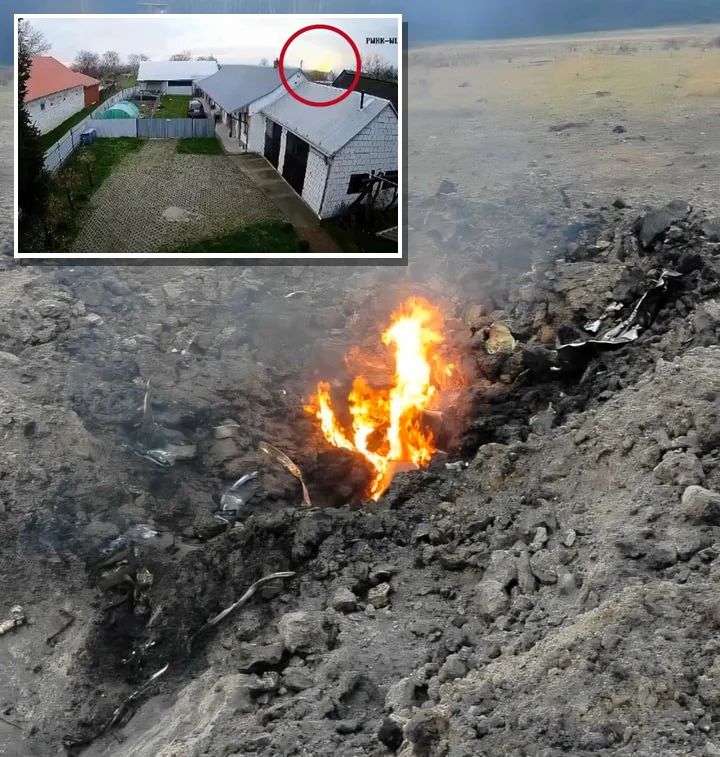
XA post on X by MEP Ewa Zajączkowska-Hernik, published shortly after the incident, with a collage image of a burning impact crater and an inset smoke plume behind a house. The text presents the incident itself and adds residents' reports of missing RCB alerts and sirens that sounded only after objects had hit. The image is an editorial composite with a red annotation circle and a PAP/Remiza.pl credit on the inset.
“Bezpieczeństwo państwa na jednym obrazku. Dwie rakiety i dron spadły dziś na Lubelszczyznę i Podkarpacie, lecąc przez nasze terytorium nawet kilkadziesiąt kilometrów. Mieszkańcy informują, że nie otrzymali wcześniej alertów RCB, syreny zawyły dopiero po zdarzeniu, a sam alert pojawił się kilkadzie…”
“State security in one picture. Two missiles and a drone fell today on the Lublin region and Podkarpacie, flying through our territory for as much as several dozen kilometres. Residents report that they did not receive RCB alerts beforehand, the sirens sounded only after the event, and the alert itself appeared severa…” — translated
Posted on X by Ewa Zajączkowska-Hernik, a Konfederacja member of the European Parliament, shortly after the incident. The collage inset carries a PAP/Remiza.pl credit, indicating a composite of news-agency and fire-service photographs.
Who posted it
XAccount check
Estimates from public signals — account age, posting pattern, audience — not a judgement of the person behind the account, and separate from whether this post is true.
What stood out
- Handle @EwaZajaczkowska is corroborated across many independent outlets as the real X account of Ewa Zajączkowska-Hernik, a sitting Polish MEP (Konfederacja / Nowa Nadzieja; LIBE committee), so the account is genuinely operated by/for a real public figure.
- Timeline is verifiably active and current: Polish media (Do Rzeczy, Konfederacja, Interia) quote X posts from her dated July, September, October and 16–17 November 2026, so the account is live this month, not dormant or a shell.
- Profile metadata supplied is entirely empty (no bio, no follower count, no creation date, not platform-verified), so identity confidence rests on the handle/name match with MEP records rather than on profile signals.
- Reliability as an information source is weak, not because of bot behaviour: Demagog's record of her checked statements is 1 true, 2 false, 5 manipulation, 0 partial truth — predominantly misleading or context-stripped framing.
- Fact-checkers have flagged specific claims: TVP Info rated her 'health education = leftist indoctrination/sexualisation of children' post as false, and Fakenews.pl documented her viral claim about a death at a Wrocław clinic that the prosecutor's office denied.
- Her content is routinely recycled by opaque networks (RT/Ruptly-style amplification of the Mirotvorets 'kill list' episode; French-language channels reposting her 2024 von der Leyen speech in 2026 as if fresh), showing her posts are treated as ready-made partisan material.
- Style is highly emotive and partisan (insults toward ministers, 'Ukraine behaves like a terrorist state'-adjacent framing, anti-Ukraine and anti-EU rhetoric), consistent with an authentic politician account rather than automated posting.
- No evidence found of coordinated inauthentic operation of this specific handle; the risk profile is 'real person, low factual reliability', not 'fake account'.
Signals (10)+
- Identity match
- Confirmed — Polish MEP Ewa Zajączkowska-Hernik (b. 20 Jan 1990, Radom)
- Affiliation
- Konfederacja / Nowa Nadzieja; MEP since 16 July 2024; ESN group until 2026, then Patriots for Europe
- Account live confirmed
- Yes — X posts quoted by media dated 16–17 Nov 2026
- Profile metadata completeness
- None (bio, followers, created_at all null; is_platform_verified false)
- Official records
- European Parliament MEP profile, parltrack.eu entry, own site ewazajaczkowska.pl
- Notable news coverage
- Extensive — Do Rzeczy, Interia, Newsweek Polska, TVP Info, Wikipedia (multiple languages), RT
- Fact check history
- Demagog: 8 statements — 1 true, 2 false, 5 manipulation; TVP Info rated one post 'fałsz'; Fakenews.pl entry on Wrocław clinic claim denied by prosecutors
- Amplification by inauthentic networks
- Her clips re-posted by RT and by anonymous francophone X/Telegram channels without name/date
- Posting style
- High-frequency partisan commentary, personal attacks, emotive framing
- Coordinated inauthentic behavior evidence
- None attributable to the account itself
Account checked November 21, 2026, 03:06 UTC
The media
Image✓ What is genuine
The photographs themselves appear to be genuine news images of a missile impact site and a smoke plume near a house, credited in part to PAP and Remiza.pl. The red circle and collage are added editorial marks.
The tells
- ●●○ Supporting signal The crater, scorched ground and scattered metal debris are physically consistent with a missile impact site and with reports of fire at Nowy Lipowiec.our visual review
- ●●○ Supporting signal The inset carries a news-agency and fire-service credit (PAP/Remiza.pl), which points to ordinary news photography rather than generated imagery.our visual review
- ●●○ Supporting signal No generative tells were visible: structures are not warped, no text is garbled, and perspective and lighting are coherent across the frame.our visual review
- ●○○ Weak signal The red circle and the composite layout are editorial annotation, not evidence of fabricated content.our visual review
Synthetic-media detector
Detector not consultedThe media is incidental to the claim; the detector was not needed.
How we checked the media
- We reviewed the image visually for signs of synthesis or editing: warped structures, garbled text, inconsistent perspective and lighting.
- We compared what the image shows — a burning crater with scattered debris and a smoke plume behind a house — with the reported physical details of the impacts at the three sites.
- We noted the editorial elements: the red annotation circle, the collage layout and the PAP/Remiza.pl credit on the inset.
Sources
10 sources reviewed- 1Rosyjskie obiekty powietrzne wtargnęły do Polski. Szef MON: to nie przypadek ↗
Polska Agencja Prasowa (PAP) · pap.plUntiereduntiered — treated as signal only, never decisiveEvidence
The defence minister names the three impact sites and the object types, including the Kh-101.
- 2Rzeczniczka MSWiA: RCB całą noc było w kontakcie z wojskiem ↗
Polska Agencja Prasowa (PAP) · pap.plUntiereduntiered — treated as signal only, never decisiveEvidence
Gives the minute-level alert, siren and impact sequence at Nowy Lipowiec and Rudnik nad Sanem.
- 3Nie do wszystkich przychodzą lub są opóźnione. Co dalej z alertami RCB? ↗
Polskie Radio Lublin · radio.lublin.plUntiereduntiered — treated as signal only, never decisiveEvidence
Documents that many residents received no RCB alert or a delayed one.
- 4Ataki Rosji blisko Polski. W Lublinie zawyły syreny alarmowe ↗
Kurier Lubelski · kurierlubelski.plUntiereduntiered — treated as signal only, never decisiveEvidence
Reports that in Lublin the sirens sounded before the RCB SMS arrived.
- 5Służby apelują, by nie blokować w telefonach powiadomień z RCB ↗
Portal Samorządowy · portalsamorzadowy.plUntiereduntiered — treated as signal only, never decisiveEvidence
The voivode gives times responding to residents who said they heard the bang before the sirens.
- 6Alarmy po fakcie? Tusk chce wyjaśnień od szefa MSWiA ↗
Bankier.pl (PAP) · bankier.plUntiereduntiered — treated as signal only, never decisiveEvidence
The prime minister asked the interior ministry for an exact account of which alerts reached which areas.
- 7Trzy rosyjskie obiekty spadły w Polsce. RCB i MSWiA dementują plotki ↗
Gazeta.pl · wiadomosci.gazeta.plUntiereduntiered — treated as signal only, never decisiveEvidence
The interior ministry spokeswoman gives alert, siren and impact times and calls claims of no warnings disinformation.
- 8Eksplozje na Lubelszczyźnie i Podkarpaciu. Podsumowujemy fakty ↗
Demagog · demagog.org.plPrimary / fact-checkerIFCN + EFCSN; PolandEvidence
An IFCN and EFCSN fact-checker summarises the confirmed facts and the alert timeline.
- 9Rosyjskie rakiety w Polsce. „Systemy są bardzo poważnie opóźnione” ↗
TOK FM · tokfm.plUntiereduntiered — treated as signal only, never decisiveContext
Places the impacts in Biłgoraj, Nisko and Jarosław counties.
- 10Naruszenie polskiej przestrzeni powietrznej. Pilny apel policji do mieszkańców ↗
Polskie Radio 24 (źródło: Reuters) · polskieradio24.plUntiereduntiered — treated as signal only, never decisiveEvidence
Reuters-sourced reporting confirms two missiles and a jet-powered drone at the three sites, with no casualties.
Further reading
- 8Demagog A fact-check that summarises the confirmed facts of the incident and the alert timeline in one place.
- 3Polskie Radio Lublin Regional reporting that documents the missing and late alerts behind the post's complaint.
- 6Bankier.pl (PAP) Shows that the alert sequence is officially under review, which is central to why the claim is contested.
The full story
During a large Russian missile and drone attack on western Ukraine, three Russian objects crossed into Polish airspace and came down on Polish soil. One fell at Nowy Lipowiec in the Lublin voivodeship; the others at Rudnik nad Sanem and Mołodycz in Podkarpacie. The defence ministry identified one as a Kh-101 cruise missile, said a second was also a missile and the third most likely a jet-powered drone. Nobody was injured and no critical infrastructure was damaged. Prosecutors and military police opened proceedings at the three sites.
Polish officials described the incursion as a deliberate provocation timed to coincide with Coalition of the Willing exercises near Nowa Dęba. Defence minister Władysław Kosiniak-Kamysz said the Kh-101 came down about 50 km from the border, which is why the post's 'several dozen kilometres' felt plausible to readers.
The warning question is where the story becomes genuinely contested rather than invented. The interior ministry published a minute-by-minute timeline stating that RCB alerts and sirens were activated shortly before each impact, and its spokeswoman called claims of no warnings disinformation. At the same time, regional reporting found residents who received no SMS or a late one, and in Lublin the text arrived after the sirens. Prime Minister Donald Tusk asked the interior ministry for an exact account of which alerts reached which areas. That is an official admission that the sequence needs clarifying — not proof that the post's blanket claim is correct.
Kernel of truth
A real airspace violation with three confirmed impact sites. The post's factual core is accurate; its warning-failure framing rests on real but contested resident testimony.
Timeline
November 20, 2026
In the night of 19-20 November, three Russian objects enter Polish airspace and come down at Nowy Lipowiec, Rudnik nad Sanem and Mołodycz. No injuries are reported. 1Polska Agencja Prasowa (PAP)
November 20, 2026
At 02:31 a potential-threat alert is issued; later a 'real threat' alert and sirens are activated minutes before each impact, according to the interior ministry timeline. 2Polska Agencja Prasowa (PAP)
November 20, 2026
Around 6:30 sirens sound in Lublin; the RCB SMS arrives several minutes later, regional reporting says. 4Kurier Lubelski
November 20, 2026
The interior ministry spokeswoman rejects claims of no warnings as disinformation and publishes alert, siren and impact times. 7Gazeta.pl
November 20, 2026
Prime Minister Donald Tusk asks the interior ministry for an exact account of which alerts reached which areas. 6Bankier.pl (PAP)
How it was framed
The post starts from a real, confirmed event and real resident testimony, but frames the warning sequence as a general failure when official times show alerts and sirens before each impact and the sequence is still under review. The image is genuine news photography used with added editorial annotation, so the problem is the framing, not fabrication.
- Missing context. The post reports residents' accounts of missing alerts but does not mention the interior ministry's published times showing alerts and sirens 1-5 minutes before each impact.
- “Visual proof”. The phrase 'Bezpieczeństwo państwa na jednym obrazku' ('State security in one picture') presents the collage as self-evident proof of the argument.
- Selective evidence. It cites residents who got no warning but not the 02:31 potential-threat alert or the documented early-warning sequence.
- Emotional language. The framing of state security and a warning failure carries an alarmist charge beyond the bare facts of the impacts.
Posted on X by Ewa Zajączkowska-Hernik, a Konfederacja member of the European Parliament, shortly after the incident. The image is a collage with a PAP/Remiza.pl credit on the inset. The input contains no outlet rating for the author.
Bias
Leans anti-government / Polish right-wing opposition. The post is by a Konfederacja MEP and frames a genuine security incident as proof of state failure ('Bezpieczeństwo państwa na jednym obrazku'), foregrounding contested resident accounts of missing alerts while omitting the official timeline in which alerts and sirens preceded the impacts. The underlying facts are real, but the selection and framing push an opposition narrative about the government's incompetence on civil defence.
Bias describes how the post frames its message — the slant of the language, selection and emphasis — and is judged separately from whether the claim is true. A true claim can still be framed with a strong slant.
How we checked
1 min 9 s- 1
We searched for reporting on the reported impacts in the Lublin region and Podkarpacie in November 2026.
- 2
We searched for coverage of RCB alerts, sirens and resident complaints after the incident.
- 3
We searched for fact-checks and official statements about the alert sequence and disinformation claims.
- 4
We reviewed the image visually for signs of synthesis or manipulation and compared it with the reported physical details of the impacts.
✓ Claim checked✓ Media checked✓ Sources checked
Why 78% confidence
HighThe event itself is confirmed by multiple independent sources, which supports HIGH confidence. The warning-sequence claim is rated MODERATE because resident testimony and official times genuinely conflict and the prime minister has ordered verification. Overall confidence is 0.78 on a corroboration method.
Limits. We did not open the underlying pages in this pass; our reading rests on the source snippets and search results recorded. We did not run an image-authenticity detector, so the media assessment rests on visual review and the news-agency credit. We could not independently verify a per-area map of which residents received which alert.
What we don’t know
- Exactly how many residents in each affected area received the early warning alert, as opposed to it being sent.
- What the interior ministry's full account to the prime minister will show about the alert sequence.
- The precise flight paths and penetration distances of the second missile and the drone.
- Whether any delay in the RCB SMS was caused by network capacity, an interrupted sending campaign or a decision not to warn earlier.
Spot it yourself
Find the overstatementLooks suspicious, isn’t proof
- The post comes from an opposition MEP and is framed politically. That is a reason to check carefully, not evidence the facts are wrong.
- The image is a collage with a red circle and a truncated caption ending in an ellipsis. Editorial layout and a cut-off sentence are common online and prove nothing about accuracy.
- The alarmist tone ('State security in one picture') may make the claim feel more dramatic than the underlying facts support.
The actual evidence
- Official briefings and wire reporting independently confirm the three impact sites and the object types.
- The interior ministry's minute-by-minute timeline gives alert, siren and impact times that can be checked against resident accounts.
- Regional reporting documents the missing and late alerts that make the post's complaint understandable.
- The prime minister's request for a full account shows the sequence is officially unresolved, which cuts against treating either side's version as final.
- 1
Separate the confirmed event from the framing.
Ask which parts of the post would be reported even by outlets critical of the government. Here the impacts are confirmed by the defence ministry, PAP and Reuters-sourced reporting; the warning failure is not.
- 2
Look for the official timeline before accepting a blanket claim.
Search for the interior ministry or voivode statement with times. If a post says 'only after', compare that with the published alert, siren and impact times.
- 3
Distinguish 'sent' from 'received'.
An alert can be issued and still not reach a phone. Look for reporting on whether messages were missing, delayed or blocked, and on why.
- 4
Check whether officials are still investigating.
If a prime minister or ministry has asked for clarification, treat the question as open rather than settled in either direction.
Takeaway
A post can be right about the event and wrong about the conclusion. Check each sentence against the official record separately, and treat an unresolved official review as a reason to wait, not a reason to pick a side.
Questions people ask
Did two missiles and a drone really fall on Poland in November 2026?+
Yes. Poland's defence and interior ministries, PAP, Reuters-sourced Polskie Radio 24 and regional outlets all report that three Russian objects came down in the night of 19-20 November 2026 at Nowy Lipowiec, Rudnik nad Sanem and Mołodycz. One was identified as a Kh-101 cruise missile. Nobody was hurt and no critical infrastructure was damaged.
Did residents get no RCB alerts before the impacts?+
It is mixed. Regional reporting found many residents received no RCB alert or a late one, and in Lublin the SMS came after the sirens. But the interior ministry's timeline shows 'real threat' alerts and sirens 1-5 minutes before each impact, and the prime minister asked for an exact account. The blanket claim is only partly supported.
Is the image in the post fake?+
It appears to be a collage of genuine news photographs, including an inset credited to PAP/Remiza.pl, with an added red circle. Our visual review found no signs of synthetic generation. The red circle and composite layout are editorial marks, not fabricated content.
What does RCB mean?+
RCB stands for Rządowe Centrum Bezpieczeństwa, Poland's Government Centre for Security. It issues public alerts, including SMS warnings, about threats such as air attacks. The dispute in this case is about when those alerts arrived relative to the impacts, not about what RCB is.
Why does it matter whether the alert came before or after?+
Because the point of an alert is to give people time to react. If sirens and texts came before impact, the system worked as designed even if some phones did not receive the message. If they came after, the system failed to warn in time. The official review is meant to settle which happened where.
Go deeper
- RCB
- Rządowe Centrum Bezpieczeństwa, Poland's Government Centre for Security, which issues public alerts including SMS warnings.
- Kh-101
- A Russian air-launched cruise missile, one of which was identified at the Nowy Lipowiec impact site.
- False context
- When genuine content is shared with information that changes its meaning, such as real photos used to support a misleading conclusion.
- Corroboration
- Confidence built by checking that independent sources describe the same facts, rather than relying on a single source.
People also search for
For educators+
- The post's factual core is accurate but its conclusion is contested. How should a reader decide how much of such a post to share?
- If an alert is issued but does not reach a phone, did the warning system fail? Who should be responsible for explaining that difference to the public?
- Why might an official review, rather than a quick claim, be the right response when the evidence conflicts?
About this check
- Platform
- X
- Posted by
- @ewazajaczkowska
- Posted
- November 20, 2026
- Age when checked
- Under 24 hours old when checked
- Where it spread
- PL
- Audience
- UK & EU audience
- Language
- PL
- Status
- ● Post is live
- Verified
- November 21, 2026, 03:08 UTC
- Published
- November 21, 2026, 03:08 UTC
Reach. 1,101 likes on primary (syndication, 21 Nov); Szłapka rebuttal 866 likes; Interia, Radio Lublin, Polsat cover the alert row; 'alert rcb' and 'alert rcb lublin/podkarpackie' top autocomplete
This verdict was generated with AI from the sources shown. AI can make mistakes — check the sources before relying on it.
Check anything yourself, in seconds.
Share any social post or video to What the Fact and get the verdict, the confidence, and the receipts.