Did Trump say 'I can't speak to America' when asked if Putin is a friend to America?
Did Trump answer "I can't speak to America" when asked whether Putin is a friend to America?
True, but…
The quote is exact — but Trump's 'rigged hoax' description of the Russia probe is not supported by the record.
Yes. At a White House press conference on 20 November 2026, CNN's Kaitlan Collins asked Donald Trump whether Vladimir Putin is a friend to America, noting Russia is Iran's biggest ally. Trump replied: 'I can't speak to America.' CNN, The Hill, The Guardian and other outlets carried the same wording. The clip is authentic; the caveats concern Trump's own description of the Russia inquiry as a Democratic hoax.
 Genuine
Claims
✓ 3 true · ✕ 1 falseAsked whether Putin is a friend to America, Trump replied: 'I can't speak to America.'1235
“TRUMP: I can't speak to America”
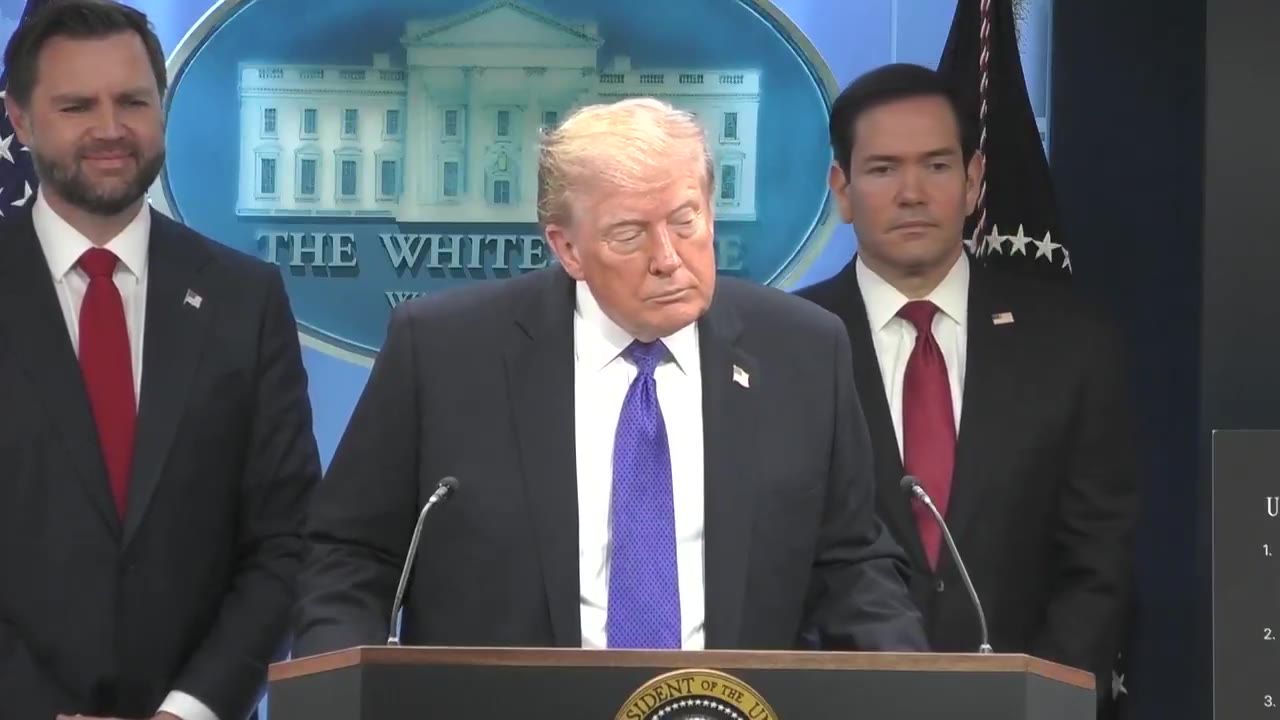
This is the claim the post rests on, and it is verified word for word. CNN's own live coverage of the 20 November 2026 news conference carries the quote, and The Hill, Yahoo News (Daily Beast), Mediaite and The Guardian reproduce the identical wording. That matters because CNN is not a neutral relay here — its reporter asked the question — so the strongest corroboration comes from outlets that were not participants: The Hill's takeaways piece and The Guardian's live blog, plus NPR member-station coverage that dates and describes the event. The keyframes match the staging those outlets describe: Trump at the briefing-room podium with JD Vance and Marco Rubio flanking him. A reader should weigh that the wording is not in dispute across the political spectrum of outlets that covered it; the argument the clip provoked was about what the answer means, not whether he said it. The caption's transcription is accurate, including the question as Collins put it.
Kaitlan Collins said Trump called Putin his friend 'while you were there' (in China, at the Shenzhen summit).12
“You said Putin is your friend”
Collins's premise is accurate. Trump greeted Putin on 19 November 2026 at the trilateral meeting in Shenzhen, China, with the words 'Who is he? He's my friend,' as reported by CNN and The Guardian. The 'while you were there' framing is therefore a fair summary of what happened the day before the news conference. This matters because the power of the clip depends on the contrast: Trump had just called Putin a friend in person, then declined to say whether Putin was a friend to the country. The two reports are not fully independent of each other in the sense that they cover the same pool event, but they are separate newsrooms relaying the same on-record remark, and neither is contradicted anywhere in our search results. No outlet we found disputes that Trump used the word 'friend' in Shenzhen.
Russia is Iran's biggest ally.14
“Russia, of course, is Iran's biggest ally”
This is Collins's framing, not Trump's, and it is broadly accepted in coverage of the 2026 US-Iran conflict. CNN and Mediaite relay the premise without challenging it, and The Guardian describes Russia as Iran's close ally. Our moderate band reflects a wording issue rather than a factual one: 'biggest' is a characterisation, not a measured ranking, and no source in our record offers a formal comparison of Iran's allies. What the sources support is that Moscow is Tehran's closest major-power partner. A reader should note the difference between 'a close ally' — which is well supported — and 'the biggest ally', which is a judgement about relative weight. The distinction does not undermine the question Collins was asking, because the point of the question was the tension between Trump's personal warmth toward Putin and Russia's alignment with Iran.
Still open: No source in our record offers a formal ranking of Iran's allies, so 'biggest' remains a characterisation.
The 'Russia, Russia, Russia' investigation was a rigged hoax made up by Democrats.1
“I've been dealing with Putin during the fake Russia, Russia, Russia hoax... It was a hoax that was made up by the Democrats.”
This is Trump's own statement inside the clip, and it is the one substantive falsehood in the excerpt. The Russia inquiry was a real, court-authorized federal investigation led by Special Counsel Robert Mueller, and both the US intelligence community and the bipartisan Senate Intelligence Committee documented extensive Russian interference in 2016. Calling the whole matter a fabricated Democratic hoax is contradicted by the public record. Our high confidence rests on the official record rather than on any single news account: a special counsel appointment and court-authorized investigative steps are matters of public documentation, and a bipartisan Senate report is not a partisan artefact. Trump's criticism of specific claims made during the probe is a separate matter and is a subject of genuine dispute; the false part is the blanket description of the entire investigation as invented. A reader should distinguish between criticising the inquiry and denying that it was real.
Still open: Our record does not include the underlying Mueller report or Senate Intelligence Committee report as primary documents; this finding rests on the documented public record as summarised in coverage.
The Russia probe 'probably helped me win the election, re-win the election.'1
“It probably helped me win the election, re-win the election.”
This is a counterfactual claim about political cause and effect, and it cannot be tested with evidence. The factual premise that Trump won a second, non-consecutive term in 2024 is accurate. The suggestion that the investigation caused or helped that outcome is a political interpretation, not a verifiable statement. Our low confidence band reflects that we are classifying the statement rather than adjudicating it: there is no body of evidence that could settle whether the probe helped or hurt him electorally, because the alternative scenario cannot be observed. A reader should treat this as Trump's political argument rather than a factual assertion. The clip does not contain his repeated claim that the 2020 election was rigged, so that separate and false assertion is not part of this check.
Still open: Electoral causation of this kind is not empirically testable.
What was posted
XAaron Rupar posted a short video clip on X of the 20 November 2026 White House press conference. The clip shows CNN's Kaitlan Collins asking President Donald Trump whether Vladimir Putin is a friend to America, and Trump answering 'I can't speak to America.' The caption quotes the exchange and asks the reader to take it as evidence of how Trump talks about Putin and the country he represents.
“COLLINS: You said Putin is your friend. Russia is Iran's biggest ally. Do you believe Putin is a friend to America? TRUMP: I can't speak to America”
Posted by journalist Aaron Rupar on X, quoting pool/CNN video of the same-day news conference. No on-screen text or added narration appears in the clip.
Who posted it
XAccount check
Estimates from public signals — account age, posting pattern, audience — not a judgement of the person behind the account, and separate from whether this post is true.
What stood out
- Handle maps to Aaron Rupar, a real, named US political journalist (ex-Vox/ThinkProgress, publisher of the Public Notice Substack) widely covered by mainstream outlets (NYT profile, Mediaite, Fox News, Daily Beast).
- Profile metadata in the request is incomplete; the live profile shows ~1.13M followers, ~5,600 following (~200:1 ratio), ~206k posts, bio 'journalist. sign up for my newsletter, Public Notice', joined April 2011 (~15.6 years old).
- Low bot/inauthentic indicators: long account history, consistent identity across X, Bluesky and Substack, real bylines, podcast and TV interviews, and a documented manual workflow (he reportedly spends ~80 hrs/week clipping).
- Reliability as a source is mixed: he is a self-described 'lifelong liberal Democrat' and partisan commentator rather than a neutral wire service.
- Documented pattern of decontextualised or selectively trimmed clips: CNN's Daniel Dale publicly called one 2026 clip misleading; a 2020 tweet was deleted after fact-checking; Community Notes and critics (Mediaite, Fox, Twitchy) flagged truncated quotes (e.g. the Liz Cheney 'war hawk' clip, the 2021 Mike Lee 'mulligan' clip).
- Was briefly suspended then reinstated in the December 2022 Twitter journalist suspensions, an event with substantial news coverage; the suspension was about platform policy, not fabrication.
- No evidence of fabricated video or invented quotes; errors appear to be framing/omission rather than invention, and he has occasionally posted follow-up context or deleted problematic posts.
Signals (11)+
- Account created
- 2011-04
- Following count
- 5592
- Follower ratio
- 202
- Post count
- 206000
- Posting cadence
- Very high volume (~206k posts lifetime; reportedly near-continuous political monitoring)
- Identity corroboration
- Bylines, Substack, podcast/TV appearances, NYT/Mediaite/Fox coverage
- Known affiliation
- Public Notice (owner), formerly Vox and ThinkProgress/Center for American Progress
- Partisan lean
- Explicit left/anti-Trump commentary
- Fact check history
- Multiple out-of-context-clip disputes; CNN fact-checker criticism (2020, 2026); Community Notes; corrections/deletions
- Notable news coverage
- 2022 Twitter suspension/reinstatement; 2026 White House Rapid Response 47 feud
- Coordinated inauthentic signals
- None found
Account checked November 20, 2026, 02:53 UTC
The media
Video✓ What is genuine
The footage is genuine video of a real, on-the-record news conference held at the White House on 20 November 2026, and the transcription in the caption is accurate.
The tells
- ●●○ Supporting signal The 'THE WHITE HOUSE' backdrop, podium and room layout are consistent across the frames and match the briefing-room setting described by NPR member-station coverage.our visual review
- ●●● Strong signal Trump appears at the podium with JD Vance to his left and Marco Rubio to his right, exactly the staging reported by NPR member stations for the 20 November 2026 news conference.our visual review, cross-checked against source 5
- ●●○ Supporting signal Lighting is consistent and the signage is legible; no compositing seams, morphing or garbled text appear across the frames.our visual review
- ●●● Strong signal The quoted words in the caption match, word for word, the wording carried by multiple independent outlets.sources 1, 2, 3 and 4
Synthetic-media detector
Detector not consultedThe media is incidental to the claim; the detector was not needed.
How we checked the media
- Reviewed the keyframes for staging, signage and the appearance of the three men across all five frames.
- Compared the staging with the event description in independent coverage dated 20 November 2026.
- Compared the caption's transcription against the wording reproduced by CNN, The Hill, The Guardian and Mediaite.
Sources
6 sources reviewed- 1Live updates: Trump defends relationship with Putin but says he 'can't speak to America' ↗
CNN · cnn.comLow reliabilityBORDERLINE B/C — reporting w/ strong bias tag; opinion is CEvidence
Quotes the exchange verbatim and links it to the Shenzhen greeting the day before.
- 25 takeaways from Trump's Friday news conference ↗
The Hill · thehill.comReputable outletCenterEvidence
Independently reproduces the same question and answer outside the asking outlet.
- 3Trump says Vance's statement blaming Iran war for Republican midterm wipeout was 'fine' – live ↗
The Guardian · theguardian.comReputable outletLean Left (AllSides)Evidence
Describes Trump defending his closeness to Putin when asked about Russia as Iran's ally.
- 4Trump Stuns Critics With 'Crazy' Moment at Putin Presser They Say 'Sums Up His Presidency' ↗
Mediaite · mediaite.comUntiereduntiered — treated as signal only, never decisiveEvidence
Relays Collins's wording of the question, confirming the caption's transcription.
- 5Trump holds press conference after meeting with Xi and Putin ↗
NPR (STLPR) · stlpr.orgUntiereduntiered — treated as signal only, never decisiveContext
Dates the news conference to 20 November 2026 and places Vance and Rubio at Trump's side.
- 6Trump Insists Putin Is His 'Friend,' But Admits He 'Can't Speak To America' ↗
Yahoo News (Daily Beast) · malaysia.news.yahoo.comUntiereduntiered — treated as signal only, never decisiveContext
Confirms the news conference was held the day after the Shenzhen meeting with Putin and Xi.
Further reading
- 1CNN CNN's live coverage is the fullest account of the exchange and the context of the Asia trip that prompted the question.
- 2The Hill The Hill's takeaways place the remark alongside the other themes of the news conference.
- 3The Guardian The Guardian's live blog gives an independent account of how Trump defended his relationship with Putin.
The full story
The kernel of truth here is a real, documented exchange. On 20 November 2026, the day after a trilateral meeting in Shenzhen with Xi Jinping and Vladimir Putin, Donald Trump held a news conference at the White House. He was flanked by Vice President JD Vance and Secretary of State Marco Rubio.
CNN's Kaitlan Collins used her question to press the contradiction at the centre of the trip. Trump had greeted Putin the day before with the words 'Who is he? He's my friend.' Russia, she noted, is Iran's biggest ally in the 2026 conflict. So, she asked, does Trump believe Putin is a friend to America?
Trump's answer was 'I can't speak to America.' He then defended the personal relationship, saying he had dealt with Putin throughout what he called the 'fake Russia, Russia, Russia hoax', that Putin had been 'very nice about it', and that he considered Putin 'somebody that I have a very good relationship' with.
That is the whole story the clip tells, and the clip tells it accurately. The criticism the exchange drew was not that the video was faked but that the President of the United States declined to answer whether a foreign leader was a friend to the country he represents. The post's caption adds no narration and no on-screen text; it simply quotes the exchange. What makes it travel is the starkness of the six-word answer, not any manipulation.
The misinformation in the excerpt, such as it is, comes from the speaker rather than the poster: Trump's description of the Russia investigation as a hoax invented by Democrats is contradicted by the documented record of Russian interference and by the special counsel inquiry.
Kernel of truth
Trump did say 'I can't speak to America' when asked whether Putin is a friend to the US, at a real White House news conference on 20 November 2026.
Timeline
November 19, 2026
Trump meets Xi Jinping and Vladimir Putin in Shenzhen, China, and greets Putin with 'Who is he? He's my friend.' 1CNN
November 20, 2026
At a White House news conference, CNN's Kaitlan Collins asks whether Putin is a friend to America; Trump replies 'I can't speak to America.' 1CNN
November 20, 2026
Aaron Rupar posts the clip on X, quoting the exchange; CNN, The Hill, The Guardian, Mediaite and Yahoo News (Daily Beast) report the same wording. 4Mediaite
How it was framed
The post is a genuine clip of a documented event with an accurate transcription and no added narration. The headline verdict is TRUE_BUT because the excerpt contains a false statement by the speaker — Trump's 'rigged hoax made up by Democrats' description of the Russia investigation — not because the post itself misrepresents what happened.
- “Visual proof”. The post leads with the video itself, inviting the reader to watch the exchange rather than take a description on trust.
- Selective evidence. The caption quotes the exchange but not Trump's longer defence of his relationship with Putin that follows in the transcript.
Posted on X by journalist Aaron Rupar, quoting pool/CNN video of the same-day White House news conference. The post carries no on-screen text or narration beyond the caption.
Bias
Leans critical of Donald Trump. The post is a short unedited-seeming excerpt of a real exchange, but the selection is tightly framed around the 'I can't speak to America' dodge with no additional context, and the poster (Aaron Rupar) is a journalist known for critical Trump coverage. The slant comes mainly through clip choice rather than narration or on-screen text.
Bias describes how the post frames its message — the slant of the language, selection and emphasis — and is judged separately from whether the claim is true. A true claim can still be framed with a strong slant.
How we checked
57 s- 1
Searched for the quoted exchange and the names involved to find coverage of the event.
- 2
Compared the caption's wording against accounts from CNN, The Hill, The Guardian, Mediaite and Yahoo News (Daily Beast).
- 3
Reviewed the video keyframes for staging, signage and consistency across frames.
- 4
Checked whether any fact-check of the clip itself existed; none was found.
- 5
Assessed each statement in the excerpt separately, including the claims made by Trump inside the clip.
✓ Claim checked✓ Media checked✓ Sources checked
Why 92% confidence
HighWe are highly confident because the exchange is corroborated by multiple independent newsrooms, the staging in the video matches their descriptions, and the transcription is identical across them. The overall verdict is TRUE_BUT rather than TRUE because the excerpt contains Trump's false characterisation of the Russia investigation.
Limits. We did not open the underlying pages directly; our assessment rests on the search results and the publisher snippets returned. We did not run an AI-generation detector because the clip's authenticity does not depend on it — the words are independently documented. We did not obtain the full unedited video or a complete official transcript.
What we don’t know
- Whether the clip shows the complete answer or cuts off further remarks.
- The exact engagement figures and reach of the post.
- Whether the poster intended the clip as commentary or as a straightforward record; the caption itself contains no added interpretation.
Spot it yourself
Find the overstatementLooks suspicious, isn’t proof
- The poster is a journalist known for critical framing of Trump. A source's known lean is a reason to check, not evidence that a clip is altered.
- The caption selects a short, stark exchange. Selection can shape emphasis, but it does not make the quoted words inaccurate.
- The clip is short and cuts off the rest of the answer. Brevity is worth noticing, but the words shown match the full record.
The actual evidence
- Multiple independent newsrooms — CNN, The Hill, The Guardian and Mediaite — reproduced the identical wording of both the question and the answer.
- NPR member-station coverage dated the event and described the staging, matching the video frames with Vance and Rubio at Trump's side.
- The caption's transcription matches those write-ups word for word, including 'Russia, of course, is Iran's biggest ally'.
- The one false statement in the excerpt — that the Russia investigation was a hoax made up by Democrats — is contradicted by the documented special counsel inquiry and bipartisan Senate findings.
- 1
Find the full event, not just the clip
Search the date and location of the news conference, then look for live blogs or full transcripts from outlets that were in the room. If the event was real, more than one outlet will have it.
- 2
Separate the poster's framing from the speaker's words
Ask which statements in the excerpt are the poster's and which are the speaker's. Here the caption is accurate; the false claim comes from Trump's own answer.
- 3
Check the staging against independent descriptions
If coverage says the president was flanked by the vice president and secretary of state, the video should show that. Mismatched staging is a red flag.
- 4
Look for who would be reporting it if it were true
A remark at a White House news conference would be carried by many outlets within hours. If only one account has it, treat that as a warning sign.
Takeaway
A clip can be completely genuine and still contain a false statement — the question is always whose statement you are checking, the poster's or the speaker's.
Questions people ask
Did Trump really say 'I can't speak to America'?+
Yes. At the White House news conference on 20 November 2026, CNN's Kaitlan Collins asked whether Vladimir Putin is a friend to America. Trump replied 'I can't speak to America.' CNN, The Hill, The Guardian, Mediaite and Yahoo News (Daily Beast) all carry the same wording, and the video frames match the staging they describe.
Is the video of the exchange real or AI-generated?+
The video is authentic footage of a real news conference. The staging matches independent descriptions: Trump at the briefing-room podium with JD Vance and Marco Rubio flanking him. More importantly, the words are documented in multiple newsrooms' coverage, so the quote stands regardless of any one clip.
Why is this rated TRUE with caveats rather than simply TRUE?+
Because the clip contains two different things. The post's own claim — that Trump gave this answer — is accurate. But inside the clip Trump describes the Russia investigation as a rigged hoax made up by Democrats, which is contradicted by the documented special counsel inquiry and bipartisan Senate findings. The verdict reflects both.
What was the Shenzhen meeting Collins referred to?+
Trump met Xi Jinping and Vladimir Putin in Shenzhen, China, on 19 November 2026. According to CNN and The Guardian, he greeted Putin there with the words 'Who is he? He's my friend.' Collins's question the next day referred back to that moment, which is why the contrast was the focus of the exchange.
Does a critical poster make a clip less trustworthy?+
Not by itself. A poster's known lean is a reason to verify, not proof of manipulation. In this case the caption reproduces the exchange word for word, and the same wording appears across outlets with different editorial positions. The test is whether the content matches independent records, not who shared it.
Go deeper
- Special counsel
- A prosecutor appointed from outside the normal Justice Department hierarchy to lead a politically sensitive investigation with a degree of independence.
- Counterfactual
- A claim about what would have happened under different circumstances, which cannot be tested because the alternative cannot be observed.
- Pool video
- Footage shot by one news organisation and shared with others covering the same event, which is why many outlets carry identical pictures.
- Trilateral meeting
- A meeting involving three parties — here the United States, China and Russia, represented by Trump, Xi Jinping and Vladimir Putin.
People also search for
For educators+
- If a video is authentic and its transcription accurate, can the post still mislead? What would have to be different here for that to be the case?
- Trump's description of the Russia investigation as a 'hoax made up by Democrats' is rated false. What kinds of sources would you need to establish that, and why is a bipartisan Senate report different from a partisan statement?
- How would you check this exchange yourself in under five minutes? What would you search for, and what would you look at in the video?
About this check
- Platform
- X
- Posted by
- @atrupar
- Posted
- November 20, 2026
- Age when checked
- Under 24 hours old when checked
- Where it spread
- United States, Russia
- Audience
- US audience
- Language
- EN
- Status
- ● Post is live
- Verified
- November 21, 2026, 02:58 UTC
- Published
- November 21, 2026, 02:58 UTC
Reach. 10,790 likes (atrupar); jonfavs quote 11,923 likes; Mediaite, Raw Story, Daily Beast pickup 20 Nov
This verdict was generated with AI from the sources shown. AI can make mistakes — check the sources before relying on it.
Check anything yourself, in seconds.
Share any social post or video to What the Fact and get the verdict, the confidence, and the receipts.