Is Israel's oil burning now after Iran's retaliation?
Does a viral video show Israeli oil storage facilities burning after Iranian retaliatory strikes in November 2026?
True, but…
Real Haifa refinery fires are documented, but this specific footage is unverified and unplaceable.
Fires at Israel's Bazan refinery in Haifa were reported after Iranian missile fire in mid-November 2026, so the core claim has a real basis. But this 17-second clip cannot be geolocated or dated to Haifa, and near-identical 'Haifa refinery' videos have been traced by AFP and Maldita to Yemen, Iran, China, Russia and Mexico.
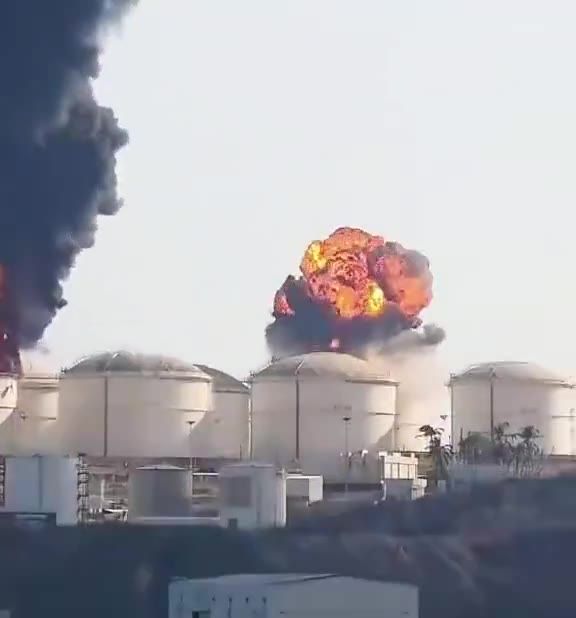 Likely genuine
Claims
3 checkedIsrael's oil is burning now — the footage shows an Israeli oil facility ablaze.14567
“Israel's oil is burning now.”
The underlying event is real: dated reporting confirms fires at Israel's Bazan refinery in Haifa after Iranian missile fire in mid-November 2026. VTV reported a missile strike on the refinery that killed three employees and caused a fire, and Daily Jang reported debris from an intercepted missile hitting the refinery, damaging an industrial building and a fuel tanker. That is enough to say Israel's oil infrastructure did burn. What is not established is that this clip shows it. The video's two camera positions — one at ground level near tanks, one from a vessel's deck — suggest a spliced compilation rather than a single continuous recording. More importantly, the same genre of oil-terminal footage has been repeatedly debunked: AFP traced a viral 'Haifa refinery' clip to Yemen's Haziz power plant, Maldita geolocated another to the same Yemeni site, and AFP's Arabic service found a claimed Haifa blaze was a 2015 firefighting drill in China. The sources confirming the event are state broadcasters and wire-derived outlets, largely reporting official claims; the fact-checkers are the stronger, independent evidence here, and they point to caution about the footage.
Still open: Whether the clip was filmed at Haifa at all, and if so on what date, remains unresolved. No original upload with a timestamp has been found.
Iran retaliated twice as hard within 24 hours of actions taken against it by Israel and the United States.123
“Iran retaliates twice as hard within 24 hours of the actions taken against it by Israel and the United States.”
Iran did launch waves of missiles at Israel within roughly a day of Israeli strikes in mid-November 2026. AP reported missiles fired late Friday and early Saturday after Israeli strikes, with sirens and explosions over Jerusalem and Tel Aviv. The Council on Foreign Relations newsletter dated 16 November 2026 covers Iranian retaliation against regional targets and energy infrastructure. So the timing element of the claim is broadly supported. 'Twice as hard' is not a measurable statement. The damage assessments in the reporting describe a localised blaze — a fuel tank or tanker ignited by missile or interceptor debris, with the refinery's production units reported safe — not a doubling of intensity. The phrase is rhetorical framing added to a real event. Readers should treat the retaliation as confirmed and the 'twice as hard' comparison as the poster's characterisation, not a finding.
The explosion in the clip is not a drone.
“不是无人机”
The Chinese-language line comes from unidentified bystanders watching the blast, not from an official assessment or a technical analyst. One person asks whether the explosion was a drone; another answers that it was not. This is casual speculation in the moment, not a checkable factual statement about the incident. It does not tell us what caused the fire, where the footage was filmed or whether it relates to Haifa. We include it because it is audible in the clip and because it shows the footage has an audio track of real people reacting, which is consistent with genuine camera work. It carries no evidentiary weight for the central claim.
What was posted
XAn anonymous war-updates account on X posted a short video with a breaking-news caption, asking readers to believe it shows Israeli oil infrastructure burning in the immediate aftermath of Iranian retaliation. The clip has two shots: a close view of white storage tanks erupting in a fireball, then a handheld view from a vessel's mooring deck across water at a tank farm with two heavy smoke columns. Bystanders speaking Chinese can be heard asking whether the blast was a drone.
“🚨 Breaking: Israel's oil is burning now. Iran retaliates twice as hard within 24 hours of the actions taken against it by Israel and the United States. 🚀💥🔥🇮🇷🇮🇱🇺🇸”
Posted on X by an account whose handle and display name frame it as a war-updates feed. The post carries no location, date or source credit for the footage.
Who posted it
XAccount check
Estimates from public signals — account age, posting pattern, audience — not a judgement of the person behind the account, and separate from whether this post is true.
What stood out
- Account @IranWar_tv ('Iran War Updates') is an anonymous, non-verified aggregator with no named operator, newsroom or masthead; bio just promises 'real-time coverage of Iran's military activities'.
- Profile page shows 5,260 posts of highly formulaic output: nearly every item is a '🚨BREAKING | IRGC: ...' statement-style post stuffed with rocket/fire emojis and attached video, the exact template DW Fact Check (14 Nov 2026) identified as content-farm behaviour.
- Posts attribute quotes to the IRGC without links, documents, named spokespeople or dateable sourcing; several carry casualty specifics (e.g. 'at least 53 soldiers killed, 327 injured') with no attributable source.
- Fits the pro-Iran aggregator ecosystem described by ISD/NewsGuard (AI-generated or repurposed footage, exaggerated Iranian military capability, engagement-farming for X payouts); no fact-checker has vetted or endorsed it, and it has no correcting/retraction record.
- Handle-name cluster suggests copycat branding rather than a single newsroom: near-identical 'Iran War Updates' accounts exist (@IranWar24, @irantvv), a pattern ISD flagged as networked cross-promotion.
- Reach comes from virality, not reliability: a Trump-'dozing at APEC' post with laughing-emoji framing was picked up and quoted by Latvian outlet jauns.lv (19 Nov 2026), i.e. recycled UGC presented as war news.
- No follower count, verification badge, creation date or self-identifying geography could be confirmed — typical of disposable/rebrandable engagement accounts (cf. 'Iranian Force', which X listed in Pakistan after six username changes).
- Bias profile: one-sided pro-Iran framing, amplifying IRGC claims of invulnerability while omitting contradicting information, consistent with coordinated influence-style content rather than journalism.
- Behavioural cadence (dozens of near-identical emoji-formatted posts per day, cross-posted to parallel handles) indicates semi-automated scheduling or a coordinated posting team; not enough evidence to call it a pure bot.
Signals (12)+
- Platform
- Handle
- Iranwar_tv
- Display name
- Iran War Updates
- Follower ratio
- Unknown
- Post count
- 5260
- Posting cadence
- Multiple near-identical 'BREAKING | IRGC' posts per day, template-driven with emoji and attached video
- Sourcing practice
- None/self-referential; no links to named outlets, officials or documents
- Content type
- IRGC statements, AI/looped-looking military video, recycled user-generated clips
- Framing bias
- Pro-Iran, one-sided military-capability amplification
- Handle cluster
- @IranWar_tv; @Iran_War24; @iran_tvv
- Fact check history
- Not individually named in DW Fact Check (Nov 2026) but matches the content-farm profile it documents; NewsGuard/ISD document 165 false Iran-war claims and pro-Iran networks with 353M views
- Notable news coverage
- Viral 'Trump dozing at APEC' post republished by jauns.lv, 19 Nov 2026
Account checked November 22, 2026, 15:05 UTC
The media
Video✓ What is genuine
The footage itself appears to be real camera work showing a genuine oil-terminal fire. It is not AI-generated and not a deepfake. What is not genuine is the claim that it was filmed at Haifa in November 2026: the clip carries no location, date or source credit, and the same visual genre has repeatedly been misattributed.
The tells
- ●●● Strong signal The fireball and rolling black smoke behave like real combustion; tank scale, palm trees and lighting are consistent across frames.our visual review
- ●●● Strong signal The second shot is filmed handheld from a vessel's mooring deck, with bollards marked 5KN / SWL 5t, ropes and ramp structures visible — plausible maritime hardware.our visual review
- ●●● Strong signal No synthetic artefacts, morphing, impossible geometry or garbled text appear; the detector scored AI generation at 0.02 and deepfake at 0.0.our detector
- ●●○ Supporting signal The clip cuts between two distinct camera positions — ground level near tanks, then a vessel deck — which suggests a spliced compilation rather than one continuous recording.our visual review
- ●○○ Weak signal The audio is Chinese-speaking bystanders, which does not fit an Israeli oil facility but is not by itself proof of anything.our visual review
Synthetic-media detector
Detector ranThe claim stands or falls on whether the media is real, so the detector ran.
Scores are the detector’s estimate for the file as uploaded. A low score does not rule out editing, a spliced caption, or footage shown out of context — those are judged above. Model v3.
How we checked the media
- Our media detector (Hive v3) analysed the video and found no sign of AI generation or deepfake manipulation: the 'not AI generated' class scored 0.9999 and the deepfake score was 0.0.
- We reviewed the footage frame by frame for visual consistency: fireball physics, smoke behaviour, lighting, camera motion and signage.
- We searched for the event the post describes and for existing fact-checks of similar 'Haifa refinery' footage.
- We compared the clip's visual details with published fact-checks that geolocated near-identical videos to other locations.
Sources
7 sources reviewed- 1Iran không kích Israel: Iran không kích nhà máy lọc dầu lớn nhất Israel, 3 người thiệt mạng ↗
VTV · vtv.vnUntiereduntiered — treated as signal only, never decisiveEvidence
Reports an Iranian missile struck Israel's largest refinery in Haifa, killing three employees and causing a fire.
- 2Iran retaliates to Israeli strikes by waves of missiles ↗
Ahram Online (AP) · english.ahram.org.egUntiereduntiered — treated as signal only, never decisiveEvidence
AP reporting establishes Iran launched waves of missiles at Israel after Israeli strikes in mid-November 2026.
- 3Across the Globe: widening of the US and Israel's war with Iran ↗
Council on Foreign Relations · link.cfr.orgUntiereduntiered — treated as signal only, never decisiveContext
A dated newsletter covers the widening US-Israel war with Iran and Iranian retaliation against energy infrastructure.
- 4ایران نے اسرائیل میں حیفہ آئل ریفائنری کو ایک بار پھر نشانہ بنادیا، آگ بھڑک اٹھی ↗
Daily Jang · jang.com.pkUntiereduntiered — treated as signal only, never decisiveEvidence
Reports debris from an intercepted missile hit the Haifa refinery, damaging a building and a fuel tanker and causing a fire.
- 5Video shows fire at power plant in Yemen, not Israel refinery hit by Iran ↗
AFP Fact Check · factcheck.afp.comPrimary / fact-checkerIFCN + EFCSN; wire-backedEvidence
AFP traced a viral 'Haifa refinery on fire' clip to the Haziz power plant in Yemen.
- 6No, este vídeo no muestra la central eléctrica del Grupo Bazan en Haifa ↗
Maldita.es · maldita.esPrimary / fact-checkerIFCN + EFCSN; SpainEvidence
Maldita geolocated a viral Haifa refinery fire video to the Haziz power station in Yemen.
- 7هذا الفيديو مصوّر في الصين عام 2015 وليس لاستهداف إيران مصفاة نفط في حيفا ↗
AFP Fact Check (Arabic) · factcheckarabic.afp.comReputable outletwire — CenterEvidence
AFP's Arabic service found a video posted as a Haifa refinery blaze shows a 2015 firefighting exercise in Chengdu, China.
Further reading
- 5AFP Fact Check AFP's geolocation of a viral 'Haifa refinery' clip to Yemen's Haziz power plant shows how the same footage gets recycled.
- 6Maldita.es Maldita's Spanish-language fact-check walks through the geolocation step by step.
- 7AFP Fact Check (Arabic) AFP's Arabic service traced another claimed Haifa blaze to a 2015 firefighting drill in China.
- 2Ahram Online (AP) AP's reporting establishes the missile exchange that forms the real background to the post.
The full story
The kernel of truth here is that Israel's oil infrastructure did catch fire. In mid-November 2026, Iran launched waves of missiles at Israel after Israeli strikes, as AP reported. Fires broke out at the Bazan refinery complex in Haifa. Reporting from VTV and Pakistan's Daily Jang describes a localised blaze — a fuel tank or tanker ignited by a missile or by debris from an intercepted missile — with the refinery's production units reported safe.
That is a real event, and it is why the post feels plausible. A major refinery fire during a missile exchange is exactly the kind of thing that would be filmed, shared and reported. The problem is the footage. The clip has no location tag, no date and no source credit. Its two camera positions suggest it was assembled from more than one recording. And the 'Haifa refinery on fire' genre has a documented history of recycling: AFP traced a viral clip to Yemen's Haziz power plant, Maldita geolocated another to the same site, and AFP's Arabic service found a claimed Haifa blaze was a 2015 firefighting drill in China. None of that proves this particular clip is recycled, but it means the footage cannot be taken as proof of the caption. The event is confirmed; the video is not.
Kernel of truth
Iranian missile fire did cause fires at Israel's Bazan refinery in Haifa in mid-November 2026, but the damage reported was localised rather than a catastrophic multi-tank conflagration.
Timeline
November 13, 2026
Israeli strikes on Iran; Iran begins launching waves of missiles at Israel late Friday and early Saturday, per AP. 2Ahram Online (AP)
November 15, 2026
Fires reported at Israel's Bazan refinery in Haifa after Iranian missile fire; VTV reports three employees killed. 1VTV
November 16, 2026
Council on Foreign Relations newsletter covers the widening US-Israel war with Iran and Iranian retaliation against energy infrastructure. 3Council on Foreign Relations
How it was framed
The footage appears to be genuine video of an oil-terminal fire, but it is presented with a specific location and timeframe — Haifa, Israel, 'now' — that cannot be verified and that matches a documented pattern of misattributed fire videos. The post also uses real events (Iranian retaliation, Haifa refinery fires) to frame the clip as proof of a larger conflagration than reporting describes.
- Emotional language. "Israel's oil is burning now" and "retaliates twice as hard" use dramatic, urgent wording.
- Urgency. The post opens with a siren emoji and "Breaking", framing the clip as immediate and time-sensitive.
- “Visual proof”. The video is presented without a source credit as direct evidence of the claim.
- Missing context. No location, date or original uploader is given for the footage.
- Us vs. them. The caption sets Iran against Israel and the United States with flag emojis and the phrase "actions taken against it".
Posted on X by an account whose handle and display name present it as a war-updates feed. The post carries no byline, no location tag and no source credit for the footage.
Bias
Leans pro-Iran / anti-Israel-United States. The post comes from an anonymous 'Iran War Updates' feed that frames an Iranian retaliatory barrage as a devastating success ('retaliates twice as hard', 'Israel's oil is burning now') using dramatic unverified footage, a framing aligned with Iranian state messaging.
Bias describes how the post frames its message — the slant of the language, selection and emphasis — and is judged separately from whether the claim is true. A true claim can still be framed with a strong slant.
How we checked
1 min 30 s- 1
We searched for reporting on the event the post describes: Iranian retaliation and fires at Israel's Haifa refinery in November 2026.
- 2
We searched for existing fact-checks of similar 'Haifa refinery' footage.
- 3
We reviewed the video visually for consistency, camera motion, signage and physics.
- 4
We ran the video through our media detector (Hive v3) to check for AI generation and deepfake manipulation.
✓ Claim checked✓ Media checked✓ Sources checked
Why 50% confidence
ModerateWe set confidence at MODERATE rather than HIGH because the underlying event is well documented by multiple outlets, but the specific clip cannot be geolocated or dated, and the same genre of footage has a documented history of misattribution. The detector's strong result on authenticity supports the footage being real, not the caption being correct.
Limits. We could not find the original upload of this clip, so we cannot confirm where or when it was filmed. We did not open the pages listed in the search results because the input records no pages opened; our assessment rests on the search results, the source snippets and our visual review. We did not independently geolocate the footage.
What we don’t know
- Where and when this specific clip was filmed.
- Whether the clip was assembled from more than one recording.
- Who first uploaded the clip and with what caption.
- The exact scale of the Haifa refinery damage beyond the localised blaze described in reporting.
Spot it yourself
Find the overstatementLooks suspicious, isn’t proof
- The account is anonymous and frames itself as a war-updates feed, which can signal a partisan or aggregator account — but anonymous accounts sometimes share real footage, so this is a reason to check, not proof.
- The caption is alarmist and uses siren and explosion emojis, which is a style choice, not evidence.
- The audio is in Chinese, which does not fit an Israeli oil facility — but bystander language alone does not prove the clip is from elsewhere.
- The clip has two different camera positions, which could be a compilation — compilations are common in news coverage too.
The actual evidence
- Dated reporting from VTV, Daily Jang and AP confirms the underlying event: Iranian missile fire caused fires at the Haifa refinery in mid-November 2026.
- Wire-derived coverage describes a localised blaze — a fuel tank or tanker ignited by missile or interceptor debris — not the multi-tank conflagration the opening frames suggest.
- AFP and Maldita have repeatedly debunked near-identical 'Haifa refinery' videos, tracing them to Yemen's Haziz power plant, a 2015 Chinese firefighting drill, Russia and Mexico.
- The clip itself carries no location, date or source credit, so it cannot be tied to Haifa or November 2026.
- Our detector found no sign of AI generation or deepfake manipulation, so the footage is likely real — but real footage can still be mislabelled.
- 1
Check whether the event is being reported by major outlets.
If a refinery fire during a missile exchange were as large as the caption implies, wire services and international broadcasters would be reporting it. Search the event, not the video.
- 2
Look for a location and date in the footage.
Check for signs, license plates, landmarks or a visible timestamp. A vessel deck with mooring bollards tells you the camera is on a ship, not where the ship is.
- 3
Run a reverse image search on a still from the clip.
Screenshot a distinctive frame — the fireball or the smoke columns — and search it. If the same frame appears in older fact-checks or on other dates, the clip is recycled.
- 4
Check what fact-checkers have already found about similar clips.
Search 'Haifa refinery fire video fact check'. AFP and Maldita have published geolocations of near-identical footage.
- 5
Separate the event from the footage.
Ask: is the claim that the event happened, or that this video shows it? The first can be true while the second is unproven.
Takeaway
Real footage of a real event can still be mislabelled with the wrong place or date. Confirm the event through reporting, then ask whether the specific clip has been tied to that place and time.
Questions people ask
Did Iran really set fire to Israel's Haifa refinery?+
Yes, fires at the Bazan refinery in Haifa were reported after Iranian missile fire in mid-November 2026. VTV reported a missile strike killed three employees and caused a fire, and Daily Jang reported debris from an intercepted missile damaged a building and a fuel tanker. The damage described was localised, not a catastrophic tank-farm conflagration.
Is the video of Israel's oil burning real?+
The footage appears to be genuine camera work of an oil-terminal fire — our detector found no sign of AI generation or deepfake manipulation. But the clip cannot be geolocated or dated to Haifa, and near-identical 'Haifa refinery' videos have been traced by AFP and Maldita to Yemen, China, Russia and Mexico.
What does 'retaliates twice as hard' mean?+
It is a rhetorical phrase, not a measurable claim. Iran did launch waves of missiles at Israel within roughly a day of Israeli strikes, as AP reported. But damage assessments describe limited, localised damage, not a doubling of intensity. Treat the retaliation as confirmed and 'twice as hard' as the poster's characterisation.
Why do old fire videos get recycled during wars?+
Dramatic fire footage is visually compelling and hard to verify quickly, so it spreads fast during breaking news. Fact-checkers have repeatedly found the same oil-terminal clips relabelled for different conflicts. The footage can be real while the caption is wrong — which is why the location and date matter as much as the flames.
How can I tell if a war video is mislabelled?+
Check whether major outlets are reporting the specific event the clip claims to show, look for location clues in the frame, reverse image search a distinctive still, and search for existing fact-checks. Separate the question 'did the event happen?' from 'does this video show it?' — the first can be true while the second is unproven.
Go deeper
- False context
- When genuine content — a real photo or video — is shared with incorrect information about where, when or what it shows.
- Geolocation
- The process of identifying where a photo or video was filmed by matching visible landmarks, signage or terrain to known locations.
- Deepfake
- A video or audio recording that has been digitally manipulated, often with AI, to make someone appear to say or do something they did not.
- Kernel of truth
- The real fact or event that a misleading claim is built on or distorts.
- Provenance
- The origin and history of a piece of media — who first uploaded it, when and where.
People also search for
For educators+
- The Haifa refinery fire really happened. Does that make the post true? Where should the line be drawn between the event and the footage?
- AFP and Maldita found near-identical clips from Yemen and China. What does that tell you about how viral footage travels during conflicts?
- If you were an editor, what information would you need before publishing this clip?
About this check
- Platform
- X
- Posted by
- @iranwar_tv
- Posted
- November 21, 2026
- Age when checked
- Under 24 hours old when checked
- Where it spread
- Israel, IR, OM
- Audience
- International audience
- Language
- EN
- Status
- ● Post is live
- Verified
- November 22, 2026, 15:07 UTC
- Published
- November 22, 2026, 15:07 UTC
Reach. Low on individual posts: @GMCNews24 (13 Nov) 175 likes; reposted 21 Nov by @Iran_War24 (13 likes) and @IranWar_tv (20 likes) (X syndication, 22 Nov); Kashif fact-check 22 Nov
This verdict was generated with AI from the sources shown. AI can make mistakes — check the sources before relying on it.
Check anything yourself, in seconds.
Share any social post or video to What the Fact and get the verdict, the confidence, and the receipts.