Was the second ship hit off Benghazi the Ascalon that left Baltiysk?
Was the second ship hit by sea drones near Benghazi on 22 Nov the Ro-Ro vessel ASCALON, which had sailed from Baltiysk, Kaliningrad?
True, but…
Identification is well supported by open-source tracking, but no authority has officially named the ship.
Broadly yes. On 22 November 2026, hours after the corvette Merkury was destroyed in Benghazi port, a second Russia-linked ship was hit offshore. Open-source analysts identified it as the sanctioned Ro-Ro Ascalon, which left Baltiysk on 30-31 October. Two caveats: the identification is analytical, not official, and Reuters' Libyan sources described the struck ship as Maltese-flagged.
 Likely genuine
Claims
✓ 3 trueThe second vessel struck off Benghazi on 22 November 2026 was the ASCALON Ro-Ro cargo ship.1268
“The second ship targeted by the Ukrainian USVs near Benghazi is the ASCALON Ro-Ro ship”
Several independent outlets reported the same identification within a day of the strike. The Guardian and the Telegraph both said a Russia-linked cargo ship, identified by open-source analysts as the sanctioned Ro-Ro Ascalon, was hit by a sea drone offshore hours after the Merkury exploded in port. Times Now reported the same sequence. That is real corroboration across wires, broadsheets and OSINT-focused outlets, but it is not fully independent: most trace back to the same open-source vessel analysis rather than to separate official confirmations. The decisive point is that the identification rests on visual matching of the attack footage, not on a named authority. Two loose ends remain. Reuters' Libyan military sources described the struck commercial ship as Maltese-flagged, while the US Treasury and VesselFinder list Ascalon as Russian-flagged. And neither Libyan nor Russian authorities have named the vessel. So the post is likely right, but a reader should treat the ship's name as a strong analytical conclusion, not a confirmed fact.
Still open: Why do Libyan military sources describe the struck ship as Maltese-flagged when Ascalon is listed as Russian-flagged? Could the vessel have been reflagged, or could two different ships be involved?
ASCALON departed from Baltiysk in Kaliningrad Oblast before heading to the Mediterranean.457
“departed from Baltiysk, Kaliningrad”
This is the best-documented part of the post. The Insider, citing Starboard Maritime Intelligence tracking data, established that Ascalon left the Russian port of Baltiysk on 30-31 October, transited the Strait of Gibraltar on 13-14 November and then went dark on AIS. UNN, citing MarineTraffic, reported the same route and the same AIS gap near Gibraltar. Satellite imagery published by OSINT projects showed the ship loading infantry fighting vehicles, armoured personnel carriers and MRAPs at Baltiysk on 15-16 October. Vessel-tracking data is a different kind of evidence from the visual ship identification: it comes from recorded position signals and commercial maritime databases, not from matching blurry video frames. The two tracking reports agree on the dates and the route, which is why we rate this part higher than the central identification. The AIS switch-off is itself a documented fact, not an inference. What the tracking cannot show is what the ship was carrying at the moment of the strike, only what it had loaded earlier.
The vessel was targeted by Ukrainian uncrewed surface vessels (USVs).12
“targeted by the Ukrainian USVs”
Reporting consistently attributes the Benghazi drone strikes to Ukraine, but the attribution is not formally confirmed. The Guardian and Reuters describe sea drones suspected to be Ukrainian. The Telegraph, citing Axios reporter Barak Ravid, reports that a source close to the SBU confirmed Kyiv's involvement, and the drone type seen in footage is consistent with Ukraine's Magura V5. Those are two different strengths of evidence: unnamed sourcing and a visual match, not a public claim of responsibility. Ukraine has not acknowledged the strike, and no government has formally attributed it. That is why we rate this likely true rather than confirmed. The distinction matters because attribution claims are easy to repeat and hard to prove. A reader should weigh the post's confident phrasing, which treats Ukrainian involvement as settled, against the fact that the formal record still stops short of confirmation. The suspicion is well founded, but the certainty in the caption runs ahead of what is publicly established.
Still open: Has any government or Ukrainian official since publicly claimed or confirmed responsibility for the strike?
What was posted
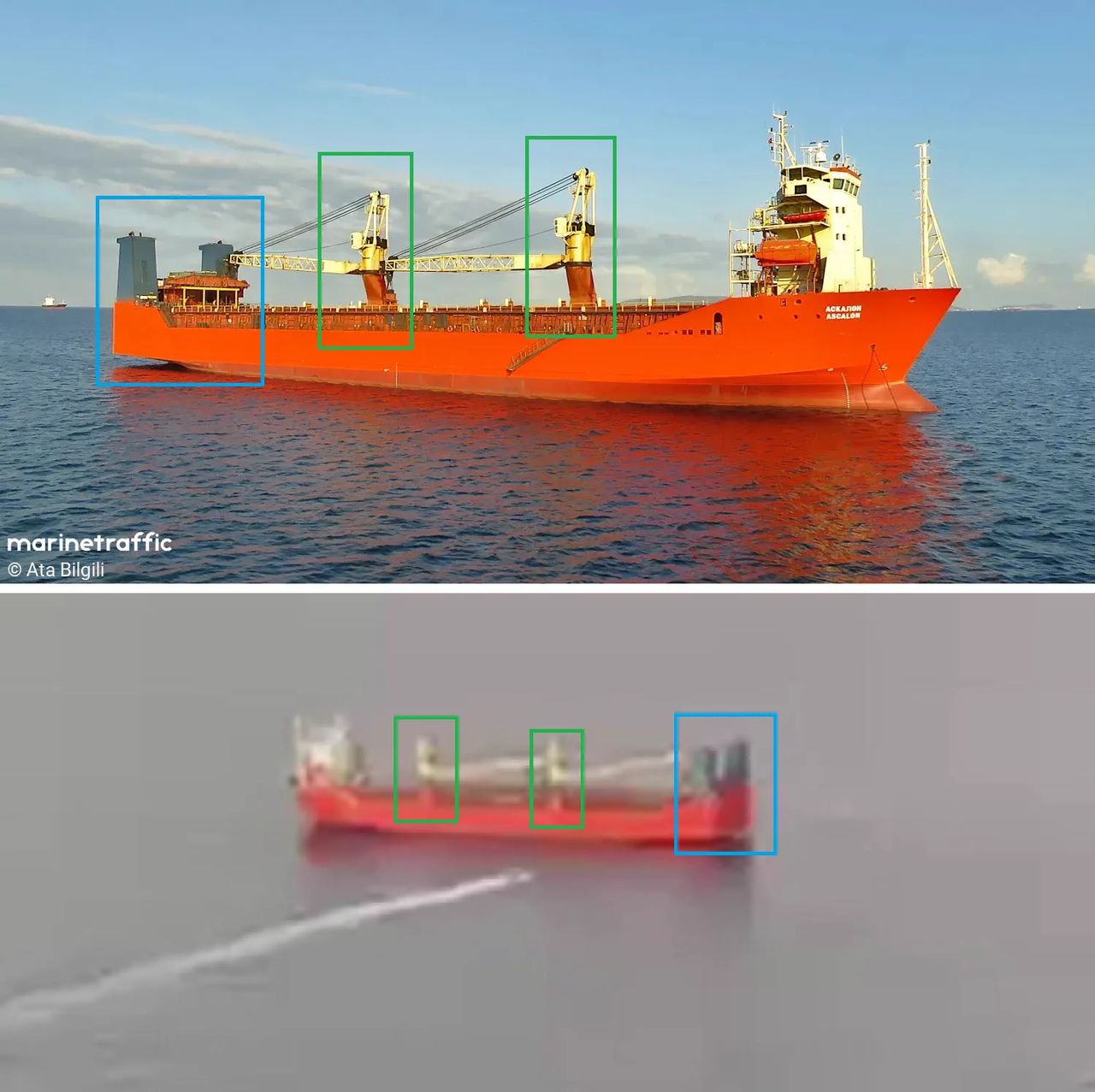
XAn X post shares a two-panel image comparing a photograph of the Ro-Ro cargo ship Ascalon with a low-resolution still from video of the 22 November 2026 drone strike off Benghazi. Coloured boxes mark features the poster says match. The caption asserts that this second vessel, hit by what it calls Ukrainian USVs, is the Ascalon and that it departed Baltiysk in Kaliningrad.
“The second ship targeted by the Ukrainian USVs near Benghazi is the ASCALON Ro-Ro ship that departed from Baltiysk, Kaliningrad”
Posted on X by an account using the handle @LayBay_ish. No engagement data or posting time was available to us. The upper photo carries a MarineTraffic watermark and photographer credit.
Who posted it
XAccount check
Estimates from public signals — account age, posting pattern, audience — not a judgement of the person behind the account, and separate from whether this post is true.
What stood out
- Account is an established OSINT geolocation contributor ('LayBay'), repeatedly credited by @GeoConfirmed, @UAControlMap and @FaytuksNetwork on conflict imagery.
- Airwars independently cited 'LayBay (@LayBay_ish)' geolocation work in a July 2026 incident report (Bandar Abbas, Iran), matching coordinates published by the account.
- GeoConfirmed's Ukraine conflict map and METIS event records attribute geolocations (Berezniki drone, Volgograd refinery, Yalta) to this handle.
- The Insider and Mediazone cited LayBay's frame analysis to correct an initial claim about which Yalta building burned — evidence of careful, corrective work rather than amplification.
- Quoted as a source by defence outlet MILMAG in November 2026 reporting on the Russian corvette Merkuriy in Benghazi.
- Posts follow a consistent, human-analyst format: coordinates, POV bearings, tag lists and explicit 'geolocated by' attribution — not engagement-farming or copy-paste spam.
- Profile metadata supplied is empty (no bio, follower count or creation date) and the account is not platform-verified, so trust rests on third-party citations rather than account signals.
- No fact-checker debunk, suspension, or misinformation record found for the handle.
Signals (5)+
- Posting cadence
- Frequent, event-driven conflict geolocations (Jun–Nov 2026)
- Notable news coverage
- Cited/credited by Airwars, GeoConfirmed, Ukraine Control Map, The Insider/Mediazone, MILMAG, UAWire
- Fact check history
- No debunks found; documented instance of correcting a misattributed strike location
- Specialisation
- Image/video geolocation (Ukraine, Russia, Iran, Libya, Ethiopia, Colombia)
- Platform metadata completeness
- Very low (all fields null)
Account checked November 23, 2026, 02:56 UTC
The media
Image✓ What is genuine
Both photographs are real material. The top is a genuine MarineTraffic photo of the ship, and the same image was used by Ukrainian outlets to illustrate Ascalon. The bottom is a real still from the 22 November strike video. The coloured boxes are added analysis, not manipulation of the underlying image.
The tells
- ●●● Strong signal The upper panel is an unaltered MarineTraffic community photo with visible watermark and the photographer credit 'Ata Bilgili'.our visual review
- ●●○ Supporting signal The lower panel is a low-resolution night still from strike video with coloured boxes added; the overlays mark features rather than alter the scene.our visual review
- ●●○ Supporting signal Detector score of 0.26% for AI generation and 0% deepfake is consistent with real photographic material and annotation.our detector
Synthetic-media detector
Detector ranThe claim stands or falls on whether the media is real, so the detector ran.
Scores are the detector’s estimate for the file as uploaded. A low score does not rule out editing, a spliced caption, or footage shown out of context — those are judged above. Model v3.
How we checked the media
- Reviewed the two-panel graphic visually, noting the MarineTraffic watermark and photographer credit on the upper photo.
- Ran the image through our AI-generation detector (hive-v3), which returned a 0.26% AI-generated score and 0% deepfake score.
- Compared the identity of the upper photo with the illustration used by Ukrainian outlets on 22-23 November 2026.
- Read the source reporting on the attack footage and the ship identification.
Sources
8 sources reviewed- 1Russian warship sinks in Benghazi after suspected Ukrainian drone attack ↗
The Guardian · theguardian.comReputable outletLean Left (AllSides)Evidence
The Guardian reports a Russia-linked cargo ship, the Ascalon, was hit by a sea drone off Benghazi hours after the warship strike.
- 2Drone destroys £150m Russian warship at Libyan naval base ↗
The Telegraph · telegraph.co.ukReputable outletBORDERLINE — Lean Right; strong bias tagEvidence
The Telegraph reports open-source analysts identified the ship as Ascalon, a sanctioned vessel linked to Russia's shadow fleet.
- 3Russian cargo ship ASCALON reportedly targeted in suspected drone attack near Benghazi ↗
The New Voice of Ukraine · english.nv.uaUntiereduntiered — treated as signal only, never decisiveEvidence
The New Voice of Ukraine reports Ascalon left Baltiysk on 31 October and that OSINT analysts saw it loading military equipment there on 15-16 October.
- 4russian Ro-Ro Ship ASCALON, Which Previously Transported S-400 Missiles and Now Carries Armored Vehicles, Hit by Drone Off Libya ↗
Defense Express · en.defence-ua.comUntiereduntiered — treated as signal only, never decisiveEvidence
Defense Express reports Ascalon departed Russia carrying military equipment before being struck by a naval drone near Benghazi.
- 5В ливийском порту Бенгази атаковали еще одно российское судно ↗
The Insider · theins.ruUntiereduntiered — treated as signal only, never decisiveEvidence
The Insider, citing Starboard Maritime Intelligence, establishes Ascalon left Baltiysk on 30 October and passed Gibraltar on 13-14 November.
- 6У берегов Ливии атаковано второе российское судно ↗
Novaya Gazeta Europe · novayagazeta.euUntiereduntiered — treated as signal only, never decisiveEvidence
Novaya Gazeta Europe notes the flag discrepancy between Reuters' report of a Maltese-flagged ship and Ascalon's Russian listing.
- 7The other vessel attacked off the coast of Libya may have been the sanctioned Russian cargo ship ASCALON ↗
Ukrainian National News (UNN) · unn.uaUntiereduntiered — treated as signal only, never decisiveEvidence
UNN, citing MarineTraffic, reports Ascalon was sailing from Baltiysk and last recorded near Gibraltar before its AIS signal was lost.
- 8Russian Warship Blown Up in Libya as Ukraine Takes Drone War to Mediterranean ↗
Times Now · timesnownews.comUntiereduntiered — treated as signal only, never decisiveEvidence
Times Now reports a second Russia-linked vessel was hit by a sea drone off Benghazi after the Merkury strike.
Further reading
- 1The Guardian The clearest short account of the Benghazi strikes and the reported identity of the second vessel.
- 5The Insider The most detailed tracking record of Ascalon's route from Baltiysk through Gibraltar.
- 6Novaya Gazeta Europe Explains the flag discrepancy between Reuters' Libyan sources and the US Treasury listing.
The full story
The kernel of truth here is real and specific. On 22 November 2026, uncrewed surface vessels struck two Russia-linked vessels off Benghazi, Libya. The corvette Merkury exploded and sank in port. A second commercial cargo ship was hit offshore later the same evening. Libyan officials confirmed the strikes and said naval and air forces intercepted more than a dozen drones.
Open-source analysts then did what they do after attacks on shipping: they compared the vessel in the strike footage with public ship photographs and tracking data. They identified the second ship as the Ascalon, a US-sanctioned Ro-Ro cargo vessel. The Insider, citing Starboard Maritime Intelligence, traced it from Baltiysk on 30-31 October, through the Strait of Gibraltar on 13-14 November, after which its AIS signal disappeared. Satellite imagery showed it loading military vehicles at Baltiysk in mid-October. That backstory is why the post felt plausible to so many readers: the ship's movements had already been watched, and its arrival in the Mediterranean was known.
What the post does not carry is an official stamp. Libyan and Russian authorities have not named the vessel, and Reuters' Libyan military sources described the struck commercial ship as Maltese-flagged, while Ascalon is listed as Russian-flagged. The attribution to Ukrainian drones is widely reported and matches the drone type seen in footage, but Kyiv has not publicly claimed it. The post compresses all this into a flat certainty. The underlying facts are strong; the certainty is slightly ahead of the public record.
Kernel of truth
A second Russia-linked cargo ship was hit off Benghazi on 22 November 2026, and open-source tracking places the Ascalon on that route from Baltiysk. The ship identification is a well-supported analytical conclusion, not an official statement.
Timeline
October 15, 2026
OSINT projects publish satellite imagery of Ascalon loading infantry fighting vehicles, armoured personnel carriers and MRAPs at Baltiysk. 3The New Voice of Ukraine
October 30, 2026
Ascalon leaves the Russian port of Baltiysk in Kaliningrad Oblast, according to Starboard Maritime Intelligence data. 5The Insider
November 13, 2026
Ascalon transits the Strait of Gibraltar on the night of 13-14 November before its AIS signal is switched off. 5The Insider
November 22, 2026
Uncrewed surface vessels strike the corvette Merkury in Benghazi port and a second cargo ship offshore; open-source analysts identify the second vessel as Ascalon. 1The Guardian
How it was framed
The post's core claim is well supported: multiple credible outlets report the second vessel hit off Benghazi was identified as Ascalon, and tracking data documents its departure from Baltiysk. The caveats concern the lack of an official naming and a flag discrepancy, not a fabricated or misleading framing. We therefore classify the underlying content as broadly accurate with noted caveats.
- “Visual proof”. The two-panel image places a clear photograph of Ascalon next to a blurry strike still with coloured boxes, inviting the reader to accept the match by eye.
- Missing context. The caption states the Ukrainian USV involvement and the ship's identity as flat facts, without noting that the identification is open-source analysis and that Kyiv has not claimed the strike.
Posted on X by an account using the handle @LayBay_ish. The post includes a two-panel comparison graphic whose upper image carries a MarineTraffic watermark and a photographer credit. We found no engagement data or posting history for the account.
Bias
Leans pro-Ukraine. The post frames the attack squarely as a Ukrainian success ('targeted by Ukrainian USVs') and presents the ship identification as settled, when both the attribution and the identification rest on open-source analysis rather than official confirmation. No falsehood is pushed, but the framing is sympathetic to Kyiv's narrative.
Bias describes how the post frames its message — the slant of the language, selection and emphasis — and is judged separately from whether the claim is true. A true claim can still be framed with a strong slant.
How we checked
48 s- 1
Searched for reporting on the Ukrainian USV attack on a ship named Ascalon near Benghazi.
- 2
Searched for the Ascalon's route from Baltiysk, Kaliningrad, and its movements in the Mediterranean.
- 3
Searched for the ship identification and the reported flag discrepancy around the Benghazi strike.
- 4
Reviewed the two-panel image visually for watermarks, credits and annotation.
- 5
Ran the image through our AI-generation detector, which returned a very low AI-generated score and a zero deepfake score.
- 6
Compared the ship photograph with the illustration used by Ukrainian outlets on 22-23 November 2026.
✓ Claim checked✓ Media checked✓ Sources checked
Why 78% confidence
HighWe rate the overall claim HIGH confidence because several independent outlets reported the identification and because vessel-tracking data corroborates the route. The individual claims carry MODERATE bands because the ship's name comes from open-source analysis, not an official statement, and because of the Maltese-flag discrepancy reported by Reuters. The media carries a likely-authentic verdict because the upper photo is a credited MarineTraffic image and the lower still is real footage with transparent annotation, supported by a near-zero AI-generation score.
Limits. We did not open the original pages ourselves; our checks relied on searches and the source snippets available to us. We could not verify the ship's identity from an official Libyan, Russian or Ukrainian statement, because none names the vessel. We did not independently analyse the full strike video, only the still in the post.
What we don’t know
- Why Libyan military sources described the struck ship as Maltese-flagged while Ascalon is listed as Russian-flagged, and whether that reflects a reflagging or a different vessel.
- Whether Ukraine will formally acknowledge the strike, and whether any government will officially name the ship.
- What the Ascalon was carrying at the moment it was hit, as distinct from what it loaded at Baltiysk in October.
- Who runs the @LayBay_ish account and what its sourcing was for the comparison graphic.
Spot it yourself
Find the overstatementLooks suspicious, isn’t proof
- The post uses a comparison graphic with coloured boxes added to a low-resolution night still. Annotation can look like manipulation, but here the boxes mark features rather than alter the scene.
- The account is anonymous and the claim is confidently worded. Confidence is a reason to check, not evidence either way.
- The lower panel is blurry and dark, which makes the match hard for a casual viewer to judge. Low image quality is not proof of fakery; it is a reason to look for better sourcing.
The actual evidence
- Multiple independent outlets — the Guardian, the Telegraph and Times Now — reported the same identification within a day, based on open-source analysis.
- Vessel-tracking data cited by The Insider and UNN documents Ascalon leaving Baltiysk on 30-31 October and passing Gibraltar on 13-14 November.
- The upper photo is a genuine MarineTraffic image with a visible photographer credit, and the same image was used by Ukrainian outlets to illustrate the ship.
- The unresolved discrepancy: Reuters' Libyan sources described the struck ship as Maltese-flagged, while Ascalon is listed as Russian-flagged — a genuine open question, not a reason to dismiss the claim.
- 1
Ask who else would be reporting this if it were true.
A strike on a Russia-linked ship off Libya would draw wire coverage. Search for the ship's name alongside the place and the date. If only one account carries it, treat it as a lead; if broadsheets and wires carry it, the core is likely real.
- 2
Separate the identification from the attribution.
Check whether the ship's name comes from an official statement or from open-source analysts. Check separately whether any government has confirmed who launched the drones. The two can have different levels of certainty.
- 3
Use vessel-tracking data as a cross-check.
Public marine traffic sites show a ship's recent route and when its signal was lost. Compare the dates in the post with the tracking record. A route that matches is stronger evidence than a visual match alone.
- 4
Look closely at annotated comparison images.
Identify what is original and what is added. Watermarks and photographer credits show the source photo is real. Coloured boxes drawn on a still are analysis, not tampering, unless they conceal or replace part of the scene.
Takeaway
A claim can be broadly right and still overstate its certainty. The useful question is not only 'is this true?' but 'how do they know, and who has confirmed it?'
Questions people ask
Was the Ascalon really the second ship hit off Benghazi?+
Multiple credible outlets, including the Guardian and the Telegraph, reported that open-source analysts identified the second vessel hit off Benghazi on 22 November 2026 as the sanctioned Ro-Ro Ascalon. The identification is analytical rather than official, and Libyan and Russian authorities have not named the ship, so it is best described as likely true rather than confirmed.
Did the Ascalon really leave Baltiysk in Kaliningrad?+
Yes, according to vessel-tracking reporting. The Insider, citing Starboard Maritime Intelligence, says Ascalon left Baltiysk on 30-31 October and passed the Strait of Gibraltar on 13-14 November before its AIS signal was switched off. UNN, citing MarineTraffic, reported the same route. This is the best-documented part of the post.
Did Ukraine carry out the drone attack?+
It is widely reported as suspected Ukrainian involvement. The Guardian and Reuters describe sea drones suspected to be Ukrainian, and the Telegraph cites Axios reporter Barak Ravid, who cited SBU sources, as confirming Kyiv's role. Ukraine has not publicly claimed the strike and no government has formally attributed it, so the attribution is strongly indicated but not officially confirmed.
Why do some reports call the ship Maltese-flagged?+
Reuters' Libyan military sources described the struck commercial ship as Maltese-flagged, while the US Treasury and VesselFinder list Ascalon as Russian-flagged. Several outlets noted the discrepancy. It may reflect a reflagging, a different vessel, or confusion in initial reporting. We could not resolve it from the available sources.
Is the comparison image in the post fake?+
No. The top panel is a genuine MarineTraffic community photo of the ship, with a visible watermark and photographer credit, and the same image was used by Ukrainian outlets to illustrate Ascalon. The bottom panel is a low-resolution still from the strike video with coloured boxes added to mark features. Our AI-generation detector scored it at 0.26% AI-generated.
Go deeper
- Ro-Ro ship
- A roll-on/roll-off vessel designed to carry wheeled cargo such as vehicles and armoured equipment that is driven on and off rather than lifted by crane.
- USV
- Uncrewed surface vessel: a small boat that operates without a crew on board, often used as a drone in naval attacks.
- AIS
- Automatic Identification System: the radio signal ships broadcast to report their position. It can be switched off, which creates a gap in public tracking.
- OSINT
- Open-source intelligence: analysis built from publicly available material such as satellite imagery, ship tracking and social media video.
- False context
- A type of information disorder in which genuine material is presented with a false or misleading explanation. This post is not an example, because its framing is broadly supported.
People also search for
For educators+
- The post says the ship was 'targeted by the Ukrainian USVs' as a flat fact. What would change if the caption had said 'suspected Ukrainian USVs' instead? Does the accuracy of the rest of the post depend on that difference?
- If several outlets all rely on the same open-source ship analysis, how many independent sources do we really have? How would you check whether the outlets did their own verification?
- The Reuters report and the US Treasury list disagree about the ship's flag. What are some possible explanations, and what evidence would settle the question?
About this check
- Platform
- X
- Posted by
- @laybay_ish
- Posted
- November 22, 2026
- Age when checked
- Under 24 hours old when checked
- Where it spread
- LY, Russia, Ukraine
- Audience
- International audience
- Language
- EN
- Status
- ● Post is live
- Verified
- November 23, 2026, 02:57 UTC
- Published
- November 23, 2026, 02:57 UTC
Reach. 2,177 likes; jurgen_nauditt 714 likes; TheLibyaUpdate (Libyan army says it intercepted more drone boats) 799 likes; AJ English video 'Second ship targeted'
This verdict was generated with AI from the sources shown. AI can make mistakes — check the sources before relying on it.
Check anything yourself, in seconds.
Share any social post or video to What the Fact and get the verdict, the confidence, and the receipts.