Did two tankers explode after hitting mines near the Strait of Hormuz?
Did two 'violating' oil tankers hit Iranian naval mines and catch fire north of Ghanam Island, east of the Strait of Hormuz, on 22 Nov, as Iran's navy/IRGC claims?
True, but…
The announcement is real; the mine-strike explanation is Iran's claim, not established fact.
Al Jazeera Arabic accurately reported a real statement: on Sunday 22 November 2026 Iran's IRGC Navy said two tankers exploded after hitting naval mines north of Ghanam Island and east of the Strait of Hormuz. The announcement is confirmed. The mine-strike cause and the 'violating vessel' framing are Iran's own contested account, which Reuters said it could not verify.
 Likely genuine
Claims
✓ 2 trueIran's IRGC Navy announced on Sunday 22 November 2026 that two tankers exploded and were halted after striking naval mines north of Ghanam Island and east of the Strait of Hormuz.134
“بحرية الحرس الثوري الإيراني: انفجار ناقلتي نفط مخالفتين شمال جزيرة غنم وشرق هرمز إثر اصطدامهما بألغام”
This is the part of the post we can settle cleanly. The statement was genuinely issued and carried the same day by multiple outlets in different media ecosystems: Middle East Eye in English, Al Bawaba in Arabic, and Iranian outlets Fars, Mehr and Tabnak. Those are not fully independent of each other in the way a court would require — Fars, Mehr and Tabnak all draw on Iranian military communications, and Middle East Eye and Al Bawaba are relaying the same announcement. But the thing being checked here is not whether mines caused the blast; it is whether the IRGC Navy said so on Sunday 22 November 2026. On that narrow question the sources agree on wording, geography and timing. That is enough to mark the reported announcement as accurate. A reader should keep the distinction sharp: a real announcement is evidence that something was said, not evidence that what was said is true.
Still open: No vessel names, flags or casualty figures were released, so we cannot tie the announcement to specific ships.
The two tankers had switched off their identification and navigation systems and were sailing on unauthorised routes in a restricted zone, in violation of prior warnings.25
The bulletin accurately attributes this to the Iranian military, but the content of the accusation cannot be checked from outside. Iran released no vessel names, no flags, no crew details and no tracking data. Nobody independent has confirmed that the ships went dark or that they entered a zone Iran had warned about. The source most likely to know — the UK Maritime Trade Operations office, which logs incidents in these waters — described strikes by unidentified projectiles rather than a picture of non-compliant vessels ignoring warnings. Reuters, reporting on the Iranian statements, said it could not independently verify them. So a reader should treat 'violating tankers' as a characterisation by one party to a conflict, not as a description of established fact. It may turn out to be right; nothing in our material confirms it.
Still open: Why Iran has not named the vessels, and whether any insurer, flag registry or crew agency has confirmed the ships' identity.
The UK Maritime Trade Operations (UKMTO) reported two maritime incidents in the Gulf of Oman.235
UKMTO did report incidents in the Gulf of Oman in that window, and the timing lines up closely with the Iranian announcement. Its records describe a tanker hit on the stern by an unidentified projectile 11 nautical miles north of Khasab and a second hit in its engine room 17 nautical miles east of Khasab, on Saturday 21 November 2026. A further report of an incident involving a tanker and military forces in the Gulf of Oman was timed at 14:25 GMT on Sunday 22 November. The bulletin's summary is therefore accurate as far as it goes. The important thing it glosses over is the mismatch in cause: UKMTO talks about projectiles, Iran talks about mines, and no source in our material establishes that the two sets of reports concern the same vessels.
Still open: Whether the UKMTO-logged incidents and the vessels Iran described are the same ships.
The cause of the tanker fires was the vessels striking naval mines.125
This is the weakest link in the bulletin and the one a reader is most likely to absorb as fact. Mine strike is Iran's version. The independent maritime reporting we hold points elsewhere: UKMTO describes tankers struck by unidentified projectiles, not mines. Washington says it has largely cleared the waterway of mines, which cuts against a mine-strike explanation but does not rule one out. Reuters could not independently confirm the Iranian account, and could not link it to the UKMTO reports. With two competing mechanisms, no physical evidence released and no independent investigator on record, the honest position is that the cause is unknown. The bulletin states the Iranian version in the same flat register it uses for confirmed facts, and adds no on-air caveat.
Still open: No independent forensic assessment of the damage, wreck imagery or debris has been published in our material.
What was posted
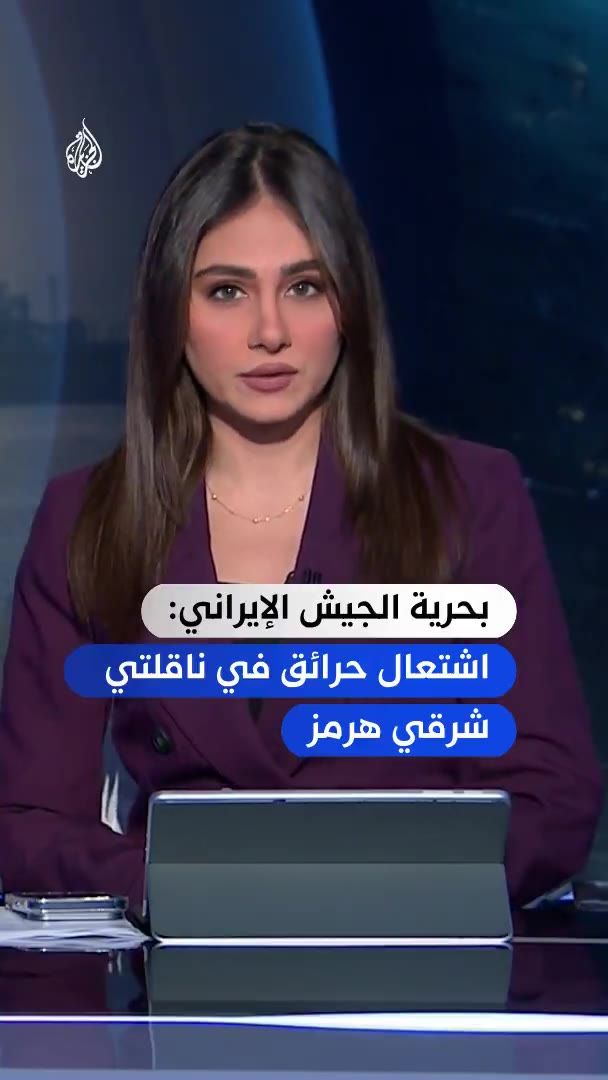
XA clip posted on X by Al Jazeera Arabic's account, presented as a news cut from the channel. A presenter reads a bulletin over a correctly rendered Arabic lower-third, followed by low-light footage of a vessel on fire at sea. The post asks readers to accept that Iran's Revolutionary Guard Navy announced two tankers exploded after striking naval mines near Ghanam Island and east of Hormuz.
“بحرية الحرس الثوري الإيراني: انفجار ناقلتي نفط مخالفتين شمال جزيرة غنم وشرق هرمز إثر اصطدامهما بألغام #الأخبار”
“Iran's Revolutionary Guard Navy: explosion of two violating oil tankers north of Ghanam Island and east of Hormuz after they struck mines #News” — translated
Posted from Al Jazeera Arabic's own X account, the channel's standard news-clip format with its hashtag #الأخبار (News).
Who posted it
XAccount check
Estimates from public signals — account age, posting pattern, audience — not a judgement of the person behind the account, and separate from whether this post is true.
What stood out
- Handle @AJArabic is the official main Arabic-language channel account of Al Jazeera (قناة الجزيرة), Doha/Qatar — confirmed by Al Jazeera Media Network materials and by Reuters/AFP/Gulf Times coverage that names '@ajarabic' as the network's 'main account' during its 2017 suspension.
- Live X page (checked now) shows the display name قناة الجزيرة, a bio cross-linking @aljazeera_now, @aljazeeraprogrm and @AJABreaking, ~597K posts, and same-day Arabic news posts on Yemen, Sudan, Gaza and the West Bank — content matches the broadcaster's editorial output.
- Account is long-established: joined April 2007 (~19.5 years old at 23 Nov 2026), ~22.9–23M followers, tracked as 'Verified (Business)' with location Qatar and website aja.me/live.
- The supplied profile metadata (isplatformverified=false, null followers, no posts) contradicts the live account — the record appears stale or incompletely scraped; the unverified flag should not be read as evidence of impersonation.
- 2017 episode: account was briefly suspended and its follower count reset from ~12M to near zero before restoration; Al Jazeera called it an 'organised campaign'. This is a platform-disruption event, not evidence of inauthentic account behaviour.
- One tracking service (twtData) marked @AJArabic (and @AJABreaking) 'no longer available on X' in early July 2026, yet the account is live and posting in Oct–Nov 2026 — most likely a scraper/API artifact or temporary restriction; no news coverage of a 2026 removal found.
- Very high output (~40 posts/day, ~98% with image/video) and a median of only ~14 interactions per post on 23M followers (≈0% engagement rate, bottom decile for its size). This is consistent with a professional newsroom plus reach suppression / weak follower quality, not with an automated bot persona.
- Institutional profile, not an individual: Qatari state-funded broadcaster with editorial standards and corrections practice, but described by media-monitoring sources as having a pro-Qatar government line; expect framing bias on Gulf, Iran and regional-conflict topics. Critics (notably Saudi/Gulf outlets) have accused it of fabrication, but it is not a flagged fact-check target for fabricated content.
- No sign of coordinated inauthentic behaviour in the account itself; main residual risks are state-linked editorial bias and hack/suspension incidents (2017 cyberattack, repeated jamming claims) that could briefly compromise the feed.
Signals (12)+
- Handle identity
- Official Al Jazeera Arabic main channel account
- Joined
- April 2007
- Following count
- 2
- Post count
- 597000
- Posting cadence
- ~40 posts/day; media in ~98% of posts
- Follower ratio
- ~11,000,000:1
- Median interactions per post
- 14
- Engagement rate
- ~0% (bottom 10% for size cohort)
- Ownership
- Al Jazeera Media Network, Qatar (state-funded)
- Editorial orientation
- Pro-Qatar government per Eurotopics media profile
- Notable news coverage
- Reuters, AFP, Gulf Times, Al Jazeera press releases on 2017 Twitter suspension/restoration
- Past incidents
- 2017 suspension + follower reset; 2017 cyberattack on network; account tracking gap July 2026
Account checked November 23, 2026, 02:45 UTC
The media
Video✓ What is genuine
The clip is a standard Al Jazeera Arabic news segment, and the announcement it reports was genuinely made on Sunday 22 November 2026.
The tells
- ●●○ Supporting signal The Arabic lower-third is clean, grammatical and typographically consistent with Al Jazeera's branding across the frames we reviewed.our visual review
- ●●○ Supporting signal Studio lighting, reflections and the presenter's laptop stay internally consistent through the read, with no warping or blending at edges.our visual review
- ●○○ Weak signal The fire footage is grainy, low-light and shot from a distance, which is what real footage from a vessel or shoreline at night looks like; it shows no compositing artefacts.our visual review
- ●●○ Supporting signal The clip is a broadcast cut, not a claim built from the footage: the bulletin would be checkable even if the video were swapped.our visual review
Synthetic-media detector
Detector not consultedThe media is incidental to the claim; the detector was not needed.
How we checked the media
- Reviewed the clip frame by frame by eye: lower-third typography, channel branding, studio lighting and reflections, and the night fire footage that follows the read.
- Checked that the Arabic on the lower-third is clean, grammatical and correctly rendered.
- Compared what the clip says with independent reporting of the same Sunday announcements.
- We did not run an automated synthetic-media detector, because the claim does not depend on this particular clip being real: the announcement is checkable from reporting alone.
Sources
5 sources reviewed- 1Two supertankers hit mines near Hormuz, Iranian navy says ↗
Middle East Eye · middleeasteye.netUntiereduntiered — treated as signal only, never decisiveEvidence
Establishes that Iran's navy announced two supertankers hit mines and caught fire east of Hormuz on 22 November 2026, and that UKMTO reported a parallel Gulf of Oman incident.
- 2Two tanker attack incidents reported near Oman's Khasab, UKMTO says ↗
CNBC / Reuters · cnbc.comReputable outletCenter/Lean Left — marketsEvidence
Establishes the UKMTO projectile description near Khasab and Reuters' inability to verify the Iranian account or link it to those incidents.
- 3انفجار ناقلتي نفط إثر اصطدامهما بألغام بحرية شرق هرمز ↗
Al Bawaba · albawaba.netUntiereduntiered — treated as signal only, never decisiveEvidence
Arabic-language confirmation of the IRGC statement's wording and geography, and of the 14:25 GMT UKMTO report.
- 4Two more oil tankers catch fire in Strait of Hormuz ↗
Tabnak · tabnak.irUntiereduntiered — treated as signal only, never decisiveContext
Shows Iran's Army Navy issued a separate but similar Sunday statement, explaining the caption/broadcast label mismatch.
- 5UKMTO Recent Incidents ↗
UKMTO · ukmto.orgUntiereduntiered — treated as signal only, never decisiveEvidence
Official UKMTO log showing repeated projectile strikes in the region through October–November 2026, the competing description the bulletin omits.
Further reading
- 2CNBC / Reuters Reuters/CNBC reporting shows UKMTO's projectile account alongside Reuters' statement that it could not verify Iran's version — the clearest view of the gap.
- 5UKMTO UKMTO's own incident list is the primary log to check next time a tanker incident is reported in these waters.
- 1Middle East Eye Middle East Eye's account of the Sunday announcement, including the restricted-area detail and UKMTO's parallel report.
The full story
The post rests on a genuine event: two public statements issued on Sunday 22 November 2026. Iran's Revolutionary Guard Navy said two supertankers had exploded and stopped after hitting naval mines north of Ghanam Island and east of the Strait of Hormuz, adding that the vessels had sailed unauthorised routes with identification and navigation systems switched off. Iran's Army Navy issued a similar statement the same day.
That gave newsrooms a real, dated, quotable announcement, and outlets in several languages carried it. It also fitted a pattern. UKMTO's incident log shows repeated tanker strikes by unknown projectiles in and around the strait through October and November 2026, including two near Khasab the day before. When ships really are being hit in a narrow waterway that carries a large share of world oil, a report of two more tankers on fire is not far-fetched. That plausibility is exactly what makes the post work: the setting, the timing and the existence of a real statement are all true.
The gap opens at the cause. Iran says mines; UKMTO's reports describe projectiles; Washington says it has largely cleared the waterway of mines; Reuters says it could not verify the Iranian account and could not tie it to the UKMTO incidents. No vessel names, flags, crew numbers or damage assessments were released. So readers get a real bulletin relaying a real statement whose central explanation is one side's account of an incident nobody independent has yet examined.
Kernel of truth
Iran's IRGC Navy really did announce on 22 November 2026 that two tankers exploded after hitting mines near Hormuz, and Iran's Army Navy said something similar the same day.
Timeline
November 21, 2026
UKMTO logs two tanker strikes near Khasab: one hit on the stern by an unidentified projectile 11 nautical miles north, one in the engine room 17 nautical miles east. 2CNBC / Reuters
November 22, 2026
Iran's IRGC Navy announces that two non-compliant supertankers exploded after striking naval mines north of Ghanam Island and east of the Strait of Hormuz; Iran's Army Navy issues a similar statement. 1Middle East Eye
November 22, 2026
UKMTO reports an incident involving a tanker and military forces in the Gulf of Oman, timed at 14:25 GMT. 3Al Bawaba
November 22, 2026
Reuters reports it cannot independently verify the Iranian statements or link them to the UKMTO incidents. 2CNBC / Reuters
How it was framed
The announcement and the broadcast are real, but the bulletin presents one party's contested explanation — mines, non-compliant vessels — in the flat register of established fact, and does not flag the competing projectile accounts or the absence of independent verification.
- Borrowed authority. The bulletin is delivered in Al Jazeera's own studio voice and branding, so an unverified military claim arrives with a trusted broadcaster's authority behind it.
- Missing context. The read gives the mine explanation and the 'violating' description but does not mention UKMTO's projectile reports, Washington's statement that the waterway was largely cleared of mines, or Reuters' inability to verify.
- “Visual proof”. Night footage of a burning vessel follows the read, supporting the impression of a confirmed incident without showing anything that establishes the cause.
- Emotional language. The Arabic 'مخالفتين' ('violating') adopts the Iranian military's label for the ships as part of the bulletin's own description.
Posted from Al Jazeera Arabic's X account in the channel's standard news-clip format with its #الأخبار hashtag. The bulletin attributes the statement on screen and in the read; the post caption attributes it to the IRGC Navy while the on-screen text and newsreader refer to the Iranian Army Navy, two forces that issued separate but similar statements the same day.
Bias
Leans pro-Iranian framing. The report relays the Iranian military account in its own vocabulary, calling the tankers 'violating' and stating the mine strikes as the cause, with only a later line noting the UKMTO reports of projectile hits. Al Jazeera Arabic is Qatari state-funded; the clip largely reproduces Tehran's framing of the incident without an on-air caveat that the claim is unverified.
Bias describes how the post frames its message — the slant of the language, selection and emphasis — and is judged separately from whether the claim is true. A true claim can still be framed with a strong slant.
How we checked
52 s- 1
Searched in English and Arabic for coverage of the tanker explosions, the mine claim and the Hormuz location around 22 November 2026.
- 2
Searched for UKMTO's reports of maritime incidents in the Gulf of Oman in the same window.
- 3
Compared the bulletin's wording, attribution and geography with the coverage we found, including Middle East Eye, Al Bawaba, Tabnak and Reuters reporting carried by CNBC.
- 4
Reviewed the clip by eye for signs of editing or synthetic generation: lower-third typography, branding, studio consistency and the fire footage.
✓ Claim checked✓ Media checked✓ Sources checked
Why 80% confidence
HighThe central claim — that the announcement was made — is rated HIGH because several outlets in different languages carried the same statement with matching timing and place. The unverifiable claims are rated MODERATE and LOW because they rest on a single party's account with no physical evidence released; that is a limit of the evidence, not uncertainty about what was said.
Limits. We did not run an automated detector on the clip, because the claim does not hinge on the footage being real; our assessment of the video rests on visual review and the reporting. We could not access the underlying statements in full, identify the vessels, or obtain any independent assessment of the damage or cause.
What we don’t know
- The names, flags and owners of the two tankers.
- Whether the UKMTO-logged incidents and the vessels Iran described are the same ships.
- What actually struck the vessels: mines, projectiles, or something else.
- Whether anyone was killed or injured, and how serious the damage is.
- Whether the ships had in fact switched off identification and navigation systems, and whether Iran had issued the warnings it says were ignored.
Spot it yourself
Find the overstatementLooks suspicious, isn’t proof
- It comes from a large broadcaster with a regional viewpoint, which makes people on the other side of the story distrust it — but a source's perspective is not evidence the specific report is wrong.
- The caption names the Revolutionary Guard Navy while the on-screen text says the Army Navy. That is sloppy labelling of two real, separate Sunday statements, not proof of fabrication.
- The fire footage is dark, grainy and unverifiable on its own. Poor image quality invites suspicion but tells you nothing about whether the announcement happened.
- The story is alarming and concerns oil and a strategic waterway, which makes it feel like propaganda. Alarm is a reason to check, not a finding.
The actual evidence
- Independent outlets across languages carried the same Sunday announcement with matching geography and timing, so the statement really was made.
- Attribution is explicit on air: the bulletin says the Iranian military said it. That is accurate reporting of a claim.
- UKMTO's own log describes projectiles, not mines, in the same waters and period — the decisive mismatch.
- Reuters said plainly that it could not verify the Iranian account, and no vessel names, flags or casualty figures were released.
- 1
Separate the announcement from the explanation
Ask: was this said, and is it true? Here the first is yes and the second is open. Any bulletin built on 'X says' inherits X's interests.
- 2
Check the maritime incident log
UKMTO publishes incident reports for these waters. Reading them shows the competing descriptions — projectiles versus mines — that the bulletin left out.
- 3
Look for what is missing
No ship names, flags, crew numbers or damage reports. When a major incident has no identifying detail, the account is still at the claim stage.
- 4
Watch the labels against the read
Compare the caption with the on-screen text and the newsreader's words. Mismatches between them are a sign of haste, and a prompt to check the original statements yourself.
- 5
Treat fire footage as atmosphere
A burning ship at night shows something burned. It cannot show what hit it, who was aboard, or whether the vessel was where Iran says.
Takeaway
A real statement reported accurately can still leave you with a false picture if the statement's own explanation is repeated without the competing evidence. Check what was said, then check what is known.
Questions people ask
Did two tankers really explode near the Strait of Hormuz in November 2026?+
Iran's IRGC Navy announced on Sunday 22 November 2026 that two supertankers exploded and stopped after hitting naval mines north of Ghanam Island and east of Hormuz, and Iran's Army Navy said something similar. UKMTO separately logged tanker incidents in the Gulf of Oman that weekend. Independent outlets carried the announcements, though no vessel names or casualty figures were released.
Is the Al Jazeera Arabic clip real?+
Yes. It is a standard Al Jazeera Arabic news segment with consistent branding, a clean Arabic lower-third and plausible night footage of a burning vessel. Our visual review found no sign of editing or synthetic generation. We did not run an automated detector, because the claim can be checked from reporting regardless of the clip.
Were the tankers hit by mines?+
That is Iran's account, not an established fact. UKMTO, which logs incidents in these waters, described tankers struck by unidentified projectiles near Khasab, and Washington says it has largely cleared the waterway of mines. Reuters said it could not verify the Iranian account or link it to the UKMTO reports.
Why does the post say Revolutionary Guard Navy when the broadcast says Army Navy?+
Both forces issued separate but similar statements on Sunday 22 November 2026, so both attributions point to real announcements. The post caption names the IRGC Navy, while the on-screen text and newsreader refer to the Iranian Army Navy. It is a labelling slip, not a sign the story was invented.
Why do navies and broadcasters describe the same sea incident differently?+
Maritime incidents are reported by whoever holds the evidence, and in a contested waterway each party's account serves its interests. Official incident logs record what was observed — a projectile strike, a fire — while governments add explanations. When accounts diverge, treat the observation as the firmer ground and the explanation as a claim until independent evidence appears.
Go deeper
- IRGC Navy
- The naval branch of Iran's Islamic Revolutionary Guard Corps, a military force separate from Iran's regular Army Navy and the one that patrols the Strait of Hormuz.
- UKMTO
- The United Kingdom Maritime Trade Operations office, which collects and publishes reports of incidents affecting ships, mainly in the Gulf and Indian Ocean.
- Strait of Hormuz
- A narrow sea passage between the Gulf and the Gulf of Oman through which a large share of the world's oil is shipped.
- Unidentified projectile
- In maritime incident reports, a weapon that struck a vessel whose type — missile, drone, shell — has not been established.
- Attribution
- Naming who made a statement or claim, which lets a reader judge the claim separately from the person or body making it.
People also search for
For educators+
- The bulletin accurately reports a real statement. At what point does accurate reporting of an unverified claim become misleading?
- What would you need to see before accepting the mine-strike explanation — and who would have to produce it?
- How does footage of a burning ship affect your judgement about the cause, even though it shows nothing about the cause?
About this check
- Platform
- X
- Posted by
- @ajarabic
- Posted
- November 23, 2026
- Age when checked
- Under 24 hours old when checked
- Where it spread
- IR, OM
- Audience
- International audience
- Language
- AR
- Status
- ● Post is live
- Verified
- November 23, 2026, 02:46 UTC
- Published
- November 23, 2026, 02:46 UTC
Reach. Only 4 likes on this relay post, but the story is widely picked up: PressTV (x2), Xinhua, MEE, Euronews, AJ English liveblog headline, Tabnak, 22-23 Nov. UKMTO reported a separate 'incident with military forces' in the Gulf of Oman
This verdict was generated with AI from the sources shown. AI can make mistakes — check the sources before relying on it.
Check anything yourself, in seconds.
Share any social post or video to What the Fact and get the verdict, the confidence, and the receipts.