Did a video really show the Russian corvette Merkury exploding in Benghazi?
Does footage show the Russian Navy corvette Merkury destroyed by an explosion in Benghazi port, Libya, in a Ukrainian sea-drone attack?
True
Real footage of the real sinking: the Merkury was destroyed at Benghazi on 22 November 2026.
Yes. The video shows the real explosion that struck the Russian Navy corvette Merkury at Benghazi naval base in the early hours of 22 November 2026. The Associated Press, the Guardian and naval analysts confirmed the blast, and satellite imagery showed the ship sunk alongside the pier. The caption is accurate.
 Likely genuine
Claims
✓ 3 trueThe video shows the Russian Navy Steregushchiy-class corvette Merkury exploding in the port of Benghazi, Libya.1234
Three separate layers of evidence point the same way. First, the event itself: the Associated Press, the Guardian, Yle and Kyiv Post all report a large explosion and fire aboard a Russian warship at Benghazi naval base on Sunday 22 November 2026, and the AP cites two Libyan military officials directly. Second, the ship: naval analyst H I Sutton and Naval News provisionally identified the vessel as the Project 20380 Steregushchiy-class corvette Merkury, matching what the caption says. Third, the clip itself: Danish broadcaster TV2 reported it assessed the circulating explosion videos as very probably genuine, noting that the same detonation was filmed from several angles, that landmarks in the footage match satellite imagery of the port, and that the ship's mast matches the Merkury. The independent sources do not all trace back to one origin — TV2's checks, the AP's official sourcing and satellite imagery are separate lines of evidence. That is why the claim is rated LIKELY_TRUE rather than TRUE: the footage was reported as very probably genuine, not certified frame by frame.
Still open: Was the precise moment in this particular clip geolocated frame by frame by an independent outlet? TV2's assessment covered the circulating explosion videos as a group.
The ship was destroyed.159
This is the part of the caption with the strongest and simplest evidence behind it. Satellite imagery published the same day showed the corvette sunk alongside the pier with only its bow above water. Defense Express published imagery from an OSINT project showing the hull submerged, and Portugal's Poder Naval described the same scene of a partially sunken hull. Naval News assessed the corvette as almost certainly destroyed, and the Guardian, AP and the specialist naval outlets all describe the vessel as sunk or wrecked at its berth. The photographs and satellite images are primary evidence of the ship's condition after the blast — they do not depend on anyone's account of what happened. A docked corvette with its hull below the waterline is a destroyed ship by any ordinary definition, so the word “destroyed” is not an overstatement here.
The explosion happened the night before the post ('last night').147
The timing in the caption checks out against every account we have. The AP, the Guardian, Yle and Kyiv Post consistently place the strike in the early hours of Sunday 22 November 2026, local time — an overnight or dawn event. The sources are independent of each other and none of them suggests a different date or time. A post dated 22 or 23 November saying “last night” is therefore consistent with the record rather than relying on the poster's own say-so. It is a small detail, but timing is one of the most common things that goes wrong in fast-moving breaking-news posts: footage from an older incident gets reused under a “last night” label. Here the reported date and the video's stated timing agree.
What was posted
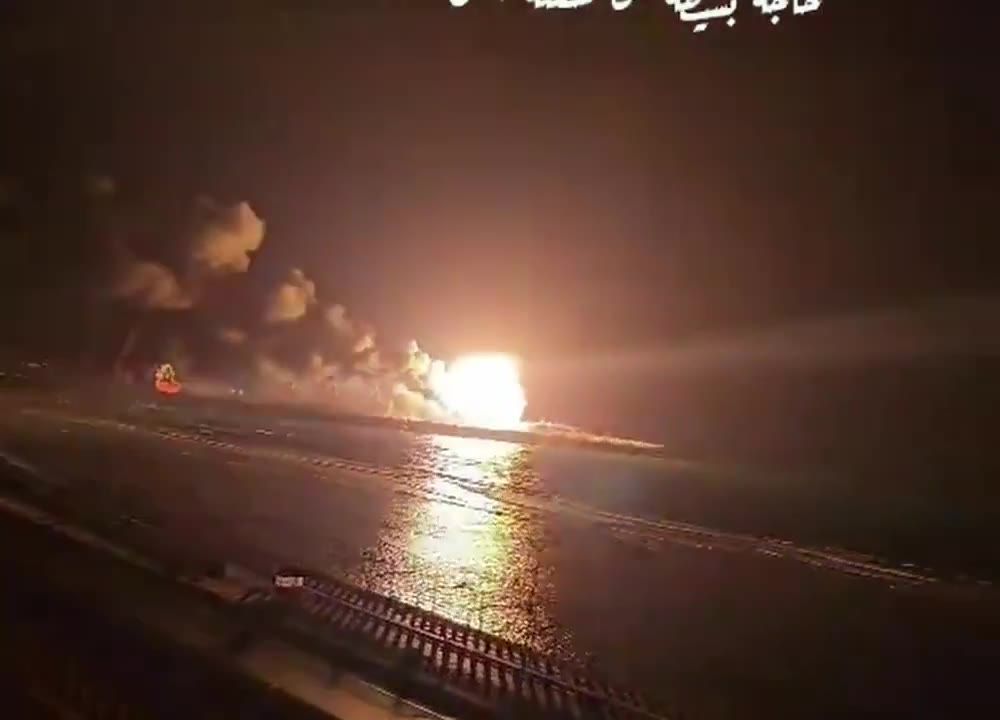
XA short night-time clip posted to X shows a large explosion across water in a port, with a fireball and rising cloud and a railing in the foreground. The caption says the footage was filmed the previous night at Benghazi and that the ship was destroyed. The reader is asked to believe this is genuine footage of a Russian warship destroyed by an explosion.
“Footage of the Russian Navy's Steregushchiy-class corvette Merkury suffering a catastrophic explosion in the port of Benghazi, Libya, last night. The ship was destroyed.”
Posted on X by the OSINTtechnical account. The clip carries an Arabic audio overlay, typical of amateur footage shared from the scene, and appears alongside other videos of the same blast filmed from different angles.
Who posted it
XAccount check
Estimates from public signals — account age, posting pattern, audience — not a judgement of the person behind the account, and separate from whether this post is true.
What stood out
- Account is openly operated by an identified, named human: Blake Spendley, an investigative reporter and Head of OSINT at Hunterbrook Media (formerly Center for Naval Analyses), per Hunterbrook's own team page.
- Long track record: created around October 2019 (~7 years old) and now one of the largest OSINT accounts on X, reportedly ~1.9M followers, embedded in academic studies of Ukraine-war Twitter networks as a central content-producing node.
- Mainstream sourcing and reuse: cited or referenced by Reuters, Bloomberg, WSJ, The Economist, Aviation Week, The Insider, Libyan outlet Al-Wasat, and NPR/WBUR (Spendley interviews), and used by CheckYourFact as an example of legitimate war footage availability.
- Demonstrated correction behaviour: publicly apologised for amplifying an Iran International clip that was at least a day old, and Hunterbrook credits him with being first to correct false oil-tanker 'Iranian strike' claims off Oman.
- Typical output is verifiable material — geolocations with coordinates, vessel/IMO identification, aviation and sanctions data, often linking primary sources (VesselFinder, UKMTO, Aviation Week, war-sanctions.gur.gov.ua).
- Structural caveat: he is a journalist for Hunterbrook Media, whose sister hedge fund Hunterbrook Capital trades on the newsroom's reporting — a genuine conflict-of-interest concern, and the target of accusations of pushing US-government-friendly narratives (e.g., Glenn Greenwald 2023).
- Not flagged by fact-checkers as a purveyor of false claims; criticism has focused on amplification/verification speed and structural bias rather than fabrication.
- High but human-attributable cadence: ~404 posts in 30 days (13.5/day, active 26/30 days), 55% replies and 13% quotes — consistent with a person live-monitoring events, not automated syndication.
- Profile metadata supplied here is sparse (no bio, follower count, or creation date) and reports isplatformverified=false, so signals were reconstructed from external reporting rather than the record itself.
- No evidence of coordinated inauthentic behaviour, fake follower networks, or handle changes; identity is confirmed by employer, conference appearances, and press citations.
Signals (12)+
- Account created approx
- October 2019
- Posting cadence
- ~13.5 posts/day (404 posts in 30 days to 6 Nov 2026)
- Reply share
- 0.55
- Quote share
- 0.13
- Follower ratio
- Not applicable / not provided
- Named operator
- Blake Spendley, Hunterbrook Media
- Affiliation
- Head of OSINT, Hunterbrook Media (hedge-fund-affiliated newsroom)
- Prior affiliation
- Center for Naval Analyses (CNA)
- Notable news coverage
- Reuters, Bloomberg, WSJ, Economist, Aviation Week, The Insider, NPR/WBUR, Al-Wasat
- Fact check history
- Cited favourably by CheckYourFact; no debunking of the account itself; self-corrected an Iran International video mislabel
- Conflicts of interest
- Employer's sibling hedge fund trades on its reporting; accused of pro-US-govt framing by Glenn Greenwald
- Coordinated inauthentic signals
- None observed
Account checked November 23, 2026, 02:47 UTC
The media
Video✓ What is genuine
The video is genuine footage of a real event: the explosion and fire aboard the Russian corvette Merkury at Benghazi on 22 November 2026. The blast was independently reported by the AP and the Guardian, and the ship's sinking was later shown in satellite imagery.
The tells
- ●●● Strong signal The same detonation was filmed from several different angles, and the footage matches landmarks in satellite imagery of the port.TV2 Denmark
- ●●● Strong signal The ship's mast visible in the footage matches the Merkury.TV2 Denmark
- ●●○ Supporting signal The explosion and rising cloud look physically consistent with a large ammunition detonation aboard a docked warship, with no morphing or impossible physics.our visual review
- ●●○ Supporting signal The Arabic audio overlay is typical of amateur footage recorded at the scene, not of polished studio production.our visual review
Synthetic-media detector
Detector not consultedSources settled the claim on their own; the detector was not needed.
How we checked the media
- Reviewed the video's keyframes by eye: a night-time blast across water, a fireball and rising cloud, and a railing in the foreground.
- Compared the visible details against published satellite imagery of Benghazi port as described by TV2's verification reporting.
- Checked whether the ship's visible features match the Merkury, as reported by TV2.
- Searched for reporting on whether the circulating explosion clips had been verified.
Sources
9 sources reviewed- 1Russian warship sinks in Benghazi after suspected Ukrainian drone attack ↗
The Guardian · theguardian.comReputable outletLean Left (AllSides)Evidence
Reports the early-hours strike on a Russian warship at Benghazi and satellite imagery showing the Merkury sunk.
- 2Suspected Ukrainian sea drones hit Russian warship at Benghazi naval base, Libyan officials say ↗
Associated Press (via Canadian Press) · thecanadianpressnews.caUntiereduntiered — treated as signal only, never decisiveEvidence
Provides the official Libyan military account that a Russian corvette was severely damaged by sea drones at Benghazi naval base.
- 3Videoer viser samme eksplosion fra flere vinkler ↗
TV2 Denmark · nyheder.tv2.dkUntiereduntiered — treated as signal only, never decisiveEvidence
Explains why the circulating explosion videos are considered very probably genuine, citing multiple angles, landmarks and the ship's mast.
- 4Russian Missile Corvette Merkury Engulfed in Flames After Explosion in Libya's Benghazi Port ↗
Kyiv Post · kyivpost.comUntiereduntiered — treated as signal only, never decisiveEvidence
Identifies the burning vessel as the Project 20380 Steregushchiy-class corvette Merkury, based on Naval News reporting.
- 5Satellite Images Show russian Merkury Corvette Sunk in Libya After Explosion ↗
Defense Express · en.defence-ua.comUntiereduntiered — treated as signal only, never decisiveEvidence
Publishes satellite imagery showing the Merkury submerged at Benghazi port.
- 6Libya says Russian corvette in Benghazi hit by drones ↗
Defence Blog · defence-blog.comUntiereduntiered — treated as signal only, never decisiveEvidence
Reports that Libya's eastern government confirmed a Russian ship was hit and opened an investigation with Moscow.
- 7Ryskt krigsfartyg angripet i hamn i Libyen ↗
Yle · yle.fiReputable outletCenter — Finnish public serviceContext
Independently places the explosion and fire on board a docked Russian warship at Benghazi on Sunday.
- 8俄艦停泊利比亞遇襲沉沒 傳遭無人艇夜間突襲 ↗
中央社 CNA · cna.com.twUntiereduntiered — treated as signal only, never decisiveContext
Reports the overnight explosion and sinking of a Russian warship at Benghazi in Chinese-language coverage.
- 9Corveta russa Merkury aparece parcialmente afundada após ataque em porto da Líbia ↗
Poder Naval · naval.com.brUntiereduntiered — treated as signal only, never decisiveContext
Describes satellite images of the partially submerged Steregushchiy-class Merkury after the attack.
Further reading
- 3TV2 Denmark TV2's account of how the explosion clips were checked is the clearest published explanation of why they are considered genuine.
- 2Associated Press (via Canadian Press) The AP report gives the official Libyan account of what hit the ship and what happened at the base.
- 5Defense Express Shows the satellite imagery that settles the question of whether the ship sank.
- 1The Guardian The Guardian's report connects the attack, the official response and the after-the-event imagery in one place.
The full story
The kernel of truth here is straightforward: a Russian warship really was destroyed at Benghazi. In the early hours of Sunday 22 November 2026, a large explosion and fire struck the Russian Navy's Steregushchiy-class corvette Merkury while it was docked at the Benghazi naval base in eastern Libya, reportedly for refuelling and supplies.
Libyan military officials told the Associated Press that Ukrainian sea drones launched from western Libya were used, with two of at least six drones hitting the ship. Libya's eastern government confirmed that a Russian vessel had been struck and said it was investigating with Moscow. Russia and Ukraine made no immediate comment, and no party formally claimed responsibility.
That gap — a dramatic event with no official claim — is exactly the environment in which speculation spreads fastest. Some Libyan emergency officials initially attributed the blast to an onshore ammunition depot, which briefly muddled the picture before the eastern government confirmed a Russian ship had been hit. Meanwhile satellite imagery settled the outcome: the corvette lay sunk alongside the pier with only its bow above water.
So the post was not inventing an event. It was sharing real footage of a real attack and getting the essentials right: the ship, the class, the port and the timing. The reason the claim earned a TRUE headline is not that the poster is reliable — it is that the reporting, the imagery and the video's own details all line up.
Kernel of truth
A genuine attack destroyed the Russian corvette Merkury at Benghazi on 22 November 2026, and the clip is real footage of that explosion.
Timeline
November 22, 2026
A large explosion and fire strike the Russian corvette Merkury while docked at Benghazi naval base in eastern Libya; Libyan military officials tell the AP that Ukrainian sea drones were used. 2Associated Press (via Canadian Press)
November 22, 2026
TV2 reports that the circulating explosion videos are very probably genuine and shows the same detonation filmed from several angles. 3TV2 Denmark
November 22, 2026
Satellite imagery shows the Merkury sunk alongside the pier with only its bow above water. 5Defense Express
November 22, 2026
Libya's eastern government confirms a Russian ship was hit and says it will investigate with Moscow. 6Defence Blog
How it was framed
The caption's assertions about the ship's identity, the explosion and its destruction are all confirmed by independent reporting and satellite imagery. There is no fabricated element, no altered media and no misleading framing to classify.
- “Visual proof”. The post leads with the footage itself — a large night-time explosion — so the reader sees the event before reading the caption.
- Missing context. The caption states the ship was destroyed but does not say who attacked it; Libyan officials' account of Ukrainian sea drones appears only in the reporting, not the post.
Posted on X by the OSINTtechnical account, an open-source intelligence account that shares and analyses footage of military events. The post's caption is in English; the clip carries Arabic audio.
Bias
Leans pro-Ukraine. The post is a factual OSINT report, but the framing language ('catastrophic explosion', 'The ship was destroyed') emphasises the severity of a loss for Russia's navy, a tone common to Ukraine-sympathetic conflict monitors. No false or unsupported detail is introduced.
Bias describes how the post frames its message — the slant of the language, selection and emphasis — and is judged separately from whether the claim is true. A true claim can still be framed with a strong slant.
How we checked
41 s- 1
Searched for coverage of a Russian corvette explosion at Benghazi, Libya, including under the ship's name.
- 2
Reviewed the video's keyframes by eye for signs of manipulation and for consistency with a large blast aboard a docked warship.
- 3
Compared the footage with reporting on how broadcasters verified the circulating explosion clips, including matching landmarks and the ship's mast.
- 4
Checked whether the ship's destruction was shown in imagery and reported by more than one independent outlet.
- 5
Searched for any existing fact-check that had challenged the footage.
✓ Claim checked✓ Media checked✓ Sources checked
Why 90% confidence
HighThe headline is TRUE with HIGH confidence because three independent lines of evidence agree: official-sourced reporting of the event, broadcaster verification of the footage, and satellite imagery of the sunken ship. We did not run an automated media detector on this clip; the media verdict rests on visual review and the published verification reporting.
Limits. We did not geolocate this specific frame-by-frame clip ourselves, and TV2's verification covered the circulating explosion videos as a group rather than this upload alone.
What we don’t know
- Who exactly launched the attack: Libyan officials described Ukrainian sea drones, but no party formally claimed responsibility and Russia and Ukraine did not comment.
- Why the Merkury was in Benghazi; reporting says it was there for refuelling and supplies, but the full purpose is not established.
- What the joint investigation announced by Libya's eastern government and Moscow will conclude.
Spot it yourself
Why it looked fakeLooks suspicious, isn’t proof
- A dramatic night explosion from an anonymous source is the classic shape of a fake — but striking footage is not evidence of fabrication on its own.
- An Arabic audio overlay on an English-language post can look like recycled or mismatched footage, but here it fits an amateur recording from the scene.
- The post came from a social media account rather than a news organisation, which is a reason to check, not a verdict.
The actual evidence
- Independent outlets, including the AP with named Libyan military officials, reported the explosion and the attack at Benghazi naval base.
- TV2 reported that the same detonation was filmed from several angles and that landmarks and the ship's mast matched satellite imagery of the port and the Merkury.
- Satellite imagery showed the corvette sunk alongside the pier with only its bow above water.
- Naval analysts identified the vessel as the Steregushchiy-class corvette Merkury, matching the caption.
- 1
Ask who else is reporting it
If a warship really sank in a foreign port, wire services and national broadcasters will be covering it within hours. Search the ship's name and the port, and see whether mainstream outlets are reporting the same event.
- 2
Check the footage against the place, not just the event
Compare visible landmarks — cranes, breakwaters, buildings — with satellite imagery of the named port. A real blast in the wrong harbour is a common trick.
- 3
Compare the ship with published images
Look for distinguishing features such as the mast or superstructure and match them to photographs of the named vessel.
- 4
Look for the same moment from other angles
Several independent recordings of one detonation are much harder to fake than a single clip, and broadcasters often compile them when verifying.
- 5
Wait for the after-picture
Satellite imagery or clear-day photographs taken after the event show whether the ship is actually damaged or sunk, which settles claims about destruction.
Takeaway
Dramatic footage from an unfamiliar account is neither automatically fake nor automatically real; the deciding evidence is usually whether independent reporters, other camera angles and after-the-event imagery describe the same thing.
Questions people ask
Was the Russian corvette Merkury really destroyed in Benghazi?+
Yes. Satellite imagery showed the Steregushchiy-class corvette Merkury sunk alongside the pier at Benghazi with only its bow above water after the explosion on 22 November 2026. Naval News assessed it as almost certainly destroyed, and the Guardian, AP and specialist naval outlets reported the vessel as sunk.
Is the explosion video real or AI-generated?+
It appears to be real. Danish broadcaster TV2 assessed the circulating clips as very probably genuine, noting that the same detonation was filmed from several angles, that landmarks matched satellite imagery of the port, and that the ship's mast matched the Merkury. The physical event was independently reported by the AP and the Guardian.
Who attacked the Merkury?+
Libyan military officials told the Associated Press that Ukrainian sea drones launched from western Libya were used, with two of at least six drones hitting the ship. No party has formally claimed responsibility, and Russia and Ukraine made no immediate comment. Libya's eastern government confirmed a Russian vessel was hit.
Why did some reports mention an ammunition depot?+
Some Libyan emergency officials initially attributed the blast to an onshore ammunition depot. The eastern government later confirmed that a Russian ship docked at the port had been hit and said it would investigate with Moscow, which resolved the early confusion.
What is a Steregushchiy-class corvette?+
It is a class of Russian Navy guided-missile corvettes, designated Project 20380. They are relatively small warships built for patrol and combat roles. The Merkury is one of these vessels, and its identity was provisionally confirmed by naval analysts and specialist outlets.
Go deeper
- Corvette
- A relatively small, fast warship, often used for patrol and escort duties; the Merkury is a Russian Project 20380 Steregushchiy-class corvette.
- OSINT
- Open-source intelligence: the practice of gathering information from publicly available material such as social media, satellite images and shipping data.
- Sea drone
- An uncrewed surface vessel, often packed with explosives, used to attack ships or port facilities.
- Geolocation
- Working out exactly where a photo or video was taken by matching visible landmarks, buildings and terrain to known maps or satellite imagery.
- Satellite imagery
- Photographs of the ground taken from orbit, often used after an event to show the condition of a site without relying on eyewitnesses.
People also search for
For educators+
- What would you need to see before accepting a dramatic explosion video as genuine, and which of those things exist in this case?
- Libyan officials blamed Ukrainian sea drones, but no party claimed responsibility. How should a careful reader describe that in a headline?
- TV2 said the clips were 'very probably' genuine. What is the difference between that and a certainty, and why might a newsroom choose the cautious wording?
About this check
- Platform
- X
- Posted by
- @osinttechnical
- Posted
- November 22, 2026
- Age when checked
- Under 24 hours old when checked
- Where it spread
- LY, Russia, Ukraine
- Audience
- International audience
- Language
- EN
- Status
- ● Post is live
- Verified
- November 23, 2026, 02:48 UTC
- Published
- November 23, 2026, 02:48 UTC
Reach. 12,245 likes on primary; visegrad24 5,084 likes; UK pickup by Mirror, GB News, Guardian 22 Nov; Kyiv Post, Maritime Executive, RedState, United24
This verdict was generated with AI from the sources shown. AI can make mistakes — check the sources before relying on it.
Check anything yourself, in seconds.
Share any social post or video to What the Fact and get the verdict, the confidence, and the receipts.