Did smoke rise over Russian National Guard unit 3702 in Krasnodar after explosions?
Did Ukrainian drones strike the Russian National Guard (Rosgvardia) headquarters/base in Krasnodar overnight on 22 November?
True, but…
The smoke and explosions are well documented; the exact target is OSINT, not official confirmation.
True, with caveats. On the night of 21-22 November 2026, explosions were heard in Krasnodar and residents photographed smoke over the site at 70 Cherkasska Street, which formerly housed military unit 3702 and now houses Russia's National Guard regional headquarters. Multiple outlets reported it, but the exact target comes from OSINT geolocation, not official Russian confirmation.
 Likely genuine
Claims
✓ 3 trueFollowing numerous explosions in Krasnodar, smoke was observed in the area of the military base of Russian National Guard unit 370212346
“Following numerous explosions in Krasnodar, smoke has been observed in the area of the military base of unit 3702 of the Russian National Guard.”
This is the core of the post and it holds up on several fronts. Outlets across different languages and newsrooms reported the same overnight sequence: explosions in Krasnodar, air-raid sirens, a burning smell, and photos and video of thick smoke. The Kyiv Post and RBC-Ukraine describe the blasts and the smoke near unit 3702's compound without relying on one another's copy. Crucially, the location of the smoke was not simply asserted: ASTRA's OSINT analysis of eyewitness images, including Exilenova+ footage, placed the likely fire at 70 Cherkasska Street. Independent corroboration of the visible event is strong. What a careful reader should weigh is the wording. The caption says smoke was observed near the base, not that the base was hit, and that narrower observation is exactly what the reporting supports. The wider interpretation — a strike on the National Guard building — is treated separately below.
The site is a Russian National Guard facility (unit 3702 / Rosgvardia regional headquarters)158
The address and its institutional history are consistent across the sources that examined it. ASTRA's analysis, as relayed by LB.ua and Charter97, identifies 70 Cherkasska Street as the location, noting it was previously the base of military unit 3702, the 47th Separate Operational Brigade, and is now the seat of the Russian National Guard's Main Directorate for Krasnodar Krai. That is a specific, checkable geographic and institutional claim rather than a general impression, and the outlets repeating it describe it the same way. The caveat is that this chain of identification is OSINT work — matching photographs to buildings — rather than a Russian official listing of the address. Still, the identification is a statement about which building stands where, and on that question the convergent reporting is firm. Readers should note that the post's own wording calls it the base of unit 3702, which matches the earlier use of the site rather than its current occupant.
Still open: Russian authorities have not published a statement confirming which building occupies the site or what damage it sustained.
The National Guard building was struck and caught fire2478
This is where the story becomes probable rather than proven. Ukrainian outlets, following ASTRA, describe the Rosgvardia regional headquarters as likely hit and ablaze, based on matching smoke imagery to the building's location. That reasoning is sound as far as it goes: the smoke is documented, and it appears over a specific address. But the step from "smoke over this address" to "this building was struck and burned" is an inference, and the one party that could confirm it directly — Russian officials — did not. Local authorities said the drone attack was repelled, and the Defence Ministry said 170 drones were intercepted overnight across several regions including Krasnodar Krai, without acknowledging fire or damage. UNN explicitly notes the strike is OSINT-based and officially unconfirmed. Absent that confirmation, a cautious reader should treat the strike as likely but not settled, which is why we rate it lower than the broader observation.
Still open: Whether the building itself was damaged, and how severely, is not established by any source in our file.
What was posted
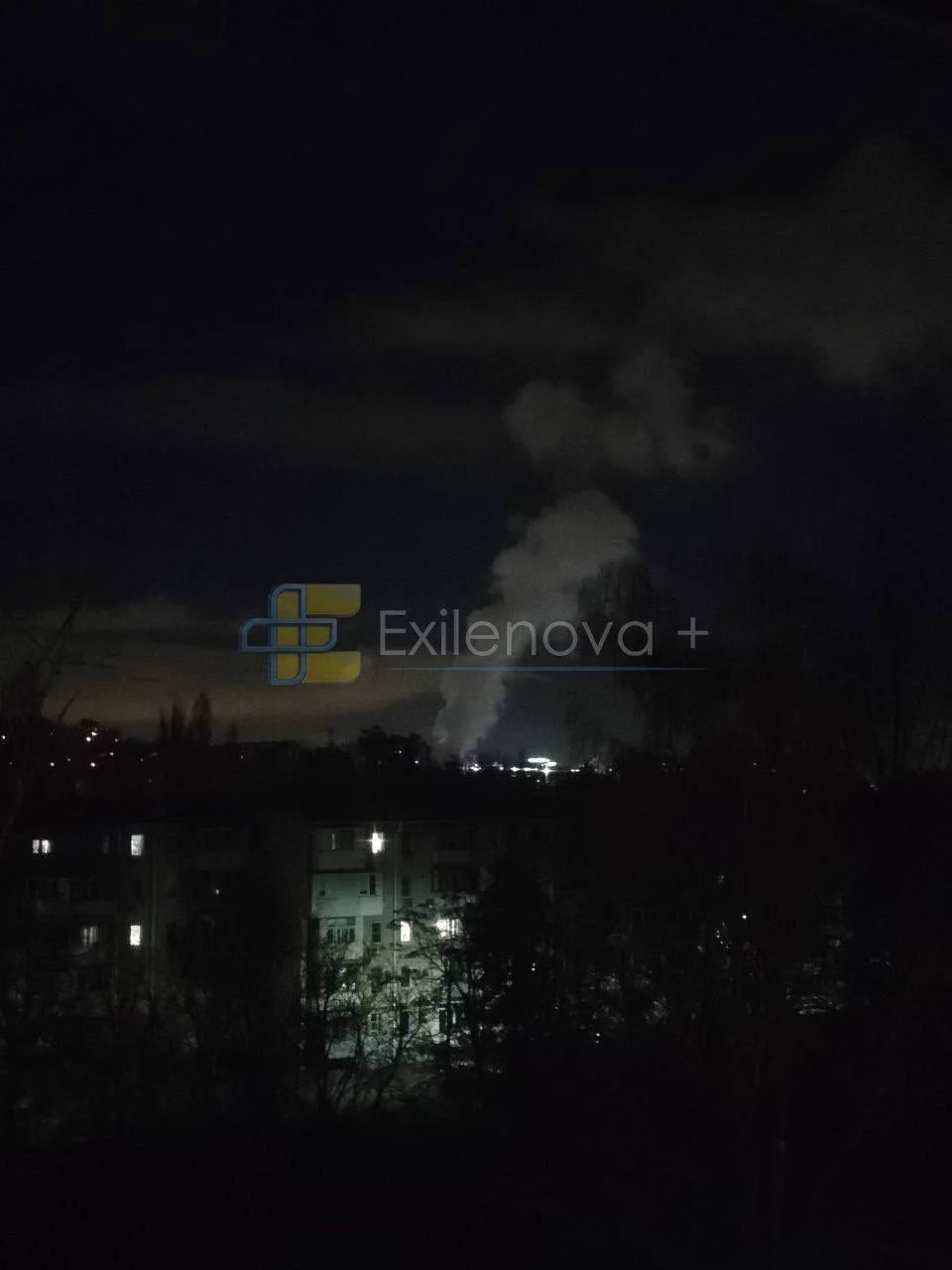
XA post on X by the Exilenova+ monitoring channel, carrying a single night-time photo of a city skyline with a pale smoke plume above the rooftops. The caption states that after numerous explosions in Krasnodar, smoke was seen in the area of the base of Russian National Guard unit 3702. The reader is asked to accept the photo as an eyewitness sighting at that specific site.
“Following numerous explosions in Krasnodar, smoke has been observed in the area of the military base of unit 3702 of the Russian National Guard.”
Posted by the Exilenova+ monitoring channel, whose eyewitness footage ASTRA later used in its geolocation analysis. No engagement figures were recorded with the post.
Who posted it
XAccount check
Estimates from public signals — account age, posting pattern, audience — not a judgement of the person behind the account, and separate from whether this post is true.
What stood out
- The X handle @Exilenova_plus is the English-language mirror of Exilenova+, a large Ukrainian OSINT/monitoring Telegram channel (~240K subscribers), per TGStat and t.me.
- It is a genuine, continuously operating collective rather than a fabricated persona: interviewed by Dagens.se (Feb 2026) as an anonymous multinational volunteer team formed on Telegram and pivoting to Ukraine war coverage after Feb 2022.
- Its material is widely cited by mainstream outlets — NV, DW (via Astra), Militarnyi, L'Indépendant, Gordon — especially geolocated strike footage and satellite imagery, which is a strong sign of genuine sourcing.
- However, it is openly belligerent-aligned: it describes its mission as supporting the Ukrainian army, deliberately covers only strikes on Russian-held territory, and never publishes material on Ukrainian targets.
- No published verification methodology, corrections policy or bylined editors; operators are anonymous even to each other, and the team declines to explain how it fact-checks.
- Documented accuracy failure: SVT Verifieringshjälpen (Oct 2025) found an Exilenova+ train video captioned as heading 'toward Estonia/Latvia' was misleading — filmed ~100 km from the border, with the direction unsourced; the English X repost amplified it to 500K+ views.
- The X account itself shows no verification badge and the profile metadata is empty on the platform side, but its posts consistently translate Telegram content — consistent with automated cross-posting (one post in the afternoon UTC), not with organic personal posting.
- No evidence of fake followers, coordinated inauthentic networks, or platform enforcement actions found; the risk profile is partisan-source bias rather than bot/astroturf.
- A caution applies: claims are typically single-source, first-to-publish strike footage, so cross-referencing with independent OSINT (Astra, GeoConfirmed) is warranted before treating them as fact.
Signals (12)+
- Account type
- Mirror of Telegram OSINT collective
- Cross platform presence
- Telegram (primary, ~240K subs), X, Instagram
- Platform verification
- No
- Telegram verification
- No
- Posting cadence
- Daily, near-fixed UTC time (automated cross-post pattern)
- Notable news coverage
- Cited by NV, DW, Militarnyi, L'Indépendant, Gordon, Ukraine Today
- Documented fact check
- SVT Verifieringshjälpen (2025-10-25): train video caption 'toward Estonia/Latvia' judged misleading
- Editorial transparency
- Low — anonymous operators, no corrections policy, undisclosed verification method
- Declared alignment
- Explicitly pro-Ukrainian, mission statement of support for Ukrainian army
- Content bias
- Selective — omits Ukrainian-side losses/targets
- Coordination evidence
- None found beyond stated partnerships with like-minded Telegram channels
- Recent activity
- Active as of 2026-11-21, covering Kaliningrad, Dorogobuzh, Krasnodar, Benghazi USV claims
Account checked November 23, 2026, 03:03 UTC
The media
Image✓ What is genuine
The photograph itself appears to be a genuine night-time image of smoke over Krasnodar, and its framing — smoke in the area of a specific site — matches what independent reporting describes.
The tells
- ●●● Strong signal Detector scores it as not AI-generated (about 0.97 confidence in that class) with a deepfake score of 0.0.our detector
- ●●○ Supporting signal The scene is an ordinary low-light phone photo: dark skyline, apartment blocks, street lights, grainy texture and a single smoke plume above the rooftops.our visual review
- ●●○ Supporting signal The Exilenova+ watermark matches the channel's own eyewitness material that ASTRA analysed, rather than a repost of unknown origin.our visual review
- ●○○ Weak signal No obvious compositing edges, repeated texture or impossible lighting where the smoke meets the rooftops.our visual review
Synthetic-media detector
Detector ranThe claim stands or falls on whether the media is real, so the detector ran.
Scores are the detector’s estimate for the file as uploaded. A low score does not rule out editing, a spliced caption, or footage shown out of context — those are judged above. Model v3.
How we checked the media
- Reviewed the image visually for physical plausibility, lighting, grain and signs of compositing.
- Ran our image detector (hive-v3), which returned a very low AI-generation score and a deepfake score of zero.
- Compared the image's watermark and appearance with descriptions of the Exilenova+ eyewitness material that ASTRA used in its geolocation analysis.
Sources
8 sources reviewed- 1Drones Strike Krasnodar, Rosgvardia Headquarters Reportedly Ablaze ↗
LB.ua · en.lb.uaUntiereduntiered — treated as signal only, never decisiveEvidence
Links the Exilenova+ smoke observation to ASTRA's geolocation at 70 Cherkasskaya Street.
- 2Drones Strike Rosgvardiya Headquarters in Krasnodar, Smoke Near Afipsky Oil Refinery ↗
Kyiv Post · kyivpost.comUntiereduntiered — treated as signal only, never decisiveEvidence
Describes the overnight drone attack on Krasnodar and the likely hit on the National Guard directorate.
- 3Explosions rock Russian regions as smoke reported near oil refinery and National Guard base ↗
RBC-Ukraine · newsukraine.rbc.uaUntiereduntiered — treated as signal only, never decisiveEvidence
Confirms explosions in Krasnodar and residents reporting smoke near the unit 3702 compound.
- 4Russian National Guard headquarters reportedly struck in overnight Krasnodar drone attack ↗
The New Voice of Ukraine · english.nv.uaUntiereduntiered — treated as signal only, never decisiveEvidence
Adds resident reports of a burning smell and airport restrictions.
- 5The Rosgvardia Main Directorate In Krasnodar Has Been Hit ↗
Charter97 · charter97.linkUntiereduntiered — treated as signal only, never decisiveEvidence
Reports ASTRA's OSINT finding that the Rosgvardia Main Directorate for Krasnodar Krai was likely struck.
- 6В Краснодаре загорелось здание Росгвардии - СМИ ↗
Korrespondent.net · korrespondent.netUntiereduntiered — treated as signal only, never decisiveEvidence
States that OSINT analysis places the fire at Cherkasskaya 70, the former unit 3702 address.
- 7Rusia derriba 170 drones ucranianos sobre ocho regiones y los mares Negro y Azov ↗
Infobae (EFE) · infobae.comUntiereduntiered — treated as signal only, never decisiveEvidence
Provides the Defence Ministry's 170-drone interception figure and the independent indication of the target.
- 8In Krasnodar, a building of the Russian Guard's main administration likely caught fire after a drone attack ↗
Ukrainian National News (UNN) · unn.uaUntiereduntiered — treated as signal only, never decisiveEvidence
Flags that the strike information rests on OSINT and has not been officially confirmed.
Further reading
- 5Charter97 Reports ASTRA's OSINT analysis identifying the Rosgvardia regional directorate as the likely target.
- 2Kyiv Post Gives the fullest English-language account of the overnight attack, including sirens, smoke reports and airport disruption.
- 8Ukrainian National News (UNN) Explicitly states that the strike information is OSINT-based and officially unconfirmed, the key caveat in this story.
- 7Infobae (EFE) Carries the Russian Defence Ministry's 170-drone figure alongside the independent channel's indication of the target.
The full story
The post rests on a real and well-documented night. Overnight on 21-22 November 2026, long-range drones attacked Russia's Krasnodar Krai. Explosions were heard in Krasnodar city, air-raid sirens sounded, and Krasnodar airport temporarily restricted arrivals and departures. Residents reported a strong burning smell and began posting photos and video of thick smoke rising over the city.
The specific site in the post came from open-source work rather than an official announcement. ASTRA analysed the published imagery, including footage from the Exilenova+ channel, and placed the likely fire at 70 Cherkasska Street. That address formerly housed military unit 3702, the 47th Separate Operational Brigade, and now houses the Russian National Guard's Main Directorate for Krasnodar Krai. Ukrainian outlets, and the EFE wire, picked up that identification and reported the regional National Guard headquarters as likely struck.
Russian officials told a different, narrower story. Local authorities said the attack was repelled. The Defence Ministry said 170 drones were intercepted overnight over several regions, including Krasnodar Krai. Neither confirmed a fire or damage at the site.
That gap is what makes the claim feel contested even though most of it is solid. The explosions, the smoke, the sirens, the smell and the airport disruption are all independently reported. The identification of the building is careful OSINT work. Only the final step — that this particular building was hit and burned — remains probable rather than confirmed, and that is why the post is true with caveats rather than flatly true.
Kernel of truth
A real overnight drone attack on Krasnodar produced genuine eyewitness photos of smoke, which OSINT analysis tied to a specific National Guard site.
Timeline
November 21, 2026
Overnight, long-range drones attack Krasnodar Krai; explosions are heard in Krasnodar and air-raid sirens sound. 2Kyiv Post
November 22, 2026
Residents report a burning smell and post photos and video of smoke; Krasnodar airport temporarily restricts flights. 4The New Voice of Ukraine
November 22, 2026
ASTRA's OSINT analysis places the likely fire at 70 Cherkasska Street, the former unit 3702 site and current Rosgvardia regional headquarters. 5Charter97
November 22, 2026
Russia's Defence Ministry says 170 drones were intercepted overnight over several regions including Krasnodar Krai; local authorities say the attack was repelled. 7Infobae (EFE)
How it was framed
The caption describes an observation — smoke seen in the area of a specific site after explosions — and that observation is supported by multiple independent reports and by OSINT geolocation. The only element beyond confirmed fact, that the building itself was struck, is framed by the wider reporting as likely, not certain, so the post is best classified as broadly accurate rather than misleading or false context.
- “Visual proof”. The post carries a single night photo of a smoke plume over rooftops, inviting the reader to treat the image as direct proof of the sighting.
- Missing context. The caption says smoke was seen "in the area of" the base but does not note that Russian authorities did not confirm any fire or damage.
Posted on X by the Exilenova+ monitoring channel. Exilenova+ eyewitness footage was among the material ASTRA used in its OSINT geolocation; several outlets relayed the Exilenova+ observation while attributing the building identification to ASTRA.
Bias
Leans pro-Ukraine. The post comes from a Ukrainian open-source monitoring channel that documents strikes on Russian military and security targets; its framing emphasises a hit on a National Guard facility, but the stated facts (explosions, smoke over the site) are reported neutrally and match other coverage.
Bias describes how the post frames its message — the slant of the language, selection and emphasis — and is judged separately from whether the claim is true. A true claim can still be framed with a strong slant.
How we checked
37 s- 1
Searched in English and Russian for reporting on explosions and smoke in Krasnodar in November 2026.
- 2
Searched for coverage of the drone attack, the National Guard site and the Defence Ministry's interception figures.
- 3
Checked whether the claimed event would be widely reported and whether it was, to test for absence of coverage.
- 4
Reviewed the image visually for physical plausibility and signs of manipulation.
- 5
Ran our image detector (hive-v3) on the photo and recorded its scores.
✓ Claim checked✓ Media checked✓ Sources checked
Why 80% confidence
ModerateWe are at MODERATE overall and HIGH on the core observation because several outlets in different languages independently describe the same explosions, smoke, sirens and airport disruption, and the image shows no sign of AI generation. The strike on the building stays at LIKELY_TRUE with MODERATE confidence because the decisive step rests on OSINT geolocation and Russian officials have not confirmed fire or damage.
Limits. We did not open the underlying articles in full, relying on their indexed summaries. We had no Russian official statement confirming damage, and we could not independently geolocate the photo ourselves beyond comparing it with ASTRA's published analysis.
What we don’t know
- Whether the National Guard building itself was damaged, and how badly.
- What, if anything, was hit at the site beyond the smoke observed.
- Whether Russian authorities will later confirm or deny damage at 70 Cherkasska Street.
- Whether other strikes that night — such as those reported near the Afipsky oil refinery — were connected to the same attack wave.
Spot it yourself
Find the overstatementLooks suspicious, isn’t proof
- The post comes from a monitoring channel with a clear point of view in the war, which makes people distrust it — but a partisan source can still publish a genuine photo.
- The image is dark, grainy and low-resolution, the kind of picture people assume must be hiding something. Night phone photos simply look like this.
- The message arrived fast, within hours of the explosions, which can feel too quick to be verified. Breaking-news eyewitness posts often are that quick and still accurate.
The actual evidence
- Independent outlets in different languages reported the same explosions, sirens, burning smell and airport restrictions, which is corroboration that does not trace to one origin.
- ASTRA geolocated the smoke to a specific address using the eyewitness imagery, turning a general impression into a checkable location.
- Our image detector found no sign of AI generation, and the visual review found nothing physically implausible.
- The Russian Defence Ministry's own account of intercepting 170 drones fits the same night, even though it does not confirm the damage.
- 1
Separate the observation from the interpretation
Ask what the post literally claims. Here it says smoke was seen in the area of a site — narrower than "the base was destroyed". Check whether the evidence supports the narrow version or the dramatic one.
- 2
Look for corroboration that does not share an origin
If five outlets all cite the same channel, that is one source. Look for reporting that adds something new, such as residents' accounts, airport notices or a geolocation by a separate analyst.
- 3
Check what the accused party says
Official statements can be incomplete or self-serving, but their silence on a specific point tells you where confirmation stops. Here Russian officials confirmed intercepting drones but not a fire.
- 4
Inspect the image for the basics, not for drama
Check lighting, shadows and edges where smoke meets buildings. Remember that a watermark shows where an image was published, not that it is real — and a clean detector result shows it is probably not AI, not that its caption is correct.
Takeaway
Real events often generate posts that are true in their observation but looser in their conclusion; the skill is separating what was seen from what was inferred, and noticing when only the first is confirmed.
Questions people ask
Did drones hit the Russian National Guard headquarters in Krasnodar?+
It is likely but not officially confirmed. Ukrainian outlets and the EFE wire reported the Rosgvardia regional headquarters as probably struck, based on ASTRA's geolocation of smoke to 70 Cherkasska Street. Russian authorities said the attack was repelled and did not confirm any fire or damage, so the strike remains OSINT-based.
Was the photo of smoke in Krasnodar AI-generated?+
No sign of it. Our detector scored the image as not AI-generated with high confidence and found no deepfake indicators, and the scene looks like an ordinary low-light phone photo. The image carries the Exilenova+ watermark, matching the eyewitness material ASTRA used in its analysis.
What is military unit 3702?+
It is the designation of a Russian military formation, the 47th Separate Operational Brigade, previously based at 70 Cherkasska Street in Krasnodar. According to ASTRA's analysis, that address now houses the Russian National Guard's Main Directorate for Krasnodar Krai.
How many drones did Russia say it intercepted that night?+
Russia's Defence Ministry said 170 drones were intercepted overnight over several regions, including Krasnodar Krai, according to the EFE wire. Local authorities said the attack was repelled. Neither statement addressed reports of a fire at the National Guard site.
Why does the wording "in the area of" matter?+
Because it describes an observation rather than a conclusion. Saying smoke was seen near a site is a claim about what a witness saw; saying the site was struck is a claim about damage. Only the first is directly supported by the imagery and by official silence on the second.
Go deeper
- OSINT
- Open-source intelligence: information gathered from publicly available material such as social media posts, photos and maps, then analysed to establish facts like a location.
- Geolocation
- The process of working out exactly where a photo or video was taken by matching visible details to maps, buildings or landmarks.
- Rosgvardia
- The Russian National Guard, a state security force separate from the regular army, with regional directorates across Russia.
- Watermark
- A logo or text overlaid on an image to show who published it; it shows provenance, not whether the picture is genuine.
- Deepfake detector
- A tool that estimates whether an image or video was made or altered by AI, usually by scoring it against known generation methods.
People also search for
For educators+
- The post says smoke was seen "in the area of" a base, while headlines said the headquarters was struck. How much difference does that wording make to what a reader believes?
- If ten outlets all cite the same monitoring channel, how many independent sources do you actually have, and how would you find more?
- When a government denies damage and analysts say otherwise, what would you need to see before deciding who is right?
About this check
- Platform
- X
- Posted by
- @exilenova_plus
- Posted
- November 21, 2026
- Age when checked
- 1–2 days old when checked
- Where it spread
- Russia, Ukraine
- Audience
- International audience
- Language
- EN
- Status
- ● Post is live
- Verified
- November 23, 2026, 03:04 UTC
- Published
- November 23, 2026, 03:04 UTC
Reach. 470 likes; Kyiv Independent, Euromaidan Press and Open (IT) liveblog 22 Nov; ASTRA OSINT
This verdict was generated with AI from the sources shown. AI can make mistakes — check the sources before relying on it.
Check anything yourself, in seconds.
Share any social post or video to What the Fact and get the verdict, the confidence, and the receipts.