Did Khalifa Haftar give a speech after the attacks on Russian ships in Benghazi?
Does a viral video show Khalifa Haftar giving a speech after the recent attacks on Russian ships in Benghazi?
Misleading
The video is genuine, but it is two years older than the caption claims.
Misleading. The Haftar footage is real, but it is his 24 December 2024 speech marking the 73rd anniversary of Libyan independence, posted by the Libyan Arab Armed Forces General Command on Facebook — not a reaction to the 22 November 2026 Ukrainian drone attacks on Russian ships at Benghazi. Those attacks did happen; Haftar made no filmed address about them.
 Genuine
Claims
✓ 1 true · ✕ 1 falseThe video shows Khalifa Haftar delivering a speech after the recent attacks on Russian ships in Benghazi.1
“كلمة خليفة حفتر بعد الهجوم الأخير على السفن الروسية في بنغازي”
The footage is authentic but its date is not. Misbar traced the clip to Haftar's address on the 73rd anniversary of Libyan independence, published on the Libyan Arab Armed Forces General Command Facebook page on 24 December 2024 — about two years before the Benghazi ship attacks. That provenance comes from a single fact-checking outlet, but it is anchored in a citable original post on the command's own page, which is stronger than a second outlet repeating the same claim. Misbar also found no filmed speech or direct statement by Khalifa Haftar about the November 2026 attacks; the eastern command's only public comment came from his son, deputy commander Saddam Haftar, in a written Facebook post. And the speech transcript itself is generic: it speaks of regional dangers, vigilance, readiness and national unity, with no mention of Russian ships, drones or Benghazi port. Weigh the caption against that: a real video, real speaker, wrong occasion. The caption's key association collapses.
Still open: The exact X account behind the post and whether it reposted the clip from elsewhere was not established in our record.
Russian ships were recently attacked in Benghazi.234
This part of the caption is accurate, and it is why the post felt credible. On the night of 21–22 November 2026 Ukrainian naval drones struck the Russian corvette Merkury while it was docked at the Benghazi naval base and it sank; hours later a Malta-flagged cargo vessel was hit offshore. Libya's eastern government, the Tripoli government, the UN mission and multiple wire services reported the attacks, and President Zelensky claimed responsibility on 23 November. The reporting is independent in the sense that it does not all trace to one origin: the Guardian, the Kyiv Independent and the Telegraph each drew on different combinations of Libyan officials, satellite imagery and Ukrainian statements. When several outlets that do not share a single source describe the same event, the event itself is well established. The true part of the caption is what gave the false part its cover.
Haftar's speech says the General Command is monitoring dangerous regional developments and is at a high level of vigilance and readiness to protect Libya's gains, security and stability.1
“أن القيادة العامة تراقب المتغيرات الخطيرة التي تجتاح المنطقة وأننا على درجة عالية من اليقظة والجاهزية لحماية مكتسباتنا ومقدراتنا”
This is what the video actually says, and it is political rhetoric rather than a checkable factual claim. The passage speaks in general terms about regional dangers, high vigilance, readiness, national unity, and the sacrifices of Libya's wounded and martyrs. It contains no date, no named event, no reference to Russian ships, drones or Benghazi port. That matters for the verdict: the words are broad enough that a viewer primed by the caption could read them as a reaction to almost anything, including the ship attacks. The text does not confirm the caption; it simply fails to contradict it outright. In fact-checking terms, a statement of intent and resolve cannot be rated true or false — it is opinion. The only false element is the caption's claim about when and why the speech was given.
What was posted
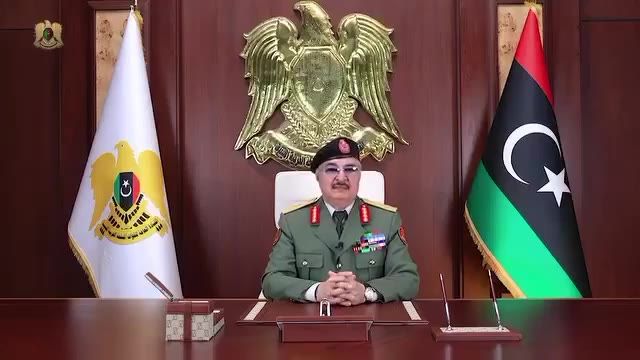
XAn account on X posted a video described as a speech by Khalifa Haftar, with a caption saying it was delivered after the recent attacks on Russian ships in Benghazi. The clip is a static talking-head recording: Haftar in uniform at a desk, with the Libyan flag, the LNA's white banner and the golden eagle emblem of the General Command behind him. It asks viewers to believe this is his reaction to the November 2026 ship attacks.
“كلمة خليفة حفتر بعد الهجوم الأخير على السفن الروسية في بنغازي #العاصمة”
“Khalifa Haftar's speech after the latest attack on Russian ships in Benghazi #Al_Assima” — translated
Posted on X by @aleasima_17 with the hashtag #العاصمة (Al-Assima). No posting date or engagement figures were captured in our record.
Who posted it
XAccount check
Estimates from public signals — account age, posting pattern, audience — not a judgement of the person behind the account, and separate from whether this post is true.
What stood out
- Handle resolves to 'هنـا_العاصمة' (Hona Al-Asema / 'Here is the Capital'), a well-known Libyan news-aggregator brand on X, not a personal account — display name and bio are anonymous/collective ('من اتاها مسالما... إنها طرابلس الحب').
- Long-lived and organically established: joined July 2018 (~8.4 years old at Nov 2026), ~22K posts (~7-8/day), ~810K-894K followers with 0 following — consistent with a media brand rather than a fake or throwaway persona.
- Content is heavily polarised Libyan politics from a Tripoli/pro-GNU, anti-Haftar and pro-Palestinian-armed-resistance stance, mixing breaking-news clips, opinion polls ('do you support what the resistance did on 7 October?') and commentary without source attribution.
- Libyan fact-checking platform Falso (falso.ly) has flagged the 'هنا العاصمة' page for circulating misleading content, notably the Derna flood 'I'm alive' child-rescue video that was actually filmed in Nablus, and a claim about a UAE aid plane to Libya.
- Annir fact-check initiative rated a 17 June 2025 post carrying the #العاصمة tag (Sudanese refugees 'deported') as misleading — the images actually showed a transfer to Kufra, not a deportation.
- Its Jan 2024 claim that Saif al-Islam Gaddafi refused the reconciliation conference over Grand Mufti al-Gharyani's presence was repeated across Libyan outlets but disputed by commenters as unsupported, illustrating a pattern of unverified 'exclusive' political claims.
- Despite that, the account is treated as a usable OSINT source by serious researchers: tweets are footnoted in UN Panel of Experts reports on Libya (S/2022/427, S/2024/914) and cited by Airwars incident records.
- No platform verification badge and no publicly named owner/editor, so there is no accountable person or editorial standards behind the reporting.
- No evidence of automation or coordinated inauthentic behaviour (no Meta takedown listings, no bot-network attribution); engagement levels (hundreds to thousands of replies/likes, 100K+ views) look human-driven.
Signals (12)+
- Joined
- July 2018
- Followers estimate
- 810000-894000
- Following count
- 0
- Posts count estimate
- 22000
- Posting cadence
- ~7-8 posts/day, sustained since 2018
- Follower ratio
- Very high followers, zero following (brand-style)
- Identity transparency
- Anonymous collective / news-brand account, no named editor
- Political orientation
- Tripoli-centric, anti-Haftar/LNA, pro-GNU, pro-Palestinian armed resistance
- Fact check history
- Flagged by Falso (Derna flood videos, UAE aid claim) and Annir (Sudanese refugees 'deportation' claim, June 2025)
- Notable news coverage
- Frequently quoted/embedded by Libyan and regional outlets; tweets footnoted in UN Panel of Experts Libya reports and Airwars
- Coordinated inauthentic behavior evidence
- None found
- Content type
- Breaking-news clips, aggregator reposts, opinion polls, partisan commentary
Account checked November 24, 2026, 03:04 UTC
The media
Video✓ What is genuine
The video is a genuine recording of a Khalifa Haftar speech. The person, the setting and the emblem are real; only the claimed date and occasion are wrong.
The tells
- ●●● Strong signal Our detector scored the clip as not AI-generated at 0.99999 confidence, with the deepfake class at 0.0000001 — there is no synthetic-generation signal.our detector (hive-v3)
- ●●○ Supporting signal The set-up — Haftar at a desk in uniform with the Libyan flag, the LNA white banner and the golden eagle emblem — is consistent across all frames, with no compositing or warping.our visual review
- ●●● Strong signal The speech never mentions Russian ships, drones or Benghazi port, which is inconsistent with a speech given after those attacks.Misbar
- ●●● Strong signal The earliest known upload is 24 December 2024 on the General Command Facebook page, roughly two years before the attacks.Misbar
Synthetic-media detector
Detector ranThe claim stands or falls on whether the media is real, so the detector ran.
Scores are the detector’s estimate for the file as uploaded. A low score does not rule out editing, a spliced caption, or footage shown out of context — those are judged above. Model v3.
How we checked the media
- Reviewed the video's visual composition across keyframes for signs of compositing, warping or synthetic generation.
- Ran our AI-generation and deepfake detector (hive-v3) on the footage.
- Compared the clip against Misbar's reverse-search findings tracing its earliest upload.
- Read the speech transcript for any reference to the ship attacks.
Sources
4 sources reviewed- 1هل يوثق الفيديو كلمة لخليفة حفتر عقب الهجمات الأخيرة على سفن روسية في بنغازي؟ ↗
Misbar · misbar.comUntiereduntiered — treated as signal only, never decisiveEvidence
Traces the clip to Haftar's 24 December 2024 independence-anniversary address on the General Command's Facebook page and shows the speech makes no reference to the attacks.
- 2Russian warship sinks in Benghazi after suspected Ukrainian drone attack ↗
The Guardian · theguardian.comReputable outletLean Left (AllSides)Evidence
Confirms a Russian warship was struck and sank at Benghazi in a suspected Ukrainian sea-drone attack.
- 3Russian warship docked in Benghazi hit by suspected drone attack, Libyan officials say ↗
The Kyiv Independent · kyivindependent.comUntiereduntiered — treated as signal only, never decisiveEvidence
Identifies the vessel as the corvette Merkury and notes satellite imagery of it capsized and almost fully sunk.
- 4Ukraine destroys £150m Russian warship at Libyan naval base ↗
The Telegraph · telegraph.co.ukReputable outletBORDERLINE — Lean Right; strong bias tagEvidence
Records Zelensky's claim of responsibility and the detail that a second vessel was hit.
Further reading
- 1Misbar The original fact-check that traced the video to its December 2024 upload and read the transcript.
- 3The Kyiv Independent Details the identity of the sunken corvette and the satellite evidence, useful for understanding the real event behind the claim.
The full story
The kernel of truth here is substantial: Russian ships really were attacked at Benghazi.
On the night of 21–22 November 2026, Ukrainian naval drones struck the Russian corvette Merkury while it was docked at the Benghazi naval base. The ship sank, and hours later a Malta-flagged cargo vessel was hit offshore. Libya's eastern government, the Tripoli government and the UN mission all responded, and President Zelensky claimed responsibility on 23 November. The Guardian, the Kyiv Independent and the Telegraph each reported the attacks using Libyan officials, satellite imagery and Ukrainian statements — outlets that do not share a single origin, which is what makes the event itself solid.
So when a clip appeared showing Khalifa Haftar speaking gravely about regional dangers and readiness, it looked like the natural next chapter. The commander of the eastern forces reacting to an attack on his soil and on Russian vessels tied to his external patrons. The caption supplied the missing frame: this is his speech after the attack.
But the frame is wrong. According to Misbar, the clip is Haftar's address on the 73rd anniversary of Libyan independence, published by the General Command on Facebook on 24 December 2024 — around two years before the strikes. And the speech says nothing specific: no ships, no drones, no port. The eastern command's only public comment on the attacks came from deputy commander Saddam Haftar in a written Facebook post, not from a filmed address by his father.
The claim worked because it did not need to invent an attack or fake a face. It only needed to move a real video to a new date, and let a real event do the persuading.
Kernel of truth
Ukrainian drones really did attack and sink a Russian corvette at Benghazi on 22 November 2026, and Khalifa Haftar really did give the speech in the video — just in December 2024, not after the attacks.
Timeline
December 24, 2024
Khalifa Haftar delivers his address marking the 73rd anniversary of Libyan independence; the General Command posts the video on Facebook. 1Misbar
November 22, 2026
Ukrainian naval drones strike the Russian corvette Merkury at Benghazi naval base, sinking it; a Malta-flagged cargo vessel is hit offshore hours later. 2The Guardian
November 23, 2026
President Zelensky claims responsibility for the attacks, and Misbar publishes its fact-check tracing the Haftar clip to December 2024. 4The Telegraph
How it was framed
The video is genuine and unaltered, but it is presented with the false context that it shows Haftar reacting to the November 2026 ship attacks. The surrounding caption, not the footage, does the deceiving.
- “Visual proof”. The post leads with a video of Haftar in uniform at a desk with the General Command emblem, inviting viewers to trust the image as proof of his reaction.
- Missing context. The caption gives no date or occasion for the speech; the missing information is that it was recorded on 24 December 2024.
- Ongoing-threat framing. The word "الهجوم الأخير" ("the latest attack") places the speech inside a continuing crisis, though the speech itself is generic.
Posted on X by an account using the handle @aleasima_17 with the hashtag #العاصمة. No further verifiable detail about the account or its posting history appears in our record.
Bias
Leans pro-Haftar. The post is from an outlet that brands itself with the 'Al-Assima' hashtag and pairs a statesmanlike address by Khalifa Haftar with a national-security crisis, implying he personally responded to the Benghazi ship attacks. Recycling an old speech to create that impression flatters the eastern commander and pushes a pro-Haftar framing of the incident.
Bias describes how the post frames its message — the slant of the language, selection and emphasis — and is judged separately from whether the claim is true. A true claim can still be framed with a strong slant.
How we checked
1 min 6 s- 1
Searched in English and Arabic for any Haftar speech or statement about the November 2026 Benghazi ship attacks.
- 2
Opened and read Misbar's fact-check tracing the video's first upload and transcript.
- 3
Reviewed the video's keyframes for visual consistency and signs of compositing.
- 4
Ran our AI-generation and deepfake detector on the footage.
- 5
Compared the speech transcript with the caption's claim about its occasion.
✓ Claim checked✓ Media checked✓ Sources checked
Why 87% confidence
HighThe central verdict is HIGH confidence because the decisive fact — the earliest known upload on the General Command's own Facebook page in December 2024 — is a specific, citable origin, and the speech text independently fails to support the caption. The attack itself is corroborated by multiple outlets that do not share a single source. We stopped short of absolute certainty only because the tracing rests on one fact-checking outlet's reverse search rather than our own direct access to the Facebook post.
Limits. We did not independently obtain or archive the December 2024 Facebook post ourselves, and we could not inspect the original poster's account history or confirm where the X user sourced the clip. We also did not review full-length footage beyond the keyframes and transcript in the record.
What we don’t know
- Who first attached the false caption to the December 2024 clip, and whether the X poster created it or copied it from elsewhere.
- Why the clip was chosen instead of any other Haftar speech — whether it was the most recent official video available or selected for another reason.
- Whether the eastern command issued any later clarification or additional statement about the attacks beyond the written Facebook post by Saddam Haftar.
Spot it yourself
Spot the fakeLooks suspicious, isn’t proof
- The post is a repost from an unfamiliar account rather than the General Command's own page — that is a reason to check the original, not proof of anything.
- The caption is short and dramatic, which can make a real clip feel staged; tone alone never decides a fact-check.
- The video looks like a standard official address, which some readers find "too polished"; official speeches normally do look like this.
The actual evidence
- Misbar's reverse search found the earliest upload on the General Command's Facebook page on 24 December 2024, about two years before the attacks.
- The speech transcript never mentions Russian ships, drones or Benghazi port, which a post-attack speech almost certainly would.
- No filmed Haftar statement about the attacks was found by Misbar or in our own searches, even though such a statement would have been widely covered.
- Our detector found no sign of AI generation, confirming the dispute is about date and context, not fakery.
- 1
Check whether the footage could have been made recently.
Look at what the speaker says. Specific names, dates or events in the speech can be matched to a known occasion; generic rhetoric is a sign the clip may be old.
- 2
Find the earliest upload.
Run the video frames through a reverse image or video search, and check the official page of the person or group shown. Here the General Command's own Facebook page carried it in December 2024.
- 3
Ask who would have reported it if the claim were true.
If Haftar had given a speech about the attacks, Libyan outlets and the international wires would have quoted it. Search for the statement, not just the video, in both Arabic and English.
- 4
Use the media itself only as a starting point.
A pristine video proves the footage was not AI-generated; it does not prove when it was filmed or what it was about. Date and context have to be checked separately.
Takeaway
A real video can still be false. When a caption says "after" or "in response to", the date and occasion are the claim — and those are exactly what a reverse search will test.
Questions people ask
Is the Khalifa Haftar video after the Benghazi ship attacks real or fake?+
The video is real, but the caption is wrong. It shows a genuine Haftar speech from 24 December 2024, marking the 73rd anniversary of Libyan independence, according to Misbar's research. It was not delivered after the 22 November 2026 attacks on Russian ships at Benghazi, and the speech never mentions ships, drones or the port.
Did Ukrainian drones really attack Russian ships in Benghazi?+
Yes. On the night of 21–22 November 2026, Ukrainian naval drones struck the Russian corvette Merkury at the Benghazi naval base and sank it, and a Malta-flagged cargo vessel was hit offshore hours later. President Zelensky claimed responsibility on 23 November, and multiple outlets reported the attacks.
Did Khalifa Haftar say anything about the attacks?+
No filmed speech or direct statement by Khalifa Haftar about the attacks was found by Misbar or in our own searches. The eastern command's public comment came instead from his son, deputy commander Saddam Haftar, in a written Facebook post.
Why does a real video with a wrong caption matter?+
It borrows the credibility of real footage and a real event to suggest a reaction that never happened. Viewers who trust the images may believe Haftar publicly addressed the attacks when he did not, which can shape how they read the region's politics. A genuine video is not proof that its caption is accurate.
Go deeper
- False context
- When real, unaltered media is shared with incorrect information about when, where or why it was created.
- Reverse image search
- A search technique that finds other places an image or video has appeared online, often revealing its earliest upload.
- AI-generation detector
- A tool that estimates whether an image, video or audio clip was produced by artificial intelligence rather than recorded from life.
- Corroboration
- Confirmation of a fact by independent sources that do not all trace back to the same origin.
People also search for
For educators+
- The caption blends one true statement (ships were attacked) with one false one (this video is his response). Why might that combination be more persuasive than a post that is false from start to finish?
- What would you search for to check whether a political leader had commented on a specific event, and why is searching for the statement different from searching for the video?
- If a video is confirmed not to be AI-generated, what has and has not been proven?
About this check
- Platform
- X
- Posted by
- @aleasima_17
- Posted
- November 23, 2026
- Age when checked
- Under 24 hours old when checked
- Where it spread
- LY
- Audience
- Local audience
- Language
- AR
- Status
- ● Post is live
- Verified
- November 24, 2026, 03:06 UTC
- Published
- November 24, 2026, 03:06 UTC
Reach. 438 likes, 91 replies on @aleasima_17 post (X syndication, 24 Nov); also shared on several Libyan Facebook pages per Misbar
This verdict was generated with AI from the sources shown. AI can make mistakes — check the sources before relying on it.
Check anything yourself, in seconds.
Share any social post or video to What the Fact and get the verdict, the confidence, and the receipts.