Did the IPCC debunk and withdraw "extreme climate science"?
Has the UN IPCC 'debunked, withdrawn and taken down' its extreme climate projections, as Trump claimed on Truth Social?
True
The IPCC retracted nothing; one extreme scenario was retired, not climate science.
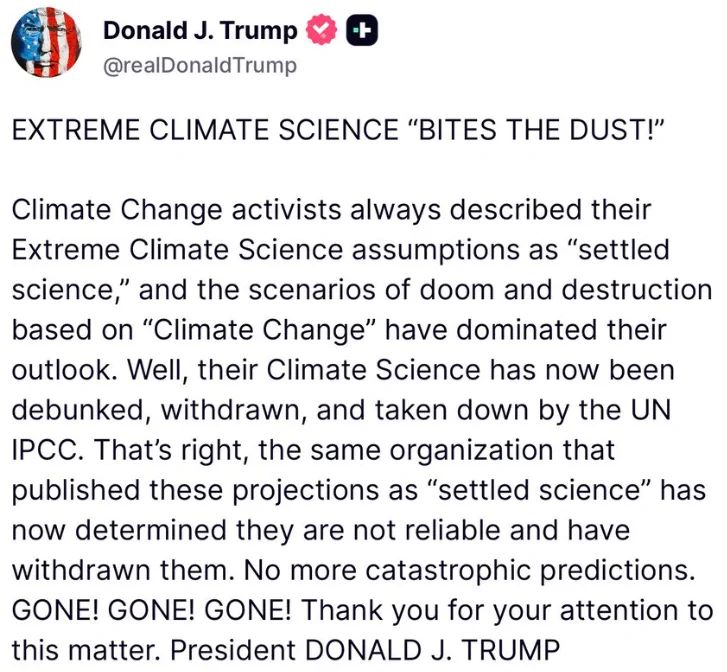
Donald Trump posted 23 November 2026 that the UN IPCC had "debunked, withdrawn, and taken down" extreme climate science. The IPCC issued no such retraction. Scenario developers had retired the worst-case RCP8.5/SSP5-8.5 pathways as no longer plausible for the Seventh Assessment Report, and the remaining high-end scenario still projects about 3.3C of warming by 2100. FALSE.
 Genuine
Claims
✓ 2 true · ✕ 1 falseThe UN IPCC has debunked, withdrawn and taken down "extreme climate science," determined its projections are not reliable, and there will be "no more catastrophic predictions."12456
This rests on two independent checks, and both go against the claim. First, the screenshot is a genuine capture of the president's post: its wording matches verbatim the archived Truth Social entry and the quotes carried by Newsmax, The Independent, Raw Story and ANI. So we are assessing real words, not a fabricated image. Second, the substance is wrong. The Independent reported that, contrary to the post, the IPCC has made no major statements or retractions. Newsmax carried the IPCC's own May clarification that it neither developed nor withdrew the emissions scenarios in question. What did happen is narrower: scenario developers retired the RCP8.5 and SSP5-8.5 high-emissions pathways as no longer plausible for the Seventh Assessment Report, and even the replacement high-end scenario still projects about 3.3C of warming by 2100. A retired scenario is a scientific update, not a debunking. The outlets agree on this point despite differing politics, which strengthens it.
Still open: The post does not name which IPCC document or statement it refers to, so there is no specific paper to compare against.
I am a lead author of the upcoming IPCC 7th Assessment Report.7
This is a checkable credential and it holds. CBC identifies Hausfather, a climate scientist at Berkeley Earth, as a lead author of the IPCC's Seventh Assessment Report, due in late 2028 or early 2029. That matters for the page: the person pushing back on the claim is not a random commenter but someone inside the process the post describes. It does not, on its own, settle the factual question — a credential is not an argument. But it tells a reader that the rebuttal comes from someone with direct knowledge of what the panel has and has not done, which raises the weight we give his account alongside the reporting.
The IPCC has not "withdrawn" any climate science; the president's claim is baseless.156
This is corroborated by independent reporting and by the panel's own clarification. No IPCC retraction of its climate findings exists. The IPCC stated that it does not develop or withdraw the emissions scenarios at issue. The only real change is the retirement of one extreme emissions pathway, which Hausfather has described publicly as normal scientific updating. We rate this MODERATE rather than HIGH because our confirmation runs through reporting and the panel's clarification rather than a document that lists every IPCC output; we could not inspect an exhaustive record of panel statements ourselves. Even so, the direction of the evidence is consistent across outlets with very different editorial lines, and none of them found a retraction.
Still open: We did not find a single consolidated IPCC page listing every public statement, so the negative finding rests on reporting and the panel's clarification.
What was posted
XZeke Hausfather, a climate scientist and IPCC lead author, posted a screenshot of a Truth Social message from Donald Trump and rejected its claim. The screenshot shows the president writing that "EXTREME CLIMATE SCIENCE" has been "debunked, withdrawn, and taken down" by the UN's climate panel. Hausfather tells his followers that he has "absolutely no idea" what the president is referring to and that no such withdrawal has happened.
Posted on X as a reply to a screenshot of the president's Truth Social post of 23 November 2026. The screenshot text matches the archived Truth Social post.
Who posted it
XAccount check
Estimates from public signals — account age, posting pattern, audience — not a judgement of the person behind the account, and separate from whether this post is true.
What stood out
- @hausfath is the well-established handle of Zeke Hausfather, a climate scientist with a PhD from UC Berkeley.
- Corroborated affiliations: Climate Research Lead at Stripe/Frontier, research scientist at Berkeley Earth, Climate Science Contributor at Carbon Brief, and lead author on IPCC AR7.
- Widely cited as an expert source by AFP Fact Check, Science et Vie, Ars Technica, and other outlets; also a Science Feedback reviewer.
- Recent posts visible via search are data-driven temperature-record analyses with links to underlying datasets and caveats, consistent with his public work.
- Criticism comes mainly from climate-contrarian accounts disputing his scientific positions, not from credible findings that he fabricates claims.
- Caveat: supplied profile metadata is largely null and says the account is not platform-verified, preventing direct automated confirmation of follower count, creation date, and posting cadence.
Signals (7)+
- Identity corroboration
- High
- Known affiliations
- Stripe/Frontier; Berkeley Earth; Carbon Brief; IPCC AR7 lead author; The Breakthrough Institute
- Fact check history
- Positive: cited as expert by AFP Fact Check and Science Feedback; no credible fact-check finding against him
- Notable news coverage
- Extensive: Ars Technica, AFP, Yale Climate Connections, international press
- Platform verification status
- Reported false in supplied data, but external sources identify the handle as genuine
- Posting cadence
- Unknown from supplied sample; search results show frequent substantive climate posts
- Handle consistency
- Same handle used across X, Mastodon/FediScience, and cited by media
Account checked November 25, 2026, 15:05 UTC
The media
Image✓ What is genuine
The screenshot itself. It is a real capture of the president's 23 November 2026 Truth Social post, and the words in it are his.
The tells
- ●●● Strong signal The wording matches the archived Truth Social post verbatim, including its distinctive phrasing.Trump's Truth archive and independent outlets
- ●●● Strong signal Multiple outlets with different editorial lines quote the same text.The Independent, Newsmax, Raw Story and ANI
- ●●○ Supporting signal The image is a plain screenshot of a social post with no visible compositing artifacts.our visual review
Synthetic-media detector
Detector not consultedThe media is incidental to the claim; the detector was not needed.
How we checked the media
- Compared the text in the screenshot with the archived Truth Social post.
- Compared the screenshot wording with quotes carried by Newsmax, The Independent, Raw Story and ANI.
- Reviewed the image visually for signs of compositing or editing.
Sources
7 sources reviewed- 1Trump declares 'extreme climate science' is 'gone' as UN panel stays silent on any retraction ↗
The Independent · the-independent.comUntiereduntiered — treated as signal only, never decisiveEvidence
Establishes that the IPCC issued no retraction or major statement and that researchers moved to a new set of scenarios.
- 2Trump Again Declares Extreme Climate Science Debunked ↗
Newsmax · newsmax.comLow reliabilityLEANS EXCLUDED — NewsGuard 20/100Evidence
Quotes the IPCC's May clarification that it did not develop or withdraw the scenarios.
- 3Donald J. Trump: 'EXTREME CLIMATE SCIENCE BITES THE DUST!' ↗
Trump's Truth (archive) · trumpstruth.orgUntiereduntiered — treated as signal only, never decisiveEvidence
Archives the president's Truth Social post, confirming the screenshot text verbatim.
- 4Trump claims UN's IPCC "withdrew" extreme climate projections as COP31 clashes over report delays ↗
ANI News · aninews.inUntiereduntiered — treated as signal only, never decisiveEvidence
Traces the claim to the phasing out of the older RCP8.5 high-emissions pathway.
- 5'GONE! GONE! GONE!' Trump posts baffling climate rant saying science was 'withdrawn' ↗
Raw Story · rawstory.comLow reliabilityLeft — partisan digitalEvidence
Describes the scenario changes as responses to new data rather than retractions, with warming continuing.
- 6Fact Check: Did the UN Admit Its Climate Projections Were Wrong? ↗
Climate Fact Checks · climatefactchecks.orgUntiereduntiered — treated as signal only, never decisiveEvidence
Fact check concluding the IPCC has not admitted its climate science was wrong.
- 7Trump calls a climate projection 'WRONG!' Turns out, climate action is working ↗
CBC · cbc.caUntiereduntiered — treated as signal only, never decisiveEvidence
Confirms Hausfather's role as a lead author and reports his description of the change as normal science.
Further reading
- 1The Independent Independent reporting that sets out what the IPCC did and did not say.
- 7CBC Explains the scenario change through the eyes of a lead author of the upcoming report.
- 6Climate Fact Checks A focused fact check on whether the UN admitted its climate projections were wrong.
The full story
There is a kernel of truth here, and it explains why the claim travelled.
Emissions scenarios are the inputs climate models run on. For years, one pathway — RCP8.5, later updated as SSP5-8.5 — assumed very high future emissions and produced the most alarming warming projections. As clean-energy costs fell and climate policy expanded, researchers concluded that pathway was no longer a plausible description of the future. They retired it for the IPCC's upcoming Seventh Assessment Report.
That is a real change, and it is the kind of thing that sounds dramatic when compressed into a headline. But it is not a retraction of climate science. The IPCC clarified in May 2026 that it neither develops nor owns these scenarios; the work was done independently under the World Climate Research Programme. And the replacement high-end scenario still projects roughly 3.3C of warming by 2100, with a range up to about 4.4C. Catastrophic warming has not been ruled out — the central estimate simply moved.
Hausfather, who is a lead author of the Seventh Assessment Report, described the change as an example of how science works: projections get updated as evidence improves. The president's post took that ordinary update and recast it as the panel abandoning its own findings. This was not the first time; a similar claim appeared in May 2026 after the scenario paper was published.
Kernel of truth
Scenario developers retired the worst-case RCP8.5/SSP5-8.5 emissions pathways as no longer plausible for the Seventh Assessment Report.
Timeline
May 2026
The IPCC clarifies that it did not develop or own the emissions scenarios at issue and did not withdraw them; Trump makes a similar claim after the scenario paper is published. 2Newsmax
November 23, 2026
Trump posts on Truth Social that "extreme climate science" has been "debunked, withdrawn, and taken down." 3Trump's Truth (archive)
November 23, 2026
The Independent, Raw Story, Newsmax and ANI report on the post and note that no IPCC retraction exists. 1The Independent
November 24, 2026
Hausfather replies on X that he has no idea what the president is talking about and that no climate science has been withdrawn. 7CBC
How it was framed
The post takes a genuine scientific development — the retirement of a worst-case emissions scenario — and frames it as the IPCC debunking and withdrawing its climate science. The underlying facts exist; the meaning attached to them does not.
- Emotional language. "EXTREME CLIMATE SCIENCE BITES THE DUST!" and "GONE! GONE! GONE!" (the latter per Raw Story's report of the post).
- Missing context. The post does not mention that the change concerned one emissions scenario, or that a high-end scenario still projects about 3.3C of warming.
- “Visual proof”. A screenshot of the post is shared as the object of rebuttal rather than as proof of the claim.
The screenshot reproduces a Truth Social post by @realDonaldTrump dated 23 November 2026. Hausfather's rebuttal was posted on X the following day.
Bias
Leans pro-climate-science, critical of Trump's climate claims. The post is a scientist's direct rebuttal of a presidential statement, pushing a corrective framing rather than a party-political one. The screenshot it carries is Trump's own text, quoted so it can be contradicted.
Bias describes how the post frames its message — the slant of the language, selection and emphasis — and is judged separately from whether the claim is true. A true claim can still be framed with a strong slant.
How we checked
51 s- 1
Searched for the president's wording and for Hausfather's rebuttal.
- 2
Searched for any IPCC response or fact check on the claim.
- 3
Searched for reporting on the RCP8.5/SSP5-8.5 retirement and the Seventh Assessment Report scenarios.
- 4
Compared the screenshot text with the archived Truth Social post and with quotes in four outlets.
- 5
Reviewed the image visually for signs of editing.
✓ Claim checked✓ Media checked✓ Sources checked
Why 85% confidence
ModerateThe central claim is FALSE at HIGH confidence because the panel's non-retraction is confirmed by outlets across the political spectrum and by the IPCC's own May clarification. The rebuttal claim, that no climate science was withdrawn, is TRUE at MODERATE because our confirmation runs through reporting and a clarification rather than an exhaustive record of panel statements.
Limits. We did not open the underlying scenario paper or an IPCC statement page directly; our reading of the scientific change rests on the reporting and the panel's quoted clarification.
What we don’t know
- Which specific IPCC document or statement the post was responding to.
- Whether the post's author was relying on a specific news report, and which one.
- How the retirement decision was communicated publicly before the post.
Spot it yourself
Spot the fakeLooks suspicious, isn’t proof
- The screenshot format: a picture of a social post can be edited, but here it matches the archive word for word. Format alone proves nothing.
- The alarmist capitals ("GONE! GONE! GONE!"). Loud tone is a reason to check, not evidence of falsity.
- The source's politics. Who posted something does not decide whether it is true.
The actual evidence
- No IPCC retraction or major statement exists, per multiple outlets with different editorial lines.
- The IPCC's own clarification that it neither develops nor withdraws the emissions scenarios.
- The remaining high-end scenario still projects roughly 3.3C of warming, so catastrophic warming was not ruled out.
- The scenario change was a normal scientific update, described as such by a lead author of the report.
- 1
Find what the panel actually said
Go to the IPCC's own site or its press releases and look for the retraction the post describes. If a body had withdrawn its science, it would say so in its own voice.
- 2
Check whether the screenshot is real before arguing about it
Search for distinctive phrases from the image. If the text matches an archive of the original account, the words are real even when the claim is wrong.
- 3
Ask what changed, precisely
Look for the specific document or scenario named. Here the change was one emissions pathway, not a body of findings.
- 4
Look for the number that survives the change
Reporting says the replacement high-end scenario still projects about 3.3C by 2100. A claim of "no more catastrophic predictions" has to explain that number.
Takeaway
A retracted scenario, an updated model or a revised estimate is not the same as a body of science being withdrawn. When a post says an institution abandoned its findings, look for that institution saying so itself.
Questions people ask
Did the IPCC withdraw its climate science?+
No. The IPCC issued no retraction of its findings on human-caused warming. What happened is that scenario developers retired one worst-case emissions pathway, RCP8.5/SSP5-8.5, as no longer plausible for the Seventh Assessment Report. The IPCC said it neither developed nor withdrew those scenarios.
What is RCP8.5 and why was it retired?+
RCP8.5, later updated as SSP5-8.5, was a high-emissions scenario used to model a worst-case future. Falling clean-energy costs and expanded climate policy made it implausible as a description of where emissions are heading, so researchers retired it for the upcoming assessment report. It was an update, not a debunking.
Does this mean catastrophic warming is ruled out?+
No. Even with the extreme scenario retired, the new high-end scenario projects about 3.3C of warming by 2100, with a range up to roughly 4.4C. The central estimate moved; the upper end did not disappear.
Who is Zeke Hausfather?+
He is a climate scientist at Berkeley Earth and a lead author of the IPCC's Seventh Assessment Report, due in late 2028 or early 2029. He publicly disputed the claim that the panel had withdrawn any climate science.
Is the screenshot of the president's post real?+
Yes. The image is a genuine capture of a Truth Social post dated 23 November 2026. Its wording matches the archived post and the quotes carried by Newsmax, The Independent, Raw Story and ANI. The image is authentic; the claim inside it is false.
Go deeper
- IPCC
- The Intergovernmental Panel on Climate Change, a UN body that assesses published climate research rather than running its own experiments.
- Emissions scenario
- A modelled description of how much greenhouse gas might be released in future, used as an input to climate projections.
- RCP8.5 / SSP5-8.5
- A high-emissions scenario representing a worst-case future, retired for the upcoming assessment as no longer plausible.
- Seventh Assessment Report
- The IPCC's next major assessment cycle, due in late 2028 or early 2029.
People also search for
For educators+
- If a worst-case scenario is retired as implausible, does that make future warming less serious or more uncertain? Explain using the projected range.
- Why might a genuine scientific change be easy to recast as a retraction? What information would a reader need to tell the difference?
- A screenshot can be authentic while the claim inside it is false. How should that change the way you check a post?
About this check
- Platform
- X
- Posted by
- @hausfath
- Posted
- November 24, 2026
- Age when checked
- Under 24 hours old when checked
- Where it spread
- United States
- Audience
- US audience
- Language
- EN
- Status
- ● Post is live
- Verified
- November 25, 2026, 15:07 UTC
- Published
- November 25, 2026, 15:07 UTC
Reach. 3,635 likes on the screenshot post (X syndication); ANI, Carbon Brief, Yahoo coverage
This verdict was generated with AI from the sources shown. AI can make mistakes — check the sources before relying on it.
Check anything yourself, in seconds.
Share any social post or video to What the Fact and get the verdict, the confidence, and the receipts.