Did Biden's NSC instruct Google to fund 40-50 Ukrainian outlets and Russian opposition media?
Do the newly released 'USAID files' show Biden's National Security Council instructing Google to fund Russian opposition media and Google/YouTube funding 40-50 Ukrainian outlets, as Kremlin envoy Kirill Dmitriev claims?
True, but…
Genuine government document, but the caption's 'NSC instructs Google' framing goes beyond what the email says.
The screenshot is a real email that the US government published in its November 2026 'USAID Files' release. It confirms Google/YouTube funded about 40-50 Ukrainian outlets through the European Journalism Centre. But Kirill Dmitriev's caption overstates it: the email says recipients weren't specified and grant decisions rested with the EJC, not an NSC instruction.
 Genuine
Claims
✓ 2 trueBiden's National Security Council instructed Google to fund additional, specifically identified Russian opposition media outlets.12
“Biden’s National Security Council instructs Google to fund additional, specifically identified Russian opposition media outlets.”
The email does contain a grain of truth: NSC staff had earlier sent YouTube a list of named Russian outlets hurt by the ad cut-off, 'following your suggestion', and the YouTube executive said funding would cover 'all the outlets that we've raised previously'. That is why 'specifically identified' is not invented. But the document itself undercuts the word 'instructs'. It records that the executive 'didn't specify to whom the funds would flow' and that 'ultimately grant-making decisions rest with EJC'. So the decision on who got money sat with a private grant-maker, not with the NSC, and nothing in the email shows an order to Google. The two sources here are not fully independent: the Raw Story analysis and the primary document describe the same email. Raw Story flagged that the post made claims the email does not show, which matches our own reading of the primary text.
Still open: The public record does not show what the NSC's earlier list of nine named outlets was used for beyond being raised with YouTube.
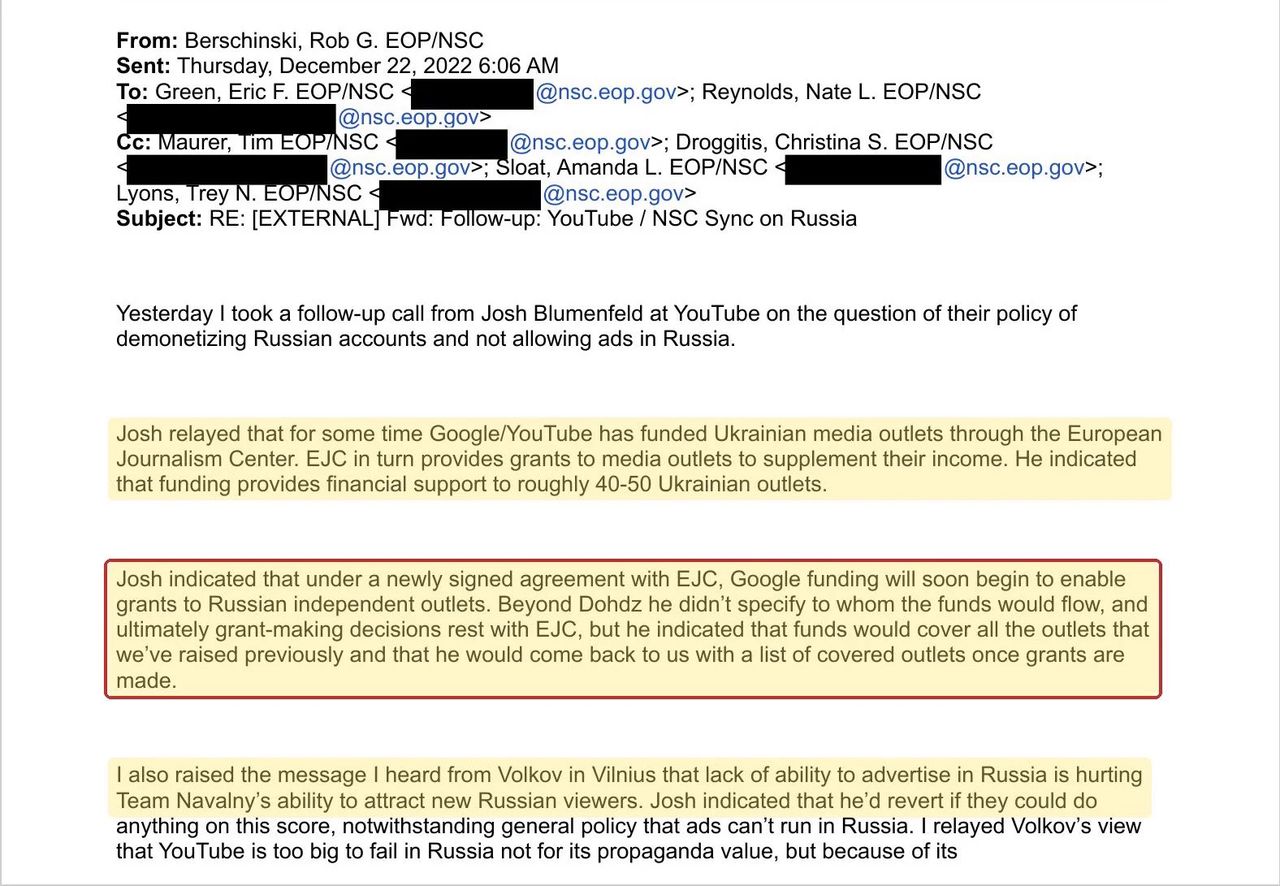
Google/YouTube has for some time funded Ukrainian media outlets through the European Journalism Centre, providing financial support to roughly 40-50 Ukrainian outlets.12
This is the strongest part of the post because it is close to a direct quote from a document the US government published itself. The page on usaid.gov reproduces the paragraph verbatim, including the OCR-style typo 'Dohdz' for Dozhd, which is a strong sign the screenshot was captured from the official PDF rather than typed up. The email is a contemporaneous NSC record of a call with YouTube's Josh Blumenfeld, so it is a first-hand account of what the government understood at the time. The usual caution about second-hand accounts does not bite here: we are not judging whether Google funded Ukrainian outlets in general, only whether the document says so, and it plainly does. What a reader should weigh is that the email reports what a YouTube executive said on a call; it is not a Google financial statement.
Under a newly signed agreement with the European Journalism Centre, Google funding would soon begin to enable grants to Russian independent outlets, beyond TV Rain (Dozhd).12
The email does record the YouTube executive saying this, and reporting summarising the release describes an October 2022 NSC list of nine affected outlets, among them Meduza, TV Rain, The Insider and Team Navalny, plus a December 2022 Google/EJC agreement. That supports the outline. The reason this is LIKELY_TRUE rather than TRUE is that the email is a second-hand account of an arrangement whose grants were still 'about to begin' as of December 2022. Neither source confirms that funding actually flowed after that date, and the phrasing is forward-looking. The evidence comes from one primary document and one outlet reading the same document, so it is one chain rather than two independent confirmations. A reader should treat the existence of the agreement as well supported and the delivery of grants as unconfirmed.
Still open: No public record in our sources confirms whether the Russian-outlet grants were ever paid out.
What was posted
XKirill Dmitriev posted on X a screenshot of an email from National Security Council official Rob Berschinski, dated 22 December 2022, with yellow and red boxes highlighting two paragraphs. The highlighted text describes a call with a YouTube executive about Google funding for Ukrainian and Russian outlets. The caption tells readers this is a 'USAID files' document showing the White House acknowledging and directing that funding.
“USAID files: Biden’s White House acknowledges that Google/YouTube funds 40–50 Ukrainian outlets and Russian opposition media. Biden’s National Security Council instructs Google to fund additional, specifically identified Russian opposition media outlets. 👇”
Posted on X by Kirill Dmitriev, identified in coverage as Putin's investment envoy and a sanctioned close ally of the Russian president. The post appeared hours after USAID posted 248 'USAID Files' documents on usaid.gov on 24 November 2026.
Who posted it
XAccount check
Estimates from public signals — account age, posting pattern, audience — not a judgement of the person behind the account, and separate from whether this post is true.
What stood out
- Account belongs to Kirill A. Dmitriev, CEO of Russia's sovereign wealth fund RDIF and Putin's special envoy for investment and economic cooperation — a real, high-profile individual, not a fake persona.
- Handle is consistently quoted and embedded by Reuters, TASS, RT, US News, Ukrainska Pravda and Balkan media as @kadmitriev, confirming the account is the genuine channel of the official.
- Account is young: RDIF announced the launch of @kadmitriev on X on 3 March 2025, so it is only ~1.7 years old despite the person's long public career.
- Metadata shows no platform verification; however the handle is widely cited in official/wire coverage and appears to be actively operated (multiple posts per week in 2025-2026).
- Content is agenda-driven Kremlin messaging (sanctions relief, 'Putin-Trump tunnel', Oreshnik boasts, attacks on EU/EC officials), often with unsourced or self-serving figures — e.g. the '$14 trillion' US-Russia projects portfolio, which fact-checkers found unsupported and ~5x Russia's annual GDP.
- Documented deceptive framing: in Feb 2026 he presented a March 2024 Putin interview clip as a fresh comment on the Epstein files (France 24 Observers/Yahoo); rima.media flagged a March 2026 post about EU/UK 'travel restrictions' as a fake by Dmitriev.
- He has also been a victim of misattribution (Washington Post corrected quotes wrongly credited to him in Oct 2025), so some viral 'his' quotes online are not his — a caution in both directions.
- Behaviour is human, not bot-like: reactive commentary, replies, threading, reactions to FT/Politico/Economist stories; low automation signal, though his posts are rapidly amplified by RT/Sputnik and state-aligned networks.
- Net: authentic identity, but low reliability as an information source — treat as a primary source for Kremlin positions, requiring independent verification of factual claims.
Signals (11)+
- Platform verification
- None per metadata (cited widely in media regardless)
- Identity confirmed
- Yes
- Affiliation
- RDIF CEO; Special Presidential Envoy of the Russian Federation
- Sanctions status
- Sanctioned by the US Treasury (2022) as a close Putin ally
- Posting cadence
- Frequent, multi-per-week, event-driven commentary
- Follower ratio
- Unknown (follower count null)
- Media citation frequency
- Very high (Reuters, TASS, RT, US News, Ukrainska Pravda)
- Fact check history
- Flagged by rima.media (Mar 2026) for a false EU/UK travel-restriction claim; misrepresented old Putin footage as Epstein-files reaction (Feb 2026); unsupported $14tn portfolio figure
- Misattribution victim
- Washington Post corrected quotes wrongly attributed to him (Oct 2025)
- Content type
- State-aligned political/economic advocacy and propaganda
- Coordination signal
- Rapid pick-up by RT/Sputnik, but no evidence the account itself is automated
Account checked November 26, 2026, 15:05 UTC
The media
Image✓ What is genuine
The email itself is genuine and was published by the US government on its own website as part of the 'USAID Files' release.
The tells
- ●●● Strong signal Every detail matches the official PDF on usaid.gov, including the sender name, the 22 December 2022 6:06 AM timestamp, the NSC distribution list and the distinctive typo 'Dohdz' for Dozhd.our visual review and source 1
- ●●○ Supporting signal The AI-generation detector placed the image at about 0.994 not-AI-generated, with a deepfake score of zero.our detector
- ●●○ Supporting signal The coloured boxes are drawn over the email text rather than replacing it; the same sentences read the same way underneath.our visual review
Synthetic-media detector
Detector ranThe claim stands or falls on whether the media is real, so the detector ran.
Scores are the detector’s estimate for the file as uploaded. A low score does not rule out editing, a spliced caption, or footage shown out of context — those are judged above. Model v3.
How we checked the media
- Compared the screenshot's text, sender, timestamp and distribution list with the PDF hosted on usaid.gov.
- Ran the image through our AI-generation detector (Hive v3), which returned a not-AI-generated score of about 0.994.
- Visually reviewed the yellow and red highlighting to confirm it is an overlay on the text and does not alter the underlying wording.
- Searched for independent reporting on the release and the email's contents.
Sources
4 sources reviewed- 1Fwd: [EXTERNAL] Fwd: Follow-up: YouTube / NSC Sync on Russia (PDF, USAID Files) ↗
USAID (U.S. Agency for International Development) · usaid.govPrimary / fact-checkerprimary/official source (by domain)Evidence
Establishes that the email is genuine, that it records Google/YouTube funding 40-50 Ukrainian outlets through the EJC, and that grant decisions rested with the EJC.
- 2Russ Vought embroiled in rollout of 'unusual' US gov website spotted in Russian campaign ↗
Raw Story · rawstory.comLow reliabilityLeft — partisan digitalEvidence
Establishes the context of the 248-document release, the October 2022 list of nine outlets, and that the post made claims the email does not show.
- 3USAID objavio interne dokumente: Prepiska sa Googleom, YouTubeom i Metom, u fokusu i finansiranje medija ↗
BL Portal · bl-portal.comUntiereduntiered — treated as signal only, never decisiveContext
Adds a further report noting that the email itself says final grant decisions were made by the European Journalism Centre.
- 4Kirill Dmitriev on X ↗
X (Kirill Dmitriev) · x.comUntiereduntiered — treated as signal only, never decisiveContext
The original post and caption as published on X.
Further reading
- 1USAID (U.S. Agency for International Development) The primary document itself, so you can read the full email and the qualifications the caption leaves out.
- 2Raw Story Independent reporting that describes the release and notes where the post goes beyond the email.
The full story
The kernel of truth here is unusually solid. On 24-25 November 2026, the US government posted 248 internal 'USAID Files' documents on usaid.gov. One of them is a 22 December 2022 email from NSC official Rob Berschinski reporting on a call with YouTube's Josh Blumenfeld. In it, Berschinski writes that Google/YouTube had for some time funded Ukrainian media through the European Journalism Centre, roughly 40-50 outlets, and that a new agreement would soon enable grants to Russian independent outlets, beyond TV Rain.
That is enough for a post to feel proven when it is illustrated with the actual page. But the same email contains the qualification the caption drops. Berschinski records that Blumenfeld 'didn't specify to whom the funds would flow' and that 'ultimately grant-making decisions rest with EJC'. There is a real earlier strand too: NSC staff had sent YouTube a list of nine named Russian outlets 'following your suggestion', which is where 'specifically identified' comes from. Read together, the document describes a conversation and a private grant arrangement, not a White House instruction to Google.
The timing explains the spread. The post went up on X hours after the release and Russian state media amplified the same email within hours, while US reporting noted that the post claims more than the document shows. The claim travels well because the first half is true and checkable, and the second half borrows that credibility.
Kernel of truth
The email is genuine and does record that Google/YouTube funded about 40-50 Ukrainian outlets through the European Journalism Centre, and that a new agreement would soon enable grants to Russian independent outlets.
Timeline
October 2022
NSC staff send YouTube a list of nine named Russian outlets and groups hurt by the ad cut-off, 'following your suggestion'. 2Raw Story
December 22, 2022
Rob Berschinski sends the NSC email reporting on a call with YouTube's Josh Blumenfeld about Google funding for Ukrainian and Russian outlets. 1USAID (U.S. Agency for International Development)
November 24, 2026
USAID posts 248 'USAID Files' documents on usaid.gov, including the Berschinski email. 2Raw Story
November 25, 2026
Kirill Dmitriev posts the screenshot and caption on X. 4X (Kirill Dmitriev)
How it was framed
The document is genuine and the first half of the caption matches it, but the caption frames a private grant arrangement as an NSC 'instruction' to Google and presents forward-looking December 2022 language as an established present-tense fact. The email is real; the framing is what misleads.
- Borrowed authority. The caption opens with 'USAID files:' and names 'Biden's White House' and 'Biden's National Security Council', wrapping the claim in the authority of official documents.
- “Visual proof”. A screenshot of the email with yellow and red boxes invites readers to treat the highlighted text as self-evident proof.
- Missing context. The caption leaves out the email's lines that the executive 'didn't specify to whom the funds would flow' and that 'ultimately grant-making decisions rest with EJC'.
- Selective evidence. The post highlights the '40-50 Ukrainian outlets' and 'specifically identified' strands but not the qualifications that limit them.
Posted on X by Kirill Dmitriev, identified in coverage as Putin's investment envoy and a sanctioned close ally of the Russian president. Russian state media amplified the same email within hours, according to Raw Story.
Bias
Leans pro-Kremlin / anti-US. The post is by Kirill Dmitriev, Putin's investment envoy and a sanctioned ally of the Russian president. It frames routine US democracy-support funding as a covert White House operation to 'brainwash' and control media, omits that grants were decided by the European Journalism Centre and that the outlets lost revenue because Russia's own ad market was closed, and drops the document's own caveats.
Bias describes how the post frames its message — the slant of the language, selection and emphasis — and is judged separately from whether the claim is true. A true claim can still be framed with a strong slant.
How we checked
1 min 11 s- 1
We ran searches on the email's sender, recipient and subject to find independent coverage of the release.
- 2
We opened the PDF on usaid.gov and compared it line by line with the screenshot, including the typo and timestamp.
- 3
We ran the image through our AI-generation detector, which returned a not-AI-generated score of about 0.994.
- 4
We reviewed the image visually to confirm the highlighting is an overlay.
- 5
We searched for existing fact-checks and found none ruling on the item, only the Raw Story analysis.
✓ Claim checked✓ Media checked✓ Sources checked
Why 78% confidence
HighThe headline confidence is HIGH because the decisive evidence is the US government's own published PDF, which matches the screenshot exactly, and the key qualification is quoted directly from that document. The confidence on the central claim is MODERATE, not HIGH, because the caption's word 'instructs' is a judgement about framing rather than a fact the document settles outright.
Limits. We did not obtain Google's or the European Journalism Centre's own statements, and we could not confirm whether the planned Russian-outlet grants were ever paid out. We also did not find a formal fact-check from a major rating organisation; the only English analysis we found was Raw Story's.
What we don’t know
- Whether the Google/EJC grants to Russian independent outlets were ever actually paid after December 2022.
- What the NSC did with its earlier October 2022 list of nine named outlets beyond raising them with YouTube.
- How the European Journalism Centre would describe the arrangement in its own words.
- Whether the full 'USAID Files' release contains other documents that bear on the same arrangement.
Spot it yourself
Find the overstatementLooks suspicious, isn’t proof
- The post comes from a partisan source with a political stake in the story. That is a reason to check carefully, not evidence the document is fake.
- The yellow and red highlighting looks like someone pushing an agenda. Highlighting is an overlay; it does not change the words underneath.
- The text includes an odd typo, 'Dohdz', which can look like a fabrication slip. Here it matches the official PDF and is a sign of an unedited capture.
The actual evidence
- The identical email, down to the typo and timestamp, appears in a PDF hosted on usaid.gov as part of the 248-document release.
- The email itself says the YouTube executive 'didn't specify to whom the funds would flow' and that 'ultimately grant-making decisions rest with EJC'.
- The 'specifically identified' wording traces to an earlier October 2022 NSC list of nine named outlets, not to an instruction in this email.
- The Russian funding is described as about to begin in December 2022, not as already running.
- 1
Find the primary document
When a post cites 'files', search the agency's own website for the document. If it is there, you can compare wording yourself instead of relying on the screenshot.
- 2
Read the sentence just before and after the highlighted part
Captions often quote a real line but cut the qualification. Here the very next line says recipients were unspecified and decisions rested with the EJC.
- 3
Check verbs like 'instructs' against the text
Ask whether the document uses words like 'instruct', 'order' or 'direct', or whether it describes a conversation and a decision made by someone else.
- 4
Check the tense and the date
The email is from December 2022 and says funding 'will soon begin'. A present-tense caption can make an old plan sound like a current fact.
Takeaway
A real document can still be framed to say more than it does. The test is not whether the screenshot is genuine but whether the caption's strongest verb appears in the text.
Questions people ask
Is the USAID Files email about Google and Ukrainian outlets real?+
Yes. The same email, including the sender Rob Berschinski, the 22 December 2022 timestamp and the typo 'Dohdz', appears in a PDF hosted on usaid.gov as part of the 248-document 'USAID Files' release posted in November 2026. Our AI-generation detector also scored the image as not AI-generated with about 0.994 confidence.
Did the NSC instruct Google to fund Russian opposition media?+
Not according to the email. It records that the YouTube executive 'didn't specify to whom the funds would flow' and that 'ultimately grant-making decisions rest with EJC'. NSC staff had earlier sent YouTube a list of named outlets, which is where the 'specifically identified' wording comes from, but the document describes a conversation, not an instruction.
How many Ukrainian outlets did Google fund through the European Journalism Centre?+
The email says roughly 40-50 Ukrainian outlets. That figure comes from what a YouTube executive told the NSC on a call, as recorded by NSC official Rob Berschinski. It is the government's contemporaneous account, not a Google financial statement.
Why is this post rated TRUE_BUT rather than false?+
Because the underlying document is genuine and the first half of the caption matches it. The 'but' is the second half: the caption says the NSC 'instructs' Google to fund specifically identified outlets, while the email says recipients were unspecified and decisions rested with the European Journalism Centre.
What does 'grant-making decisions rest with EJC' mean?+
It means the European Journalism Centre, a private grant-making organisation, decided who received the money. Google provided funding through an agreement with the EJC, but the email says the choice of recipients was the EJC's, not the White House's.
Go deeper
- NSC
- The US National Security Council, the White House body that advises the president on national security and foreign policy.
- European Journalism Centre (EJC)
- A private grant-making organisation that, according to the email, decided who received the Google funding.
- USAID Files
- The name given to a release of 248 internal US government documents posted on usaid.gov on 24-25 November 2026.
- Dozhd (TV Rain)
- A Russian independent television channel; the email's typo 'Dohdz' is a rendering of its name.
People also search for
For educators+
- The post uses a real government document. Does that make the post trustworthy? What would you need to check beyond the document's authenticity?
- The caption says the NSC 'instructs' Google. Find the words in the email that either support or contradict that verb. How much does one verb change the story?
- Why might a post that is half true spread further than one that is entirely false?
About this check
- Platform
- X
- Posted by
- @kadmitriev
- Posted
- November 25, 2026
- Age when checked
- 1–2 days old when checked
- Where it spread
- United States
- Audience
- International audience
- Language
- EN
- Status
- ● Post is live
- Verified
- November 26, 2026, 15:06 UTC
- Published
- November 26, 2026, 15:06 UTC
Reach. 5,209 likes / 144 replies (X syndication counts, 2026-11-26); Raw Story reports Russian campaign amplifying the USAID files
This verdict was generated with AI from the sources shown. AI can make mistakes — check the sources before relying on it.
Check anything yourself, in seconds.
Share any social post or video to What the Fact and get the verdict, the confidence, and the receipts.