Did this person really get compulsory military service call-up papers from the UK Ministry of Defence?
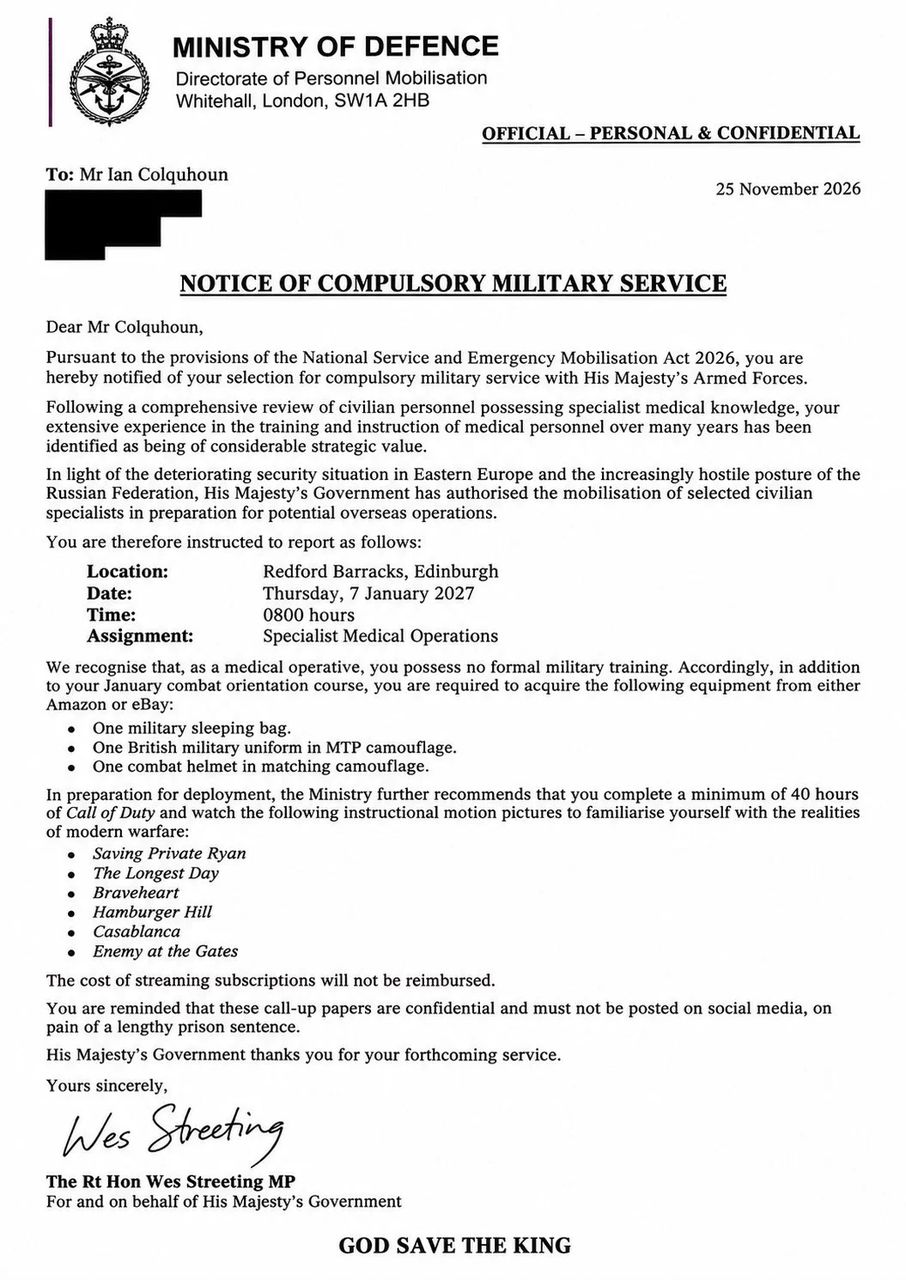
Did the UK Ministry of Defence send 'Notice of Compulsory Military Service' call-up papers under a 'National Service and Emergency Mobilisation Act 2026', as a viral image shows?
False
The letter is not real: the MoD says it is fake and an AI watermark sits in the image.
No. The 'call-up papers' image posted on X in late November 2026 is a fabricated document. The Ministry of Defence told Lead Stories it is fake, and OpenAI's SynthID watermark shows the image was made with OpenAI image tools. The UK has no conscription.
 AI-generated
Claims
✕ 3 falseThe poster received genuine Ministry of Defence 'notice of compulsory military service' call-up papers dated 25 November 2026.1
The document is contradicted by the two sources that would know. The Ministry of Defence's news desk told Lead Stories in a 27 November 2026 email, 'This is fake.' Separately, Lead Stories found an OpenAI SynthID watermark in the image, which identifies it as output from OpenAI's image-generation tools. Those two findings are independent of each other: one is the issuing authority denying the document, the other is a technical trace in the file itself. A reader should also weigh the document's contents. A real mobilisation notice would not tell a recruit to buy his own uniform on Amazon or eBay, nor require 40 hours of Call of Duty. The letter cites an Act that does not exist. No genuine call-up notices of this kind have been issued, and the UK has no conscription. Because the whole post is 'here are my papers', the fake document settles the claim on its own.
A 'National Service and Emergency Mobilisation Act 2026' exists and authorises compulsory military service for civilian medical specialists.2
No UK legislation of that name appears in searches. The document's own citation is the weak point: a real notice would cite a real statute, and the absence of any such Act in the record is decisive. The government has said it has no plans to introduce conscription. The real legislative work in this area is the Armed Forces Bill 2026-27, which concerns widening recall conditions for former personnel, not creating a new conscription act for civilian medical specialists. A reader should note the pattern: the fake letter borrows the language of an emergency law to make an invented policy sound already enacted. Naming a statute is a common way to make a document look authoritative, but the name has to check out.
Recruits are instructed to buy uniform, sleeping bag and helmet themselves on Amazon or eBay and to complete 40 hours of Call of Duty plus watch Saving Private Ryan and other war films.1
This is the satirical core of the letter, and it is the detail that should make any reader pause before believing it. No real mobilisation notice tells a recruit to source his own kit from online retailers, and none sets a video-game quota. The Ministry of Defence confirmed to Lead Stories that the document as a whole is fake, which covers these instructions. The absurdity is not incidental: it is a signal that the document was made as a joke, even though the post presents it in deadpan first person with no parody label. That combination is what lifted it out of private humour and into public misinformation once it was reposted by others as if real. The evidence here is both official denial and the plain content of the document.
The UK government is mobilising people because of a deteriorating security situation and a hostile Russia.23
There is a real story underneath the fake letter, and that is why it felt plausible. In late November 2026 the Ministry of Defence wrote to about 100,000 members of the Strategic Reserve asking them to update contact and skills details, and ministers cite a heightened threat environment. That much is true. What the letter adds is not. The government and service chiefs stress that the letters are not mobilisation or conscription; the letters signed by the heads of the three armed services invite veterans to volunteer for training and exercises, and responding creates no new obligations. The fake document takes a genuine administrative exercise and reframes it as a compulsory call-up. The sources here are weaker than on the other claims — one is an untiered outlet — so we treat this finding as context rather than as the decisive point.
Still open: How many reservists respond to the letters, and whether the government later changes its position on compulsion, are open political questions beyond this fact-check.
What was posted
XAn X post written in the first person says the author has received army call-up papers and will report because he is 'not a coward'. Attached is a single image of a typed letter on what looks like Ministry of Defence letterhead, headed 'Notice of Compulsory Military Service', addressed to a named individual and dated 25 November 2026. The letter cites a 'National Service and Emergency Mobilisation Act 2026', orders the recipient to Redford Barracks in Edinburgh for January 2027, tells him to buy uniform and kit on Amazon or eBay, and requires 40 hours of Call of Duty plus war films including Saving Private Ryan. It is signed with the name of the defence secretary.
“Well, I got my army callup papers today. I'm stunned. I'm not a coward so I'll go, though 💪”
Posted on X by the account @TheHibsAreHere. Near-identical copies of the same fake letter, with different names inserted, were reposted the same week, including by a large X account and on internet forums.
Who posted it
XAccount check
Estimates from public signals — account age, posting pattern, audience — not a judgement of the person behind the account, and separate from whether this post is true.
What stood out
- Account is the personal X/Twitter account of Ian Colquhoun, a published Scottish author/historian (Hibs books 'The Hibs Are Here', 'From Oblivion to Hampden'), actor and stuntman — identity is publicly established via his own website, Wikipedia, and press interviews.
- Account was created during lockdown (early 2020) to promote his Hibs book and share 90s Hibs nostalgia clips; it has since become an established fan-culture account quoted by The Courier, Edinburgh Reporter, Football Insider and Fan Banter.
- Mainly a football nostalgia/humour personality account, which appears in 'on this day' media citations and podcast appearances (Longbangers) — consistent with a genuine single operator, not a coordinated network.
- In Nov 2026 it posted an AI-generated fake 'Notice of Compulsory Military Service' addressed to Ian Colquhoun (praising Call of Duty and Saving Private Ryan), which Lead Stories fact-checked after the MoD confirmed it was fake and OpenAI's SynthID watermark was detected.
- The fake letter reads as a joke, but it was not clearly labelled as satire, so it briefly functioned as viral misinformation — a hit to reliability as an information source, not to the account's real-person authenticity.
- No follower count, creation date or verification status supplied; no evidence of bot-like or coordinated behaviour found.
Signals (8)+
- Account type
- Personal / fan-culture humour account
- Real identity
- Ian Colquhoun (Scottish author, Hibs historian)
- Estimated created
- 2020 (lockdown)
- External citations
- The Courier (2021, 2022); The Edinburgh Reporter (2021); Football Insider (2024); Fan Banter (2023); Hibs.net / Longbangers podcast
- Fact check history
- Lead Stories fact check, 26 Nov 2026 — AI-generated fake UK military call-up letter (MoD: 'This is fake'; SynthID watermark found)
- Misinformation risk
- Moderate — satire has been picked up and debunked as misinformation
- Coordinated network indicators
- None found
- Posting cadence
- Regular, human-paced (historical clips, jokes, replies)
Account checked November 28, 2026, 14:53 UTC
The media
Image✓ What is genuine
The letter format borrows real features of government correspondence — a crest, a Whitehall address, a reference number and the name of the defence secretary — and it is addressed to a named person. The underlying public story it distorts is genuine: the Ministry of Defence did write to around 100,000 Strategic Reservists in late November 2026.
The tells
- ●●● Strong signal An OpenAI SynthID watermark is embedded in the image, which identifies it as output from OpenAI's image-generation tools.Lead Stories
- ●●● Strong signal The document cites a 'National Service and Emergency Mobilisation Act 2026' that does not exist.our searches and Around Prague reporting
- ●●○ Supporting signal The instructions to buy kit on Amazon or eBay and to play 40 hours of Call of Duty are not the language of any real mobilisation notice.our visual review
- ●○○ Weak signal Our detector scored the image as overwhelmingly not AI-generated (ai_generated score 0.0097), so it did not identify the manipulation; we did not rely on it.our detector
Synthetic-media detector
Detector ranThe claim stands or falls on whether the media is real, so the detector ran.
Scores are the detector’s estimate for the file as uploaded. A low score does not rule out editing, a spliced caption, or footage shown out of context — those are judged above. Model v3.
How we checked the media
- Reviewed the image visually: it is laid out as a typed Ministry of Defence letter with a crest, address, reference line, a named recipient and a ministerial signature.
- Ran our image-detection model (hive-v3) on the image.
- Checked Lead Stories' forensic finding that an OpenAI SynthID watermark is present in the image.
- Checked the Ministry of Defence's statement to Lead Stories that the document is fake.
Sources
4 sources reviewed- 1Fact Check: FAKE UK 'Notice Of Compulsory Military Service' Orders Recruits To Play Call Of Duty And Watch Saving Private Ryan In Preparation -- Made With OpenAI ↗
Lead Stories · hoax-alert.leadstories.comPrimary / fact-checkerIFCN; strong on viral/AI mediaEvidence
The Ministry of Defence told Lead Stories the document is fake, and Lead Stories found an OpenAI SynthID watermark in the image.
- 2Reservist call-up letters: what ministers and the Armed Forces Bill say ↗
Around Prague · aroundprague.czUntiereduntiered — treated as signal only, never decisiveContext
The government says it has no plans for conscription, and the Armed Forces Bill concerns recall conditions rather than a new conscription act.
- 3Após contatar reservistas para possível mobilização, Reino Unido percebe não ter dados de quase metade deles ↗
CBN · cbn.globo.comUntiereduntiered — treated as signal only, never decisiveContext
The reservist letters invite veterans to volunteer for training and exercises and do not create new obligations.
- 4Fact Check: Image Does NOT Show Real U.K. PM Andy Burnham's Order Deploying Veterans To Ukraine ↗
Lead Stories · leadstories.comPrimary / fact-checkerIFCN; strong on viral/AI mediaFurther reading
A very similar fake MoD letter was debunked in August-September 2026, showing a recurring format.
Further reading
- 1Lead Stories The original fact-check recording the MoD's 'This is fake' statement and the OpenAI SynthID finding.
- 2Around Prague Explains what the Armed Forces Bill and reservist letters actually say, against the fake document's claims.
- 3CBN Details the real reservist letters signed by the heads of the armed services and the government's position.
- 4Lead Stories Shows an earlier fake MoD letter in the same style, demonstrating the recurring hoax format.
The full story
The fake letter did not come from nowhere. In late November 2026 the Ministry of Defence wrote to about 100,000 members of the Strategic Reserve asking them to update their contact details and skills. Letters signed by the heads of the three armed services invited veterans to volunteer for training and exercises, and the government stressed that responding would not create new obligations. Ministers also spoke about a heightened threat environment. That is a real, if mundane, administrative exercise — and it is exactly the kind of real story that a fake document can attach itself to.
The fabricated 'Notice of Compulsory Military Service' took that context and added everything the real letters did not contain: a non-existent Act, a compulsory reporting date at Redford Barracks in January 2027, instructions to buy uniform and kit on Amazon or eBay, and a requirement to play 40 hours of Call of Duty and watch Saving Private Ryan. It was signed with the name of the defence secretary. The Ministry of Defence told Lead Stories the document is fake, and Lead Stories found an OpenAI SynthID watermark in the image, showing it was made with OpenAI image tools.
The post itself was written in deadpan first person — 'I'm not a coward so I'll go' — with no parody label. Near-identical copies with different names were reposted within days, including by a large X account and on internet forums. A very similar fake MoD letter 'recalling veterans to Ukraine' had been debunked in the same style in August-September 2026. The format is recurring.
Kernel of truth
The Ministry of Defence really did write to about 100,000 Strategic Reservists in late November 2026 asking them to update their details — but the government says this is not mobilisation or conscription, and the UK has no conscription.
Timeline
November 25, 2026
Date printed on the fabricated 'Notice of Compulsory Military Service'. 1Lead Stories
November 26, 2026
The X post by @TheHibsAreHere sharing the fake letter is dated by Lead Stories to this day. 1Lead Stories
November 27, 2026
The Ministry of Defence tells Lead Stories by email: 'This is fake.' 1Lead Stories
How it was framed
The image is a fabricated document — it cites an Act that does not exist and contains invented instructions — but it works by attaching itself to a real late-November 2026 story about reservist letters. The post presents the invented notice as a personal call-up, giving genuine content a false frame.
- “Visual proof”. The post's entire argument is the attached image of a letter laid out as official correspondence, with crest, address and signature.
- Borrowed authority. The document is presented as Ministry of Defence letterhead and signed with the name of the defence secretary.
- Missing context. The post does not mention that the letter cites a non-existent Act, nor that the government says the reservist letters are not mobilisation.
- Emotional language. 'I'm stunned' and 'I'm not a coward so I'll go, though 💪' frame the document as a personal, serious moment.
Posted on X by the account @TheHibsAreHere. Near-identical copies of the same fake letter with other names were reposted the same week, including by a large X account and on internet forums. Lead Stories dates the post to 26 November 2026.
Bias
Leans sceptical of UK government defence and call-up messaging. The post is a jokey, deadpan satire built around conscription anxiety and mocks the idea of being summoned to war; it carries a mild anti-conscription slant but pushes no organised political agenda.
Bias describes how the post frames its message — the slant of the language, selection and emphasis — and is judged separately from whether the claim is true. A true claim can still be framed with a strong slant.
How we checked
56 s- 1
We read the post and the attached image, noting the name, date, the Act cited and the instructions in the document.
- 2
We searched for the exact name of the 'National Service and Emergency Mobilisation Act 2026'.
- 3
We searched for reporting on UK conscription call-up letters and on the reservist letters of late November 2026.
- 4
We reviewed Lead Stories' fact-check, which records the Ministry of Defence statement that the document is fake and its finding of an OpenAI SynthID watermark.
- 5
We ran our image-detection model on the image and recorded its output, which did not flag the image as AI-generated; we therefore did not rely on it.
- 6
We reviewed the document visually against the known facts.
✓ Claim checked✓ Media checked✓ Sources checked
Why 93% confidence
HighWe rate the central claim FALSE with HIGH confidence because two independent lines of evidence agree: the issuing authority, the Ministry of Defence, told Lead Stories the document is fake, and Lead Stories found an OpenAI SynthID watermark in the image showing it was generated with OpenAI tools. The document's non-existent Act and absurd instructions corroborate this. Our own detector scored the image as very likely not AI-generated, which is a reminder that detector output alone can be wrong; the official statement and watermark carry the finding.
Limits. We did not examine the original image file ourselves, and we could not independently run a SynthID check; that finding rests on Lead Stories. Our own detector did not identify the image as AI-generated. We did not establish who first created the template or why.
What we don’t know
- Who created the fake letter template, and whether it began as a private joke before being reposted as real.
- Whether the named recipient on the letter exists or is invented.
- Whether the account that posted it believed the document was real at the time of posting.
Spot it yourself
Spot the fakeLooks suspicious, isn’t proof
- The account name and informal tone — a casual poster can still share a real document, so tone alone decides nothing.
- The letter looks slightly too clean and well-laid-out, which some readers read as 'too perfect'. Production quality is a reason to look closer, not proof.
- The emoji and the first-person framing make it feel like a joke, but jokes are sometimes used to spread real-looking fakes, and fakes are sometimes posted in earnest.
The actual evidence
- The Ministry of Defence told Lead Stories the document is fake.
- Lead Stories found an OpenAI SynthID watermark in the image, showing it was made with OpenAI image tools.
- The letter cites a 'National Service and Emergency Mobilisation Act 2026' that does not exist.
- The instructions — buy kit on Amazon or eBay, play 40 hours of Call of Duty — are not the language of any real mobilisation notice.
- No genuine call-up notices of this kind have been issued, and the UK has no conscription.
- 1
Ask who would be reporting this if it were true.
Compulsory call-up papers for civilians would be a national emergency story on every UK front page. If the only source is one social post and reposts of the same image, that is a strong warning sign.
- 2
Check the law the document cites.
Search the exact name of the Act in quotation marks. A real statute will appear in official records and news coverage; a made-up one will return only the fake document and fact-checks of it.
- 3
Look for the official denial.
Search for the department's press office and the claim together, e.g. 'Ministry of Defence fake call-up letter'. The MoD told Lead Stories directly that this document is fake.
- 4
Inspect the document's internal logic.
Real mobilisation notices do not tell recruits to buy their own uniform online or complete video-game hours. Absurd instructions are a strong clue that the document was invented, even when it is typed neatly.
- 5
Check whether the image carries an AI watermark.
OpenAI's SynthID can be detected by compatible tools. A watermark check can confirm AI generation when it is found, but its absence does not prove an image is real.
Takeaway
A document can look official — crest, address, signature — and still be invented. The checks that actually decide it are outside the document: who issued it, whether the law it cites exists, and whether the real authority denies it.
Questions people ask
Is the UK bringing back conscription?+
No. The government has said it has no plans to introduce conscription. In late November 2026 the Ministry of Defence wrote to around 100,000 Strategic Reservists asking them to update contact and skills details, but the government stresses this is not mobilisation or conscription.
Is the 'Notice of Compulsory Military Service' letter real?+
No. The Ministry of Defence told Lead Stories the document is fake, and Lead Stories found an OpenAI SynthID watermark in the image showing it was made with OpenAI image tools. It cites an Act that does not exist and tells recruits to buy kit on Amazon.
What is the 'National Service and Emergency Mobilisation Act 2026'?+
It does not exist. Searches for the exact name turn up no UK legislation of that title. The real legislative work in this area is the Armed Forces Bill 2026-27, which concerns widening recall conditions for former personnel, not creating a conscription act.
What is a SynthID watermark and what does it prove?+
SynthID is a watermark that some OpenAI image tools embed in their output, and a compatible detector can find it. Finding one shows an image was made with those tools. Not finding one does not prove an image is real, because not all tools add watermarks and some images are edited afterwards.
Why did people believe the fake call-up letter?+
Because something real was happening at the same time. The Ministry of Defence really did write to about 100,000 reservists in late November 2026, and ministers spoke about a heightened threat environment. The fake letter took that real context and added compulsory call-up details the real letters did not contain.
Go deeper
- SynthID
- A watermark some OpenAI image tools embed in their output, which a compatible detector can identify.
- False context
- When genuine information or real events are placed in a false frame so that a fake claim seems believable.
- Strategic Reserve
- Former service personnel the Ministry of Defence can contact about voluntary training and exercises; responding does not create new obligations.
- Conscription
- Compulsory military service, which the UK does not currently have.
People also search for
For educators+
- The letter tells recruits to buy kit on Amazon and play 40 hours of Call of Duty. Why might a hoax include obviously absurd details, and how should that affect whether you believe it?
- Our image detector did not flag this image as AI-generated, but the MoD said the document is fake. What does that tell you about relying on a single tool?
- If a real government letters campaign was happening at the same time, how could a reader tell the genuine letters from the fake one?
About this check
- Platform
- X
- Posted by
- @thehibsarehere
- Posted
- November 26, 2026
- Age when checked
- 1–2 days old when checked
- Where it spread
- United Kingdom
- Audience
- UK & EU audience
- Language
- EN
- Status
- ● Post is live
- Verified
- November 28, 2026, 14:55 UTC
- Published
- November 28, 2026, 14:55 UTC
Reach. 5,653 likes, 2,413 replies; circulating alongside real MoD letters to ~100k strategic reservists (Metro, LBC 27 Nov)
This verdict was generated with AI from the sources shown. AI can make mistakes — check the sources before relying on it.
Check anything yourself, in seconds.
Share any social post or video to What the Fact and get the verdict, the confidence, and the receipts.