Did Iran use helicopters to attack US bases in the Gulf after disabling their radar?
Does a viral video show Iranian attack helicopters striking US military targets in the Gulf after knocking out US radar and air defences?
False
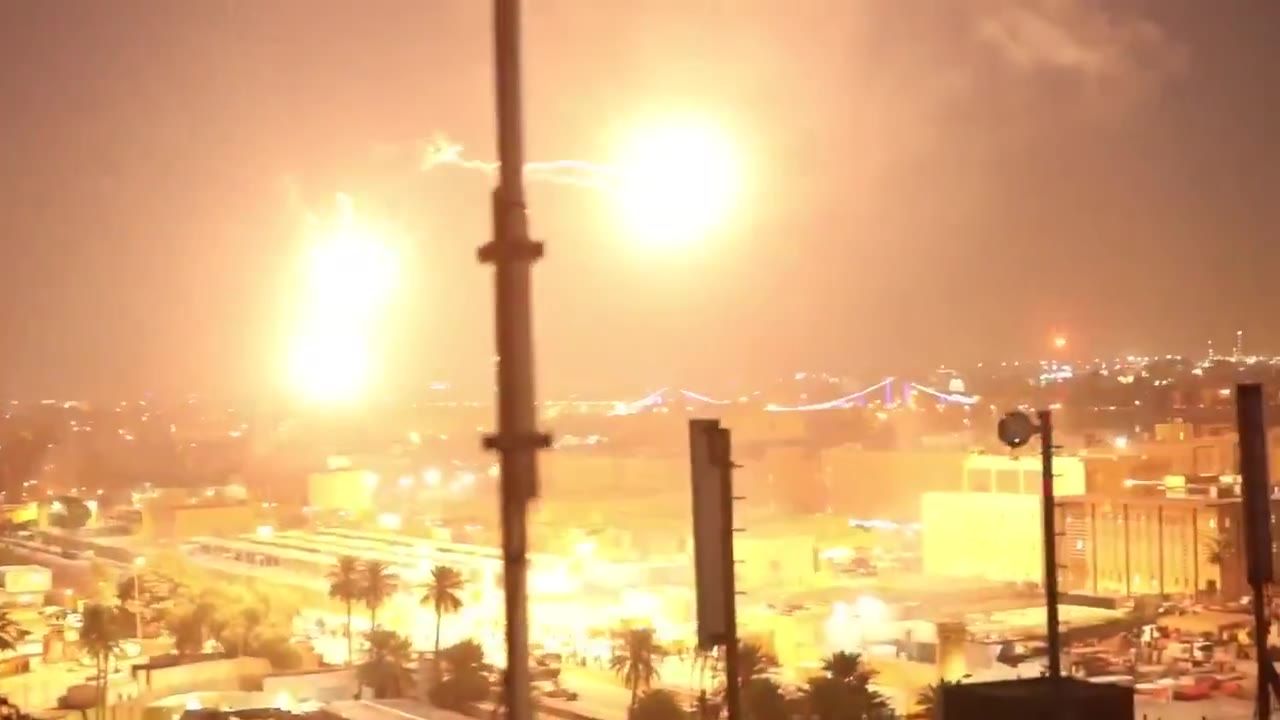
The footage is genuine 2019 Baghdad flare footage, not an Iranian helicopter attack.
FALSE. The video is real but old: it shows US Army Apache helicopters releasing flares over the US Embassy in Baghdad on 31 December 2019. No credible source reports Iranian helicopters attacking US bases in the Gulf in November 2026. Iran's documented claims that month involved drones and missiles on Bahrain radar sites, not helicopters.
 Genuine
Claims
✕ 1 falseIran began using helicopters to attack US military targets in the Gulf12
“پس از آنکه ایران سیستمهای راداری و پدافند هوایی پایگاههای آمریکا در کشورهای خلیج فارس را از کار انداخت، شروع به استفاده از بالگرد برای حمله به اهداف نظامی کرد”
The video is the entire evidentiary basis of the claim, and it does not show what the caption says. Misbar, the fact-check unit of Alaraby TV, matched the clip to footage of US Army AH-64 Apache helicopters dropping flares over the US Embassy in Baghdad on 31 December 2019. A longer version of the same scene was published on WarLeaks' YouTube channel on 3 January 2020. That is positive identification of a different event, in a different country, more than six years earlier. Beyond the video, our searches of reporting on the November 2026 escalation found extensive coverage of Iranian drone and missile claims against radars in Bahrain, but nothing about helicopter strikes on US targets. A helicopter attack on a US base would be an immediate, major international story; defence, wire and Gulf outlets would report it within hours. None did. Two separate lines of evidence therefore point the same way: the footage is identified as something else, and the event it describes is missing from the record.
Still open: Who first attached the Baghdad clip to this caption is not established in our record.
Iran disabled the radar and air-defence systems of US bases in Persian Gulf countries34
“ایران سیستمهای راداری و پدافند هوایی پایگاههای آمریکا در کشورهای خلیج فارس را از کار انداخت”
This part rests on one side's statements, and the other side rejects them. Iran's Islamic Revolutionary Guard Corps claimed drone and missile strikes on US radar sites at Bahraini bases on 13, 15 and 21 November 2026, naming early-warning and Patriot radars at Al-Riffa, Awali and Sheikh Isa. Those claims reach us through Iranian state media, including Iran Daily's account of six drones aimed at the Al-Riffa radar on 15 November. Bahrain's military said its air defences intercepted the drones before they reached their targets, and US Central Command rejected at least one of the earlier claims. Both sides have an interest in how this is described: the IRGC in showing success, Bahrain and the US in showing that defences held. We found no independent assessment — no imagery analysis, no neutral on-the-ground reporting — confirming that any radar was put out of action. The claim is therefore not false on the evidence we have; it is unverified, and the confident 'disabled' framing is not supported by anything outside Iranian state media.
Still open: No independent damage assessment of the Bahraini radar sites is available in our sources.
Attacking with helicopters is cheaper than using fighter jets and missiles6
“این کار از جتهای جنگنده و موشکها کمهزینهتر است”
This is a general cost argument, not a report of something that happened, so it cannot be checked as true or false in the way a factual claim can. The underlying economics are partly real: a helicopter's cannon rounds cost far less than interceptors or precision-guided missiles. But the comparison only matters if the aircraft can do the job. Iranian helicopters are not demonstrated to have the range, payload and survivability to reach and attack US bases across the Gulf, and our searches found no documented use of them in that role. The cost argument also has an unexpected real-world anchor: analysis of Gulf states' use of Apache and armed Black Hawk helicopters in a counter-drone role — the opposite side of this fight — is where cost-effective rotorcraft employment in the Gulf actually appears. So the post borrows a plausible-sounding military argument and attaches it to an event that did not happen.
What was posted
XA post on X from an account styled 'Geopolitics (IRGC)' shared a night-video clip of a helicopter releasing bright flares over a city skyline with streaks in the air. The Persian caption presents it as breaking news: Iran, having disabled US radar and air-defence systems at Gulf bases, has begun attacking US military targets with helicopters because that is cheaper than fighter jets and missiles. The video is the only evidence offered for the claim.
“فوری: پس از آنکه ایران سیستمهای راداری و پدافند هوایی پایگاههای آمریکا در کشورهای خلیج فارس را از کار انداخت، شروع به استفاده از بالگرد برای حمله به اهداف نظامی کرد. این کار از جتهای جنگنده و موشکها کمهزینهتر است!”
“URGENT: After Iran disabled the radar and air-defence systems of US bases in the Persian Gulf countries, it began using helicopters to attack military targets. This is cheaper than fighter jets and missiles!” — translated
Posted on X by an account using the name 'Geopolitics (IRGC)'. No posting date is shown in our record; the post circulated alongside the November 2026 Iran–US escalation.
Who posted it
XAccount check
Estimates from public signals — account age, posting pattern, audience — not a judgement of the person behind the account, and separate from whether this post is true.
What stood out
- Profile resolves on X as 'ژئوپلیتیک (IRGC )🌐' (@Geopolitics_IRG) — a Persian-display-name geopolitics account that brands itself with the IRGC name, yet carries no platform verification.
- IRGC itself disowns such accounts: official statements (Sepah News/Fars, 9 Jun and 18–19 Jul 2026) list the only authorised IRGC X accounts — @IRGCHQ, @irgcspeaker, @niroodayayi, @IrgcCommander, @BasijHQ, @esmailqaani — and declare every other account using the IRGC name or logo 'fake, unauthorised and unreliable'. @Geopolitics_IRG is not on that list, so its IRGC branding is self-assumed.
- No trace of this handle in any news outlet, fact-check, or research dataset: it is absent from ShadowGraph's 21-account 'IRGC'-branded network (Jul 2026) and from Clemson's 62-account IRGC-affiliated operation (Mar 2026), so no sourcing record or editorial accountability can be established.
- It fits the documented genre of anonymous 'IRGC'-branded aggregator personas: West Asia-based, English/Persian war content, batch-created in 2026, and known in that cluster for fabricated quote-over-video posts and recycled/AI imagery.
- Metadata supplied is nearly empty (no bio, followers, creation date, or sample posts), which prevents any cadence or follower-ratio analysis; scores lean on the impersonation/attribution evidence rather than behaviour logs.
- Comparable accounts in this genre were assessed as human-operated rather than fully automated (Clemson 2026), so coordinated-inauthentic risk is high but pure-bot likelihood is moderate.
Signals (12)+
- Account exists
- Yes
- Display name
- ژئوپلیتیک (IRGC )🌐
- Posting cadence
- Unknown (no posts in sample)
- Follower ratio
- Unknown (follower count null)
- Self declared affiliation
- IRGC branding in display name
- Irgc official disavowal
- Yes
- Irgc authorised account list excludes handle
- Yes
- Impersonation flag
- Yes
- Notable news coverage
- None found
- Fact check history
- None found
- Named in known irgc networks
- No (absent from ShadowGraph 21-account and Clemson 62-account sets)
- Network genre match
- Anonymous IRGC-branded geopolitics aggregator persona
Account checked November 28, 2026, 14:56 UTC
The media
Video✓ What is genuine
The video itself is real footage of US Army Apache helicopters releasing flares over the US Embassy in Baghdad on 31 December 2019. It is not synthetic and not manipulated. Only the caption's description of it is wrong.
The tells
- ●●● Strong signal The aircraft reads as a single coherent airframe across frames, with no morphing or texture artefacts typical of generated video.our visual review
- ●●● Strong signal The AI-generation detector scored the video not AI-generated at 99.99%, with deepfake score 0.0.our detector
- ●●○ Supporting signal Flare dispersion, smoke and lighting behave the way they do in documented real footage of Apache flare drops over Baghdad's Green Zone.our visual review
- ●●● Strong signal The night footage matches a longer clip of US Army AH-64 Apaches over the US Embassy in Baghdad on 31 December 2019, published on WarLeaks' YouTube channel on 3 January 2020.Misbar (Alaraby TV)
Synthetic-media detector
Detector ranThe claim stands or falls on whether the media is real, so the detector ran.
Scores are the detector’s estimate for the file as uploaded. A low score does not rule out editing, a spliced caption, or footage shown out of context — those are judged above. Model v3.
How we checked the media
- Reviewed keyframes visually for synthetic artefacts: lighting, smoke, flare dispersion and the aircraft's shape across frames.
- Ran our AI-generation detector (Hive v3) on the video, which scored it 99.99% not AI-generated.
- Checked provenance against published fact-checks that identified the original footage and its earliest known upload.
Sources
6 sources reviewed- 1الفيديو من العراق وليس لمروحيات إيرانية هاجمت أهدافًا أميركية ↗
Misbar (Alaraby TV) · misbar.comUntiereduntiered — treated as signal only, never decisiveEvidence
Traces the clip to US Apache flares over the US Embassy in Baghdad on 31 December 2019 and dates the longer WarLeaks version to 3 January 2020.
- 2Does the Video Show Iranian Helicopters Attacking U.S. Military Bases? ↗
Misbar (Alaraby TV) · misbar.comUntiereduntiered — treated as signal only, never decisiveContext
Shows an earlier use of the same footage to claim Iranian helicopter strikes, indicating recycling.
- 3Iran Hits Bahrain Again As Guards Declare Hormuz "Closed" ↗
Gulf Insider · gulf-insider.comUntiereduntiered — treated as signal only, never decisiveEvidence
Reports the IRGC's 15 November 2026 drone claim on the Al-Riffa radar and Bahrain's statement that the drones were intercepted.
- 4IRGC targets US air defense radar in Bahrain base with six drones ↗
Iran Daily · newspaper.irandaily.irUntiereduntiered — treated as signal only, never decisiveEvidence
Iranian state-linked account of drone attacks on radar, and records CENTCOM's rejection of an earlier claim.
- 5ویدیوی نادرست منتسب به حملات تلافیجویانه جدید ایران به بحرین ↗
Factnameh · factnameh.comUntiereduntiered — treated as signal only, never decisiveContext
An earlier fact-check of a different video falsely tied to Iranian retaliation on a Bahrain base, showing the pattern of recycled claims.
- 6The Gulf at War (IISS Strategic Dossier) ↗
IISS · iiss.orgUntiereduntiered — treated as signal only, never decisiveEvidence
Establishes that Gulf states, not Iran, use Apache and Black Hawk helicopters cost-effectively in a counter-drone role.
Further reading
- 1Misbar (Alaraby TV) The Misbar fact-check that identified the footage as Baghdad 2019 and rated its use misleading.
- 3Gulf Insider Independent reporting that shows what Iran actually claimed in November 2026 — drone and missile strikes on Bahrain radar, not helicopters — and Bahrain's response.
- 6IISS Expert analysis of how Apache and Black Hawk helicopters are actually used cost-effectively in the Gulf, by Gulf states against drones.
The full story
On the night of 31 December 2019, US Army AH-64 Apache helicopters from the 1st Battalion, 227th Aviation Regiment flew over the US Embassy compound in Baghdad and released flares. Crowds had attacked the embassy that day. Flare drops are a standard defensive and deterrent measure: they light up the ground and warn people below. The scene was filmed, and a longer version went up on the WarLeaks YouTube channel on 3 January 2020.
Nearly seven years later, during the November 2026 Iran–US escalation, a Persian-language X account recirculated the footage with a new caption. The caption says Iran had knocked out US radar and air-defence systems at Gulf bases and then switched to helicopters because they are cheaper than jets and missiles. The footage is real; the story attached to it is not.
What gives the claim its plausibility is that something real was happening. On 13, 15 and 21 November 2026, the IRGC claimed drone and missile strikes on US radar sites at Bahraini bases. Those claims were carried by Iranian state media; Bahrain said it intercepted the drones, and CENTCOM rejected at least one claim. A genuine exchange of drone and missile claims, in the same Gulf theatre and the same month, makes an invented helicopter chapter feel like the next paragraph of a real story. The 'cheaper' line leans on a real debate about cost-effective rotorcraft use in the Gulf — but that debate concerns Gulf states using Apaches and Black Hawks against drones, not Iran attacking US bases.
The mechanical trick is simple and effective: take genuine, dramatic night footage from one conflict, strip its date and location, and re-label it as breaking news from another. Viewers see real flares over a real city, and the caption supplies the rest.
Kernel of truth
Iran did claim drone and missile strikes on US radar sites in Bahrain in November 2026, and the video is genuine military flare footage — but from Baghdad in 2019, not an Iranian helicopter attack.
Timeline
December 31, 2019
US Army Apache helicopters release flares over the US Embassy compound in Baghdad during unrest there. 1Misbar (Alaraby TV)
January 3, 2020
A longer version of the Baghdad flare footage is published on the WarLeaks YouTube channel. 1Misbar (Alaraby TV)
November 13, 2026
The IRGC claims it destroyed a US early-warning radar; CENTCOM rejects the claim. 4Iran Daily
November 15, 2026
The IRGC says six drones targeted the US air-defence radar at Al-Riffa helicopter base; Bahrain says the drones were intercepted. 3Gulf Insider
November 28, 2026
Misbar publishes a fact-check identifying the circulated clip as the 2019 Baghdad footage. 1Misbar (Alaraby TV)
How it was framed
The video is authentic footage of real events, but it is presented with a false date, place and actor: Baghdad 2019 becomes the Gulf in 2026, and US Apaches become Iranian attack helicopters. The caption also uses the real November 2026 drone-and-missile exchange to make the invented helicopter chapter feel like a continuation of a true story.
- Urgency. The caption opens with 'فوری' ('URGENT').
- “Visual proof”. Dramatic night footage of flares is offered as the sole evidence for the claim, with no date or location given.
- Missing context. The caption does not say the footage is old or from Iraq, though the original was published in 2020.
- Unsourced statistic. The claim that helicopters are 'cheaper than fighter jets and missiles' is asserted without figures or sourcing.
- Borrowed authority. The account presents itself as 'Geopolitics (IRGC)', borrowing the name of Iran's Revolutionary Guard.
The post appears on X from an account using the name 'Geopolitics (IRGC)'. Our record does not show the post's date or engagement figures.
Bias
Leans pro-Iranian / IRGC propaganda. An account branding itself 'Geopolitics (IRGC)' presents recycled 2019 US helicopter footage as proof of a new, cost-effective Iranian tactic against US bases in the Gulf, amplifying IRGC claims of success without noting US and Bahraini denials or the absence of independent verification.
Bias describes how the post frames its message — the slant of the language, selection and emphasis — and is judged separately from whether the claim is true. A true claim can still be framed with a strong slant.
How we checked
1 min 4 s- 1
We ran targeted searches in English and Persian on the November 2026 Iran–US escalation, looking for reports of Iranian helicopter attacks on US bases in the Gulf.
- 2
We reviewed keyframes of the video for visual plausibility and synthetic artefacts.
- 3
We ran our AI-generation detector (Hive v3) on the video.
- 4
We checked published fact-checks and provenance records to identify the earliest known source of the footage.
- 5
We compared the caption's cost claim against expert analysis of helicopter use in the Gulf.
✓ Claim checked✓ Media checked✓ Sources checked
Why 85% confidence
HighOur confidence is HIGH on the central claim because two independent lines of evidence converge: Misbar positively identified the footage as the 2019 Baghdad flare drop, and our own searches found no reporting of any helicopter attack on US bases despite the event's high newsworthiness. The radar claim is rated UNVERIFIABLE rather than false because the only sourcing is Iranian state media and the opposing side's statements, with no independent damage assessment.
Limits. We did not open or analyse the original X post directly; our record does not include its date or engagement data. We did not carry out a frame-by-frame forensic comparison between the circulated clip and the WarLeaks original. No independent satellite or ground assessment of the Bahraini radar sites was available to us.
What we don’t know
- Who first paired the Baghdad footage with this Persian caption, and whether they knew its origin.
- Whether any radar at the Bahraini bases was actually damaged, and if so how badly.
- Whether the X post is still online and how widely it spread.
Spot it yourself
Spot the fakeLooks suspicious, isn’t proof
- The account name 'Geopolitics (IRGC)' signals a side in the conflict, but a partisan source can still post real footage.
- The 'URGENT' opening and exclamation mark are alarmist, but alarmist language proves nothing about whether an event happened.
- Night footage with flares looks dramatic and 'too perfect' to some viewers, but this particular scene was real — in Baghdad in 2019.
The actual evidence
- Positive identification: Misbar matched the clip to US Apache flare drops over the US Embassy in Baghdad on 31 December 2019, with a longer version on WarLeaks from 3 January 2020.
- The event is missing from the record: a helicopter attack on a US base would be covered immediately by wires, Gulf outlets and defence media, and none reported one.
- The caption supplies no date or location for the footage — the two details that would let you check it.
- Our detector found the video not AI-generated at 99.99%, confirming that the deception is in the caption, not the pixels.
- 1
Ask whether the event would be everywhere if true
A helicopter attack on a US base is a major international story. Search a wire service and a Gulf outlet for the place and date; if nothing appears, treat the post as unproven.
- 2
Check the original source of the footage
Look for a longer version or earlier upload of the same clip — here, a YouTube channel posted it in January 2020. An earlier upload of the same footage under a different description is strong evidence of recycling.
- 3
Look for date and place anchors in the video
Skyline, landmarks, uniforms and vehicle types can tie footage to a city. If the caption gives no date or place, that is a gap you should try to fill yourself.
- 4
Separate 'is this video real?' from 'does this video show what the caption says?'
A detector can tell you footage is not AI-generated, but it cannot tell you where or when it was filmed. Check the claim's caption against reporting, not just the video's authenticity.
Takeaway
Real footage can carry a false story. Before believing a video caption, ask what a viewer sees versus what the caption asserts — and check whether the event the caption describes was reported anywhere else.
Questions people ask
Is the helicopter video real?+
Yes. The video is genuine footage of US Army Apache helicopters releasing flares over the US Embassy in Baghdad on 31 December 2019. A longer version was posted on the WarLeaks YouTube channel on 3 January 2020. Our AI-generation detector also scored it not AI-generated. The problem is the caption, not the footage.
Did Iran attack US bases with helicopters in November 2026?+
No. There are no credible reports of Iranian helicopters attacking US targets. In November 2026 the IRGC claimed drone and missile strikes on US radar sites at Bahraini bases; Bahrain said it intercepted the drones and CENTCOM rejected at least one claim. No helicopter attack is documented.
What is 'false context'?+
False context is when genuine content is shared with incorrect information about where, when or what it shows. The video here is real, but its date, location and actors are wrong. The deception is in the caption, which is why checking only whether the footage is real would miss it.
Why would a post say helicopters are cheaper than jets and missiles?+
The cost argument has some real basis: helicopter cannon rounds are cheaper than interceptors or precision missiles. But the argument only works if the aircraft can reach the target. Iranian helicopters are not shown to have the range or survivability to strike US bases across the Gulf, and no such attack has been documented.
Go deeper
- False context
- Genuine photo, video or audio shared with a wrong date, location or explanation.
- AH-64 Apache
- A US Army attack helicopter, the type shown in the footage releasing flares.
- Flares
- Bright burning pyrotechnics released by military aircraft to distract heat-seeking missiles or to illuminate and warn people below.
- CENTCOM
- United States Central Command, the US military command responsible for the Middle East.
- Provenance
- The documented history of where a piece of media first came from and how it has travelled.
People also search for
For educators+
- If the video is real, why is the post still false? What exactly is the false part?
- The post was published during a period when Iran was making drone and missile claims against Bahrain radar sites. How does real background news make a false claim more believable?
- What would you search for to check whether a helicopter attack on a US base had happened, and what would count as confirmation?
About this check
- Platform
- X
- Posted by
- @geopolitics_irg
- Posted
- November 27, 2026
- Age when checked
- Under 24 hours old when checked
- Where it spread
- IR, United States, IQ
- Audience
- International audience
- Language
- FA
- Status
- ● Post is live
- Verified
- November 28, 2026, 14:57 UTC
- Published
- November 28, 2026, 14:57 UTC
Reach. 551 likes at recheck; English and Arabic copies live; Misbar fact-check 28 Nov
This verdict was generated with AI from the sources shown. AI can make mistakes — check the sources before relying on it.
Check anything yourself, in seconds.
Share any social post or video to What the Fact and get the verdict, the confidence, and the receipts.