Did two oil tankers catch fire after hitting naval mines in the Strait of Hormuz?
Did two more oil tankers explode and catch fire after hitting Iranian naval mines in the Strait of Hormuz (off Khasab) on 27 November, as Iran's IRGC Navy claims?
Misleading
The claim and the footage are real IRGC output, but the mine-strike cause is unverified and officially disputed.
Iran's IRGC did announce in late November 2026 that two tankers caught fire after hitting naval mines in the Strait of Hormuz, and Press TV posted genuine IRGC night footage. But the mine cause is Iran's word alone. Reuters could not verify it, maritime bodies said it was unconfirmed, and the dark clip shows no vessel.
 Likely genuine
Claims
2 checkedTwo oil tankers burst into flames after hitting naval mines in the Strait of Hormuz, according to Iran's IRGC.12456
The reporting half of this claim checks out. It is accurate that the IRGC Navy issued exactly this announcement in late November 2026, and several independent agencies — Reuters, Middle East Eye, The Jerusalem Post — duly reported that the IRGC had said so. The problem is what the post does with that statement: it presents the mine-strike cause as fact rather than as one side's account. That cause rests entirely on Iranian military and state media. Reuters said plainly it could not independently verify the Iranian account, or even establish whether it referred to the same incidents UKMTO had logged. The Joint Maritime Information Center reported that Iranian claims of tankers striking mines had not been confirmed by any official body or national authority, and CENTCOM denied the main corridors were mined, while confirmed Hormuz attacks were described as hits by unidentified projectiles. The IRGC also repeated near-identical mine-strike announcements on 8, 15, 17, 19, 25 and 27 November, which is a pattern to weigh. So: real statement, real attacks on shipping, unverified and disputed cause presented as settled.
Still open: Whether any vessel actually struck a mine in this specific incident, and which vessels were involved, remains unresolved.
The attached footage shows the oil tanker(s) on fire after a mine strike.3
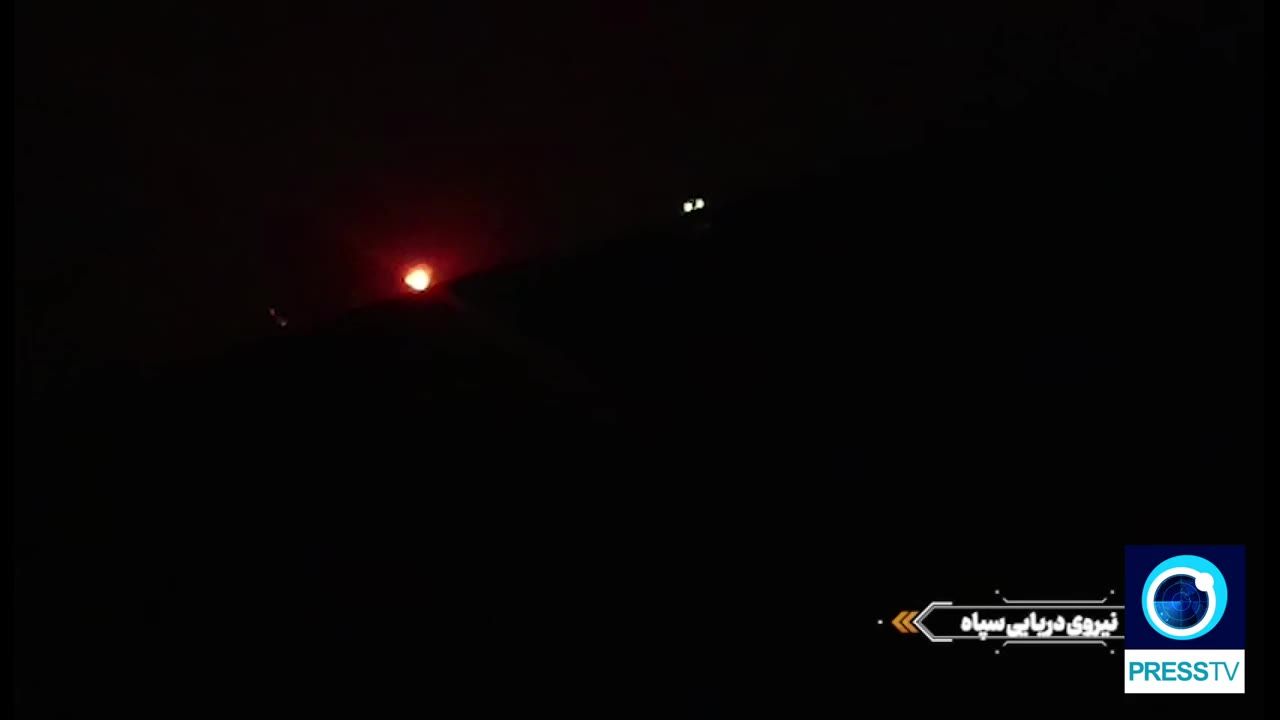
The footage cannot carry the weight put on it. Our own review of the frames found a very dark night seascape with a distant orange glow on the water and a few pinpoint lights — no hull, no name, no flag, no shoreline and no location marker. That is what a burning vessel filmed from far away at night could look like, but it is equally consistent with a fire on a rig, a flare, or any other distant blaze. There is nothing in the image that ties it to these tankers, this date or a mine. Our AI-detection check found no sign the video was synthesised, so we treat it as genuine IRGC-released material — which makes it authentic footage of something, not proof of the specific claim. Maritime trade press reached the same conclusion about comparable IRGC releases, noting fire and smoke on water with "no discernible vessel" and no independent verification of the claimed attacks behind the video.
Still open: We cannot establish what the fire in the clip is, where it was filmed, or when.
What was posted
XPress TV, Iran's state broadcaster, posted a short night-video clip on X with a caption attributing to the IRGC Navy an announcement that two more oil tankers burst into flames after hitting naval mines in the Strait of Hormuz. The footage carries Press TV branding and a Persian-language "IRGC Navy" graphic. It shows a distant orange fire glow on dark water with a few small lights. It asks the reader to accept the Iranian military's account of the incident as established fact.
“Iran's IRGC says two more oil tankers burst into flames after hitting naval mines in the Strait of Hormuz. Follow:”
Posted on the X account of Press TV, Iran's state broadcaster, which is the outlet distributing IRGC-provided material. The post says "two more" tankers, following a series of near-identical IRGC mine-strike announcements through November 2026.
Who posted it
XAccount check
Estimates from public signals — account age, posting pattern, audience — not a judgement of the person behind the account, and separate from whether this post is true.
What stood out
- Account is genuinely operated by Press TV, the English-language arm of Iran's state broadcaster IRIB — not an impersonation; created Sept 2010 and still active (posts dated 19-20 Nov 2026).
- Editorially controlled from Tehran: Ofcom revoked its UK broadcast licence in 2012 over lack of editorial independence and an interview aired that was conducted under duress; Ofcom/US/EU/Canada/Australia sanctions and YouTube ban followed.
- X removed its blue/gold verification in Feb 2024 and dropped 'state-affiliated media' labels, which per NewsGuard coincided with a ~97% jump in engagement — platform trust signals no longer flag it.
- Documented purveyor of fabricated/unsourced content: AI-generated 'Tel Aviv missile strike' and Bahrain skyscraper fire videos (FDD, AFP Factual, Maldita, NYT), recycled Ukrainian/Pakistani footage passed off as Israel-Iran war imagery (RFE/RL).
- GDELT's Nov 2026 fact-check matrix tags several Press TV claims 'Clearly False', 'Unsupported' or 'Misleading' (e.g. ongoing airstrikes on Tehran, 'Mecca Alliance', Hegseth impeachment, oil price figures).
- CCDH and UK Parliament evidence document Holocaust denial, antisemitic conspiracy content and LGBT/women's-rights attacks across Press TV's social output.
- Anchored in state messaging infrastructure: research identifies a 'Press TV Francais' persona network amplifying anti-government narratives in France (2026), indicating institutional coordinated messaging beyond a single account.
- Bot probability moderate-low: the account itself behaves like a staffed newsroom feed (high cadence, human-written copy, live correspondent posts), but acts as an amplifier node in state-aligned coordination.
- Some output is accurate or partly accurate (e.g. CREA $331.5bn energy-cost figure, BoE rate hike, Nasser Hospital strike), typically wrapped in selective omission or causal spin.
Signals (11)+
- Account created
- 2010-09
- Follower count estimate
- 329000
- Follower count as of
- 2024-02 (last published figure)
- Platform state label
- Removed by X; engagement rose ~97% after removal (NewsGuard)
- Owner
- Islamic Republic of Iran Broadcasting (IRIB), head appointed by Supreme Leader
- Regulatory status
- UK Ofcom licence revoked 2012; sanctioned by US, EU, Canada, Australia; banned from YouTube 2021
- Posting cadence
- High-volume, multi-post daily newsroom output (including Nov 2026 posts)
- Fact check history
- Repeated debunks 2025-2026 by RFE/RL, AFP Factual, Maldita.es, FDD, GDELT; AI-generated and recycled war imagery
- Coordinated network evidence
- Press TV Francais persona network documented Sep-Nov 2026 (Golden Owl / Asymmetric Intelligence)
- Content flags
- Holocaust denial/apologetics, antisemitic conspiracy content (CCDH, UK Parliament submission Feb 2025)
- Accuracy mix
- Occasional accurate facts, frequently paired with selective omission, spin or unverifiable military claims
Account checked November 22, 2026, 14:44 UTC
The media
Video✓ What is genuine
The footage itself appears to be genuine IRGC-released night video distributed by Press TV, carrying the broadcaster's branding and an IRGC Navy graphic. It is authentic footage of a fire at sea — just not identifiable proof of this incident.
The tells
- ●●● Strong signal Detector scored the video as not AI-generated, with an AI-generated probability of about 0.0002 and a deepfake score of 0.0.our detector
- ●●○ Supporting signal The frames are physically plausible: a dark sea at night, a distant fire glow, small lights, no warped geometry or garbled on-screen text.our visual review
- ●●● Strong signal No vessel, hull, name, flag or location is identifiable, so the clip cannot tie itself to these tankers or to a mine.our visual review
Synthetic-media detector
Detector ranThe claim stands or falls on whether the media is real, so the detector ran.
Scores are the detector’s estimate for the file as uploaded. A low score does not rule out editing, a spliced caption, or footage shown out of context — those are judged above. Model v3.
How we checked the media
- Reviewed the clip's keyframes by eye: dark seascape, distant orange glow, small lights, Press TV logo and Persian-language "IRGC Navy" graphic, no visible vessel.
- Ran the clip through our AI-generation detector (hive-v3), which returned a very low probability of synthesis.
Sources
6 sources reviewed- 1UK maritime agency reports two tanker incidents near Oman; Iran says vessel hit mine east of Hormuz ↗
Reuters (via Raleigh News & Observer) · newsobserver.comUntiereduntiered — treated as signal only, never decisiveEvidence
Reuters reported the Iranian mine claim and said it could not independently verify it.
- 2"Sunk" Tankers With No Names or Wreck Sites: Maritime Facts Contradict IRGC Accounts in Hormuz ↗
Ajel (citing Asharq Bloomberg) · news-ajel.comUntiereduntiered — treated as signal only, never decisiveEvidence
The Joint Maritime Information Center said Iranian mine-strike claims were not confirmed by any official body or national authority.
- 3Two tankers confirmed struck, Iran claims VLCC sinking in Hormuz ↗
Seatrade Maritime · seatrade-maritime.comUntiereduntiered — treated as signal only, never decisiveEvidence
Seatrade Maritime noted the IRGC footage showed no discernible vessel and the attacks were unverified.
- 4Two oil tankers ablaze after striking naval mines in the Strait of Hormuz ↗
Middle East Eye · middleeasteye.netUntiereduntiered — treated as signal only, never decisiveEvidence
Middle East Eye relayed the IRGC's statement, confirming the announcement was made and reported.
- 5IRGC: Three oil tankers hit mines, caught fire while transiting Hormuz with US support ↗
The Jerusalem Post · jpost.comUntiereduntiered — treated as signal only, never decisiveContext
The Jerusalem Post reported the IRGC mine claim and noted CENTCOM had not responded.
- 6Two oil tankers catch fire after hitting naval mines in Strait of Hormuz: IRGC ↗
Press TV (Iranian state broadcaster) · presstv.co.ukUntiereduntiered — treated as signal only, never decisiveEvidence
Press TV itself carried the IRGC Navy statement and posted the footage.
Further reading
- 1Reuters (via Raleigh News & Observer) Shows how a major agency reported the IRGC claim while stating it could not verify it.
- 2Ajel (citing Asharq Bloomberg) Gives the Joint Maritime Information Center's assessment that the mine claims were unconfirmed.
- 3Seatrade Maritime Trade-press analysis of the IRGC's footage and the lack of independent verification.
The full story
Something real was happening to shipping in and around the Strait of Hormuz in November 2026. Maritime authorities logged repeated attacks on vessels, including projectile strikes near Khasab, relayed by Reuters and other outlets. Tankers were hit and fires broke out. That is the kernel of truth here, and it is why the post feels plausible.
The IRGC went further. Through November it issued a run of near-identical announcements — on 8, 15, 17, 19, 25 and 27 November — saying tankers on an "unauthorised route" had struck naval mines and caught fire. Press TV, Iran's state broadcaster, carried each one, in this case with night footage of a fire at sea.
What the announcement lacked was confirmation. Reuters said it could not verify the Iranian account or establish whether it referred to the incidents UKMTO had logged. The Joint Maritime Information Center reported that Iranian mine-strike claims had not been confirmed by any official body or national authority. CENTCOM denied the main corridors were mined. Independent descriptions of confirmed attacks pointed to unidentified projectiles, not mines — a different cause with different implications for shipping and for who is to blame.
The footage sits in the same gap. It shows a distant fire on dark water with no discernible vessel, the same feature trade press noted in earlier IRGC releases. It is consistent with a burning ship. It is not evidence of one, and it says nothing about a mine.
Put together, real attacks and real IRGC footage are arranged to support a conclusion the evidence does not carry: that mines, and therefore Iran's account, explain what happened.
Kernel of truth
Vessels were genuinely attacked and caught fire in and around the Strait of Hormuz in November 2026, and the IRGC genuinely issued this mine-strike announcement.
Timeline
November 8, 2026
The IRGC issues one of a series of near-identical announcements that tankers struck naval mines in the Strait of Hormuz. 6Press TV (Iranian state broadcaster)
November 19, 2026
The Joint Maritime Information Center reports that Iranian claims of tankers striking naval mines have not been confirmed by any official body or national authority. 2Ajel (citing Asharq Bloomberg)
November 25, 2026
The IRGC announces a comparable two-tanker mine-strike incident in the Strait of Hormuz. 6Press TV (Iranian state broadcaster)
November 27, 2026
The IRGC announces two more tankers hit mines north of Ghannam Island; Press TV posts the night footage on X. 6Press TV (Iranian state broadcaster)
How it was framed
Genuine IRGC-released footage and a real IRGC announcement are framed so the mine-strike cause reads as established fact. The material is real; the framing pushes a disputed explanation beyond what the evidence supports.
- “Visual proof”. The post attaches night video of a fire at sea, offering the impression that the claim has been shown, not just asserted.
- Borrowed authority. "Iran's IRGC says" presents a military statement as the source of a causal fact rather than as one party's account.
- Missing context. The caption gives no hint that the mine cause is unverified and disputed by maritime authorities.
- Ongoing-threat framing. "two more oil tankers" implies a continuing series of mine strikes, matching the run of near-identical IRGC announcements.
Posted on X by Press TV, Iran's state broadcaster, which distributes IRGC-provided statements and footage. The account's post attributes the claim to the IRGC Navy.
Bias
Leans pro-Iran / pro-IRGC. The post is from Press TV, Iran's state-owned English-language broadcaster (IRIB), and relays an IRGC Navy statement as the factual account, complete with IRGC-supplied footage and the framing that vessels were 'violating' Iran's rules while escorted by the US military. No independent source, maritime authority or vessel identification is given, so the item functions as amplification of Iranian military messaging.
Bias describes how the post frames its message — the slant of the language, selection and emphasis — and is judged separately from whether the claim is true. A true claim can still be framed with a strong slant.
How we checked
1 min 7 s- 1
Searched for independent coverage of tanker fires and mine claims in the Strait of Hormuz in November 2026.
- 2
Compared the IRGC/ Press TV statement with reporting by Reuters, Middle East Eye and The Jerusalem Post, and with the Joint Maritime Information Center's assessment.
- 3
Reviewed the clip's keyframes by eye for any identifiable vessel, location or timestamp.
- 4
Ran the clip through our AI-generation detector to check whether it was synthesised.
✓ Claim checked✓ Media checked✓ Sources checked
Why 62% confidence
ModerateWe rate the headline MISLEADING with moderate confidence. The direction is clear: the announcement is real, the cause is unverified and disputed, and the footage shows no identifiable vessel. We stop short of high confidence because the underlying attacks on shipping were real and reporting on them is still developing.
Limits. We did not open the original pages behind our sources (we worked from search results and snippets), could not establish which vessels or locations the footage shows, and found no prior fact-check of this specific Press TV asset.
What we don’t know
- Which vessels, if any, were involved in the specific incident the post describes.
- Where and when the night footage was filmed, and what is actually burning in it.
- Whether any mine was used at all in the November 2026 attacks.
- Whether CENTCOM or maritime authorities will later confirm or rule out the Iranian account.
Spot it yourself
Spot the fakeLooks suspicious, isn’t proof
- The source is a state broadcaster aligned with one side of a conflict. That is a reason to check its claims, not proof the claim is false — state media sometimes report real events accurately.
- The footage is dark, distant and low-detail. Poor image quality is common in real night video and proves nothing either way.
- The caption is confident and urgent ("burst into flames", "two more"). Tone is a signal to slow down, not evidence of falsity.
The actual evidence
- Independent agencies reported the announcement but explicitly said they could not verify the mine cause.
- The Joint Maritime Information Center said the mine-strike claims had not been confirmed by any official body or national authority.
- Confirmed attacks were described as hits by unidentified projectiles, a different cause from mines.
- The footage shows no vessel, name or location, so it cannot substantiate the specific claim.
- The IRGC issued near-identical mine-strike announcements repeatedly through November, a pattern worth weighing.
- 1
Ask who would confirm this if true
A mine strike on two tankers in the Strait of Hormuz would prompt statements from maritime authorities, navies and shipping insurers. Search for those, not just for reports repeating the IRGC line.
- 2
Separate the announcement from the cause
Check whether outlets are reporting "the IRGC said X" or independently confirming X. Headlines that relay a statement are not verification.
- 3
Inspect what the footage actually shows
Pause the clip and look for a hull, name, flag, shoreline or timestamp. If none are visible, the video cannot tie itself to the claimed event.
- 4
Look for a pattern in the source's releases
Search the outlet's earlier posts. Repeated near-identical announcements with no independent confirmation are a warning sign.
- 5
Know what a detector can and cannot tell you
An AI-detection check can suggest a clip was not synthesised. It says nothing about whether the footage shows what the caption claims.
Takeaway
Genuine footage and a genuine statement can still be arranged to support a conclusion the evidence does not carry. Ask whether the cause, not just the event, has been independently confirmed.
Questions people ask
Did two oil tankers really hit naval mines in the Strait of Hormuz?+
Iran's IRGC said so in late November 2026, and Press TV broadcast the claim. But no maritime authority or independent agency has confirmed the mine cause. Reuters said it could not verify the account, and the Joint Maritime Information Center said the claims were unconfirmed. Confirmed attacks were described as projectile strikes.
Is the Press TV video of burning tankers fake?+
No sign of fakery was found; our detector scored it as not AI-generated. But the dark clip shows only a distant fire glow on water, with no vessel, name or location. It is genuine footage of a fire at sea that cannot be tied to these tankers or to a mine.
Why would a state broadcaster post unverified footage?+
We cannot say what motivated it. What we can say is that Press TV is Iran's state broadcaster and distributes IRGC-provided statements, and that the IRGC issued a series of near-identical mine-strike announcements through November 2026 without independent confirmation.
How can I check a claim like this myself?+
Separate the announcement from the cause: ask whether outlets are reporting that a military said something, or independently confirming it. Then look for confirmation from maritime authorities, and inspect the footage for anything that identifies the vessel or place.
What is the Strait of Hormuz and why does it matter?+
It is a narrow sea passage through which a large share of the world's oil shipped by sea must pass. Attacks there affect insurance, prices and international tensions, which is why claims about incidents in the strait get wide attention and are contested.
Go deeper
- IRGC
- Iran's Islamic Revolutionary Guard Corps, a branch of Iran's armed forces that also plays a major political and economic role.
- Strait of Hormuz
- A narrow passage between the Persian Gulf and the Gulf of Oman through which a large share of seaborne oil passes.
- UKMTO
- The United Kingdom Maritime Trade Operations, a naval body that logs and shares reports of incidents affecting commercial shipping.
- CENTCOM
- United States Central Command, the US military command responsible for the Middle East.
- Misleading content
- Genuine information used in a way that frames an issue or person falsely, so readers draw a wrong conclusion.
People also search for
For educators+
- The video is probably genuine. Does that make the post true? What exactly would the video need to show to support the claim?
- How would you find out whether the mine cause had been confirmed, and which bodies would you trust to confirm it?
- Why might a repeated pattern of similar announcements matter when judging a single one?
About this check
- Platform
- X
- Posted by
- @presstv
- Posted
- November 27, 2026
- Age when checked
- Under 24 hours old when checked
- Where it spread
- IR, OM, United States
- Audience
- International audience
- Language
- EN
- Status
- ● Post is live
- Verified
- November 28, 2026, 14:44 UTC
- Published
- November 28, 2026, 14:44 UTC
Reach. PressTV posts (153 likes on primary at recheck); Express Tribune 28 Nov coverage alongside CENTCOM denial of related Iranian claims; Hormuz trending in Egypt Google Trends
This verdict was generated with AI from the sources shown. AI can make mistakes — check the sources before relying on it.
Check anything yourself, in seconds.
Share any social post or video to What the Fact and get the verdict, the confidence, and the receipts.