Are Peshmerga forces blocking roads to stop the Iraqi army advancing on Kurdistan?
Does a viral video show Kurdish Peshmerga forces blocking the roads into the Kurdistan Region this week to stop the Iraqi army from advancing?
Can't verify
Real-looking footage, but unconfirmed date and location, and the stated motive is disputed.
We can't verify it. The video looks like genuine footage of bulldozers building earth barriers on a desert road in Iraq, but its date and location are unconfirmed. Reports of Peshmerga road-blocking around 25 November 2026 trace mainly to one anonymous security source, and Baghdad denies any plan to send troops into the Kurdistan Region.
 Likely genuine
Claims
1 checkedIn late November 2026, Peshmerga forces blocked roads leading to the Kurdistan Region with heavy machinery in order to prevent the Iraqi army advancing toward the Region's borders.12345678
“قوات البيشمركة تغلق الطرق المؤدية إلى إقليم كردستان بهدف منع تقدم الجيش العراقي نحو حدود الإقليم”
The general description is reported, but weakly. Dated outlets describe Peshmerga road-blocking around 25 November 2026: NEWSru.co.il reported checkpoints and barriers to keep out Iraqi forces, Akşam reported roads closed with heavy machinery, and an Erbil security source quoted by an Iraqi video agency said Peshmerga deployed heavily at Erbil's entrances. All of these hedge their wording ("it was claimed", "according to information coming from northern Iraq") and appear to trace back to that one anonymous source. Arab News and Asharq Al-Awsat both stressed that footage of the deployment could not be independently verified, and both reported a government denial. The stated motive is the weakest part: an Iraqi government source said Baghdad had no plans to send troops into the Region, and a KDP official told T24 the deployment was routine rather than preparation for fighting federal forces. The footage itself could not be dated or geolocated, and this same information wave already carried at least one recycled clip exposed by Annahar's fact-check unit. Weak, single-origin reporting plus a contested motive is not enough to support the claim as posted, so it stays UNSUPPORTED at LOW confidence.
Still open: The original date and location of the footage, and whether any official body has confirmed the blockade's purpose, remain unknown.
What was posted
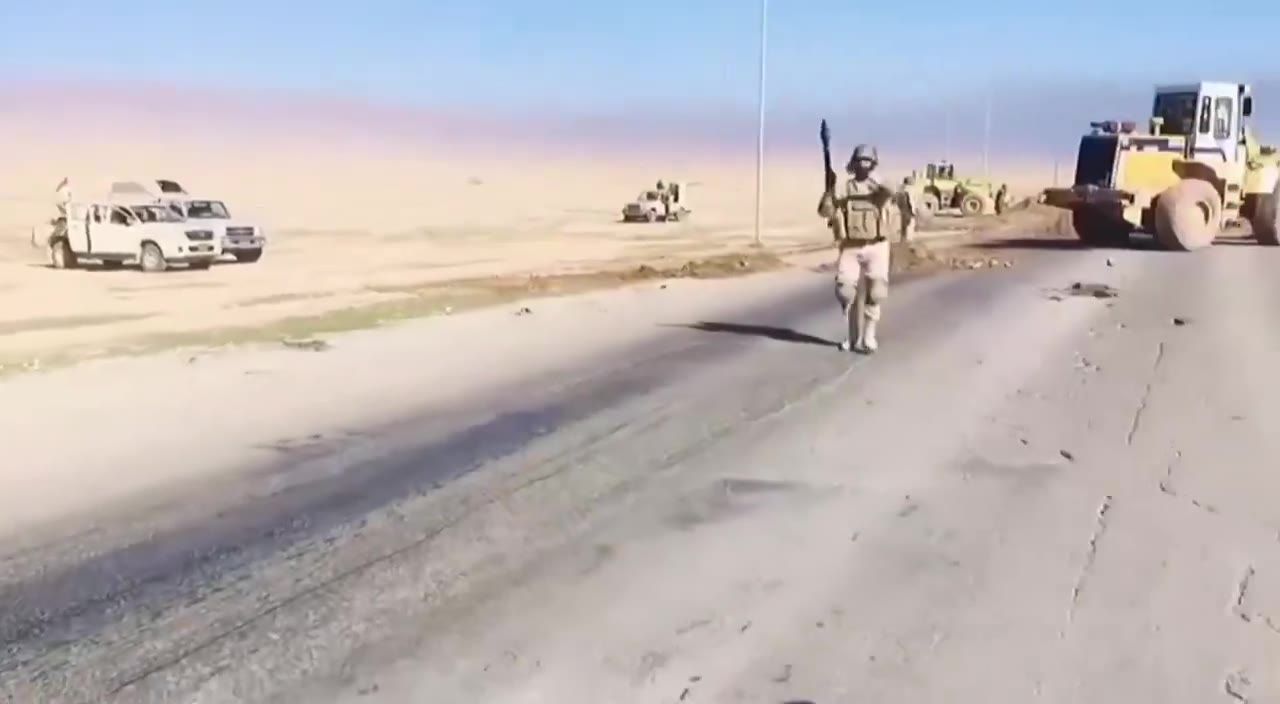
XAn account on X (@Rawafiid) posted a short video said to show Peshmerga forces closing roads leading to the Kurdistan Region. The clip shows wheel loaders pushing earth across a paved desert road while armed men in mixed camouflage stand by. The caption tells readers this is being done to stop the Iraqi army advancing toward the Region's borders.
“قوات البيشمركة تغلق الطرق المؤدية إلى إقليم كردستان بهدف منع تقدم الجيش العراقي نحو حدود الإقليم”
“Peshmerga forces close the roads leading to the Kurdistan Region in order to prevent the Iraqi army's advance toward the Region's borders” — translated
Posted on X by the account @Rawafid, which presents the clip without naming a location, date or original source. No earlier upload of this exact footage was found.
Who posted it
XAccount check
Estimates from public signals — account age, posting pattern, audience — not a judgement of the person behind the account, and separate from whether this post is true.
What stood out
- Account @Rawafiid is 'روافد - Rawafid' — its own bio self-describes as an Iraqi news platform covering local and regional events, and its feed (≈5,521 posts) is consistent with that: Iraqi/Kurdish security and political news, Peshmerga reinforcements, statements by Iraqi officials.
- It behaves like a real, continuously edited news-aggregator account rather than an obvious spam/follower-farm: topic coherence, Arabic-language curation, no giveaway bot patterns (no hashtag spam, no crypto/ad content in visible sample).
- Its content does get picked up by mainstream Arabic outlets: an Al Arabiya piece (26 Sep 2026) and a Masrawy piece (27 Sep 2026) both quote/embed its 25 Sep 2026 post on the 'Sibu 1' tanker and the al-Shaghanna tribe's claim to have freed it — evidence of real reach and citation.
- But that same example shows weak sourcing standards: it relayed tribal/activist claims and unverified onboard combat footage, while the competing narrative (Puntland maritime police conducted the rescue, per AFP) and the absence of any Iraqi official confirmation were not reconciled — outlets framed it as 'alleged/contested'.
- No verification badge, no named editor, owner, or funding disclosed, and no linked website or institutional masthead was found tying @Rawafiid to a registered outlet — it is an anonymous brand account, not a transparent newsroom.
- Key metadata is missing from the supplied record (no follower count, no account creation date, no sample posts), so age/audience/coordination signals cannot be measured directly; the account's own page shows activity but no follower metric was retrievable.
- No fact-checker debunk specifically naming @Rawafiid surfaced in searches; the account is a reporter of viral UGC rather than an identified originator of fabricated claims.
Signals (12)+
- Display name
- روافد - Rawafid
- Declared identity
- Iraqi news platform (منصة إخبارية عراقية)
- Self declared organisation
- Yes
- Post count visible
- 5521
- Posting cadence
- High-volume, frequent news posts (live-feed style)
- Follower ratio
- Unknown
- Institutional transparency
- None found — no site, editor, ownership or funding disclosure
- Notable news coverage
- Al Arabiya (alarabiya.net, 2026-09-25/26) and Masrawy (2026-09-26/27) embedded its posts as the source of the viral 'Sibu 1' tanker footage; also cited by arabwire24 and pressbee syndications
- Fact check history
- No direct debunk of @Rawafiid found; adjacent context shows Arabic fact-checkers (Arab Fact Check Hub/Musnad, No_Rumors) repeatedly debunking miscaptioned Iraq-sourced conflict videos in Oct–Nov 2026
- Sourcing quality
- Relays citizen/UGC video and partisan or tribal claims with little attribution or verification
- Content focus
- Iraq and Kurdistan region security, politics, viral video
- Coordination indicators
- None observed in sample; no hashtag brigading, no crypto/ad spam
Account checked November 28, 2026, 02:56 UTC
The media
Video✓ What is genuine
The scene itself appears to be real, unmanipulated video of armed men and heavy machinery building earth barriers on an Iraqi road.
The tells
- ●●● Strong signal Detector scored the clip as not AI-generated at 0.9999, with deepfake probability near zero.our detector
- ●●○ Supporting signal Dust haze, shadows and the cracked road surface stay consistent from frame to frame; the loaders behave like real machines.our visual review
- ●●○ Supporting signal Uniforms, weapons and tactics match documented Iraqi practice — Peshmerga closed roads with earth berms in October 2017.Annahar FactCheck reporting and Elaph (source 8)
- ●●○ Supporting signal No generative artefacts such as morphing objects, impossible anatomy or garbled signage appear.our visual review
Synthetic-media detector
Detector ranThe claim stands or falls on whether the media is real, so the detector ran.
Scores are the detector’s estimate for the file as uploaded. A low score does not rule out editing, a spliced caption, or footage shown out of context — those are judged above. Model v3.
How we checked the media
- Ran the clip through our AI-media detector (hive-v3) to check for synthetic generation or deepfake manipulation.
- Reviewed keyframes by eye for physical consistency: shadows, dust, road surface, machinery behaviour and uniforms.
Sources
8 sources reviewed- 1Курдские ополченцы начали блокировать дороги, ведущие на юг, ожидая вторжения ↗
NEWSru.co.il · newsru.co.ilUntiereduntiered — treated as signal only, never decisiveEvidence
Dated report of Peshmerga checkpoints and barriers, with hedged sourcing.
- 2Komşuda petrol restleşmesi! Yollar kapatıldı, birlikler bölgeye yöneldi ↗
Akşam · aksam.com.trUntiereduntiered — treated as signal only, never decisiveEvidence
Turkish report that road closures with heavy machinery were claimed.
- 3Al-Zaidi's crackdown gains legal backing, no plans to send troops to Kurdistan ↗
Arab News · arabnews.comUntiereduntiered — treated as signal only, never decisiveEvidence
Kurdish-platform footage could not be verified and Baghdad denied plans to send troops.
- 4غطاء قانوني لحملة الزيدي... ولا خطط لإرسال قوات إلى كردستان ↗
Asharq Al-Awsat · aawsat.comUntiereduntiered — treated as signal only, never decisiveEvidence
Echoes the denial and the unverified footage.
- 5Bağdat-Erbil hattında gerilim tırmanıyor; Peşmerge olası müdahaleye karşı teyakkuzda ↗
T24 · t24.com.trUntiereduntiered — treated as signal only, never decisiveEvidence
KDP official says deployment is routine, not preparation for war.
- 6Security source: Movements of the Iraqi army towards Erbil and Sulaymaniyah to close informal smuggling routes ↗
Video Agency Iraq · video-agencyia.iqUntiereduntiered — treated as signal only, never decisiveEvidence
The Erbil security source behind the deployment reports.
- 7فيديو لانتشار البيشمركة في إقليم كردستان اعتراضاً على قرارات بغداد؟ النهار تتحقق ↗
Annahar FactCheck · annahar.comUntiereduntiered — treated as signal only, never decisiveEvidence
A recycled SDF parade video in the same wave.
- 8البيشمركة تقطع الطرق لكردستان والجيش يسقط مسيرة لها ↗
Elaph · elaph.comUntiereduntiered — treated as signal only, never decisiveContext
The October 2017 Peshmerga road-blocking precedent.
Further reading
- 3Arab News Explains Baghdad's denial of plans to send troops into the Region.
- 7Annahar FactCheck Shows a recycled clip from the same wave, a useful case study in false context.
- 8Elaph Documents the 2017 road-blocking precedent behind this tactic.
The full story
The video landed in the middle of a real and serious dispute. In late November 2026, Iraqi Prime Minister Ali al-Zaidi ordered federal authorities to take over border crossings and oilfields administered by the Kurdistan Region, and Iraq's Federal Supreme Court backed the right to deploy federal forces on international borders. That is a genuine confrontation, and it gives any dramatic clip about Peshmerga and the Iraqi army an immediate ring of truth.
Road-blocking is also a real Peshmerga tactic with a documented history. In October 2017, Peshmerga forces cut the Erbil–Mosul and Duhok–Mosul roads with earth berms, citing Iraqi troop movements. Earth barriers across a desert highway are therefore exactly what a real blockade in this conflict would look like.
Around 25 November 2026, several outlets did report that Peshmerga were building barriers and checkpoints. But those reports leaned on the same anonymous Erbil security source, and at least two of them openly said the footage circulating could not be verified. Baghdad denied any plan to send troops into the Region, and a KDP official called the deployment routine. The same wave of posts already produced at least one recycled clip — a Syrian Democratic Forces parade from July 2025 — passed off as Peshmerga deployment. So the post shows a plausible scene from a real crisis, but it is not confirmed evidence of the specific claim in the caption.
Kernel of truth
A real Baghdad–Erbil standoff and a documented Peshmerga record of closing roads with earth barriers made the scene plausible.
Timeline
October 2017
Peshmerga close the Erbil–Mosul and Duhok–Mosul roads with earth berms, citing Iraqi troop movements. 8Elaph
July 16, 2025
A Syrian Democratic Forces military parade is published — footage later recycled as Peshmerga deployment. 7Annahar FactCheck
November 25, 2026
An Erbil security source says Peshmerga deployed heavily at Erbil's entrances; NEWSru.co.il reports checkpoints and barriers; an authorised Iraqi source denies plans to send troops into the Region. 6Video Agency Iraq
November 25, 2026
Annahar's fact-check unit finds a night convoy video presented as Peshmerga deployment is actually from July 2025. 7Annahar FactCheck
November 25, 2026
A KDP official tells T24 the Peshmerga deployment is routine, not preparation for fighting federal forces. 5T24
November 26, 2026
Akşam reports it was claimed Peshmerga closed some roads with heavy machinery. 2Akşam
How it was framed
The footage appears genuine and the general activity is reported, but the clip cannot be dated or geolocated, and the stated purpose in the caption is contested by both Iraqi and Kurdish officials. With the central claim resting on weak, single-origin reporting, the fair label is unverifiable rather than false.
- “Visual proof”. The post offers the bulldozer footage itself as proof of a blockade aimed at the Iraqi army.
- Missing context. The caption gives no location, date or source for the clip.
- Ongoing-threat framing. The wording "منع تقدم الجيش العراقي" (preventing the Iraqi army's advance) frames an imminent confrontation.
Posted on X by the account @Rawafid with a caption in Arabic; no author display name, engagement or posting date was available in our record.
Bias
Leans pro-Kurdistan Region (KDP/Peshmerga). The caption presents Peshmerga road closures as a defensive measure against an Iraqi army advance toward the Region's borders, adopting the Kurdish-nationalist framing of the November 2026 Baghdad–Erbil crisis without noting that the 'advancing army' premise rests on a single anonymous security source, that the KDP describes the Peshmerga deployment as routine, and that Baghdad denies any plan to send troops into the Region.
Bias describes how the post frames its message — the slant of the language, selection and emphasis — and is judged separately from whether the claim is true. A true claim can still be framed with a strong slant.
How we checked
1 min 30 s- 1
Searched in Arabic, English and Turkish for the claim about Peshmerga closing roads to the Kurdistan Region.
- 2
Searched for earlier uploads of the same footage and for fact checks of recycled videos in this wave.
- 3
Opened dated reports from regional and Kurdish outlets covering the Baghdad–Erbil dispute.
- 4
Ran the clip through our AI-media detector (hive-v3) and reviewed keyframes by eye.
✓ Claim checked✓ Media checked✓ Sources checked
Why 40% confidence
LowConfidence is LOW because the central claim rests on hedged reporting that traces to one anonymous source, the caption's motive is disputed by officials, and we could not date or geolocate the footage. The detector result is strong, but it only tells us the video is probably real, not that it shows what the caption says.
Limits. We found no earlier upload of this exact clip, and we had no on-the-record statement from the Peshmerga ministry, the KRG or the Iraqi army confirming the blockade's purpose.
What we don’t know
- When and where this specific video was recorded.
- Whether the blockade was ordered to stop an Iraqi army advance.
- Who first uploaded the clip and under what caption.
Spot it yourself
Why we can't tellLooks suspicious, isn’t proof
- The post is anonymous and gives no date or place for the footage — that is a reason to check, not proof of wrongdoing.
- The scene is dramatic and matches a tense news cycle, which can make people suspect staging.
- The clip circulated alongside a known recycled video, which raises suspicion of the whole wave.
The actual evidence
- Our detector found no sign the clip was AI-generated or deepfaked, so the imagery is probably real.
- The tactic matches documented Peshmerga road-closing in October 2017, so the scene is plausible.
- Every dated report of the road closures hedges and traces to one anonymous Erbil security source.
- Baghdad and a KDP official both dispute the caption's motive.
- 1
Search in the language of the country
Look for the Arabic or Kurdish wording of the claim and add a fact-check outlet's name to see if it has been tested already.
- 2
Look for the original upload
Use a reverse image or video search on key frames to find the earliest copy; an earlier date would show the clip is recycled.
- 3
Ask who would confirm this
If a real blockade aimed at the army existed, the Peshmerga ministry, the KRG or the Iraqi army would say so on the record. Check for that.
- 4
Separate the video from the caption
A real video can be paired with a false purpose. Judge the scene and the words separately.
Takeaway
Genuine footage can still prove nothing if its date, location or stated purpose cannot be confirmed. Check the caption, not just the clip.
Questions people ask
Is the Peshmerga road-blocking video real?+
The footage looks like genuine, unmanipulated video: our detector found no sign of AI generation or deepfaking. But we could not confirm when or where it was recorded, so it cannot be tied to the late-November 2026 events described in the caption.
Did Peshmerga forces block roads toward the Kurdistan Region?+
Several dated outlets reported road closures and barriers around 25 November 2026, but they hedge and largely trace to one anonymous Erbil security source. No official Peshmerga, KRG or Iraqi army statement confirming the blockade's purpose was found.
Did Iraq send troops into the Kurdistan Region?+
An authorised Iraqi government source told Arab News and Asharq Al-Awsat that Baghdad had no plans to send troops into Kurdistan, and said the border-crossing dispute would be handled through constitutional channels.
Why would Peshmerga close roads with earth berms?+
Earth-berm road closures are a documented Peshmerga tactic: in October 2017 forces cut the Erbil–Mosul and Duhok–Mosul roads with earth barriers, citing Iraqi troop movements. That precedent makes the scene plausible but does not date it.
What is false context?+
False context is when genuine content is shared with a misleading caption, date or place. The video may be real, but if it was recorded earlier or elsewhere and paired with a current-event caption, that is false context.
Go deeper
- Peshmerga
- The armed forces of the Kurdistan Region of Iraq.
- Earth berm
- A raised bank of soil pushed across a road or field, often used as a barrier.
- False context
- Sharing genuine content with a misleading date, place or caption.
- Geolocation
- Working out where a photo or video was recorded by matching visible details to known places.
People also search for
For educators+
- The video is probably genuine, but the caption may not be. How should we treat a real clip whose date and place are unknown?
- Why does a single anonymous security source limit how strongly we can report a claim?
- What would an on-the-record confirmation from officials look like, and why does it matter?
About this check
- Platform
- X
- Posted by
- @rawafiid
- Posted
- November 25, 2026
- Age when checked
- Older post, still live
- Where it spread
- IQ
- Audience
- International audience
- Language
- AR
- Status
- ● Post is live
- Verified
- November 28, 2026, 02:58 UTC
- Published
- November 28, 2026, 02:58 UTC
Reach. Shared by media and social accounts (Misbar lists takvim.com.tr, Rawafiid and several individual accounts plus FB reels) as the Baghdad-Erbil crisis escalates; Al Jazeera Inside Story 27 Nov 'Is Iraq facing renewed instability?'; a separate SDF-parade video was also shared as a Peshmerga deployment
This verdict was generated with AI from the sources shown. AI can make mistakes — check the sources before relying on it.
Check anything yourself, in seconds.
Share any social post or video to What the Fact and get the verdict, the confidence, and the receipts.