Did the Houthis carry out five operations in Saudi Arabia in 48 hours?
Did the Houthis hit King Khalid International Airport in Riyadh, the Jazan refinery, the Hawiyah gas plant and the Shuqaiq and Jazan power stations in five attacks on Saudi Arabia, as their spokesman Yahya Saree claimed on 28 November?
True, but…
The announcement is real and reported; the 'direct hit' framing on key targets is not confirmed.
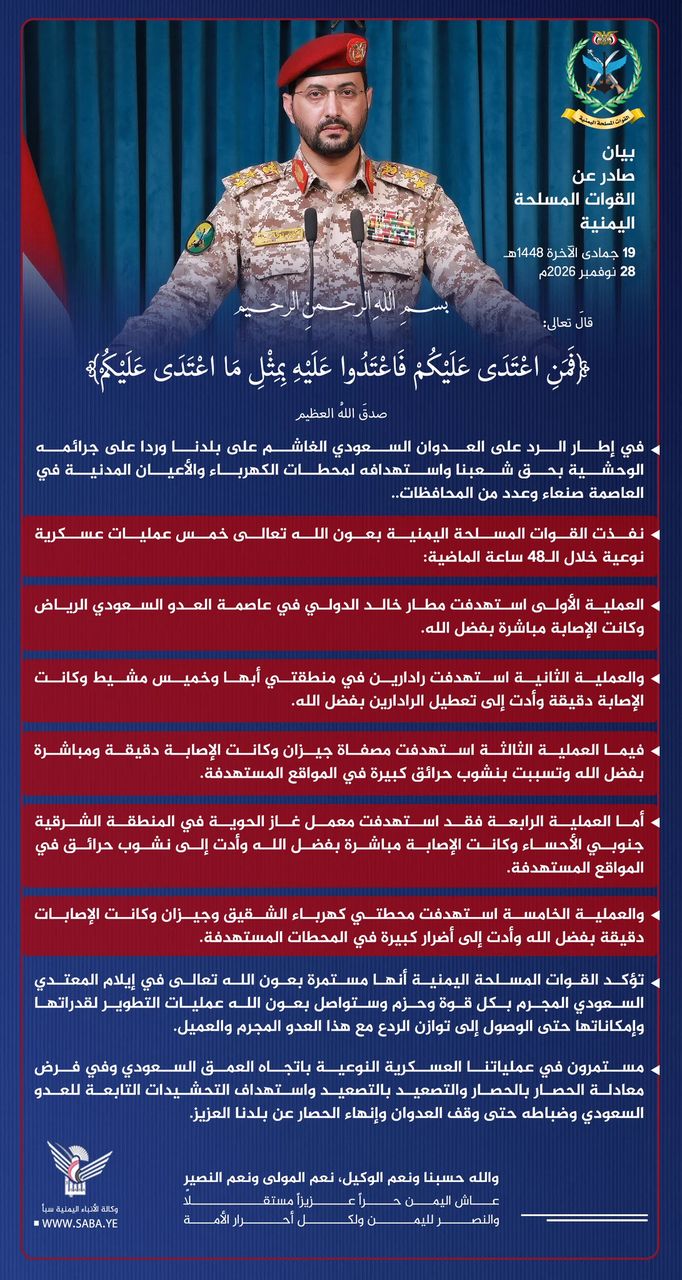
The graphic is a genuine statement card from Brig. Gen. Yahya Saree posted on 28 November 2026, and Reuters, CNN Arabic, Anadolu and Arab48 reported the five-operation announcement. But the specific claims of direct hits on Riyadh's King Khalid airport and the Al-Shuqaiq power facilities are contested: the Saudi-led coalition says those missiles were intercepted.
 Likely genuine
Claims
✓ 1 trueThe Yemeni Armed Forces carried out five qualitative military operations in the past 48 hours against targets in Saudi Arabia, announced on 28 November 2026.14567
“نفذت القوات المسلحة اليمنية خمس عمليات عسكرية نوعية خلال الـ48 ساعة الماضية”
This is the claim the headline rests on, and it holds. The statement was published on Saree's own X account on 28 November 2026, and four news organisations — Reuters, CNN Arabic, Anadolu and Arab48 — reported the same announcement the same day. The Saudi-led coalition also confirmed that projectiles were fired at the kingdom that day and said it intercepted some of them. So the existence of the announcement, its date, and the fact of new attacks are corroborated by sources on both sides of the conflict. That does not make every detail inside the statement true; it means the central event happened and was reported. The sources are not fully independent of one another — CNN Arabic, Anadolu and Arab48 are all reporting Saree's announcement — but the coalition's confirmation of incoming fire comes from the opposing side, which strengthens the finding.
The first operation struck King Khalid International Airport in Riyadh and scored a direct hit.13
“استهداف مطار الملك خالد الدولي في الرياض وكانت الإصابة مباشرة”
This is where the statement overreaches. Munitions were fired toward Riyadh overnight and sirens sounded, but the Saudi-led coalition said the cruise missile aimed at Riyadh was intercepted and destroyed. No Saudi confirmation of a hit or damage at the airport exists for this date. The claim reads as plausible because earlier rounds of the campaign did hit the airport, and readers may remember those reports. But a previous hit is not evidence of this one. The coalition's interception statement is a single source and comes from a party to the conflict, so it is not neutral; still, it directly contradicts the 'direct hit' wording, and no independent outlet has verified damage at the airport. That is enough to mark the specific claim as misleading rather than true.
Still open: No independent damage assessment from the airport has been published.
The second operation precisely struck two radars in the Abha and Khamis Mushait areas and put them out of service.
“استهداف رادارين في منطقتي أبها وخميس مشيط وتدميرهما”
Nothing in the record confirms or refutes this. No Saudi, coalition or independent reporting describes damage to air-defence radars at Abha or Khamis Mushait in this period. The claim rests entirely on the Houthi statement. Radar sites are legitimate military targets and are rarely discussed publicly, so silence is not proof that nothing happened. But a claim that cannot be checked against any source outside the party making it cannot be rated true. We mark it unverifiable, which is an honest statement about the evidence, not a judgment that the event did or did not occur.
Still open: Military radar damage is seldom publicly confirmed by either side, so this may remain unverifiable.
The third operation struck the Jazan refinery with a direct hit, causing large fires.1
“استهداف مصفاة جازان وكانت الإصابة مباشرة وأدى إلى حرائق كبيرة”
The site really was hit, which is why this claim sits closer to true than the others. Saudi authorities confirmed a projectile struck the Aramco Jazan refinery in the same week, killing a Nepalese worker, injuring others and temporarily disrupting operations. That confirmation comes from the Saudi side, not from the Houthis, which makes it stronger evidence than the statement itself. What is not confirmed is the Houthi framing: that the strike fell inside their stated 48-hour window and that it produced the large fires described. The confirmed hit and the confirmed casualty are solid; the precise timing and the scale of the damage are the parts that remain open. That mix is what 'partly true' means here.
Still open: The exact timing of the refinery hit relative to the stated 48-hour window is not established in the record.
The fourth operation struck the Hawiyah gas plant in the Eastern Province south of Al-Ahsa, causing fires at the targeted sites.1
“استهداف معمل الغاز في الحوية جنوب الأحساء وأدى إلى حرائق في المواقع المستهدفة”
Saudi civil defence issued security alerts in the Eastern Province and other regions on 28 November, which is consistent with a threat. But no confirmation of damage or fires at the Hawiyah gas plant has been published by Saudi authorities, the coalition or independent outlets. The alerts show that something was happening; they do not show what, or where. A gas plant fire of the kind described would be difficult to keep entirely quiet, but the absence of reporting is not proof either way. As with the radar claim, the only source for the specific damage is the party making the claim.
Still open: Whether the Eastern Province alerts related to Hawiyah specifically has not been established.
The fifth operation precisely struck the Al-Shuqaiq and Jazan power stations and caused major damage.12
“استهداف محطتي كهرباء الشقيق وجازان وإلحاق أضرار كبيرة بهما”
The Saudi-led coalition reported that a ballistic missile aimed at Al-Shuqaiq — the coastal town hosting the desalination and power facilities — was intercepted, and that falling debris caused no civilian injuries. That wording indicates the projectile did not deliver the precise damage claimed. The coalition is a party to the conflict, so its account is not neutral, but it is a direct, specific statement about this target on this day, and no independent report supports the Houthi version of major damage. The claim is therefore not a fabrication — a missile really was fired at the area — but the description of precise strikes and major damage is misleading.
What was posted
XA designed statement card, circulating on X, carries the insignia of the Yemeni Armed Forces and the SABA news agency, a portrait of Brig. Gen. Yahya Saree, and a long Arabic communiqué dated 19 Jumada al-Akhirah 1448 AH (28 November 2026). It announces five military operations over 48 hours against targets in Saudi Arabia and asks readers to accept that each struck its target precisely.
“بيانٌ صادرٌ عن القواتِ المسلحةِ اليمنيةِ ... صنعاءُ 19 جمادى الآخرة 1448هـ الموافقُ 28 نوفمبر 2026م.”
“A statement issued by the Yemeni Armed Forces ... Sanaa, 19 Jumada al-Akhirah 1448 AH, corresponding to 28 November 2026.” — translated
The same statement text appeared on the @Yah_Saree X account on the same day; the card circulates as a shareable graphic version of that official communiqué.
Who posted it
XAccount check
Estimates from public signals — account age, posting pattern, audience — not a judgement of the person behind the account, and separate from whether this post is true.
What stood out
- @Yah_Saree is the (alternate/rebuilt) X account of Brig. Gen. Yahya Saree, official military spokesman of the Houthi-aligned 'Yemeni Armed Forces' since Oct 2018 — a genuine, identifiable organisational voice, not an anonymous or fabricated persona.
- News outlets (ABNA, Siasat, Drop Site, Al-Masirah-affiliated Yemeni agencies) routinely embed tweets from this exact handle for Oct–Nov 2026 statements, indicating it is the operative account used for official claims.
- Account functions as a primary propaganda channel: it announces drone/missile claims on Saudi airports, Aramco sites, shipping, etc., which are frequently unverified and sometimes disputed (e.g., Saudi interception claims dismissed as 'lies').
- History of platform enforcement: main Arabic account suspended April 2022 (~340k followers), blue check removed 2024 after US terrorist redesignation, and a Saree account (~121k followers) suspended again in August 2026 — so this handle is one of several successive re-creations, raising impersonation/copycat ambiguity.
- Content is one-way broadcast of official statements (no personal/interactive posting pattern), consistent with a state/propaganda mouthpiece rather than organic personal use — low bot likelihood but very low independence.
- Provided profile metadata is entirely empty (no bio, follower count, creation date, or posts), so identity attribution rests on external corroboration only.
Signals (9)+
- Posting cadence
- Event-driven broadcast of official military statements; no personal posting
- Known identity
- Brig. Gen. Yahya Qasim Saree, spokesperson, Yemeni Armed Forces (Houthi/Supreme Political Council), born 1970, appointed 17 Oct 2018
- Affiliation
- Houthi (Ansar Allah) media apparatus; statements also carried on Al-Masirah TV and Telegram
- Platform enforcement history
- Suspensions in Apr 2022 (340k followers), Apr 2025, Aug 2026 (~121.5k followers); multiple re-created handles
- Notable news coverage
- Reuters/Al Jazeera/JPost and regional outlets regularly cite @Yah_Saree posts on Red Sea and Saudi-related attacks
- Fact check history
- Claims frequently unconfirmed or contradicted (e.g., denied Saudi intercepts over Madinah, claimed strikes with no independent evidence)
- Content type
- Official military communiques / wartime propaganda
- Metadata completeness
- None supplied by platform snapshot
- Assessment note
- Authentic identity, low automation, but low reliability as an independent information source: it is a partisan primary source requiring corroboration.
Account checked November 29, 2026, 02:41 UTC
The media
Image✓ What is genuine
The statement card itself appears to be a genuine design produced for the Yemeni Armed Forces, and the announcement it carries was independently reported by international outlets.
The tells
- ●●● Strong signal The Arabic text matches, almost word for word, the statement Saree's own account posted the same day.our visual review
- ●●● Strong signal The printed date (19 Jumada al-Akhirah 1448 AH / 28 November 2026) matches the dated post.our visual review
- ●●○ Supporting signal The layout, insignia, SABA logo, fonts and watermark are typical of Ansar Allah and SABA communiqué graphics.our visual review
- ●○○ Weak signal A minor typographical slip in the closing line reads as an ordinary design error rather than fabrication.our visual review
Synthetic-media detector
Detector not consultedThe media is incidental to the claim; the detector was not needed.
How we checked the media
- Compared the card's text with the statement posted in text form on Saree's X account on 28 November 2026.
- Checked that the printed Hijri and Gregorian dates match the date of that post.
- Reviewed the design elements: insignia, SABA logo, portrait, fonts and watermark.
- Reviewed the formal Arabic prose for errors that would suggest a synthetic or copied design.
Sources
8 sources reviewed- 1Saudi Arabia intercepts missiles as Houthis claim attacks on Riyadh airport, energy sites (Reuters) ↗
The Korea Times / Reuters · koreatimes.co.krUntiereduntiered — treated as signal only, never decisiveEvidence
Reports the Houthi claim of five operations and the coalition's interception of projectiles aimed at Riyadh, plus the confirmed Jazan refinery hit.
- 2Saudi Arabia intercepts missiles as Houthis claim attacks on Riyadh airport, energy sites ↗
ThePrint / Reuters · theprint.inUntiereduntiered — treated as signal only, never decisiveEvidence
Records the coalition saying a ballistic missile aimed at Al-Shuqaiq was intercepted.
- 3Saudi-led coalition intercepts, destroys Houthi cruise missile targeting Riyadh ↗
Khaleej Times · khaleejtimes.comUntiereduntiered — treated as signal only, never decisiveEvidence
Records the coalition saying it intercepted a cruise missile aimed at Riyadh.
- 4الحوثيون: نفذنا 5 عمليات نوعية ضد السعودية خلال 48 ساعة ↗
CNN Arabic · arabic.cnn.comLow reliabilityBORDERLINE B/C — reporting w/ strong bias tag; opinion is CEvidence
Quotes Saree announcing five operations, the first against King Khalid airport.
- 5الحوثيون يدعون استهداف 5 مواقع بالسعودية خلال 48 ساعة ↗
Anadolu (via News-Ajel) · news-ajel.comUntiereduntiered — treated as signal only, never decisiveEvidence
Reports the Houthi claim of five operations against Saudi sites.
- 6الحوثيون يعلنون عن 5 عمليات استهدفت مطار الرياض ومنشآت في السعودية ↗
Arab48 · arab48.comUntiereduntiered — treated as signal only, never decisiveEvidence
Reports the five-operation announcement and the coalition's interception statement.
- 7Post by Brig. Gen. Yahya Saree with the same statement text, 28 November 2026 ↗
X / Yahya Saree · x.comUntiereduntiered — treated as signal only, never decisiveEvidence
The original statement post, confirming the card's text and date.
- 8Truth or Fake: No, these pictures do not show the Houthi attacks on Riyadh's King Khalid Airport ↗
France 24 · france24.comReputable outletCenter/Lean Left — public serviceFurther reading
Documents previous fabricated media about Riyadh airport strikes, providing context for why readers should check visuals.
Further reading
- 1The Korea Times / Reuters Reuters' account gives the clearest summary of what the coalition said it intercepted.
- 7X / Yahya Saree The original post lets you compare the card's text with the statement directly.
- 8France 24 Shows how fabricated videos and photos of earlier Riyadh airport strikes circulated, a useful contrast with this genuine card.
The full story
The kernel of truth here is substantial: on 28 November 2026, Yemen's Houthi-run armed forces did announce five operations over 48 hours against targets inside Saudi Arabia, and that announcement was real, dated and reported. Reuters, CNN Arabic, Anadolu and Arab48 all carried it the same day. The Saudi-led coalition also confirmed that projectiles were fired toward the kingdom that day, saying it intercepted a cruise missile aimed at Riyadh and a ballistic missile aimed at Al-Shuqaiq.
Part of the Houthi account is supported by the other side. Saudi authorities confirmed a projectile hit the Aramco Jazan refinery during the same week, killing a Nepalese worker and disrupting operations. That is a real strike with a real casualty, and it is the strongest reason the whole statement feels credible.
What the statement does beyond that is inflate. A missile fired at Riyadh becomes a 'direct hit' on the airport. An intercepted missile over Al-Shuqaiq becomes 'major damage' to power stations. Claims about radars at Abha and Khamis Mushait and fires at the Hawiyah gas plant have no confirmation outside the statement itself.
This is one-sided wartime messaging from a belligerent party, and it should be read that way. It is not a fabricated document: the card is genuine, the date is right and the attacks happened. The problem is the gap between what was fired and what was claimed to have been destroyed.
Kernel of truth
The Houthis did announce five operations on 28 November 2026, projectiles were fired at Saudi Arabia that day, and the Jazan refinery was genuinely hit during the same week.
Timeline
November 28, 2026
Brig. Gen. Yahya Saree announces five operations over 48 hours against targets in Saudi Arabia, including Riyadh's King Khalid airport, the Jazan refinery, the Hawiyah gas plant and power stations at Al-Shuqaiq and Jazan. 7X / Yahya Saree
November 28, 2026
The Saudi-led coalition says it intercepted a cruise missile aimed at Riyadh and a ballistic missile aimed at Al-Shuqaiq, with debris causing no civilian injuries. 1The Korea Times / Reuters
How it was framed
The statement and the attacks are real, but the claim uses real military activity to frame the outcome as precise hits and major damage when the coalition says key missiles were intercepted and other strike claims are unconfirmed. It is not fabricated content; it is real content used to create a misleading picture of the results.
- “Visual proof”. The card presents the claims as a formal military communiqué with insignia, a portrait and an official date, inviting readers to treat it as a verified record.
- Missing context. The statement does not mention the coalition's interception reports or distinguish between munitions fired and damage caused.
- Us vs. them. The operations are described as retaliation for Saudi strikes on Yemeni electricity and civilian infrastructure.
Posted on the X account @Yah_Saree, the account of the Yemeni Armed Forces spokesperson, which also posted the same statement in text form on 28 November 2026.
Bias
Leans Houthi/Ansar Allah military propaganda, anti-Saudi. The card is a belligerent party's own communiqué: it presents every operation as a precise success, calls Saudi Arabia a 'criminal enemy and agent', and makes no reference to interceptions or failed strikes, so it functions as one-sided war messaging rather than a factual report.
Bias describes how the post frames its message — the slant of the language, selection and emphasis — and is judged separately from whether the claim is true. A true claim can still be framed with a strong slant.
How we checked
1 min 19 s- 1
Searched for coverage of the 28 November 2026 Houthi announcement in English and Arabic.
- 2
Compared the card's text and date with the statement posted on Saree's X account.
- 3
Reviewed the design elements of the card for signs of fabrication.
- 4
Read reporting on the Saudi-led coalition's interception statements and on the Jazan refinery hit.
- 5
Rated each of the five strike claims separately against the available evidence.
✓ Claim checked✓ Media checked✓ Sources checked
Why 72% confidence
ModerateThe headline verdict is MODERATE because the announcement and the attacks are strongly corroborated, while the specific strike claims are contested or unverified. The central claim is rated HIGH because the document matches the official post and four outlets reported it. The individual strike claims are rated MODERATE or LOW because the evidence for them is thinner and in some cases comes only from one side of the conflict.
Limits. We did not have access to damage assessments at the individual sites, and the coalition's interception reports are statements by a party to the conflict rather than independent observations.
What we don’t know
- Whether the missiles aimed at Riyadh and Al-Shuqaiq were fully intercepted or caused damage not yet reported.
- Whether the radars at Abha and Khamis Mushait were damaged.
- Whether fires occurred at the Hawiyah gas plant.
- The exact timing of the Jazan refinery hit relative to the stated 48-hour window.
Spot it yourself
Find the overstatementLooks suspicious, isn’t proof
- The source is a party to the conflict, which is a reason to check carefully but does not by itself make the statement false.
- The tone is formal and declaratory, which is normal for military communiqués and not evidence of fabrication.
- The graphic is polished and official-looking, which tells you it is a designed document, not whether its content is accurate.
The actual evidence
- The statement's date and text match a post on Saree's own X account, confirming the document is genuine.
- Four news organisations reported the five-operation announcement the same day.
- The Saudi-led coalition confirmed projectiles were fired but said it intercepted the missiles aimed at Riyadh and Al-Shuqaiq.
- Saudi authorities confirmed a real hit on the Jazan refinery during the same week, which supports part of the account.
- 1
Check whether a statement was independently reported
Search the main claim in more than one language and look for wires and major outlets reporting it the same day, as Reuters, CNN Arabic, Anadolu and Arab48 did here.
- 2
Separate 'fired' from 'hit'
Look for the opposing side's account of what happened to the munitions — interception reports change a 'direct hit' claim into a contested one.
- 3
Find the confirmed facts inside the claim
A confirmed refinery hit and a confirmed casualty are real evidence, but they do not confirm separate claims about airports or power stations.
- 4
Check each target separately
A statement that bundles five operations often contains a mix of confirmed, contested and unconfirmed claims; rate them one by one.
Takeaway
A genuine document can contain overstated claims. Verify the document and verify its contents separately, and pay attention to the difference between a weapon being fired and a target being destroyed.
Questions people ask
Is the Yahya Saree statement card real?+
Yes. The card's text matches, almost word for word, the statement posted on Saree's own X account on 28 November 2026, and the printed date matches. The insignia, SABA logo and layout are typical of official communiqué graphics. The card is genuine; that does not mean every claim inside it is accurate.
Did the Houthis really attack Riyadh airport?+
The Houthis said they did, and projectiles were fired toward Riyadh that night. The Saudi-led coalition said the cruise missile aimed at Riyadh was intercepted and destroyed, and no Saudi confirmation of a hit at the airport exists for this date. Earlier rounds of the campaign did hit the airport, which is why the claim sounds plausible.
Was the Jazan refinery hit?+
Yes. Saudi authorities confirmed a projectile struck the Aramco Jazan refinery during the same week, killing a Nepalese worker, injuring others and disrupting operations. The confirmed hit supports part of the Houthi account, though the exact timing and the scale of the fires are not independently confirmed.
Why does a real statement contain claims that are not confirmed?+
Wartime announcements are made by parties to a conflict and often describe intended results rather than verified ones. A statement can be genuine and still overstate what was destroyed, especially when the opposing side reports intercepting the same munitions.
What is a statement card?+
A statement card is a designed graphic that turns an official announcement into an image people can share. It usually carries logos, a portrait and a date to signal authority. The format tells you who produced it, not whether its claims are accurate.
Go deeper
- Houthi / Ansar Allah
- The Yemeni armed movement that controls much of northern Yemen and has been fighting a Saudi-led coalition since 2015.
- Saudi-led coalition
- The military alliance led by Saudi Arabia that intervened in Yemen in 2015 and reports on attacks against the kingdom.
- Interception
- The destruction of an incoming missile or drone by air defences before it reaches its target.
- Statement card
- A designed graphic that presents an official announcement as a shareable image.
- Hijri calendar
- The Islamic lunar calendar used in Saudi Arabia and Yemen alongside the Gregorian calendar.
People also search for
For educators+
- A statement can be genuine and still contain inaccurate claims. How would you explain that difference to someone who says 'but the account is official'?
- The coalition says the missiles were intercepted, while the Houthis say they hit their targets. What kinds of evidence would you look for to decide between the two accounts?
- Why might a news organisation report a claim without confirming it, and how should readers interpret that kind of coverage?
About this check
- Platform
- X
- Posted by
- @yah_saree
- Posted
- November 28, 2026
- Age when checked
- Under 24 hours old when checked
- Where it spread
- SA, YE
- Audience
- International audience
- Language
- AR
- Status
- ● Post is live
- Verified
- November 29, 2026, 02:43 UTC
- Published
- November 29, 2026, 02:43 UTC
Reach. 682 likes (syndication); Saudi Google Trends 'عملية عسكرية' 5000+; Siasat, anews, Daily News Egypt, Hamer Intel pickup
This verdict was generated with AI from the sources shown. AI can make mistakes — check the sources before relying on it.
Check anything yourself, in seconds.
Share any social post or video to What the Fact and get the verdict, the confidence, and the receipts.